Grant

Tradition / Region: English Mythology
Alternate Names:
Category: Horse, Demon


The Myth

There is said to be in England a kind of demon called the Grant. It appears in the form of a young horse or yearling foal, standing upright on its hind legs, with bright, sparkling eyes. Though not always seen, it most often shows itself in the streets during the heat of the day or around sunset.

When danger is about to strike—especially fire or disaster expected during the coming night or the following day—the Grant emerges and runs through the streets. As it moves, it provokes dogs to bark and chase it. By pretending to flee, it draws the dogs after it, though none can ever catch it.

Through this strange behavior, the Grant serves as a warning. Its sudden appearance and commotion alert the inhabitants that danger is near. Though terrifying to those who witness it, the demon’s actions are said to protect the people by putting them on guard before disaster can strike.

Thus the Grant is remembered as a fearful yet strangely helpful presence—an illusionary demon whose wild run through the streets signals that harm is approaching.


Sources

Wikipedia contributors. (n.d.). Grant (folklore). In Wikipedia. Retrieved June 29, 2026, from https://en.wikipedia.org/wiki/Grant_(folklore)


Zwanenjonkvrouw

Tradition / Region: Netherlands (Noord-Holland, Heemskerk)
Alternate Names:
Category: Swan maiden / nymph


The Myth

In Noord-Holland, people tell of the Zwanenjonkvrouw, a woman of extraordinary beauty who can take the form of a swan. She changes between swan and human shape by means of a magical swan shirt, known as her zwanenhemd. When she wears it, she becomes a swan; when it is removed, she remains human.

In many tales, a man discovers the Zwanenjonkvrouw while she is bathing and steals her swan shirt. Without it, she is unable to return to her true form. The man then forces her to become his wife, and she lives among humans, bound by the loss of her garment rather than by her own will.

For a time, she remains with him, but she never ceases to long for her swan shirt. When she eventually finds it again, she immediately leaves her husband without mercy and disappears, returning to her true nature and her former life.

In a legend from Heemskerk, the story ends more tragically. When the man chooses to abandon her in favor of an ordinary human woman, the Zwanenjonkvrouw falls down dead, her life ending the moment she is rejected.

Thus the Zwanenjonkvrouw is remembered as a swan-maiden bound by theft, marriage, and loss, whose fate is sealed by the recovery of her stolen form or by betrayal.


Interpretive Lenses

Religious Readings
Philosophical Readings
Psychological Readings
Esoteric Deep Dive
Political / Social Readings
Other

Anhangá

Tradition / Region: Brazilian Mythology
Alternate Names: Anhanga, Anhan, Agnan, Kaagere
Category: Deer


The Myth

Anhangá is a feared spirit known among many Indigenous peoples of Brazil. It is said to torment both the living and the dead, appearing in nature through sudden, violent sounds such as storms, tempests, and unexplained noises. The presence of Anhangá brings fear, confusion, illness, and suffering.

Most often, Anhangá appears in the form of a deer. Hunters describe seeing a white or red deer with burning, fiery eyes, sometimes with antlers covered in hair. This deer is not an ordinary animal but a spirit that guards wildlife. It watches over animals in open fields and forests and punishes hunters who hunt abusively, especially those who pursue females with young.

When Anhangá intervenes in a hunt, it brings fever, madness, and confusion. A hunter may lose his sense of direction, mistake one being for another, or act against his own family without realizing it. In one well-known story, a hunter chased a doe and her nursing fawn. He seized the fawn to draw the mother closer and fired his weapon. Only afterward did he discover that Anhangá had deceived him, and that he had killed his own mother, mistaking her for the animal.

Anhangá does not appear only as a deer. It is said to take many forms in order to deceive and afflict people. It may appear as birds, mammals, fish, reptiles, or strange hybrid beings. These forms include an armadillo, a pirarucu fish, a turtle, oxen, birds such as the tinamou, and human-like figures. Because of this, hunters and travelers are taught never to trust appearances in the wilderness.

The spirit is also believed to torment the souls of the dead. During funerary rituals, people feared that Anhangá would seize the soul on its journey to the Land Without Evils, a blessed place where virtuous souls were meant to go. To protect the dead, food offerings were placed near the burial site so that Anhangá would consume the offerings instead of the soul. Fires were kept burning to warm and protect the deceased and to keep Anhangá at a distance. The living encouraged the dead to keep their fires from going out.

It was believed that only the most virtuous souls — those who had defended their people and killed many enemies — reached the high mountain of the Land Without Evils. Those who failed in this were said to fall under the power of Anhangá, becoming tormented spirits themselves.

Anhangá was also feared during travel, especially over water. Storms and violent sounds were sometimes believed to be caused by the spirits of the dead associated with Anhangá. Among some groups, Anhangá was said to follow or serve Jurupari, and together they were feared as dangerous spirits capable of possession, kidnapping, and death.

Because Anhangá could change form at will, it was impossible to know when it was near. Its presence was marked by fear, illness, illusion, and the sudden reversal of fortune. Hunters, mourners, and travelers all treated the wilderness with caution, knowing that Anhangá might be watching, waiting to punish disrespect, cruelty, or weakness.


Source

Wikipedia contributors. (n.d.). Anhangá. In Wikipedia, The Free Encyclopedia, from https://en.wikipedia.org/wiki/Anhang%C3%A1



Rashamen

Tradition / Region: Japan (Edo period)
Alternate Names: Raschamen
Category: Sheep


The Myth

Rashamen was the name used for sheep brought to Japan by overseas ships. Because sheep were unfamiliar, people associated them with foreigners, and the name was said to come from rasha, the woolen clothing worn by Westerners.

In 1776, during the An’ei era, an animal called a raschamen was exhibited as a public spectacle in the districts of Ryōgoku and Asakusa in Edo. People paid to see it as a rare and strange creature from abroad. The animal on display was a sheep, with paint smeared over its body to make it look more unusual.

The spectacle became widely known. The sheep was taken around and shown to crowds, presented as something exotic rather than as an ordinary animal.

The event was later mentioned by Hiraga Gennai in his work Hoheiron Kohen, where he described the rashamen performance and noted that it was simply a painted sheep being displayed to the public.


Interpretive Lenses

Religious Readings
Philosophical Readings
Psychological Readings
Esoteric Deep Dive
Political / Social Readings
Other

Vadzyany Byk

Tradition / Region: Belarusian Mythology
Alternate Names: Water Bull, Vadzyany byk
Category: Cow


The Myth

In the lakes of the Ushachi Lakeland, people speak of a creature known as the Vadzyany Byk, the Water Bull. It is said to live beneath the surface of quiet waters, especially in lakes that appear shallow near the shore but suddenly drop into deep, rocky depths. At sunrise and sunset, its presence is announced by a deep, resonant roar that rolls across the water, described as a slow, echoing “woo-woo-woo.”

Those who claim to have encountered the Water Bull describe it as a medium-sized aquatic animal with a powerful body and a broad, spade-shaped tail. It is said to circle the lake endlessly, moving just below the surface. Fishermen tell of seeing ripples and feeling unseen movement beneath their boats, and some recall moments when they were too afraid to cast their lines, convinced that the creature could seize them and drag them into the depths.

The Vadzyany Byk is believed to inhabit dangerous waters filled with large stones and sudden drop-offs, places where drowning is easy and escape difficult. For this reason, it is sometimes called the master of the lake, a being that rules its waters and punishes carelessness. Though many admit they have never seen it clearly, its voice alone is enough to inspire fear and respect.

The Water Bull is also linked to similar beings known as swamp bulls, said to dwell in marshes and wetlands. Its legend appears beyond oral tradition as well, including in stories set in Belarusian landscapes, where such creatures are treated as ancient inhabitants of water and fog.

Rarely seen and never fully understood, the Vadzyany Byk endures as a presence felt more than witnessed — a roaring shadow beneath the surface, guarding the depths of the lake and reminding those nearby that the water is not empty.


Sources

Bestiary.us. (n.d.). Water Bull from Ushachy Lakeland. In New Bestiary: Encyclopedia of Imaginary Beings. Retrieved June 29, 2026, from https://www.bestiary.us/vodyanoi-byk-ushachskogo-poozerya


Keledones

Tradition / Region: Greek Mythology
Alternate Names: Celedones, Khryseiai Keledones (“Golden Charmers”)
Category: Object, Bird


The Myth

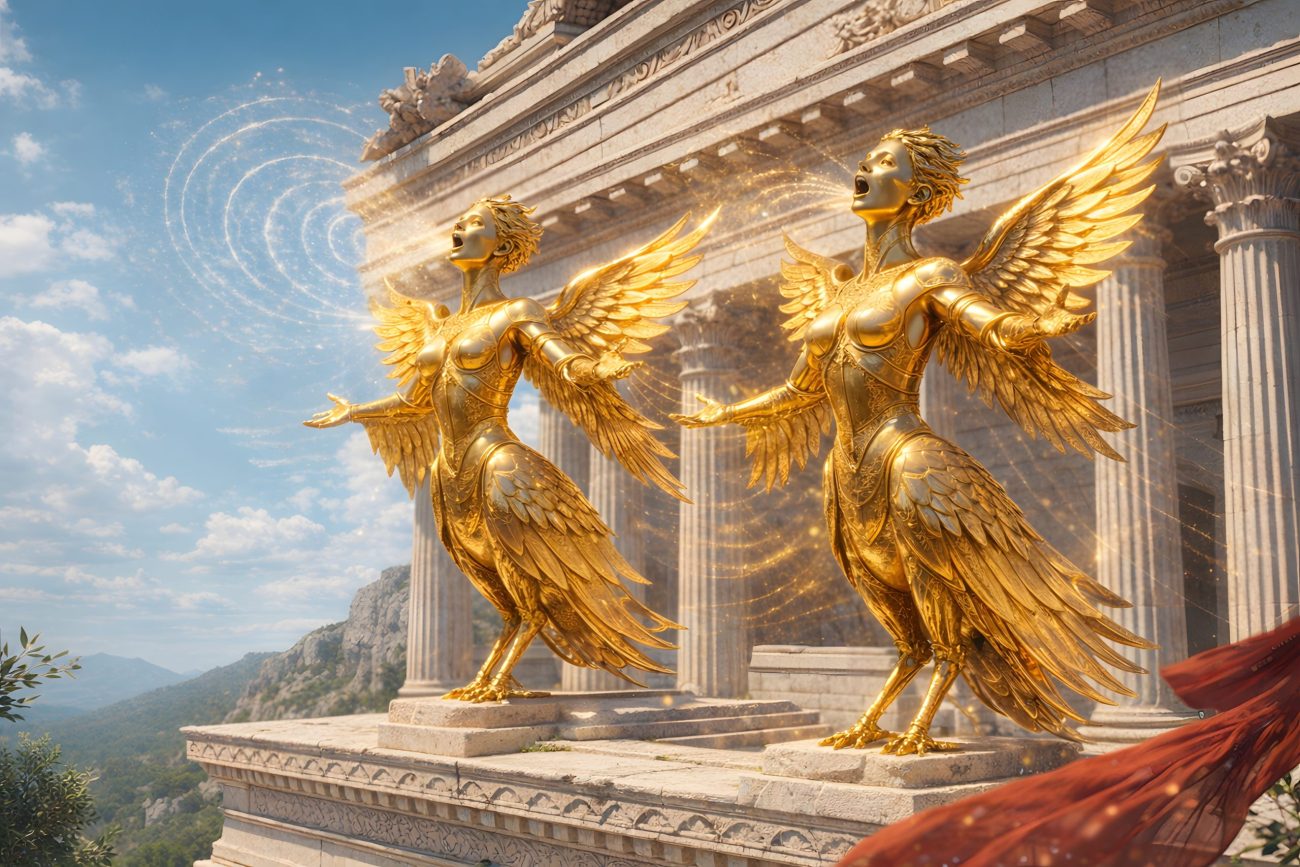
In the age when gods still shaped wonders with their own hands, the divine smith Hephaistos forged a set of miraculous beings for the temple of Apollon at Delphi. These were the Keledones, golden singers crafted not of flesh, but of shining metal, alive with sound and enchantment.

The Keledones were made entirely of gold and were said to sing with voices of supernatural power. Some described them as beautiful maidens, others as wryneck birds, and still others as strange bird-women, reminiscent of the Sirens. However they appeared, their song possessed a soothing and bewitching force, capable of charming all who heard it.

They were placed high upon the temple, above the pediment, where their voices rang out continuously. There, the Golden Charmers sang in honor of Apollon, their music filling the sacred space with an otherworldly harmony. Ancient poets spoke of them as wonders beyond human craft, comparing their song to that of the Sirens, though fashioned not to destroy but to enthrall.

Some later writers questioned whether such beings truly existed or whether they were poetic embellishments inspired by earlier myths. Yet the tradition endured: that once, at Delphi, golden singers adorned the god’s temple, their voices echoing across stone and air, forged by divine hands and animated by sacred song.

Thus the Keledones remained in memory as marvels of divine artifice — not born, but made; not living, yet singing — eternal symbols of beauty, craft, and the dangerous power of enchanted sound.


Laurentius Christophori Hornaeus

Era / Region: Early Modern Period, Sweden
Lifespan: 1645 – April 27, 1719
Primary Role(s): Priest; parish vicar
Alternate Names / Titles: Lars Christophri Hornæus; Lars Christoffersson


The Life

Laurentius Christophori Hornaeus was born in 1645 in Härnösand, Sweden, under the name Lars Christoffersson. During his lifetime, it was common for Swedish students and clergy to adopt Latinized names, often derived from their place of origin. The name Hornaeus is generally understood to be a Latinized form of Härnösand.

He began theological studies in the 1660s and was enrolled at the University of Uppsala by 1667, where he studied alongside his brother Petrus. In 1672, Lars was ordained as a priest of the Church of Sweden.

Following his ordination, he was appointed assistant minister in Ytterlännäs, serving under Olaus Erici Rufinius, who held responsibility for the parish of Torsåker and its surrounding areas, including the annex parish in the Dal Hundred. Rufinius died later in 1672, and Lars succeeded him as assistant minister.

Hornaeus became parish vicar through the customary practice of widow conservation, by which a clergyman inherited a parish by marrying the widow or daughter of his predecessor. Since Rufinius had been widowed, Hornaeus married his daughter, Brita Olofsdotter Rufinia, in a ceremony held at the parsonage in Sunnanåker, within Ytterlännäs parish. The couple had a son, Lars Hornaeus, who later became a minister. Through his descendants, Hornaeus’s family remained active in the clergy for multiple generations.

In 1668, a wave of witchcraft accusations began spreading through Sweden. By 1674, the witch panic reached Torsåker. As parish vicar, Laurentius Christophori Hornaeus presided over the Torsåker witch trials, which became the largest witch trial episode in Swedish history.

Hornaeus continued his clerical duties until his death on April 27, 1719, in Nordanåker, Ytterlännäs parish. He was buried beneath the old church in Ytterlännäs, where his grave remains preserved beneath a hatch in the church floor between the altar and the sacristy entrance.

Following his death, his son Lars Larsson Hornaeus succeeded him as pastor and led the congregation until 1751.


Interpretive Lenses

Religious Readings
Philosophical Readings
Psychological Readings
Esoteric Deep Dive
Political / Social Readings
Other

Lady Rokujo

Tradition / Region: Japan (Heian-period court literature)
Alternate Names: Rokujo no Miyasudokoro, Miyasudokoro
Category: Vengeful spirit / living ghost


The Myth

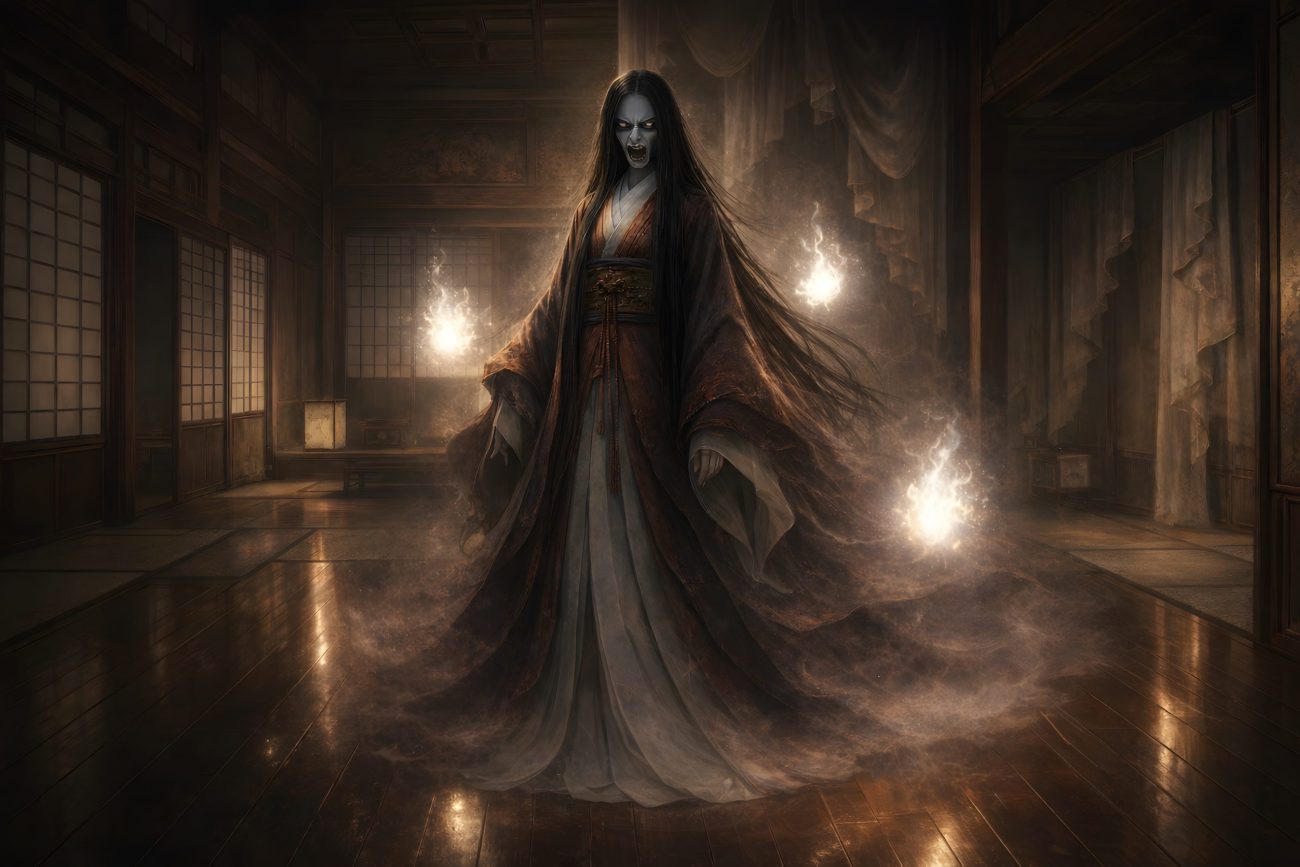
Lady Rokujo was a noblewoman of great refinement, the daughter of a minister and once the wife of the Crown Prince. Widowed at a young age, she later became the lover of Hikaru Genji. Though dignified and proud of her rank, she suffered deeply from jealousy and humiliation, especially as Genji’s affections shifted toward younger women. These unspoken emotions slowly twisted within her.

During the events recorded in The Tale of Genji, her resentment grew so powerful that her spirit began to leave her body without her conscious will. At the Kamo Festival, after being humiliated in a carriage dispute involving Genji’s lawful wife, Lady Aoi, Lady Rokujo’s spirit fully manifested. Invisible yet deadly, it began to torment Lady Aoi, who was pregnant at the time.

Lady Aoi suffered greatly. After a long and painful labor, she gave birth to a son, but her condition suddenly worsened, and she died only days later. Meanwhile, Lady Rokujo realized that her spirit had wandered when she noticed the smell of ritual mustard seeds clinging to her own clothing. Genji himself witnessed her spirit while tending to Lady Aoi. Horrified by what she had become, Lady Rokujo resolved to sever her ties with him.

She left the capital, parting from Genji at Nonomiya, and traveled to Ise with her daughter, who served as a sacred princess. Yet even distance could not quiet her heart. After returning to Kyoto, Lady Rokujo fell ill and died, entrusting her daughter to Genji’s care. Death, however, did not end her suffering.

Her spirit continued to appear, driven by lingering obsession. It haunted Lady Murasaki and later the Third Princess, afflicting them with sickness and terror. Through these hauntings, her bitterness toward Genji was made known again and again.

Only after memorial rites were performed, urged by Genji and carried out for her troubled soul, was it hoped that Lady Rokujo might finally find release. Until then, she endured as one of the most feared figures of courtly legend — a woman whose restrained emotions became so powerful that even death could not contain them.


Interpretive Lenses

Religious Readings
Philosophical Readings
Psychological Readings
Esoteric Deep Dive
Political / Social Readings
Other

Näcken

Tradition / Region: Swedish Mythology
Alternate Names: Strömkarlen, Bäckamannen, Kvarngubbe, Kvarnrå, Forskarlen, Dammapågen
Category: Water spirit


The Myth

In Swedish folklore, Näcken dwelled in lakes, rivers, streams, and mill waters, haunting places where the current moved quietly or gathered strength beneath the surface. He was not a single spirit but a powerful water-being known by many names, feared and respected wherever people lived close to water.

Näcken most often appeared as a naked man, sometimes young and slender, sometimes old and bearded, seated upon a rock or at the water’s edge. His hair was said to be green or woven with foliage, as if grown from the river itself. In his hands he held an instrument, most often a violin, though he was also known to play horns, flutes, or other melodies. His music was said to be irresistibly beautiful. Those who heard it felt drawn toward the sound, their feet carrying them closer to the water without their will.

Näcken was a master of deception. Though water might seem shallow and harmless, he could seize a person’s footing, locking their legs in place and pulling them beneath the surface. Many drownings were blamed on him, and children were warned never to trust the calm of a stream or the beauty of music drifting across the water at dusk.

At times, Näcken took other forms. He could appear as animals — a black or white horse, a bull, a dog, or a cat — and these shapes often bore a subtle wrongness, such as having three legs instead of four. He could also disguise himself as floating objects or tempting treasures, lying in wait for the unwary.

Näcken was not merely a minor spirit, but a powerful force of the natural world, sometimes spoken of as nearly divine. He embodied the danger of water itself: beautiful, life-giving, and deadly. To encounter him was to be reminded that rivers and lakes were alive, watching, and never fully under human control.


Marcus Attilius

Era / Region: Roman Imperial Period, Italy
Lifespan: Unknown (active mid–1st century CE)
Primary Role(s): Gladiator
Alternate Names / Titles:


The Life

Marcus Attilius is known through surviving graffiti discovered near the Nucerian Gate at Pompeii. These inscriptions record gladiatorial contests held at Nola and preserve the names and outcomes of several fighters. Unlike most gladiators named in the graffiti, Marcus Attilius bears both a praenomen and a gens name, identifying him as a free-born Roman citizen rather than a slave.

Attilius entered the arena as a voluntary gladiator, enrolling in a gladiatorial school by contract. By doing so, he temporarily surrendered his legal rights and social standing for the duration of his service. He fought as a murmillo, a heavily armed gladiator equipped with a gladius, a large rectangular shield, a crested helmet, and protective shin guards.

The graffiti records that the games at Nola marked Attilius’s first appearance in the arena. Despite being a tiro, or novice, he was matched against Hilarus, an experienced gladiator who had fought fourteen times and won twelve victories and who was associated with the household of Emperor Nero. In this contest, Marcus Attilius forced Hilarus to surrender and was declared the victor.

Attilius fought a second bout shortly thereafter against another veteran gladiator, Lucius Raecius Felix, who had also achieved twelve victories in previous contests. Attilius won this fight as well.

Because Hilarus was associated with the household of Emperor Nero, Marcus Attilius’s activity can be placed within the reign of Nero, between 54 and 68 CE.

These victories were recorded by spectators in painted inscriptions, showing Attilius armed as a murmillo and listing his opponents and results. The eruption of Mount Vesuvius in 79 CE buried Pompeii and preserved these graffiti, ensuring that Marcus Attilius’s career survived in the archaeological record.


Interpretive Lenses

Religious Readings
Philosophical Readings
Psychological Readings
Esoteric Deep Dive
Political / Social Readings
Other