Azuki Arai

Tradition / Region: Japanese Mythology
Alternate Names: Azukitogi, Azuki Togi
Category: Yōkai, Mountain Dweller, River Dweller


The Myth

Deep in the mountains of Japan, near forest streams and quiet rivers, there is said to live a yōkai known as Azuki Arai, the Bean Washer. It dwells far from villages, choosing remote riverbanks where the sound of flowing water masks its presence. Travelers rarely see it, but many have heard it.

Azuki Arai spends its time crouched beside the water, washing red azuki beans in a basket. As it works, it sings a strange song, its voice mingling with the sound of beans being rinsed:

“Azuki araou ka?
Hito totte kuou ka?”

“Shall I wash my beans,
or shall I catch a human to eat?”

Between the lines of the song comes the sound shoki shoki, the rhythmic noise of beans being washed. The voice carries through the valley, echoing along the stream.

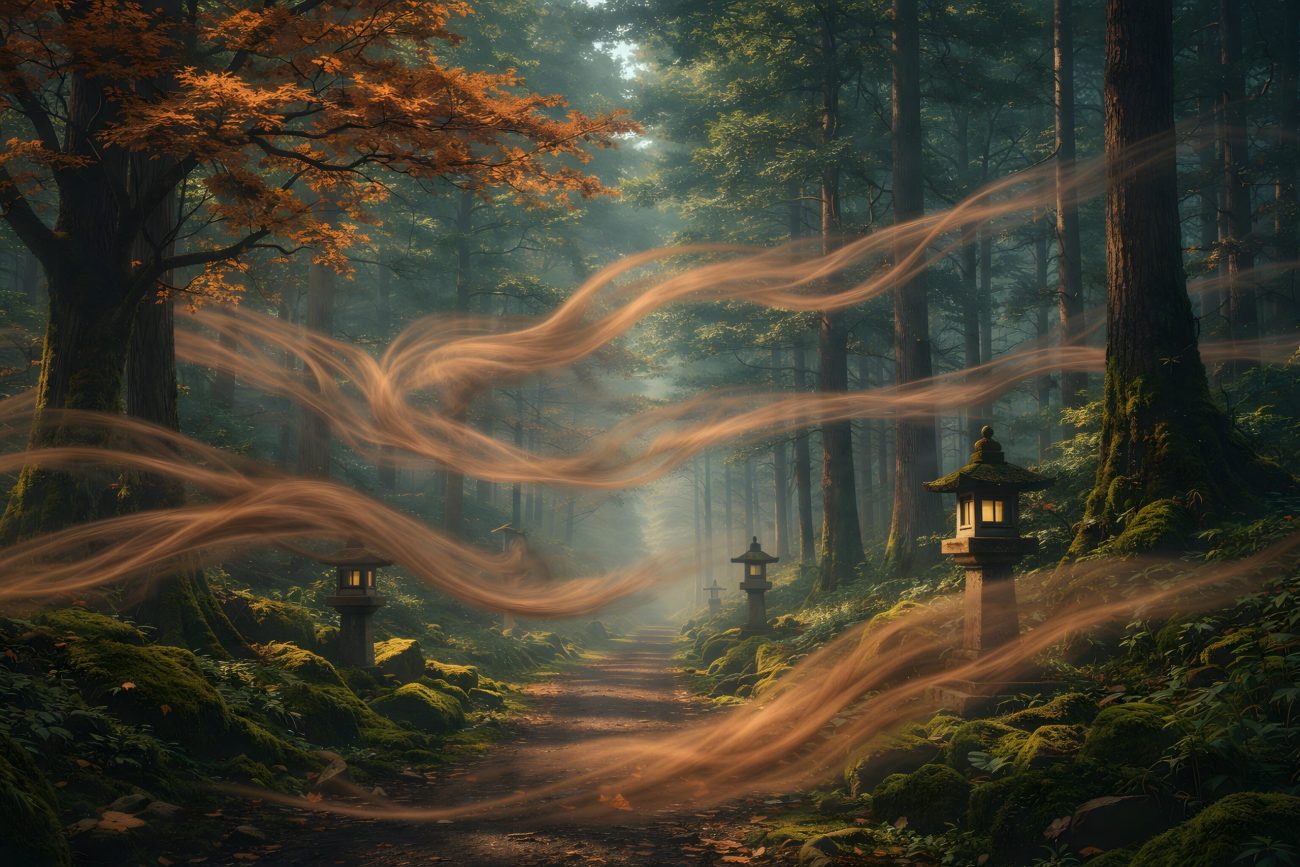
Those who hear the song are often startled or unsettled. It is said that people drawn too close to the sound lose their footing and slip into the water. The splash frightens Azuki Arai, and it immediately flees into the forest, vanishing without a trace.

Azuki Arai is known to be extremely shy and avoids being seen. It mimics the sounds of nature—rustling leaves, flowing water, birds, and insects—to conceal itself. Because of this, most encounters are only auditory, and sightings are rare. Those who do catch a glimpse describe a small, squat figure resembling a monk or peasant, with a large head, wide eyes, and an unsettling grin, seated by the river as it washes beans.

Despite its eerie song, Azuki Arai is not considered truly dangerous. It does not pursue humans, and it disappears at the slightest disturbance. In some regions, seeing it is considered a sign of good fortune, as few are ever able to do so.

Thus, when the sound of beans being washed rises from a mountain stream, people say Azuki Arai is near—quietly working by the water, singing its strange song, and slipping away unseen the moment it is discovered.
Moku Musume

Tradition / Region: Japanese Mythology (Gunma–Nagano, Usui Pass)
Alternate Names: Shumoku Musume
Category: Yōkai / Mountain Dweller / Shark


The Myth

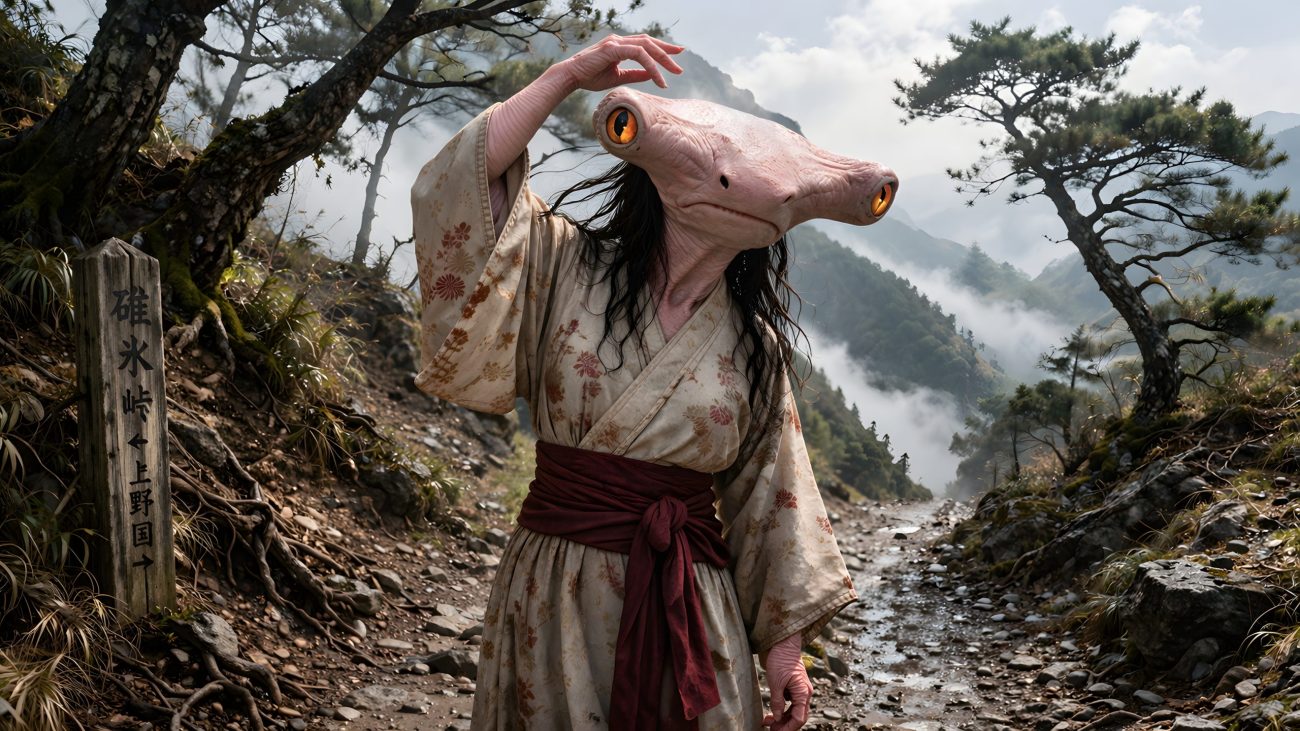
Moku Musume, also known as Shumoku Musume, is a yōkai known from monster paintings and traditional karuta cards. Her appearance is immediately recognizable and unlike that of any ordinary being. Her head is shaped like a shumoku, a T-shaped Buddhist mallet used to strike bells in temples. On each end of this T-shaped head are eyes, giving her vision to both sides, and her face resembles that of a hammerhead shark.

She is depicted as a female figure whose body is otherwise human, with the strange hammer-shaped head defining her supernatural nature. Because of this form, she is sometimes associated visually with Buddhist ritual objects, though her exact behavior is not described in surviving sources.

One karuta card explicitly names her as the “Shumoku Musume of Usui Pass,” suggesting that she was believed to appear at Usui Pass, the mountainous route connecting present-day Gunma and Nagano Prefectures. Travelers passing through the pass would have regarded the area as dangerous and uncanny, and the presence of Moku Musume was tied to this liminal mountain road.

Beyond her appearance and place-name association, little is recorded of her actions. She endures primarily as a visual yōkai, preserved through paintings and cards, her strange hammer-shaped head marking her as a being that belongs neither fully to the human world nor to the ordinary realm of spirits.


Interpretive Lenses

Religious Readings
  • Christian Ascetic Deep Dive
Philosophical Readings
  • Nietzschean Deep Dive
Psychological Readings
  • Jungian Deep Dive
Esoteric Deep Dive
  • Hermetic Deep Dive
Political / Social Readings
  • Marxist Deep Dive
Other
  • How to Invite The Spirit

Chairo-kaze

Tradition / Region: Japan
Alternate Names: Brown Wind
Category: Spirit wind / atmospheric yōkai


The Myth

Chairo-kaze, or “Brown Wind,” is a mysterious spirit wind described by Shigeru Mizuki based on an experience from his childhood. He wrote about it in a school composition titled Brown Wind, later recalling it in his personal writings.

As a child, Mizuki would occasionally encounter a strange wind that made him feel uneasy and different from ordinary gusts of air. The experience always occurred at night, so he could never actually see the wind’s color. Despite this, he instinctively named it the “Brown Wind,” sensing that it carried an uncanny and mysterious presence.

This phenomenon is later mentioned in books about yōkai and supernatural phenomena, including sections devoted to so-called “spirit winds,” where Chairo-kaze is treated as an example of an unseen but perceptible supernatural force felt rather than seen.


Interpretive Lenses

Religious Readings
  • Christian Ascetic Deep Dive
Philosophical Readings
Psychological Readings
Esoteric Deep Dive
  • Hermetic Deep Dive
Political / Social Readings
Other

Kodama

Tradition / Region: Japanese folklore (mountain regions, Honshu, Izu Islands, Okinawa)
Alternate Names: Kidama-sama, Kodama-sama, Kiinushii
Category: Tree spirit / forest guardian


The Myth

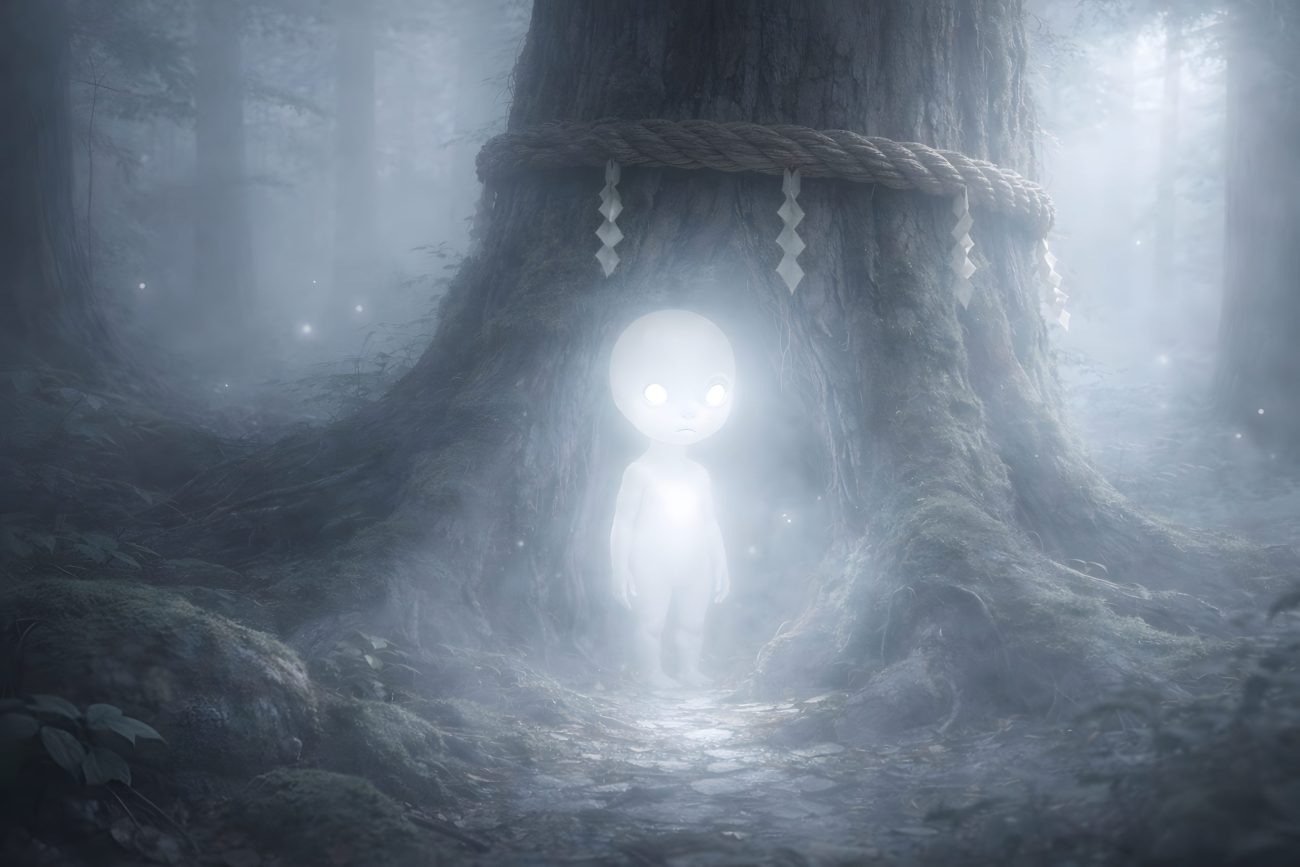
Deep in the mountainous forests of Japan, ancient trees are believed to be inhabited by spirits known as Kodama. These spirits dwell within very old trees, and their lives are inseparably bound to their host. If the tree dies, the kodama perishes with it; if the kodama is destroyed, the tree cannot survive.

Kodama are rarely seen, but their presence is often heard. In forests and mountain valleys, sounds sometimes echo longer than they should, returning with an unnatural delay. This phenomenon, known as yamabiko, is traditionally attributed to kodama responding to human voices. When they do appear visually, kodama may manifest as faint, distant orbs of light, or as small, oddly shaped, vaguely humanoid figures moving through the forest.

Although their bodies may leave the tree temporarily, kodama remain guardians of their groves, tending to the balance of nature. Trees inhabited by kodama are considered sacred. Villagers traditionally mark such trees with shimenawa, sacred ropes, to signal their divine status and warn against harm. Cutting down a tree that houses a kodama is believed to bring a powerful curse, capable of plunging an entire community into ruin. In some traditions, when an ancient tree is cut and blood appears to flow from the wood, it is taken as proof that a kodama lived within it.

The belief in tree spirits is ancient. In early Japanese texts, kodama are closely associated with gods and yōkai alike. The tree deity Kukunochi no Kami, recorded in the Kojiki (712 CE), is sometimes interpreted as a kodama. In the Heian-period dictionary Wamyō Ruijushō, tree gods are listed under the name “kodama.” Classical literature such as The Tale of Genji refers to kodama alongside oni, fox spirits, and gods, indicating their liminal nature between kami and yōkai.

Kodama are said to take many forms. Some appear as ghostly lights, others as animals or humans. One story tells of a kodama that fell in love with a human and left its tree, assuming human form in order to meet them. According to medieval Shinto texts such as the Reikiki, kodama may dwell in groups deep within the mountains and are sometimes heard speaking, particularly at moments of death.

Regional traditions preserve related beliefs. On Aogashima and Hachijō-jima in the Izu Islands, shrines are built at the base of great cryptomeria trees and worshipped under the names kidama-sama or kodama-sama, and festivals are held whenever such trees are cut. On Okinawa, tree spirits are called kiinushii, and prayers are made before felling any tree. Nighttime sounds resembling falling trees are believed to be the cries of kiinushii, followed by the tree withering days later. The Okinawan yōkai kijimuna is sometimes said to be a manifestation of these spirits.

In the Gazu Hyakki Yagyō by Toriyama Sekien, kodama are depicted as elderly men and women standing among trees, with the explanation that when a tree reaches a hundred years of age, a divine spirit comes to dwell within it. Through these traditions, kodama remain enduring symbols of the living soul of the forest and the sacred bond between trees and spirit.


Interpretive Lenses

Religious Readings
Philosophical Readings
Psychological Readings
Esoteric Deep Dive
  • Hermetic Deep Dive
Political / Social Readings
Other

Me-te

Tradition / Region: Japan
Alternate Names: Te no Me (“Eye of the Hand”)
Category: Yōkai


The Myth

Me-te is a yōkai known from writings attributed to Sato Arifumi. It is described as a blind creature that wanders through open fields, moving as though it cannot see the world around it.

Despite its blindness, Me-te is extremely dangerous. People are warned never to mock or make light of it. Those who laugh at Me-te or assume it is helpless are said to be punished, for the yōkai will suddenly attack and suck out their eyeballs.

Me-te is also known by the name Te no Me, meaning “Eye of the Hand,” a name that reflects its strange and unsettling nature. In illustrations, it appears in a form similar to figures shown in Gazu Hyakki Yagyō, though it is depicted without wrinkles on the face, and its empty eye sockets are shown through deep shading.

Though little is recorded about its origin or fate, Me-te is remembered as a wandering field yōkai whose apparent weakness conceals a brutal and sudden threat.


Interpretive Lenses

Religious Readings
Philosophical Readings
Psychological Readings
Esoteric Deep Dive
Political / Social Readings
Other

Jatai

Tradition / Region: Japan (Ehime Prefecture and other regions)
Alternate Names: —
Category: Object/ yōkai


The Myth

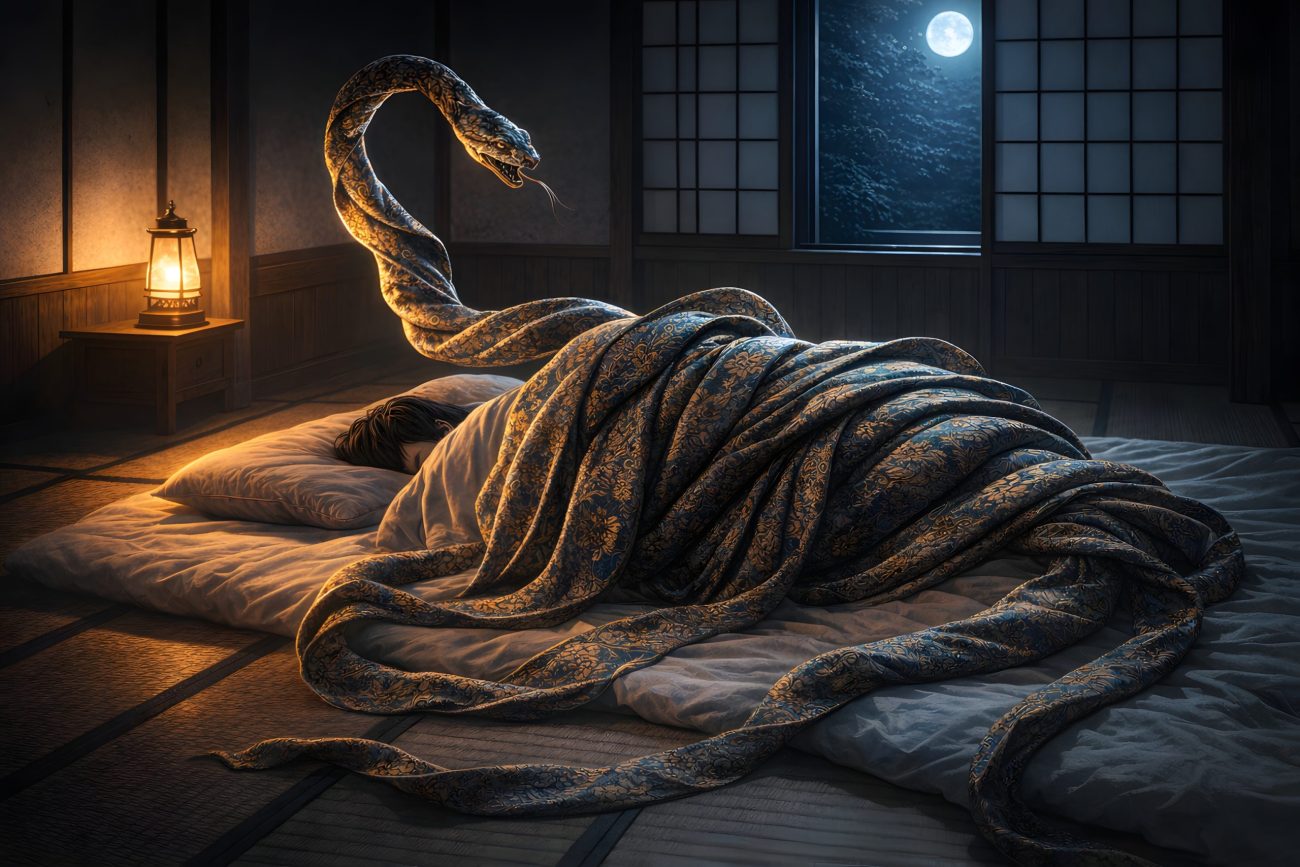
The Jatai is said to appear at night as a living obi, a kimono sash that moves on its own like a great snake. By day it is nothing more than a length of cloth, but after night falls it slithers from its resting place, coiling and gliding through rooms in search of victims.

According to old folk belief, if a person lays an obi near their pillow while sleeping, they may dream of snakes. From this belief grew the story that the obi itself can transform. Because the word for a snake’s body sounds the same as the word for a wicked heart, the sash was believed to awaken as a murderous being. In this form it becomes the Jatai, a dangerous tsukumogami born from jealousy and malice.

The Jatai is especially associated with an obi once worn by a jealous woman. After long use, the resentment bound into the garment gives it life. When it hunts, it wraps itself around sleeping men and strangles them in their beds.

The creature is described as a poisonous snake, long enough to coil itself around a person seven times. This detail is remembered as part of its fearsome nature and its unnatural length. Once the Jatai has tightened its coils, escape is said to be impossible.

The Jatai is depicted in Toriyama Sekien’s Konjaku Hyakki Shūi, where it appears as a living sash transformed into a deadly serpent. Through these tales, the Jatai is remembered as a reminder that strong emotions can linger in objects, waiting for the moment when they take on a life of their own.


Interpretive Lenses

Religious Readings
Philosophical Readings
Psychological Readings
Esoteric Deep Dive
Political / Social Readings
Other

Nurikabe

Tradition / Region: Japan (Edo-period yōkai scrolls)
Alternate Names: —
Category: Yōkai / Lion / Dog


The Myth

In illustrated yōkai scrolls from Japan, a creature known as the Nurikabe appears in a form unlike the better-known invisible wall of later folklore. This Nurikabe is a tangible beast with four legs and a powerful body. Its most striking feature is its enormous face, which bears three eyes that shine with an unnatural blue light. It has large, drooping ears like those of an elephant and two black tusks that curve outward. Its body is painted white, giving it a ghostly and imposing appearance. Some describe it as resembling a dog or a lion, though it does not fully match any known animal.

In the scrolls where it appears, the Nurikabe is shown near crashing waves. Behind it emerge figures such as Umi-otoko, a human seaman, and Umi-bōzu, a fearsome sea spirit. This setting places the Nurikabe at the boundary between land and sea, standing where the human world meets the supernatural. It does not act directly against the figures shown, but its presence dominates the scene, suggesting a powerful being that guards or obstructs passage.

The scroll depicting this Nurikabe is dated to the early nineteenth century. No clear written legend accompanies it, and its precise origin is unknown. It is uncertain whether this beast represents a specific local tradition or whether it was created by the artist as a yōkai form inspired by existing beliefs. Its connection to the later Nurikabe known for blocking travelers’ paths is not clearly stated in the original material.

As it appears in the scroll, the Nurikabe remains an enigmatic creature: a massive, watchful being standing firm amid waves and spirits, neither clearly hostile nor welcoming, marking a place where movement forward is uncertain and dangerous.


Interpretive Lenses

Religious Readings
Philosophical Readings
Psychological Readings
Esoteric Deep Dive
Political / Social Readings
Other

Rashamen

Tradition: Japanese Mythology
Alternate Names: Raschamen
Category: Sheep


The Myth

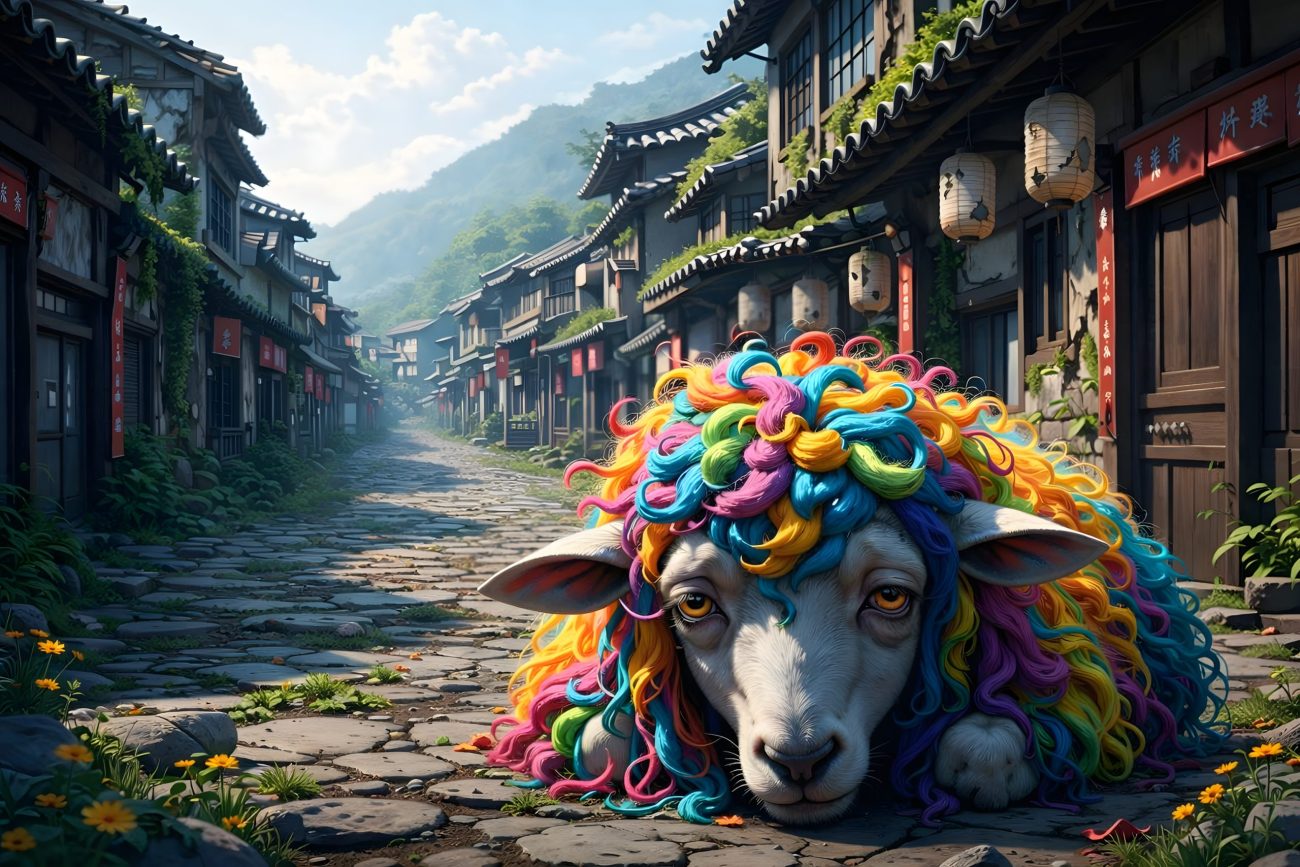
Rashamen was the name used for sheep brought to Japan by overseas ships. Because sheep were unfamiliar, people associated them with foreigners, and the name was said to come from rasha, the woolen clothing worn by Westerners.

In 1776, during the An’ei era, an animal called a raschamen was exhibited as a public spectacle in the districts of Ryōgoku and Asakusa in Edo. People paid to see it as a rare and strange creature from abroad. The animal on display was a sheep, with paint smeared over its body to make it look more unusual.

The spectacle became widely known. The sheep was taken around and shown to crowds, presented as something exotic rather than as an ordinary animal.

The event was later mentioned by Hiraga Gennai in his work Hoheiron Kohen, where he described the rashamen performance and noted that it was simply a painted sheep being displayed to the public.


Sources

Takahashi, Toshihiro. “羅紗緬 [らしゃめん] (Rashamen).” 新版TYZ 妖怪図鑑 (New TYZ Yokai Encyclopedia). January 7, 2015. https://tyz-yokai.blog.jp/archives/1017091835.html


Lady Rokujo

Tradition / Region: Japan (Heian-period court literature)
Alternate Names: Rokujo no Miyasudokoro, Miyasudokoro
Category: Vengeful spirit / living ghost


The Myth

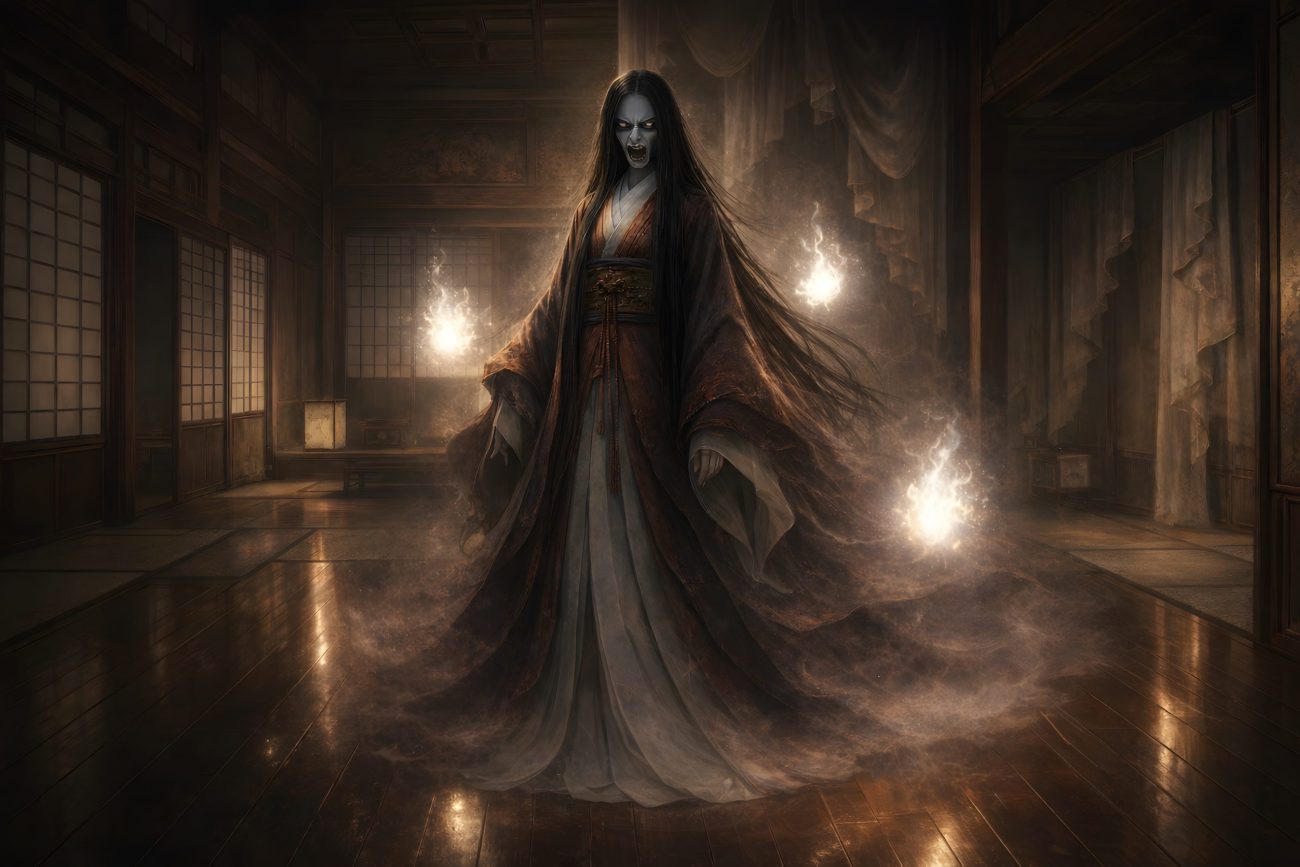
Lady Rokujo was a noblewoman of great refinement, the daughter of a minister and once the wife of the Crown Prince. Widowed at a young age, she later became the lover of Hikaru Genji. Though dignified and proud of her rank, she suffered deeply from jealousy and humiliation, especially as Genji’s affections shifted toward younger women. These unspoken emotions slowly twisted within her.

During the events recorded in The Tale of Genji, her resentment grew so powerful that her spirit began to leave her body without her conscious will. At the Kamo Festival, after being humiliated in a carriage dispute involving Genji’s lawful wife, Lady Aoi, Lady Rokujo’s spirit fully manifested. Invisible yet deadly, it began to torment Lady Aoi, who was pregnant at the time.

Lady Aoi suffered greatly. After a long and painful labor, she gave birth to a son, but her condition suddenly worsened, and she died only days later. Meanwhile, Lady Rokujo realized that her spirit had wandered when she noticed the smell of ritual mustard seeds clinging to her own clothing. Genji himself witnessed her spirit while tending to Lady Aoi. Horrified by what she had become, Lady Rokujo resolved to sever her ties with him.

She left the capital, parting from Genji at Nonomiya, and traveled to Ise with her daughter, who served as a sacred princess. Yet even distance could not quiet her heart. After returning to Kyoto, Lady Rokujo fell ill and died, entrusting her daughter to Genji’s care. Death, however, did not end her suffering.

Her spirit continued to appear, driven by lingering obsession. It haunted Lady Murasaki and later the Third Princess, afflicting them with sickness and terror. Through these hauntings, her bitterness toward Genji was made known again and again.

Only after memorial rites were performed, urged by Genji and carried out for her troubled soul, was it hoped that Lady Rokujo might finally find release. Until then, she endured as one of the most feared figures of courtly legend — a woman whose restrained emotions became so powerful that even death could not contain them.


Interpretive Lenses

Religious Readings
Philosophical Readings
Psychological Readings
Esoteric Deep Dive
Political / Social Readings
Other