Tradition / Region: Greek Mythology
Alternate Names: —
Category: Bat, Vampire
The Myth
On the Greek islands of Crete and Rhodes, people tell of a vampire known as the katakana. It is believed that certain dead do not remain at rest. In older times, Cretans feared that if a person were buried in loose, unconstrained earth, the dead might rise again as a katakana. Because of this danger, holy soil was brought from sacred places, including the Holy Sepulcher, and sprinkled over cemeteries to prevent the dead from returning.
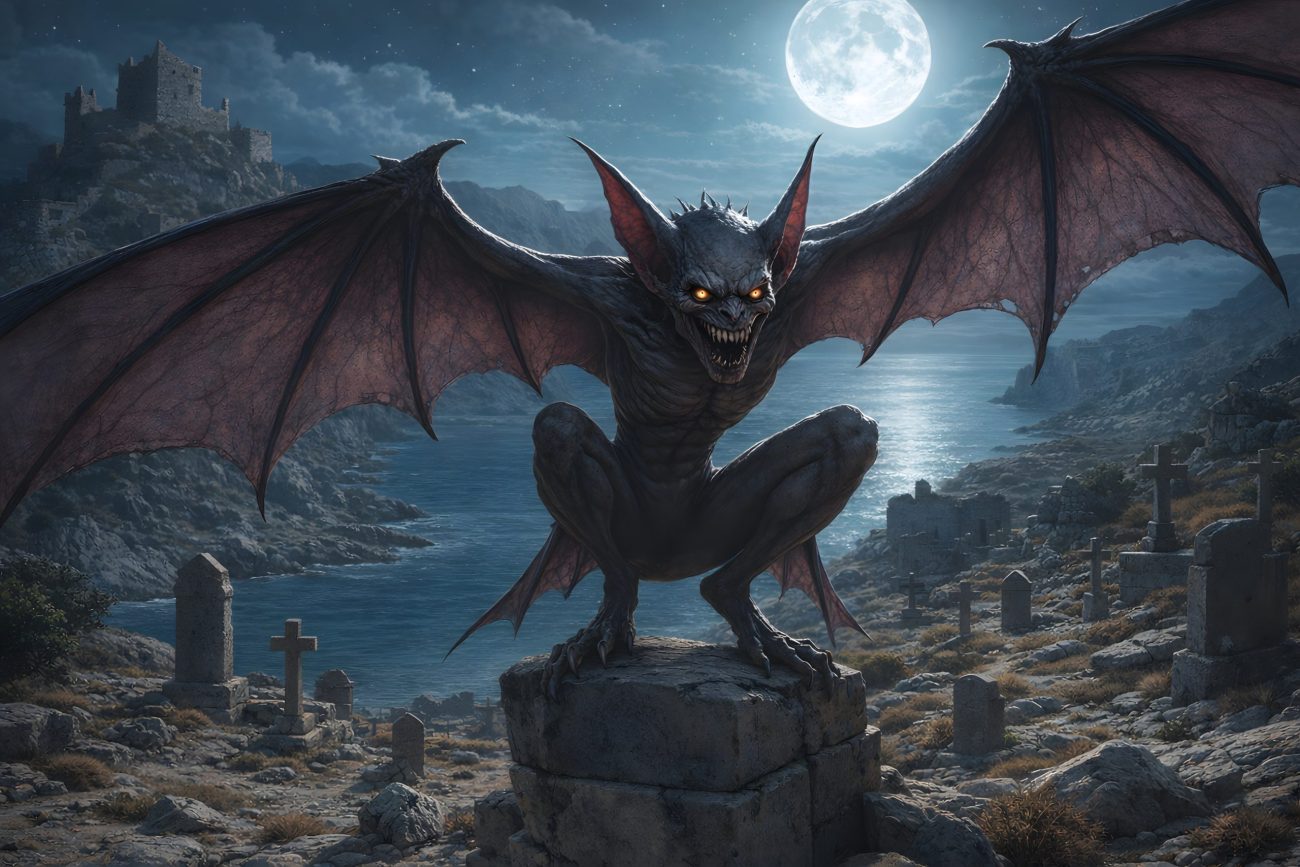
The katakana was said to arise from the bodies of suicides, evil people, or those who had been excommunicated from the church. After death, such individuals could transform into vampires, retaining a distorted likeness of their former selves. The katakana was described as constantly smiling, its teeth always visible, giving it a chilling and unnatural expression.
Unlike some other undead beings, the katakana did not rely solely on biting to create others of its kind. Instead, it was said to spit a burning, bloody discharge at people. If this sticky substance struck its target, the victim would in time become a katakana as well, transformed into a vampire like the one that cursed them.
People believed the katakana could be driven away temporarily by gunshots, but destroying it required strict measures. To kill it permanently, the vampire had to be decapitated, or at least struck in the head with a sharp-edged weapon. Its severed head was then boiled in vinegar, and its nails were burned. Another method involved trapping the katakana in a container filled with salt water, which could immobilize it.
These actions had to be carried out within the first forty days after the vampire’s rise. If this time passed, the katakana was believed to become indestructible, immune to all attempts to destroy it. Because of this, vigilance and speed were considered essential when signs of a katakana appeared.
Beliefs about the katakana were understood as a local island form of broader Greek vampire traditions, yet its distinctive grin, burning spit, and specific methods of destruction set it apart as one of the most feared undead beings of the Aegean islands.