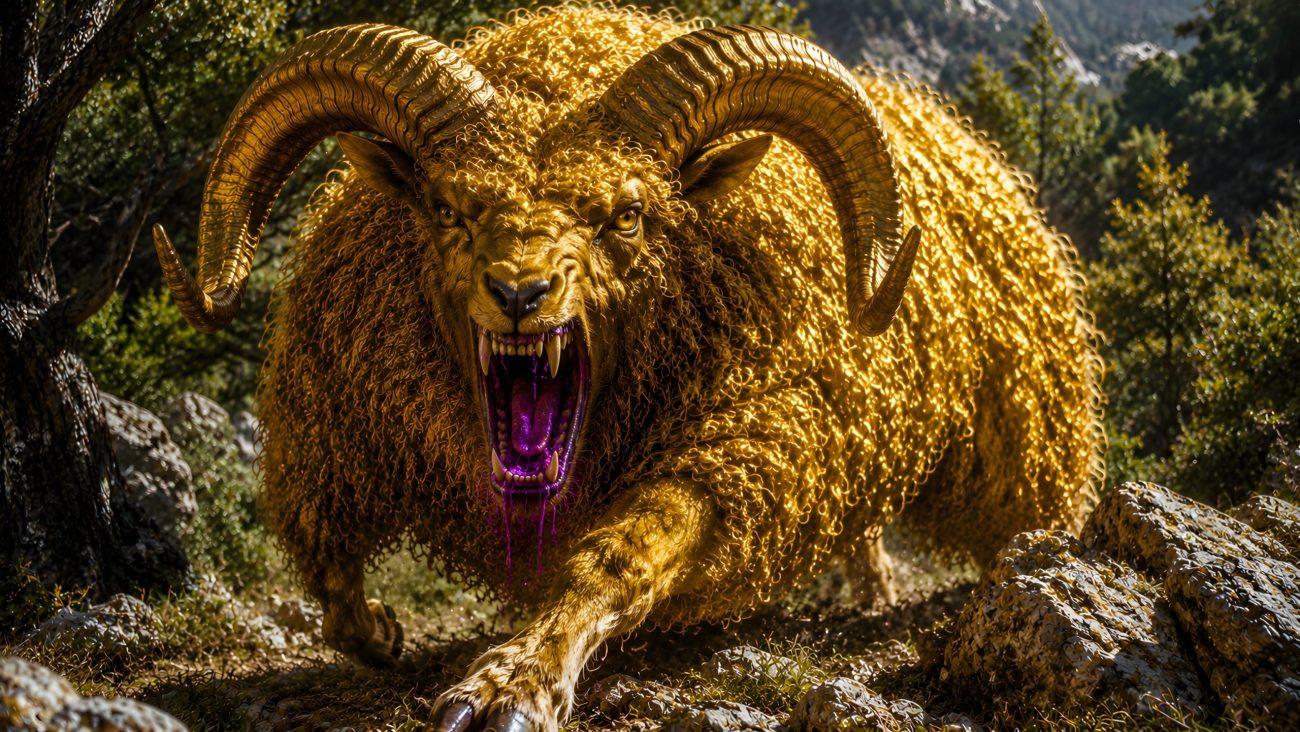
Meloi Khryseoi

Tradition / Region: Greek Mythology
Alternative names: Golden Sheep
Category: Sheep


The Myth

The Golden Sheep (Meloi Khryseoi) were a flock of magical sheep whose fleeces shone with pure gold. Despite their beautiful appearance, they were among the most dangerous creatures in Greek mythology. During the heat of the day they became violently aggressive, charging with rock-hard heads, sharp horns, and even poisonous bites capable of killing humans.

The sheep appear in the story of Psyche, who was ordered by Aphrodite to collect a tuft of their priceless golden wool as one of her impossible labors. Rather than confronting the beasts directly, Psyche was advised by a prophetic river reed to wait until evening, when the flock had calmed. Instead of shearing them, she gathered the golden wool that had become caught on nearby branches and bushes, allowing her to complete the task without facing the murderous animals.

The Golden Sheep are largely a literary creation of the Roman author Apuleius, who combined elements of two famous Greek myths: the Golden Fleece of the ram sought by Jason and the Golden Apples of the Hesperides. This wordplay was possible because the Greek word mēlon could mean either “sheep” or “apple”, allowing the “Golden Sheep” to function as a clever fusion of both legendary treasures.

Although they appear only briefly in mythology, the Meloi Khryseoi represent a recurring Greek theme: great beauty and immense wealth guarded by deadly supernatural danger, where wisdom and patience succeed where force would fail.


Sources

Atsma, A. J. (n.d.). Meloi Khryseoi (Golden Sheep) – Poisonous flock of Greek mythology. In Theoi Greek Mythology. Retrieved June 28, 2026, from https://www.theoi.com/Ther/MeloiKhryseoi.html
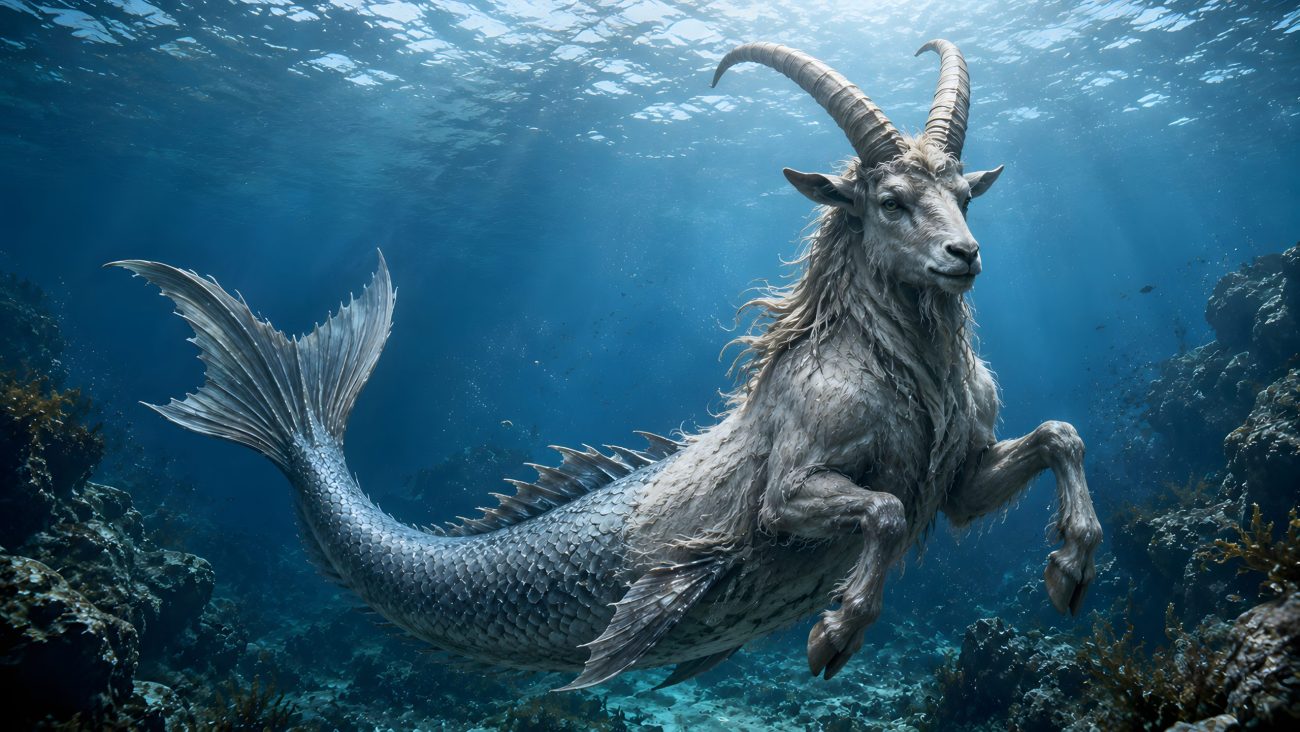

Aegipan

Tradition / Region: Greek Mythology
Alternative names: Aigipan, Goat-Pan, Aegocerus
Category: Sheep, Deity, Fish


The Myth

Aegipan (Greek: Aigipan, meaning “Goat-Pan” or “All-Goat”) is a goat-legged rustic deity closely associated with Pan, though ancient traditions disagree on whether he was Pan himself, Pan’s father, or an entirely separate god. He is best known as the divine Sea Goat, whose image became the constellation Capricorn.

Most depictions portray Aegipan with the upper body of a horned, bearded goat-man and the tail of a fish, allowing him to move freely across both mountains and seas. In some traditions he possessed the terrifying ability to inspire panic among armies, giving rise to the word “panic” itself.

His greatest role came during the war between Zeus and the monstrous Typhon. After Typhon defeated Zeus by cutting the sinews from his hands and feet and hiding them in the Corycian Cave, where they were guarded by the dragon-woman Delphyne, Aegipan joined Hermes on a daring rescue mission. Together they secretly recovered Zeus’s stolen sinews and restored them to his body, enabling the king of the gods to continue the battle and ultimately defeat Typhon.

Another tradition tells that Aegipan helped destroy Typhon through cunning rather than strength. He lured the monster from its hiding place with the promise of a feast of fish, bringing Typhon into the open where Zeus struck him down with thunderbolts.

During Typhon’s assault on the gods in Egypt, many Olympians transformed themselves into animals to escape. Aegipan leapt into a river, changing his lower half into the tail of a fish while retaining his goat-like upper body. Zeus admired both his cleverness and his loyalty, placing his image among the stars as the constellation Capricorn, forever commemorating the Sea Goat in the heavens.

Ancient authors also give conflicting accounts of Aegipan’s parentage. Some describe him as the son of Zeus and the she-goat Aega (or Boetis), while others make him the son of Hermes, or even the father of Pan himself. Regardless of his origins, Aegipan consistently appears as a loyal ally of Zeus and one of the heroic figures responsible for preserving the rule of the Olympian gods.


Sources

Atsma, A. J. (n.d.). Aigipan (Aegipan) – Greek goat-fish sea god. In Theoi Greek Mythology. Retrieved June 28, 2026, from https://www.theoi.com/Georgikos/Aigipan.html.

Wikipedia contributors. (n.d.). Aegipan. In Wikipedia. Retrieved June 28, 2026, from https://en.wikipedia.org/wiki/Aegipan