Tradition / Region: Greek Mythology
Alternative names: Kharybdis
Category: Sea Dweller
The Myth
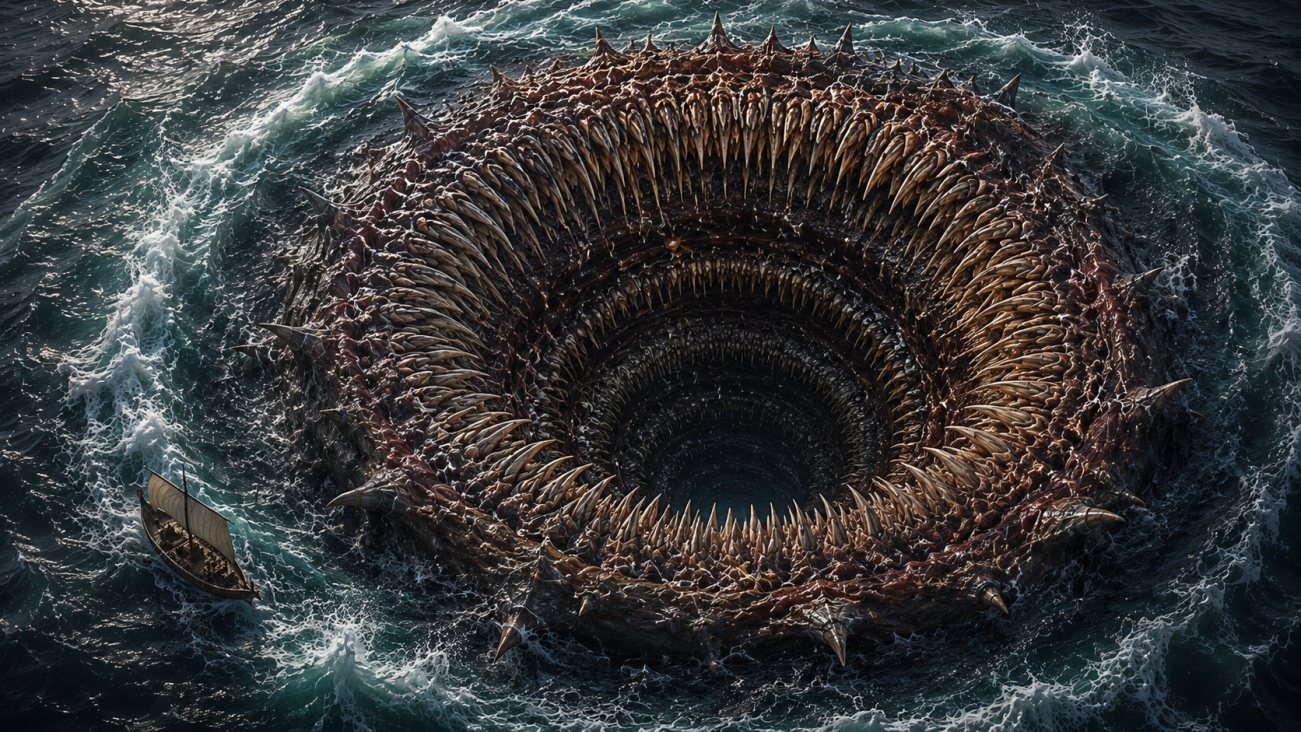
Charybdis is one of the most feared monsters of Greek mythology, dwelling beneath the waters of the narrow strait between Sicily and Italy. Rather than roaming the sea like an ordinary beast, she exists as a colossal living whirlpool whose enormous mouth opens beneath the waves. Three times every day she drinks in the sea itself, swallowing vast quantities of water along with anything caught within it. Ships, sailors, and sea creatures are dragged into her gaping maw before the waters are violently expelled again, creating terrifying whirlpools capable of destroying entire fleets.
Several traditions explain her origin. Some describe Charybdis as a primordial daughter of the sea and the earth, born from the ancient powers of the ocean. A later and more famous legend tells that she was once a woman, the daughter of Poseidon and Gaia. During a conflict involving Heracles, she stole the hero’s sacred cattle out of greed and gluttony. Zeus punished her for her insatiable appetite by striking her with a thunderbolt and hurling her into the sea. There she was transformed into a monstrous being cursed with endless hunger, forever swallowing and vomiting the waters of the ocean.
Charybdis is most famous for her role in Homer’s Odyssey. When Odysseus journeyed home after the Trojan War, the sorceress Circe warned him that he would have to pass through a narrow channel guarded by two horrors. On one side waited the six-headed monster Scylla, who snatched sailors directly from the decks of passing ships. On the other lurked Charybdis, whose whirlpool was so powerful that not even Poseidon himself could save a ship caught when she swallowed the sea. Circe advised Odysseus to sail closer to Scylla, for losing a few companions was better than having his entire crew consumed by Charybdis.
Odysseus followed her advice and escaped complete destruction, though Scylla seized six of his men. Later, however, after Zeus destroyed his ship for the crimes of his companions, Odysseus alone drifted helplessly back toward Charybdis on pieces of the wreck. Just as the monster began swallowing the sea once more, he leapt upward and clung to the branches of a wild fig tree that grew from the cliff above her whirlpool. Hanging there for hours, he waited until Charybdis spat the sea and the shattered timbers back onto the surface. Only then did he release his grip, fall onto the floating wreckage, and paddle away before the monster could swallow the sea again.
Ancient Greek writers described the sound of Charybdis as a deafening roar that echoed across the strait as the sea disappeared into her mouth. When she drew in the water, the seabed itself could briefly be seen before the ocean rushed back with tremendous force. Sailors considered the passage between Charybdis and Scylla one of the most dangerous places in the world, and the expression “between Scylla and Charybdis” became a proverb for being trapped between two equally deadly dangers.
Unlike many monsters of Greek mythology, Charybdis is not remembered for fighting heroes with claws or weapons. She is the sea itself turned into a ravenous creature—an endless mouth beneath the waves whose hunger never ceases, swallowing everything unfortunate enough to pass within her reach.
Sources
Atsma, A. J. (n.d.). Kharybdis (Charybdis) – Greek whirlpool monster. In Theoi Greek Mythology. Retrieved June 29, 2026, from https://www.theoi.com/Pontios/Kharybdis.html