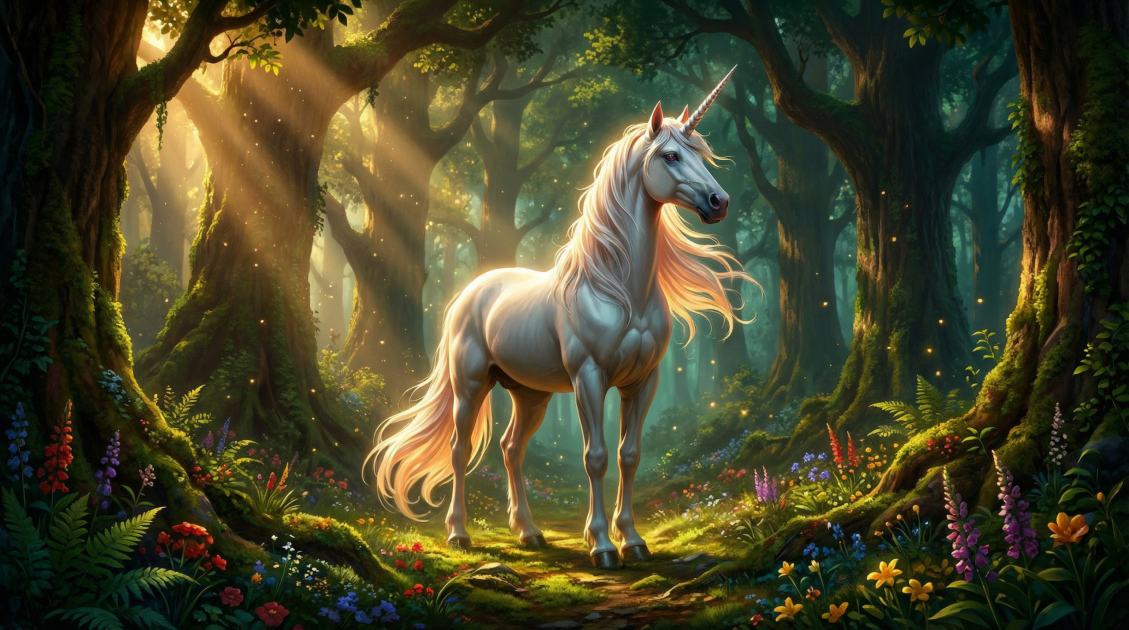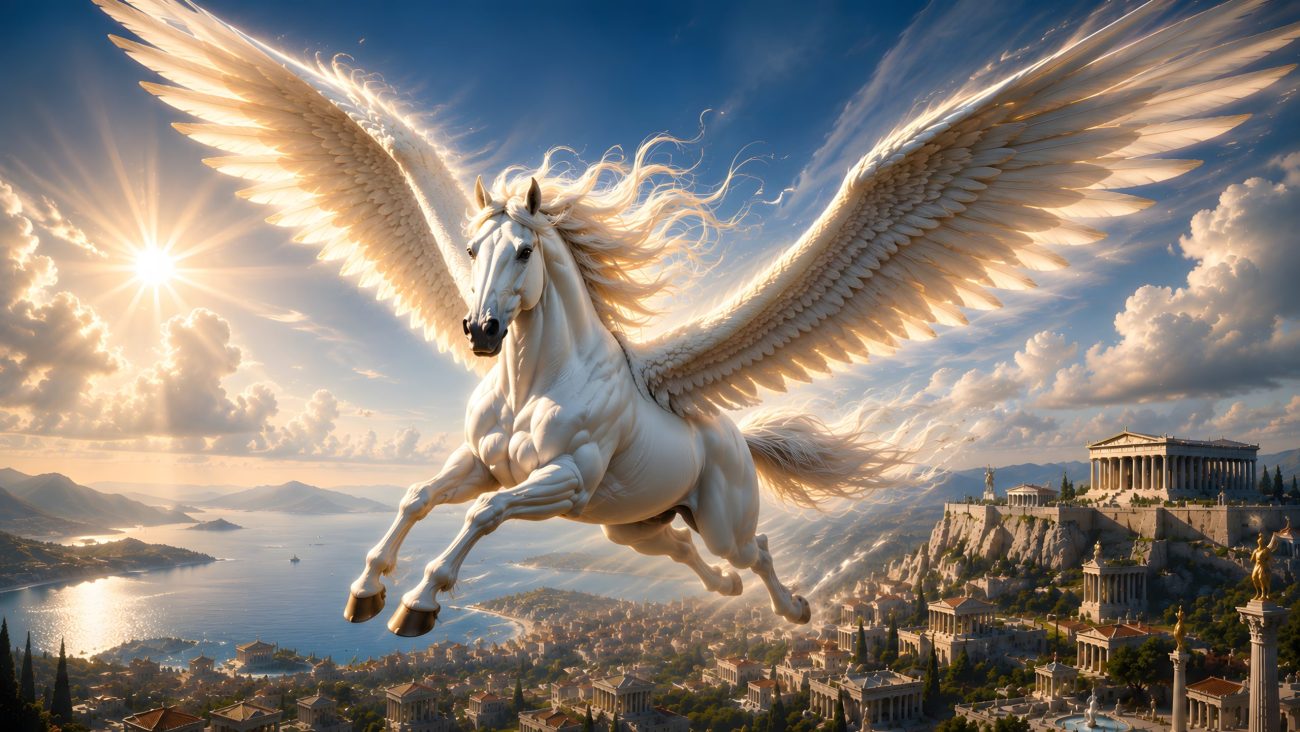
Pegasus

Tradition / Region: Greek Mythology
Alternative names: Pegasos
Category: Horse


The Myth

Pegasus is the famous winged horse of Greek mythology, usually depicted as a white stallion. He was sired by Poseidon in his role as the horse-god and was born together with his brother Chrysaor from the blood of the Gorgon Medusa after she was beheaded by Perseus. Some traditions instead state that the brothers arose when Medusa’s blood fell upon the earth, while others connect their birth to the mingling of her blood with sea foam.

After his birth, Pegasus flew to the heavens and became a servant of Zeus, carrying the god’s thunderbolts and thunder from Olympus.

Pegasus was also associated with miraculous springs. Wherever he struck the ground with his hoof, a spring burst forth. The most famous of these was Hippocrene on Mount Helicon, created by Pegasus’ hoof. Another sacred spring connected with him was located at Troezen.

The hero Bellerophon captured Pegasus near the spring of Peirene. Following Athena’s instructions, Bellerophon slept in her temple, where the goddess appeared in a dream and presented him with a golden bridle. The following morning he found Pegasus drinking at the spring and used the bridle to tame the winged horse with the help of Athena and Poseidon.

Mounted upon Pegasus, Bellerophon defeated the monstrous Chimera and accomplished many other heroic deeds. Eventually, however, he attempted to ride Pegasus to Mount Olympus. For this act of pride he fell from the horse. Some traditions say that both Bellerophon and Pegasus died by the will of Zeus for attempting to reach Olympus, while others state that Pegasus alone continued to Olympus, where he remained in the service of Zeus, bearing his thunderbolts.

Pegasus was later honored as a constellation and became one of the most enduring figures of Greek mythology, frequently appearing in ancient Greek art and later Renaissance paintings and sculptures.


Sources

Wikipedia contributors. (n.d.). Pegasus. In Wikipedia. Retrieved June 29, 2026, from https://en.wikipedia.org/wiki/Pegasus
Hippoi Kabeirikoi

Tradition / Region: Greek Mythology
Alternative names: Horses of the Cabeiri
Category: Horse


The Myth

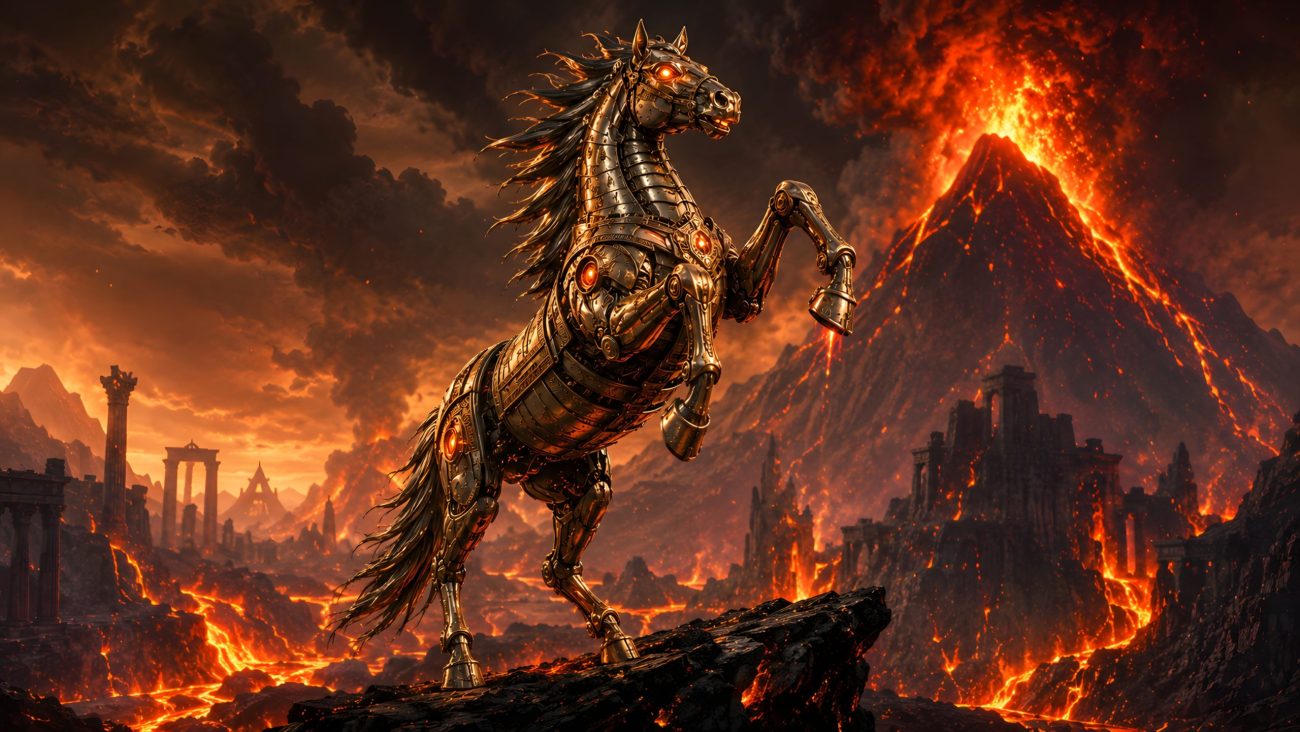
The Hippoi Kabeirikoi were four horse-shaped bronze automata forged by the god Hephaestus to draw the adamantine chariot of his sons, the Cabeiri.

The supernatural horses were fashioned with Hephaestus’ unmatched skill. Their hooves and bodies were made of bronze, and as they galloped they struck the earth with rattling brass hooves while emitting a dry, metallic whinny. Fire blazed from between their teeth, making them as fearsome as the brazen-footed bulls that Hephaestus had once forged for King Aeëtes of Colchis.

The fiery horses drew the adamantine chariot of the Cabeiri, while Eurymedon, one of the divine brothers, guided their iron-footed steeds with a blazing bridle.


Sources

Atsma, A. J. (n.d.). Hippoi Kabeirikoi (Horses of the Cabeiri). In Theoi Greek Mythology. Retrieved June 29, 2026, from https://www.theoi.com/Ther/HippoiKabeirikoi.html


Centaur

Tradition / Region: Greek Mythology
Alternative names: Hippocentaur
Category: Horse


The Myth

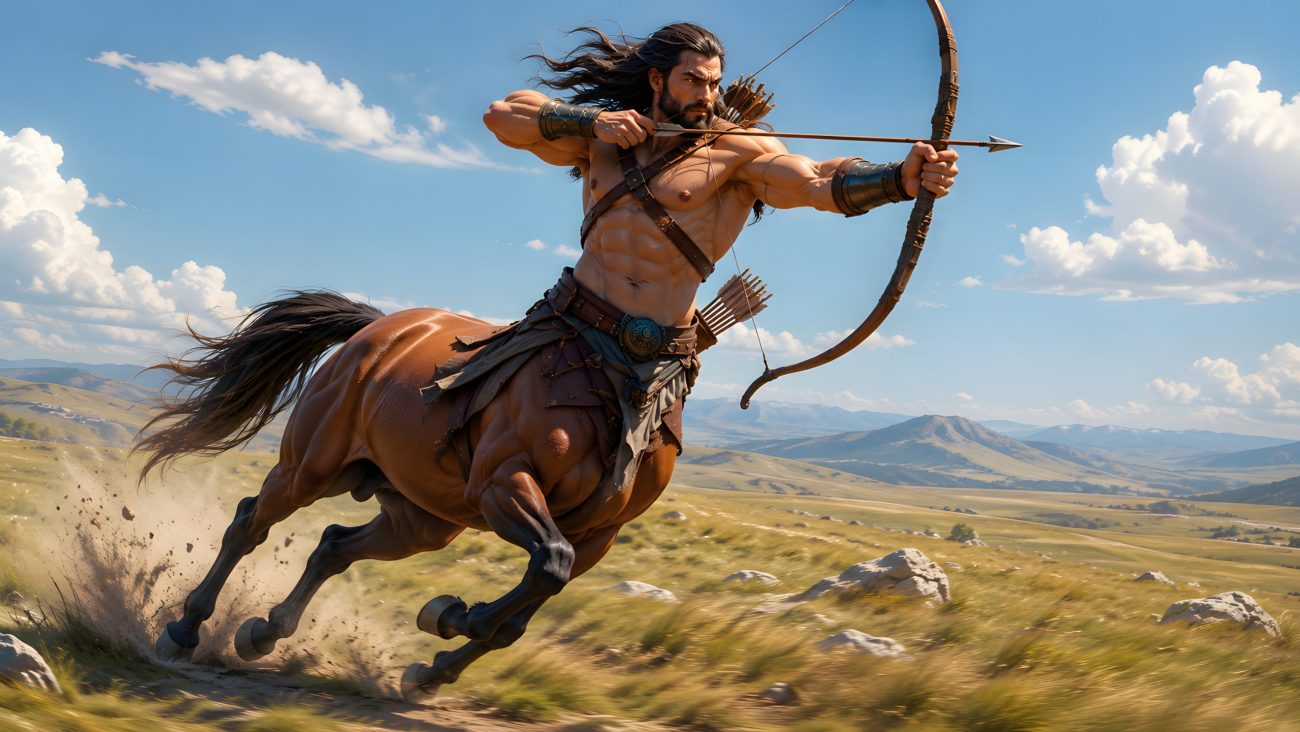
The Centaur is one of the most recognizable creatures of Greek mythology, possessing the upper body of a human and the lower body of a horse. They were said to inhabit the mountains of Thessaly, particularly Mount Pelion and the region of Magnesia, as well as other wild forests and remote landscapes of Greece.

According to the most common tradition, the centaurs were born from the union of Ixion and Nephele, a cloud fashioned by Zeus in the likeness of Hera. Other traditions state that they descended from Centaurus, who fathered them with the mares of Magnesia. Centaurus was himself described either as the son of Ixion and Nephele or as the son of Apollo and the nymph Stilbe.

Most centaurs were portrayed as wild, untamed beings driven by instinct and passion. They possessed tremendous strength and were often depicted hurling rocks or uprooted trees in battle. Living apart from human society, they embodied the untamed forces of nature and frequently clashed with civilization.

Their most famous legend is the Centauromachy, the battle between the Centaurs and the Lapiths. During the wedding feast of King Pirithous and Hippodamia, the centaurs became drunk and attempted to abduct the bride and the other Lapith women. A violent conflict followed, with the hero Theseus joining the Lapiths. After a fierce struggle, the centaurs were defeated and driven from the region.

Although many centaurs were violent and unruly, not all shared this nature. Some, most notably Chiron, were renowned for their wisdom, learning, and kindness, serving as teachers of many Greek heroes. This contrast made the centaurs symbols of both humanity’s untamed instincts and its capacity for wisdom.

The Centaur remained an enduring figure in Greek and later Roman mythology, representing the constant tension between civilization and the wild forces of nature.


Sources

Wikipedia contributors. (n.d.). Centaur. In Wikipedia. Retrieved June 29, 2026, from https://en.wikipedia.org/wiki/Centaur


Arion

Tradition / Region: Greek Mythology
Alternative names: Areion
Category: Horse


The Myth

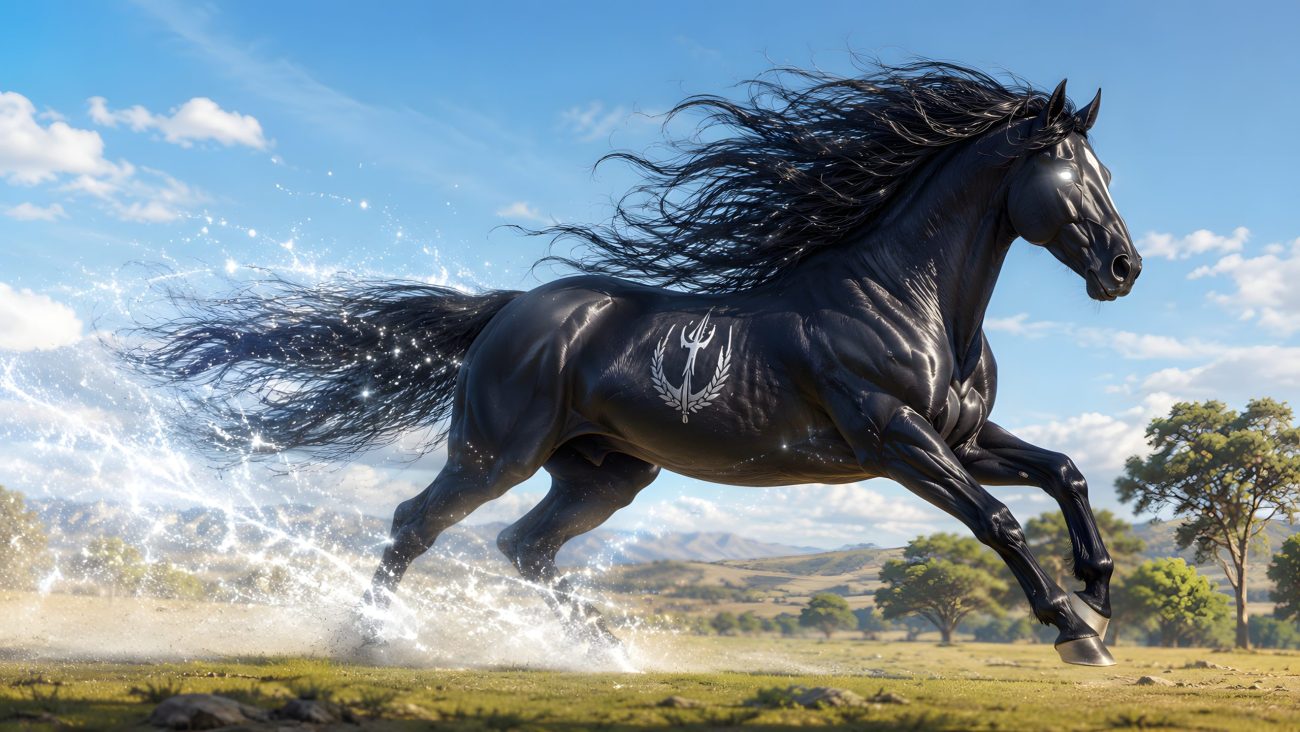
Arion was a divine, black-maned horse renowned for its incredible speed, intelligence, and heavenly origin. It was considered one of the greatest horses in Greek mythology.

According to the most common tradition, Arion was born when the sea god Poseidon pursued Demeter as she searched the world for her abducted daughter Persephone. To escape him, Demeter transformed herself into a mare and hid among a herd of horses in Arcadia. Poseidon discovered her, became a stallion himself, and their union produced the immortal horse Arion. Other traditions instead claim Arion was born from Gaia (Earth) or from the West Wind Zephyrus and a Harpy.

Arion was eventually given to Heracles, who rode the divine horse during several of his campaigns, including his battle against Cycnus, the son of Ares, and his expedition against Elis. After these adventures, Heracles presented Arion to King Adrastus of Argos.

The horse became most famous during the legendary war of the Seven Against Thebes. Before the campaign, Arion won the horse race at the first Nemean Games, demonstrating his unmatched speed. When the expedition ended in disaster and every other Argive leader was killed, Arion alone succeeded in carrying Adrastus safely away from the battlefield, saving his master’s life through his extraordinary swiftness.

Ancient poets describe Arion as far more than an ordinary horse. He was said to be almost impossible to control in his youth, moving with the speed of the wind and even racing across the sea beside Poseidon’s divine steeds. Later, after years beside heroic riders, he became calmer while losing none of his supernatural speed.

Some traditions even attributed speech to Arion, placing him among the rare intelligent horses of Greek mythology. Throughout Greek literature he symbolizes divine favor, heroic endurance, and the miraculous bond between a legendary hero and an immortal steed.


Sources

Wikipedia contributors. (n.d.). Arion (horse). In Wikipedia. Retrieved June 29, 2026, from https://en.wikipedia.org/wiki/Arion_(horse)


Unicorn

Tradition / Region: Greek Mythology
Alternate Names: Monokeros
Category: Horse


The Myth

In ancient Greek accounts, the unicorn was spoken of as a rare and formidable creature dwelling in distant forests and mountains beyond the familiar world. It resembled a powerful horse or goat-like beast, marked by a single long horn rising from the center of its forehead. Swift, strong, and fiercely independent, it could not be overtaken by hunters nor subdued by force.

The unicorn was said to possess extraordinary strength. When pursued, it could leap from great heights, landing upon its horn without injury, and vanish into rough terrain where no human could follow. Its body was lean and fast, its senses sharp, and its temperament untamable. No net or trap could hold it, and weapons were useless against its speed.

Only one method was said to succeed in capturing a unicorn. If a maiden of pure character was left alone in the forest, the creature would approach her without fear. Trusting her presence, it would rest its head in her lap, allowing hunters to seize it. Without such purity, the unicorn would never come near, fleeing at the first hint of deceit or threat.

The unicorn’s horn was believed to hold powerful properties. It could cleanse poisoned water, neutralize venom, and protect against corruption. Because of this, kings and physicians prized the horn above all treasures, though few ever possessed one. Its power was tied to the creature itself, and the horn was never obtained without consequence.

Though later traditions layered the unicorn with symbolism, in the older Greek imagination it remained a wild and dangerous being. It was neither gentle nor benevolent, but bound to strict conditions of approach. To encounter the unicorn was to face a creature that tested restraint, intention, and respect, existing beyond human command and beyond the reach of ordinary ambition.


Sources

Wikipedia contributors. (n.d.). Unicorn. In Wikipedia. Retrieved June 29, 2026, from https://en.wikipedia.org/wiki/Unicorn