Dragon of Gelre

Tradition: Dutch Mythology
Alternative Names: De Draak van Gelre, Gelderse Draak
Category: Dragon


The Myth

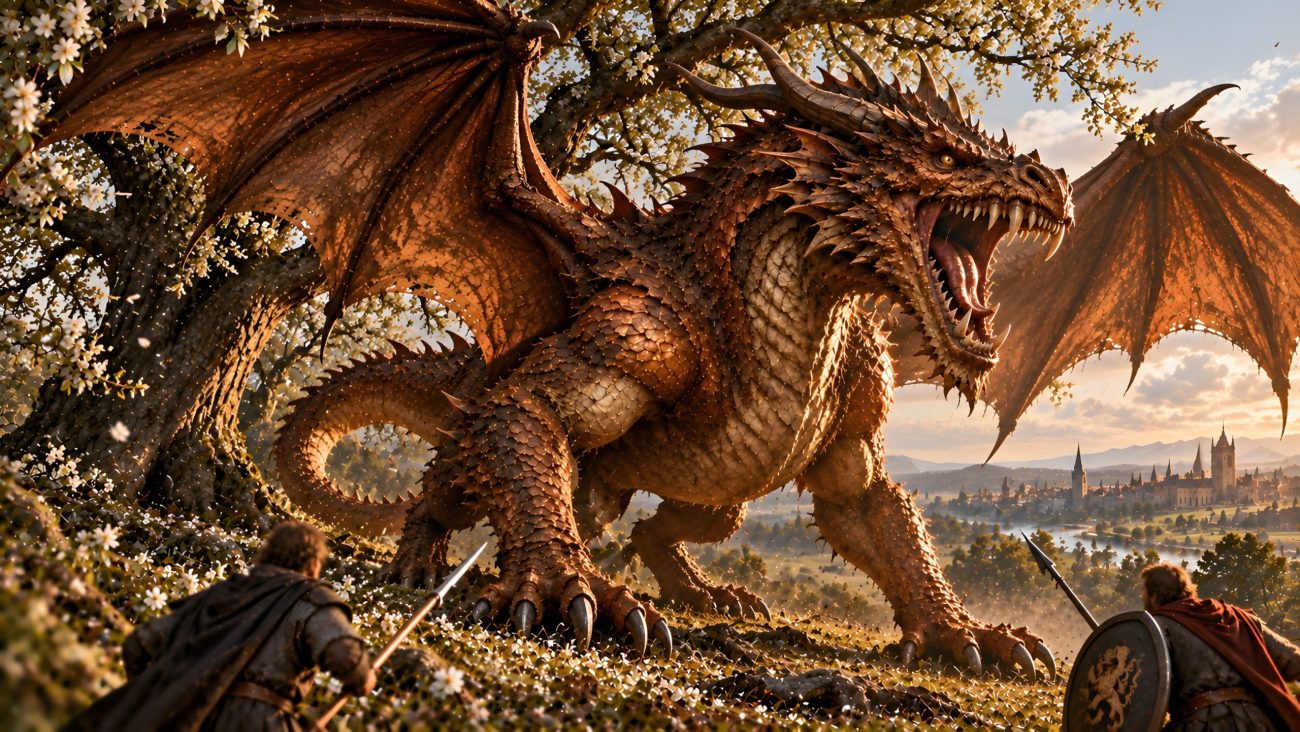
A fearsome dragon lived beneath an ancient medlar tree. It terrorized the surrounding countryside, seizing both people and animals and tearing them apart. The dragon’s terrible cry was always the same: “Gelre, Gelre!”

Lupold and Wichard, sons of Otto, lord of Pont, heard of the beast and set out to destroy it. Beneath the old medlar tree they found the dragon and confronted it. After a fierce struggle, the brothers succeeded in killing the monster.

Where the dragon had been slain, the brothers founded a castle and named it Gelre, after the strange cry that had come from the dragon’s mouth.

Lupold later died without children, and his younger brother Wichard succeeded him. Wichard was married to a daughter of Zutphen, sometimes named Margaretha, daughter of Herman of Hameland. From that time onward he bore three medlar flowers in his coat of arms, preserving the memory of the dragon that had been defeated beneath the ancient medlar tree.


Sources

“De draak van Gelre.” Mijn Gelderland. Accessed September 30, 2026. https://mijngelderland.nl/inhoud/verhalen/de-draak-van-gelre


Dragon of Wasmes

Tradition: Belgian Mythology
Alternative Names: Gilles van Chin’s Dragon
Category: Dragon


The Myth

A fearsome dragon lived in the dangerous marshes of Wasmes, where it made its lair in a cave. The beast had captured a young girl and carried her into its den, holding her prisoner there.

In 1133, Gilles van Chin came to Wasmes and confronted the dragon. The battle lasted for hours, continuing until evening. In one telling of the tale, the imprisoned girl managed to help Gilles by giving him a thorny branch. He used it against the dragon, and the branch became lodged in the creature’s mouth.

At last Gilles struck the dragon through the heart and killed it. He then cut off its head and carried the monstrous trophy to Count Baldwin. The rescued girl was brought back to the village in triumph, freed from the creature that had held her captive in the marshes.


Sources

“Gilles van Chin.” Wikipedia, de vrije encyclopedie (Dutch Wikipedia). Wikimedia Foundation. Accessed September 30, 2026. https://nl.wikipedia.org/wiki/Gilles_van_Chin


Dragon of Burgbrunnen

Tradition: Luxembourg Mythology
Alternative Names: Dragon of the Burgbrunnen, Dragon of the Castle Well
Category: Dragon


The Myth

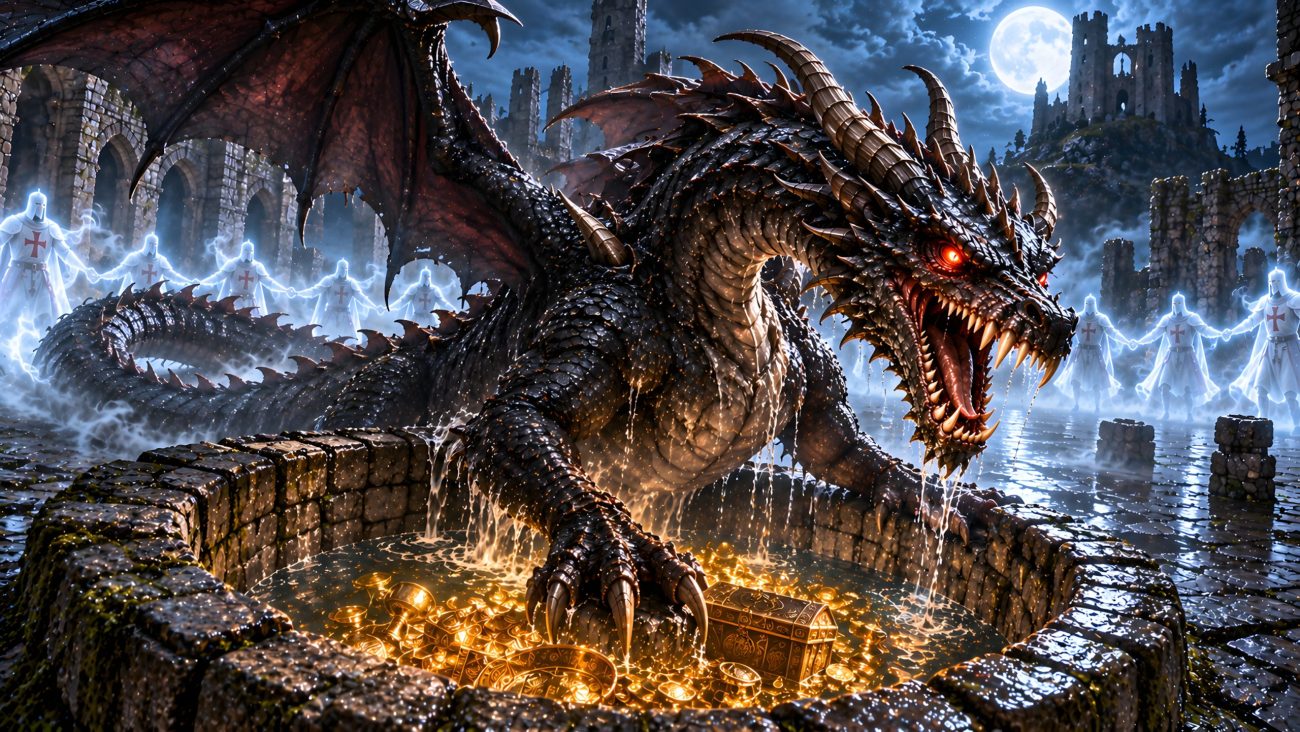
The dragon of the Burgbrunnen is the transformed spirit of a treacherous castle bailiff who guards a treasure at the bottom of the castle well. He appears as a supernatural guardian of the dark shaft, emerging from its depths on Good Friday at midnight.

On a dark and stormy night, the lady of Fels sat beside the cradle of her sleeping infant. Her thoughts wandered between her beloved child and her husband, who was away from the castle. Suddenly she heard the rattling and creaking of the drawbridge being lowered.

Believing that her husband had returned, she rushed to the window, hoping to see him through the darkness. Instead, a terrible uproar erupted in the courtyard. The sounds of clashing weapons, curses, and the groans of dying warriors filled the castle. A flash of lightning briefly illuminated the scene, revealing the truth: the Templars of Heringen, bitter enemies of her house, had seized the fortress and were already storming toward her chambers.

The woman seized her infant and fled toward a secret passage. But when she reached the courtyard, another flash of lightning revealed her pursuers closing in. With no escape left, she commended her soul to God and threw herself into the castle well with her child rather than allowing them to fall into the hands of the enemy.

Even the brutal victors were shaken by the courage of the mother. They pulled the bodies of the woman and her infant from the water. Then, seeking to shift the blame for the deaths of the innocent victims, they seized the castle bailiff—the man who had betrayed the fortress to them through bribery—and threw him into the same well.

The bailiff’s spirit was transformed into a dragon. Deep within the wet shaft of the castle well, he was condemned to guard the gold that had been the price of his betrayal.

Yet the dragon does not remain below forever. Every year, at midnight on Good Friday, he rises from the depths. On the deserted castle grounds, the Templars gather around the well and dance a hellish procession, led by the dragon who once betrayed the fortress.


Sources

La Fontaine, Edmond de. Luxemburger Sagen und Legenden. Luxemburg: Jos. Beffort, 1882.


Goldkaul Dragon

Tradition: Luxembourg Mythology
Alternative Names: Goldkaul Dragon, Dragon of the Goldkaul
Category: Dragon


The Myth

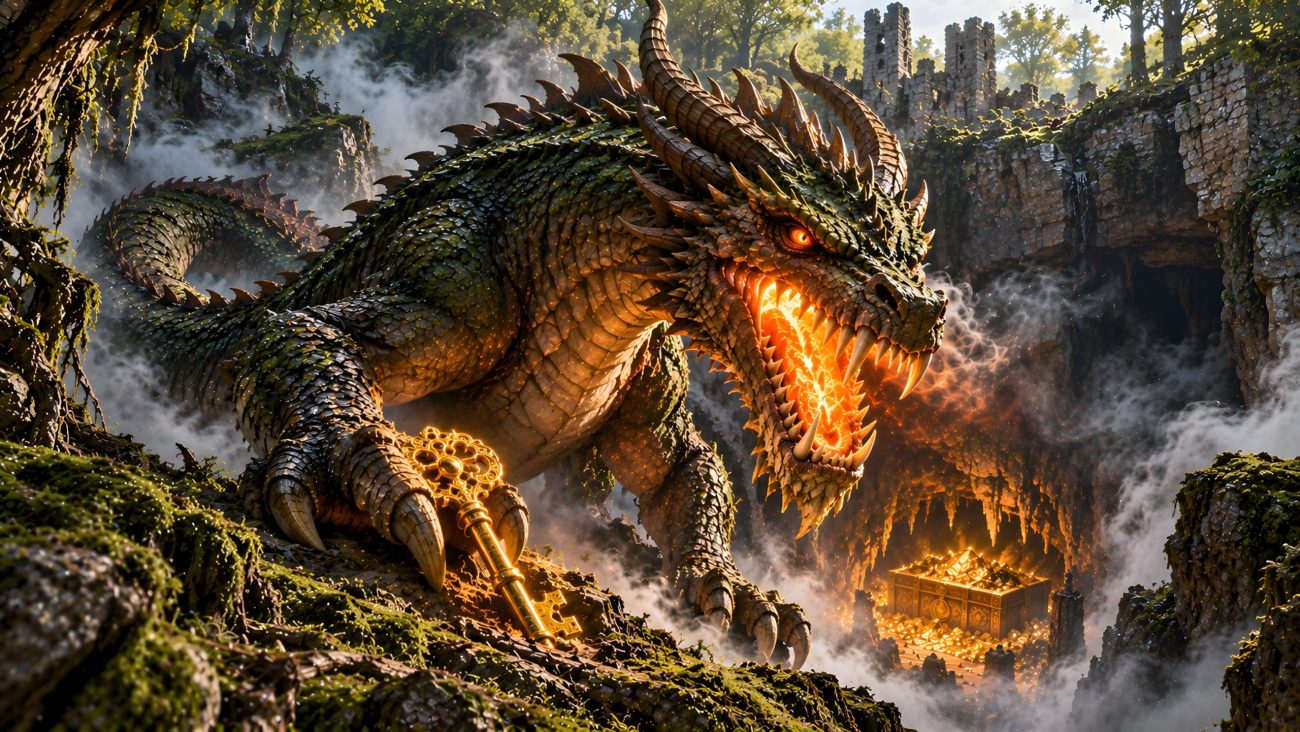
The dragon of the Goldkaul guards a treasure buried deep beneath the earth near Consdorf. It has a fiery mouth and keeps the key to a chest filled with gold, guarding it from anyone who might try to claim the hidden riches.

Long ago, a knight’s castle stood on the land known as Burgkopf. A widow lived there with her daughter, and the two were constantly quarrelling. Although the daughter was still too young to marry, she desperately wanted a husband and demanded her inheritance in gold every day.

Her mother repeatedly refused. As their arguments grew more bitter, the widow finally lost her patience. She took a chest filled with money, threw it at her daughter’s feet, and cursed her to the depths of the earth.

The curse immediately came true. The greedy young woman disappeared into the ground together with her treasure chest, and even the nearby village of Eonsbrück vanished into the abyss. The place where everything disappeared became known as the Goldkaul.

Even in daylight, an eerie mist rises from the pit. It is said to be the breath of the unfortunate daughter—or the breath of the fierce dragon that guards her treasure. Deep underground, the dragon holds the key to the golden chest in its fiery jaws.

When the full moon shines at midnight, the shadowy figure of the cursed daughter can be seen flying from tree to tree. She still waits for someone to free her from the curse.

But the treasure and the girl’s release cannot be won by ordinary courage. Only someone in a state of grace, possessing holy courage, can descend into the Goldkaul and wrest the key from the dragon.


Sources

La Fontaine, Edmond de. Luxemburger Sagen und Legenden. Luxemburg: Jos. Beffort, 1882.


Kirishitan Ryū

Tradition: Japanese mythology
Alternative Names: Kirishitan Ryū, Christian Dragon
Category: Dragon


The Myth

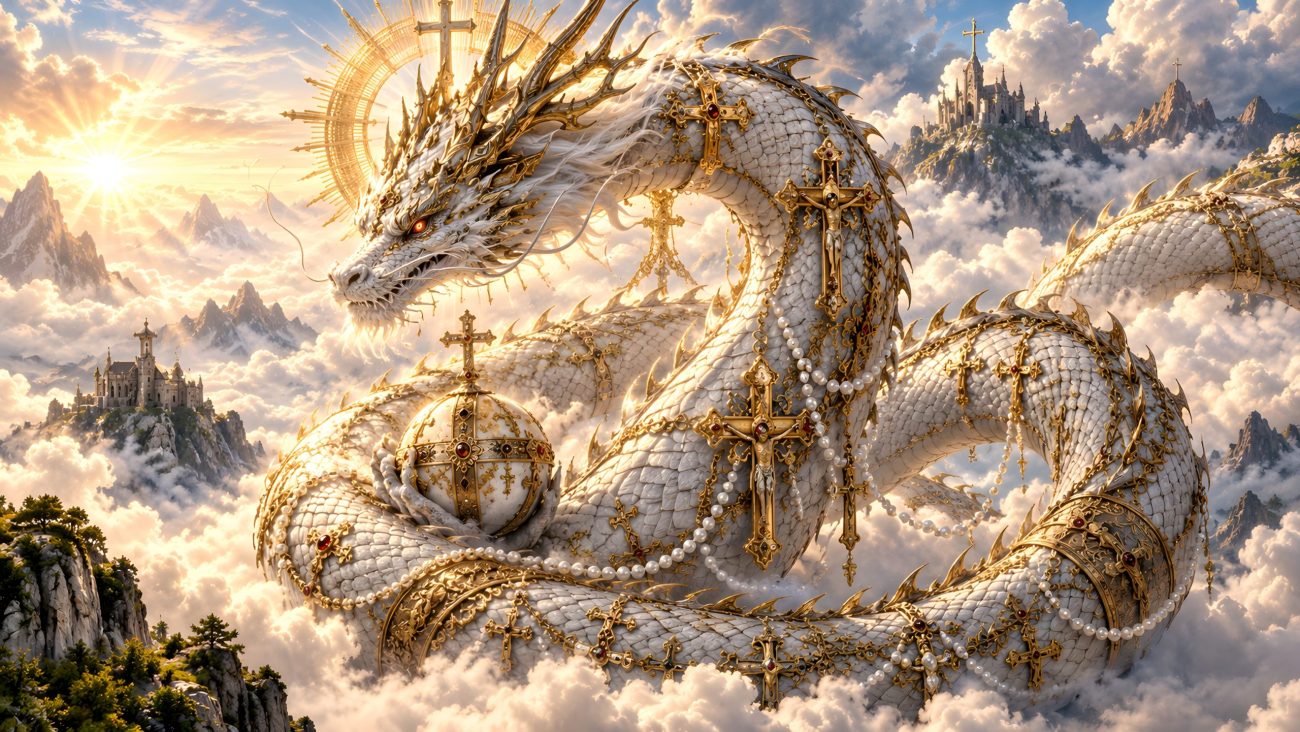
The Kirishitan Ryū are two great dragons said to have lived inside enormous holes on Ikeshima, a small island between Nagaurajima and Maeshima in the Amakusa Islands. One was male and the other female, and each eventually became the master of one of the ancient holes on the island.

Their appearance in the world was connected to the Shimabara–Amakusa Rebellion of 1637–1638. As the rebellion reached its bloody end, the forces of the shogunate surrounded Hara Castle, where the Christian rebels had taken refuge. After fighting desperately with whatever weapons they could find, the rebels eventually ran out of ammunition and food. Their last hope was simply to kill as many of their enemies as possible before they themselves were destroyed.

Their sixteen-year-old commander, Amakusa Shirō, was said to possess miraculous powers. He could supposedly walk across the sea from Shimabara to Yushima and perform other supernatural feats, including breathing flames from his mouth.

Late on the night of February 27, after the main keep of Hara Castle had burned, Shirō remained inside one of the inner houses. He took out a dragon jewel and raised it toward heaven, praying, “Ah, God, bestow your blessing upon us.” He then threw the jewel toward the shogunate’s warships anchored offshore.

Suddenly the sky darkened. Black clouds descended over the sea, and from them appeared two enormous dragons. A tremendous storm erupted. Two pillars of water rose from the sea all the way into the black clouds, and the warships were caught up in a gigantic waterspout. The ships were hurled into the air, overturned, and sank beneath the waves.

But the miracle could not save the rebels. At the same time, the house where Shirō had been hiding caught fire, its flames illuminating the sky.

By noon the following day, the shogunate army had finally annihilated the remaining rebels. The two dragons, riding within the black clouds, had witnessed the fall of Hara Castle. They then plunged into the sea and swam rapidly eastward. They too were grievously wounded, and their blood turned the seawater red.

Eventually the dragons reached Ikeshima. They crawled up onto the island and searched among its hills until they discovered two enormous holes that had existed there since ancient times. Each dragon entered one of the holes and disappeared from sight. From then on, the two became the guardians of the caves: the one entered by the male dragon became known as the Male Dragon Hole, while the other became the Female Dragon Hole.

Amakusa Shirō was said to have died at Hara Castle, but another tradition preserves a darker mystery: the two dragons themselves were said to be manifestations of Shirō.

After the dragons made their homes on Ikeshima, they became guardians of the island and providers of rain. Whenever drought struck Amakusa, people gathered at Ikeshima to pray for rain. Black clouds would then descend from the heavens, and rain was said to follow.


Sources

Takahashi, Toshihiro. “キリシタン竜 [きりしたんりゅう] (Kirishitan Ryū).” 新版TYZ 妖怪図鑑 (New TYZ Yokai Encyclopedia). December 22, 2014. https://tyz-yokai.blog.jp/archives/1016421998.html


Kafkhyŭndar

Tradition: Ossetian mythology, Russian Mythology
Alternative Names: Kafkhyŭndar, Kæfkhyŭndar
Category: Dragon


The Myth

Kafkhyŭndar is a terrifying seven-headed dragon that controls the water supply of the land. It cuts off water from people, animals, and plants until beautiful maidens are offered to it as tribute. Its name in modern Ossetian literally means “crocodile.”

In the tales of Ossetian mythology, the monster is eventually confronted by a brave young man who manages to cut off seven of its heads. Yet another tradition gives the creature a more unusual fate. A beautiful young woman realizes that Kafkhyŭndar can only be destroyed through a voluntary sacrifice, and she throws herself directly into the monster’s mouth.

By sacrificing herself willingly, the girl destroys the dragon and saves the people from its control over the water supply.


Sources

“Kafkhuyndar.” New Bestiary (Bestiary.us). Accessed September 26, 2026. https://www.bestiary.us/kafkhuyndar


Krepel

Tradition: Polish Mythology
Alternative Names: Bytom Dragon, Smok Bytomski, Bytōmski Smok
Category: Dragon


The Myth

Krepel was a dragon said to live in the forests surrounding the early settlement of Bytom in Upper Silesia. Unlike many Polish dragons, he was not a cruel beast that preyed upon the local people, but a remarkably well-mannered creature who guarded a great treasure.

In the days when Bytom was still a small settlement on St. Margaret’s Hill, surrounded by dense and seemingly impenetrable forests, stories spread among the elders of a dragon protecting hidden riches. A young farmhand, tempted by the promise of treasure, decided to venture into the wilderness and claim it for himself.

As he approached the dragon’s territory, he passed through scorched fields and forests littered with fallen trees. The remains of knights’ armor lay scattered about, convincing him that he had finally reached the lair of the beast. He soon discovered a grotto and gripped his club, preparing himself for a battle.

But before he could enter, a voice came from inside the grotto. The dragon asked why the young man wished to begin such an unequal fight when Krepel had done him no harm. Instead of attacking him, the dragon invited him into his home and even offered him some of its treasure. There was only one problem: the grotto was too small, so the dragon asked the farmhand to go to its second residence while it went ahead to put the kettle on.

The farmhand accepted the strange invitation rather than fighting. He followed Krepel to the dragon’s other residence, where the two spent time together peacefully. Krepel kept his promise and gave the young man some of his treasure.

With his newfound wealth, the farmhand later bought a tenement in Bytom and placed an image of Krepel there in honor of the dragon who had become his friend.


Sources

“Krepel (mythology).” Wikipedia: The Free Encyclopedia. Wikimedia Foundation. Accessed September 26, 2026. https://en.wikipedia.org/wiki/Krepel_(mythology)


Kasuga Ryūjin

Tradition: Japanese mythology
Alternative Names: Kasuga Ryūjin, Kasuga Dragon God, Ryūjin
Category:Dragon


The Myth

Kasuga Ryūjin appears as a magnificent dragon god associated with Kasuga Grand Shrine and the divine manifestations of the Kasuga deities. In the Noh play Kasuga Ryūjin, the Dragon God ultimately appears with the Eight Great Dragon Kings, accompanied by dragon women and countless supernatural beings. He is portrayed with a red wig, black beard mask, and a dragon-shaped crown.

The story begins with Myōe Hōshi, a Kegon Buddhist monk who had built a hermitage at Toganoo in Yamashiro Province. Myōe had long wished to travel to Tang China and then continue to India to visit the sacred places where Śākyamuni Buddha had lived and preached. Before beginning his journey, he went to Kasuga Grand Shrine to say farewell.

At the shrine, Myōe met an old man who served as its caretaker. The old man warned him not to leave Japan. He told Myōe that the deity of Kasuga cherished him like a son and that journeying to China and India would go against the deity’s wishes. Myōe replied that his purpose was to visit the places where the Buddha had taught, and therefore his journey could not truly be contrary to the divine will.

The old man continued to persuade him. There was no need, he said, to travel all the way to India when Japan itself contained sacred mountains that could serve as their equivalents. Mount Kasuga could be compared to Mount Tiantai, while Mount Jinpō could be compared to Mount Wutai. Myōe gradually began to understand the encounter as a divine oracle and abandoned his plan to travel abroad.

The old man then revealed the divine promise behind his words. If Myōe remained in Japan, he would show him the sacred scenes he wished to see by projecting the land of India onto Mount Mikasa. He would witness everything from the birth of Śākyamuni Buddha to his enlightenment, his preaching on Vulture Peak, and his death beneath the twin sal trees.

The old man introduced himself as Tokifū Hideyuki and suddenly vanished.

Then the mountains were flooded with light. The fields and peaks of Kasuga became a golden world, while grasses and trees transformed into the forms of Buddhas. The earth trembled, and the Eight Great Dragon Kings appeared: Nanda, Upananda, Sāgara, Vāsuki, Takṣaka, Anavatapta, together with the other great dragon kings. They were surrounded by hundreds of thousands of followers.

Other supernatural beings appeared as well, including the Kinnara King, Gandharva King, and Ashura King, each accompanied by countless followers. Dragon women danced among the waves of the ocean while the Eight Great Dragon Kings rose above the clouds of Mount Mikasa.

The Dragon Kings called upon the guardians of the flying fires and caused the entire life of Śākyamuni Buddha to appear in the heavens before Myōe: his birth, enlightenment, preaching, and finally his death beneath the twin sal trees.

The Dragon King then asked Myōe whether he still intended to travel to Tang China and onward to India. Myōe replied that he no longer wished to make the journey. The Dragon King told him that however far he might travel or whatever wonders he might seek, he would find no greater spectacle than the one before him.

The Dragon Woman then flew southward. The Dragon Gods stirred the waters of Sarusawa Pond into enormous waves and transformed themselves into a gigantic serpent a thousand fathoms long. Its immense body stretched across the heavens and the earth before the divine apparition finally vanished.

The older tale preserved in the Kokin Chomonshū tells the same basic story of Myōe abandoning his journey after receiving a divine oracle from Kasuga Myōjin. There, however, the miraculous signs take a different form: sixty deer bow before Myōe, while Kasuga Myōjin possesses Myōe’s aunt to communicate the divine will. The Tokifū Hideyuki figure, the Dragon Gods, and the heavenly recreation of Buddha’s life belong specifically to the later Noh version.


Sources

Takahashi, Toshihiro. “春日龍神 [かすがりゅうじん] (Kasuga Ryūjin).” 新版TYZ 妖怪図鑑 (New TYZ Yokai Encyclopedia). October 21, 2024. https://tyz-yokai.blog.jp/archives/1083036726.html

Jaculus

Tradition: Greek Mythology, Roman Mythology, Italian Mythology
Alternative Names: Jaculus, Iaculus, Javelin Snake
Category: Dragon


The Myth

The Jaculus is a small mythical serpent or dragon, sometimes depicted with wings and occasionally with front legs. It was a creature that attacked from above, hiding among the branches of trees before launching itself at unsuspecting victims like a living javelin.

Its name comes from the Latin word for “thrown,” reflecting the extraordinary force with which the serpent hurled itself through the air. Rather than relying upon venom, the Jaculus killed through the sheer impact of its body. When it struck a victim, the force of the collision caused a fatal wound.

The creature was feared precisely because its attack could come without warning. Hidden high in the branches, it would suddenly spring from its perch and fly through the air toward its target. Pliny described the serpent as being dangerous not merely to a person’s feet, but as something that could actually fly through the air as though launched from a weapon.

Lucan likewise described the Jaculus as a deadly attacker, emphasizing that it was the wound inflicted when the creature struck that caused death, rather than poison.

The same strange idea of a serpent used as a living projectile appears in Malagasy folklore in the tale of the fandrefiala. This small snake was said to carefully calculate its trajectory before hurling itself at a victim with such force that the impact could break a metal pot, killing both the snake and its target.

The Jaculus also appears in the Old Norse Yngvars saga viðfǫrla, where the creature is described not as a tiny serpent but as an enormous dragon. Medieval European tradition likewise preserved the creature as the “javelin-snake,” a serpent that launches itself from trees, as recorded in the Aberdeen Bestiary.


Sources

“Jaculus.” Wikipedia: The Free Encyclopedia. Wikimedia Foundation. Accessed September 26, 2026. https://en.wikipedia.org/wiki/Jaculus


Guivre

Tradition: French Mythology
Alternative Names: Guivre, Givre, Vouivre
Category: Dragon


The Myth

The Guivre is a long, serpentine dragon with a dragon’s head and, in some descriptions, horns upon its forehead. Its hind legs are barely visible or may be absent altogether, giving the creature the appearance of an enormous serpent. Guivres were said to possess venomous breath and were notoriously aggressive, sometimes attacking people without provocation. They dwelled in pools and lakes, forests, and other damp places throughout the French countryside.

Yet the Guivre had a strange weakness: it was said to fear naked human beings. When confronted with one, the fierce creature would blush and turn its head away.

One of the most unusual tales surrounding the creature concerns Samson of Dol and Saint Suliao. Samson had come to visit Suliao with a group of followers. Suliao was poor and could offer his guests little food, but he did what he could to provide them with a meal.

One of the priests accompanying Samson was dissatisfied with the humble food. He secretly took a bread roll and hid it beneath his robe. Almost immediately, the man began to convulse. Suliao pulled open his robe to discover the terrible cause: a hideous little serpentine creature, the Guivre, had somehow emerged in connection with the stolen bread.

Suliao rebuked the priest and seized the creature. He exorcised it and then ordered another man to carry it to the roof of a building in Garot and throw it down, casting the monstrous serpent away.

The Guivre is also closely associated with the name Vouivre, and the two names can describe the same creature. In other French traditions, however, the Vouivre takes on a more distinctive form. In the tales of Franche-Comté, it is described as an enormous serpentine dragon carrying a ruby upon its forehead, the precious stone serving as its eye.

Other traditions give the Vouivre a female form, with dazzling green scales that produce a sound as she flies. She is depicted as greedy and associated with precious treasures, wearing pearls upon her head and a golden ring around her tail. She spends most of her time hidden inside a cave, emerging only briefly to bathe.


Sources

“Guivre.” Wikipedia: The Free Encyclopedia. Wikimedia Foundation. Accessed September 26, 2026. https://en.wikipedia.org/wiki/Guivre