Tradition: Japanese mythology
Alternative Names: Kasuga Ryūjin, Kasuga Dragon God, Ryūjin
Category:Dragon
The Myth
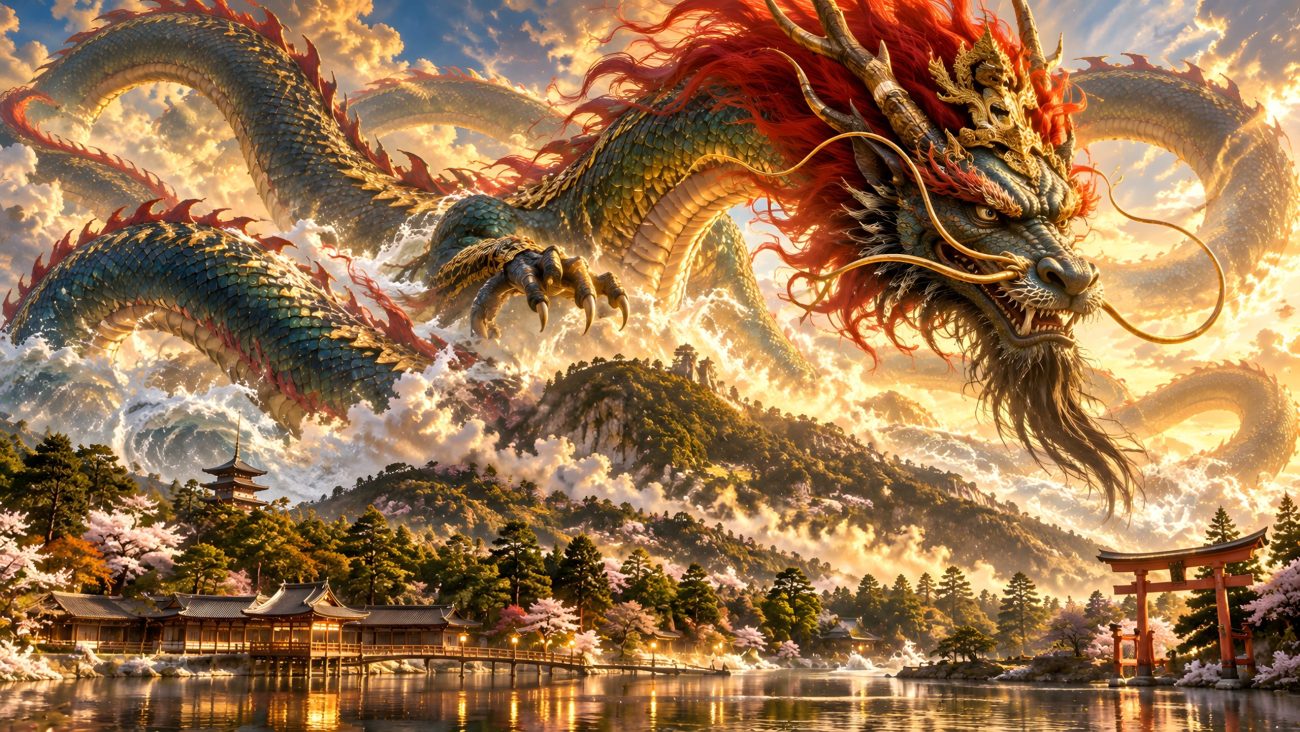
Kasuga Ryūjin appears as a magnificent dragon god associated with Kasuga Grand Shrine and the divine manifestations of the Kasuga deities. In the Noh play Kasuga Ryūjin, the Dragon God ultimately appears with the Eight Great Dragon Kings, accompanied by dragon women and countless supernatural beings. He is portrayed with a red wig, black beard mask, and a dragon-shaped crown.
The story begins with Myōe Hōshi, a Kegon Buddhist monk who had built a hermitage at Toganoo in Yamashiro Province. Myōe had long wished to travel to Tang China and then continue to India to visit the sacred places where Śākyamuni Buddha had lived and preached. Before beginning his journey, he went to Kasuga Grand Shrine to say farewell.
At the shrine, Myōe met an old man who served as its caretaker. The old man warned him not to leave Japan. He told Myōe that the deity of Kasuga cherished him like a son and that journeying to China and India would go against the deity’s wishes. Myōe replied that his purpose was to visit the places where the Buddha had taught, and therefore his journey could not truly be contrary to the divine will.
The old man continued to persuade him. There was no need, he said, to travel all the way to India when Japan itself contained sacred mountains that could serve as their equivalents. Mount Kasuga could be compared to Mount Tiantai, while Mount Jinpō could be compared to Mount Wutai. Myōe gradually began to understand the encounter as a divine oracle and abandoned his plan to travel abroad.
The old man then revealed the divine promise behind his words. If Myōe remained in Japan, he would show him the sacred scenes he wished to see by projecting the land of India onto Mount Mikasa. He would witness everything from the birth of Śākyamuni Buddha to his enlightenment, his preaching on Vulture Peak, and his death beneath the twin sal trees.
The old man introduced himself as Tokifū Hideyuki and suddenly vanished.
Then the mountains were flooded with light. The fields and peaks of Kasuga became a golden world, while grasses and trees transformed into the forms of Buddhas. The earth trembled, and the Eight Great Dragon Kings appeared: Nanda, Upananda, Sāgara, Vāsuki, Takṣaka, Anavatapta, together with the other great dragon kings. They were surrounded by hundreds of thousands of followers.
Other supernatural beings appeared as well, including the Kinnara King, Gandharva King, and Ashura King, each accompanied by countless followers. Dragon women danced among the waves of the ocean while the Eight Great Dragon Kings rose above the clouds of Mount Mikasa.
The Dragon Kings called upon the guardians of the flying fires and caused the entire life of Śākyamuni Buddha to appear in the heavens before Myōe: his birth, enlightenment, preaching, and finally his death beneath the twin sal trees.
The Dragon King then asked Myōe whether he still intended to travel to Tang China and onward to India. Myōe replied that he no longer wished to make the journey. The Dragon King told him that however far he might travel or whatever wonders he might seek, he would find no greater spectacle than the one before him.
The Dragon Woman then flew southward. The Dragon Gods stirred the waters of Sarusawa Pond into enormous waves and transformed themselves into a gigantic serpent a thousand fathoms long. Its immense body stretched across the heavens and the earth before the divine apparition finally vanished.
The older tale preserved in the Kokin Chomonshū tells the same basic story of Myōe abandoning his journey after receiving a divine oracle from Kasuga Myōjin. There, however, the miraculous signs take a different form: sixty deer bow before Myōe, while Kasuga Myōjin possesses Myōe’s aunt to communicate the divine will. The Tokifū Hideyuki figure, the Dragon Gods, and the heavenly recreation of Buddha’s life belong specifically to the later Noh version.
Sources
Takahashi, Toshihiro. “春日龍神 [かすがりゅうじん] (Kasuga Ryūjin).” 新版TYZ 妖怪図鑑 (New TYZ Yokai Encyclopedia). October 21, 2024. https://tyz-yokai.blog.jp/archives/1083036726.html