Toralindo

Tradition: Indonesian Mythology
Alternative names: Toralindo
Category: Cow


The Myth

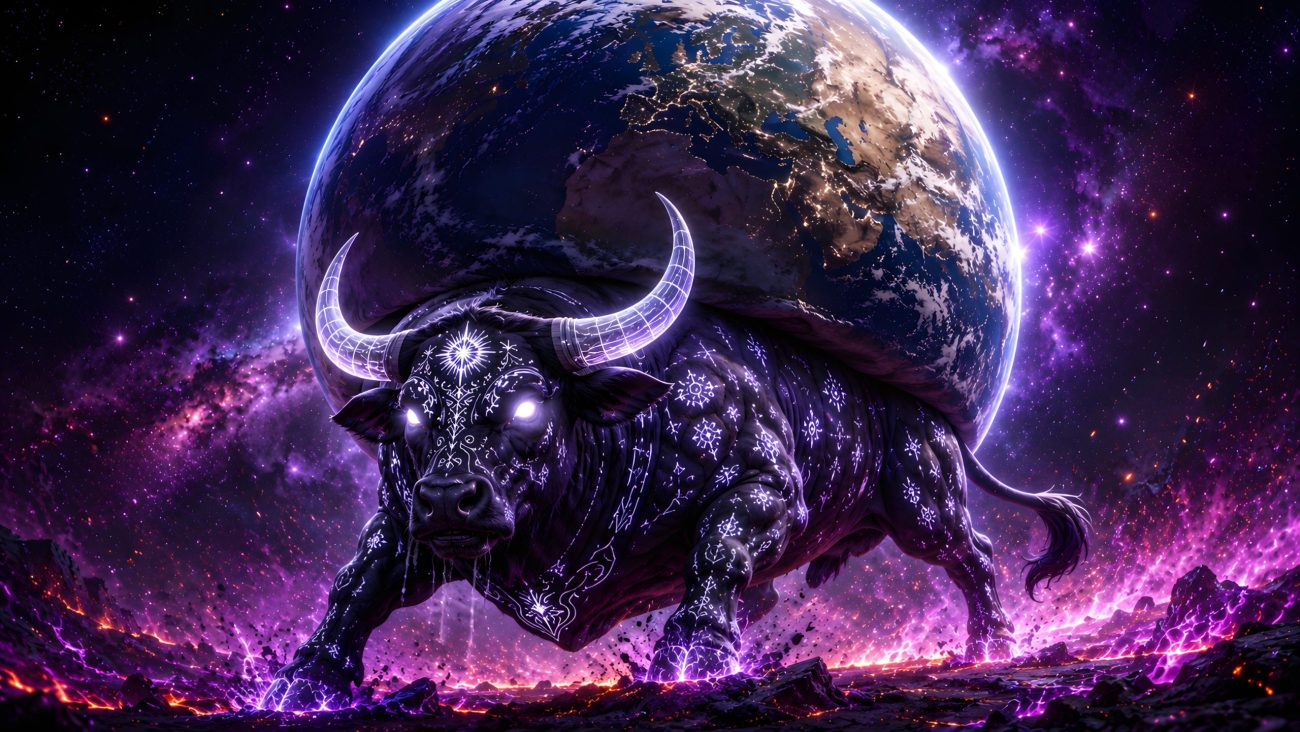
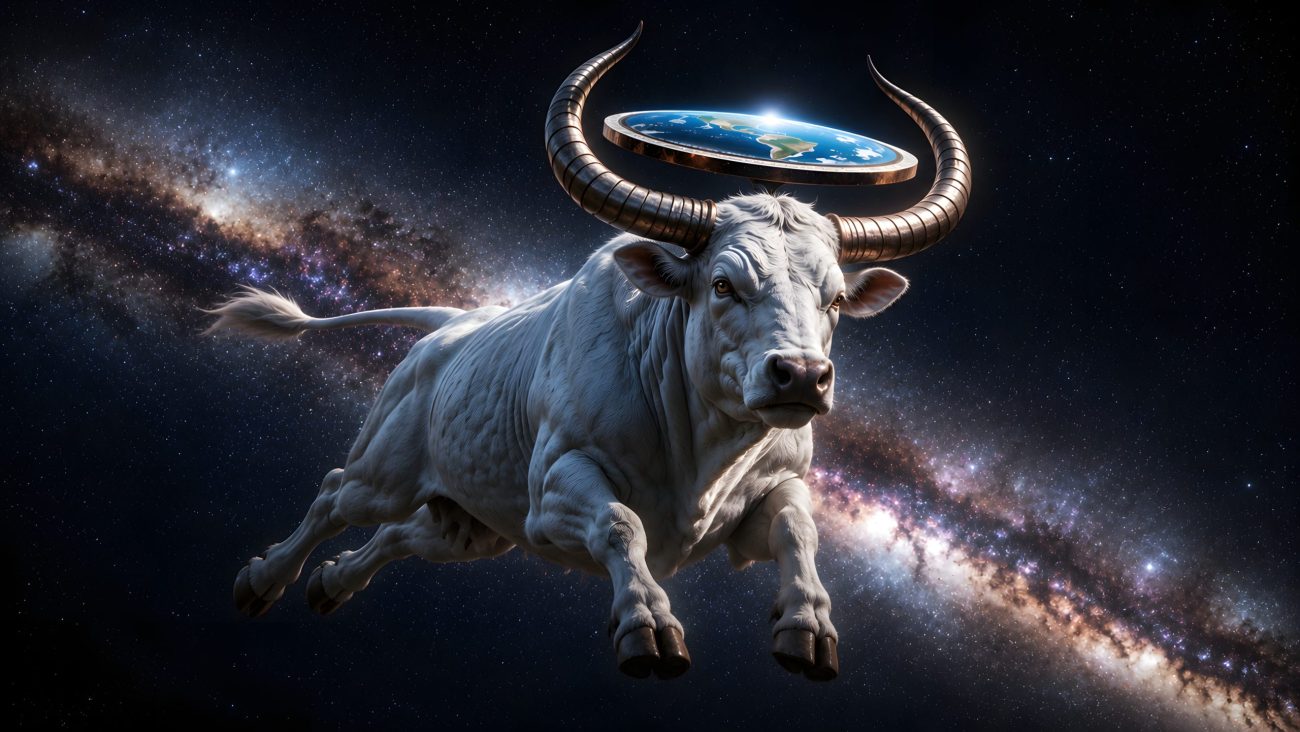
Toralindo is a gigantic buffalo from the mythology of the Torajan people of Sulawesi. It is believed to support the Earth upon its horns, and its movements are associated with earthquakes.

Toralindo is an enormous buffalo capable of carrying the Earth on its horns. Its movements can cause the ground to shake, and its reactions to sounds or animals can influence the stability of the Earth.

According to Torajan tradition, the Earth is flat and is supported by the giant buffalo Toralindo. When Toralindo is bitten by a fly, it shakes its head to drive the insect away, causing an earthquake.

Different villages have different ways of trying to stop Toralindo from shaking its head. Some people begin to meow loudly, because buffaloes are believed to be afraid of cats. When Toralindo hears the meowing, it forgets about the fly and stops shaking its head.

Other people imitate a pig being struck with a stick, believing that the resulting squealing will distract Toralindo and prevent it from continuing to shake its head.


Sources

“Toralindo.” New Bestiary (Bestiary.us). Accessed August 30, 2026. https://www.bestiary.us/toralindo


Tonzo

Tradition: Japanese mythology
Alternative names:
Category: Cow


The Myth

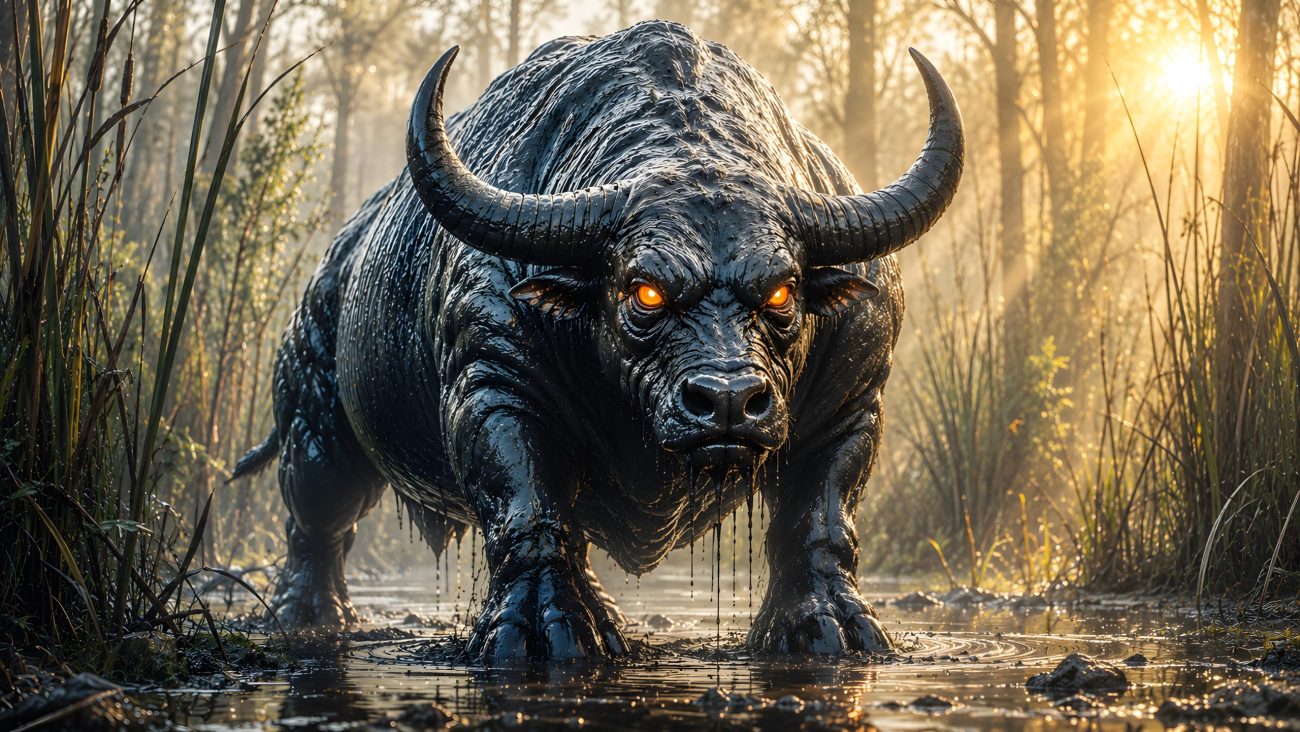
Tonzo is a mysterious yokai from Iwaizumi in Iwate Prefecture. It is described as a pitch-black, bull-like flying monster with enough supernatural strength to shake the ground and destroy trees.

One evening, an experienced hunter named Sahei-dono went hunting in Miyanosawa. For some reason, no deer appeared that night. As dawn approached, he was preparing to leave when a pitch-black creature resembling a bull suddenly jumped out before him.

The creature spoke in a human voice and declared that it was Tonzo, challenging Sahei to strike it and threatening to crush him if he did. Sahei had his hand on the knife at his waist, but he was so frightened that he fled.

Some time later, Sahei went to Yokonaga-mine. Near a chestnut tree, Tonzo appeared again. The ground trembled as the creature leaped onto the tree. It shook the tree violently and snapped its branches.

Tonzo then reminded Sahei of their previous encounter and threatened to seize and kill him if he returned. Terrified, Sahei begged for forgiveness and fled.

About ten days later, Sahei fell ill and died.

The true nature of Tonzo is unknown. The only description preserved in the tradition is that it was a flying monster resembling a bull.


Sources

Takahashi, Toshihiro. “トンゾウ (Tonzo).” 新版TYZ 妖怪図鑑 (New TYZ Yokai Encyclopedia). December 3, 2011. https://tyz-yokai.blog.jp/archives/1010654094.html


Tilla And Šerišu

Tradition: Hurrian mythology, Syrian Mythology
Alternative names: Tilla, Šerišu; dtil-la, gudti-el-la
Category: Cow, Deity


The Myth

Tilla was a Hurrian god who was associated with the form of a bull. He is best known from texts discovered at Nuzi and was worshipped particularly in the kingdom of Arrapha in northern Mesopotamia. His principal cult center was Ulamme, where he appears to have been the chief deity.

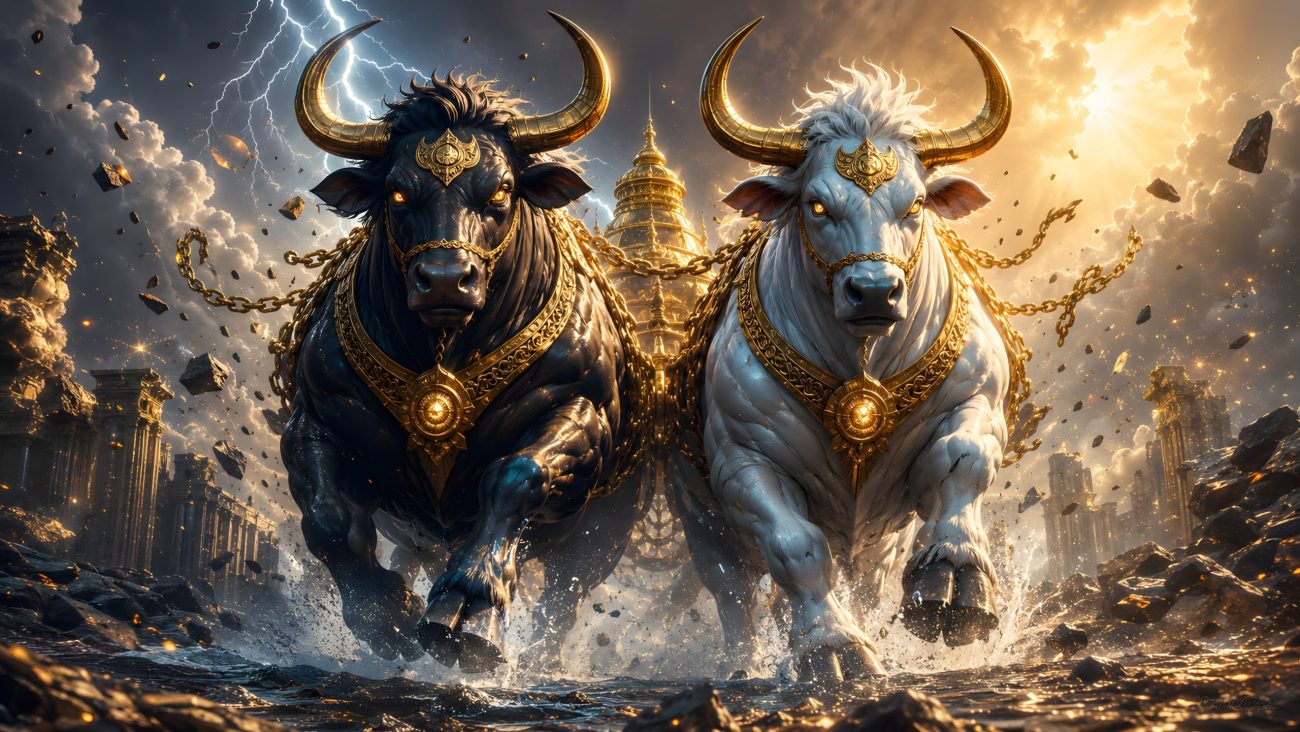
The clearest description of Tilla as a bull occurs in the Song of Ullikummi, part of the mythological cycle surrounding the god Kumarbi. Tilla was one of two divine bulls who pulled the chariot of Teshub, the Hurrian weather god. The other was Šerišu. Before Teshub went into battle against Ullikummi, a gigantic stone being, Teshub ordered that Tilla’s tail be covered with gold.

Tilla and Šerišu were therefore not ordinary cattle, but powerful divine bulls belonging to the entourage of Teshub. Their presence reflects the important connection between bulls and weather gods found throughout the ancient Near East, although the precise origins of this association remain uncertain.

Tilla’s relationship with Teshub may, however, have developed over time. Texts from Nuzi sometimes treat Tilla as an independent deity rather than simply as Teshub’s divine draft animal. Other sources also pair Šerišu with a different bull deity, Hurriš. Scholars have consequently suggested that Tilla, Šerišu, Hurriš and Šarruma belonged to a broader group of bull deities connected with Teshub.

Tilla was widely worshipped in Arrapha and was particularly prominent at Nuzi. He appears frequently in Hurrian theophoric names, including names expressing ideas such as “Tilla helps,” “Tilla frees,” and “Tilla is reliable.” An entu priestess associated with his cult is also attested.

The surviving evidence therefore presents Tilla as a powerful divine bull whose importance extended beyond his role as one of Teshub’s chariot animals. His cult, personal names and association with the weather-god tradition show that the bull could represent an important manifestation of divine power in Hurrian religion.


Sources

Vonbun, Franz Josef. “Die schwarze Kuh.” In Die Sagen Vorarlbergs. Mit Beiträgen aus Liechtenstein, no. 183, p. 141. Reproduced by SAGEN.at. Accessed August 29, 2026. https://www.sagen.at/texte/sagen/oesterreich/vorarlberg/montavon/schwarzekuh.html


Tarbh Uirge

Tradition: Scottish Mythology
Alternative names: Tarbh Uirge
Category: Cow


The Myth

The Tarbh Uirge was a supernatural creature associated with small, lonely moorland lochs. Unlike the Water-horse, it was considered harmless and did not harm people who approached its haunts.

The creature normally remained in the lochs and emerged only at night. It could sometimes be heard lowing near the water before wandering among farmers’ cattle, although it was rarely seen.

Its presence was believed to explain a particular kind of unusual calf. Calves with abnormally short ears, as though the upper part had been cut away with a knife, were said to be the offspring of the Tarbh Uirge. Since the Tarbh Uirge itself was believed to have no ears, its calves supposedly inherited only half-sized ears. In Gaelic these calves were called Carc-chluasach, meaning “knife-eared.”

One account from the district of Lorn tells of a dairymaid and a herdsman who were preparing to leave a cattle fold in the evening. They suddenly saw a small, ugly, extremely black animal moving among the cattle. It had the shape of a bull, but its body was described as soft and slippery and its bellow was unnatural, sounding somewhat like the crowing of a cock.

Terrified, the two fled from the fold. When they returned the following morning, however, they found the cattle lying peacefully inside as though nothing unusual had happened.

The Tarbh Uirge was therefore a strange but essentially harmless creature of the Scottish lochs, associated particularly with nighttime appearances, unusual cattle, and an eerie supernatural bellow.


Sources

Campbell, John Gregorson. Superstitions of the Highlands & Islands of Scotland: Collected Entirely from Oral Sources. Glasgow: James MacLehose and Sons, 1900.


Schwarze Kuh

Tradition: Austrian Mythology
Alternative names: The Black Cow
Category: Cow


The Myth

One evening, a shepherd from Montavon arrived late at the Latonz Alp to retrieve a black cow that had been left behind when the herd descended from the mountain. He put the cow in the stable and spent the night sleeping on a bunk in the alpine hut.

Around midnight, the alpine spirits, known as Bütze, entered the hut. They began cooking, boiling, and roasting in the room with an incredible din. The shepherd awoke and stared at them in confusion.

Suddenly, one of the spirits called to him to come down from his bunk. He was forced to leave his sleeping place and join them.

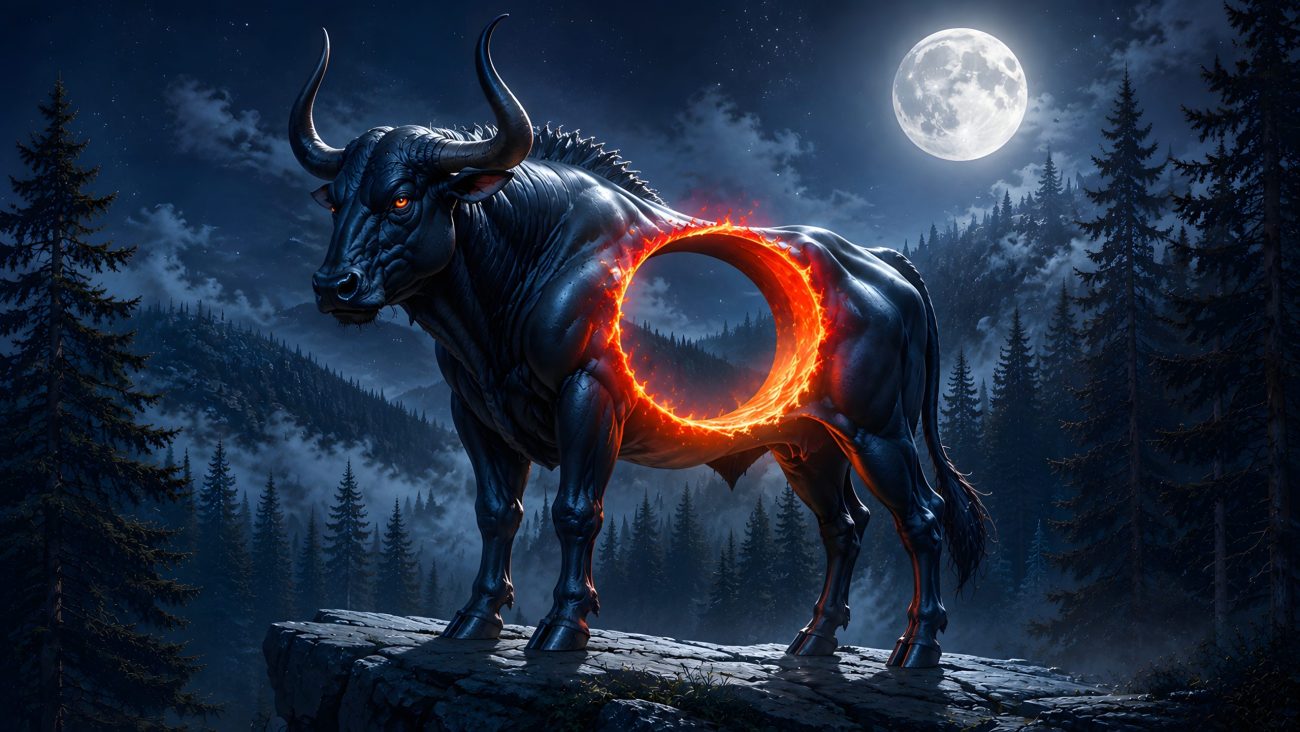
Then he noticed something horrifying. His black cow, standing outside in the stable, appeared to have an enormous hole in its body. The shepherd thought that the spirits had cut the flesh out of his cow and feared that they would have eaten the entire animal before dawn.

After their meal, the Bütze began playing music and dancing so violently that the alpine hut seemed almost to come apart. At the first light of dawn, the strange visitors departed.

The shepherd watched them leave and noticed a hide stretched across the doorway of the alpine hut. He believed that it was the hide of his black cow.

But when daylight had fully arrived, the hide had mysteriously disappeared. Outside, the black cow stood in the stable completely unharmed.

The terrifying events of the night had apparently been an illusion—or something supernatural that had left no lasting mark on the cow.


Sources

Vonbun, Franz Josef. “Die schwarze Kuh.” In Die Sagen Vorarlbergs. Mit Beiträgen aus Liechtenstein, no. 183, p. 141. Reproduced by SAGEN.at. Accessed August 29, 2026. https://www.sagen.at/texte/sagen/oesterreich/vorarlberg/montavon/schwarzekuh.html


Svetna Krava

Tradition: Slovenian Mythology
Alternative names: Svetna Krava, World-Supporting Bull
Category: Cow


The Myth

In Slovenian folk tradition, there is a saying that the world stands upon a bull. The belief was recorded in the nineteenth century by Davorin Trstenjak and published in Slovenski Glasnik in 1860. The tradition was presented as a surviving fragment of an older Slavic cosmogony.

According to the belief, the entire world rests upon the bull. Whenever the bull twitches its ear, the whole world shakes.

A closely related version was recorded among the Serbs by Vuk Stefanović Karadžić in his Serbian Dictionary of 1852. In this version, some people said that the world stood upon water, while others jokingly said that the world stood upon the bull, and that when the bull moved its ear, the world shook.

The tradition therefore places the bull in a cosmic role as the foundation supporting the entire world. The source also connects this conception with broader Indo-European traditions in which animals such as bulls, horses, cows, fish, snakes, whales, and turtles function as beings supporting or participating in the creation or structure of the cosmos.

The bull’s importance is particularly significant in the discussion of Slavic tradition because cattle were economically important to many Slavic peoples. The source also notes another South Slavic motif in which supernatural opponents transform into a black bull and a red bull, representing opposing forces such as good and evil or rival communities.

The exact ancient Slavic cosmology behind the belief is uncertain, but the Slovenian and Serbian records provide evidence that the image of a bull supporting the world survived in South Slavic folk tradition.


Sources

Kropej, Monika. Supernatural Beings from Slovenian Myth and Folktales. Ljubljana: Scientific Research Centre of the Slovenian Academy of Sciences and Arts, 2012.


Stiertratte

Tradition: Austrian Mythology
Alternative names:
Category: Cow


The Myth

In the Glödnitz Valley, near the place known as the “Bauer im Ort,” there is a location called the Stiertratte.

According to the legend, a group of arrogant miners once committed a cruel act against a living bull. They skinned the animal alive and drove it to Weitensfeld for people to see. They then spread the bull’s hide out at the location of the Stiertratte and played dice upon it.

As an eternal disgrace and punishment for their arrogance and cruelty, not a single blade of grass has grown at the place ever since.

The story therefore explains the existence of the barren patch of land known as the Stiertratte as a supernatural punishment for the miners’ mistreatment of the bull.


Sources

Rappold, J. “Die Stiertratte.” In Sagen aus Kärnten. Augsburg and Leipzig, 1887, no. 17, p. 23. Reproduced by SAGEN.at. Accessed August 29, 2026. https://www.sagen.at/texte/sagen/oesterreich/kaernten/allgemein/stiertratte.html


Sarangay

Tradition: Philippine mythology
Alternative names: Sarangay
Category: Cow


The Myth

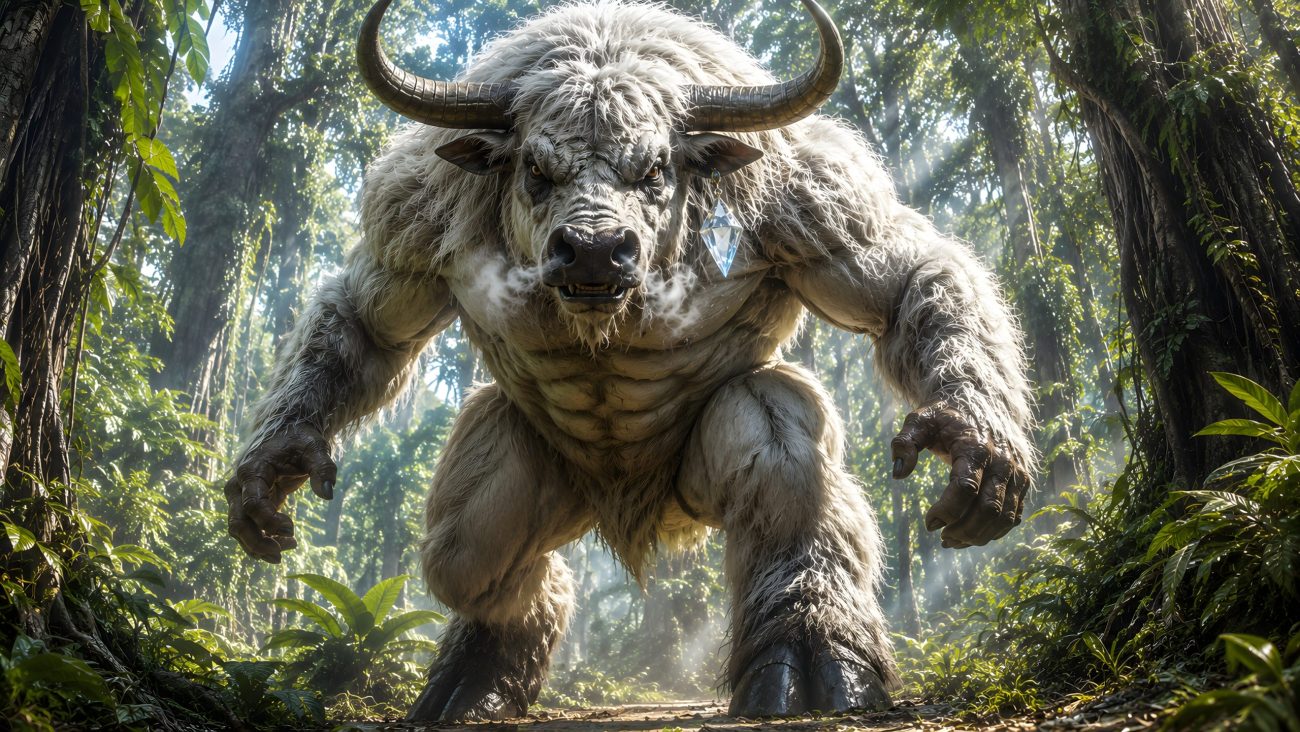
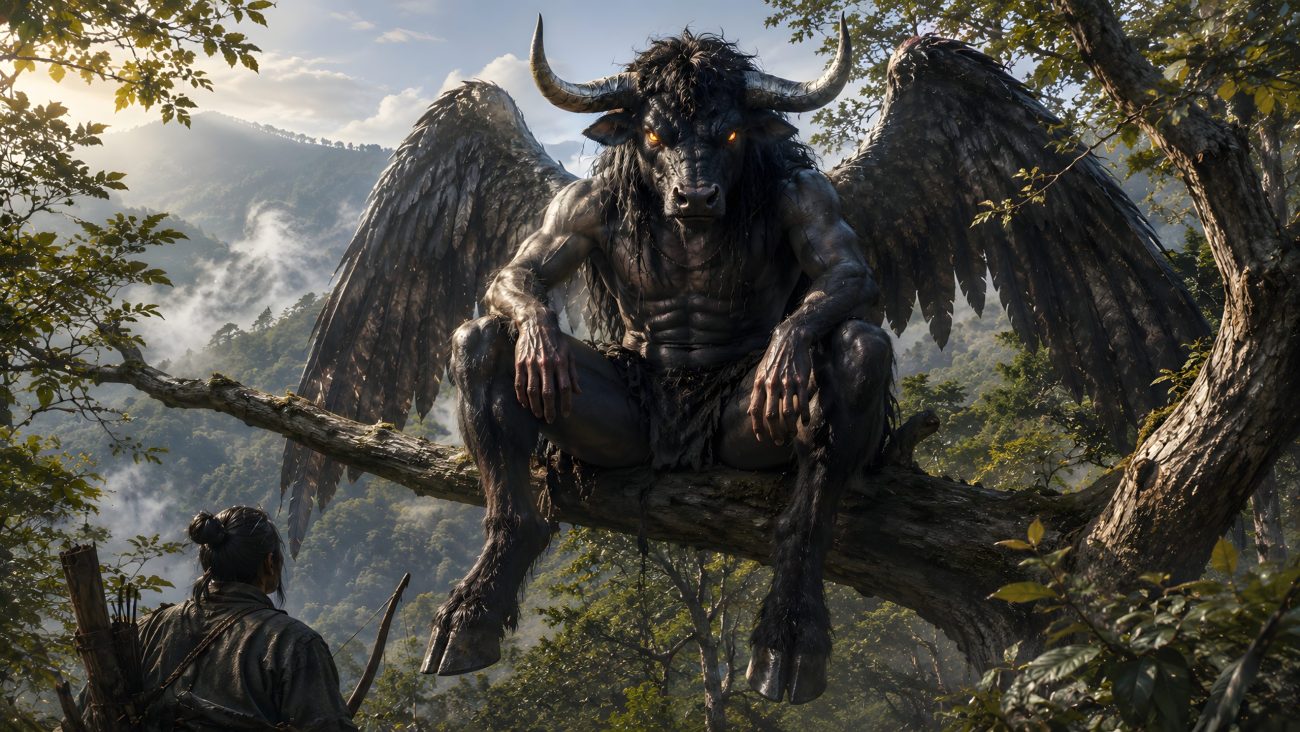
The Sarangay is a creature from Philippine mythology described as a powerful hybrid resembling a minotaur. It has the body of a man combined with that of a male water buffalo.

The creature is said to possess a precious gemstone attached to its ears. The Sarangay guards these jewels fiercely, and anyone who attempts to steal them is said to be killed mercilessly.

When a Sarangay becomes enraged, smoke is said to pour from its nostrils, emphasizing its dangerous and supernatural nature.

When Spanish observers encountered accounts of the creature in the seventeenth century, they reportedly interpreted the description as resembling the Greek Minotaur.


Sources

“Sarangay.” Wikipedia: The Free Encyclopedia. Wikimedia Foundation. Accessed August 29, 2026. https://en.wikipedia.org/wiki/Sarangay


Roaring Bull o’ Bagbury

Tradition: English Mythology
Alternative names: The Roaring Bull of Bagbury
Category: Ghost, Cow


The Myth

A notoriously wicked man once lived at Bagbury Farm. According to the story, he had done almost no good in his life, with only two acts of kindness remembered: giving a waistcoat to a poor old man and giving bread and cheese to a poor boy.

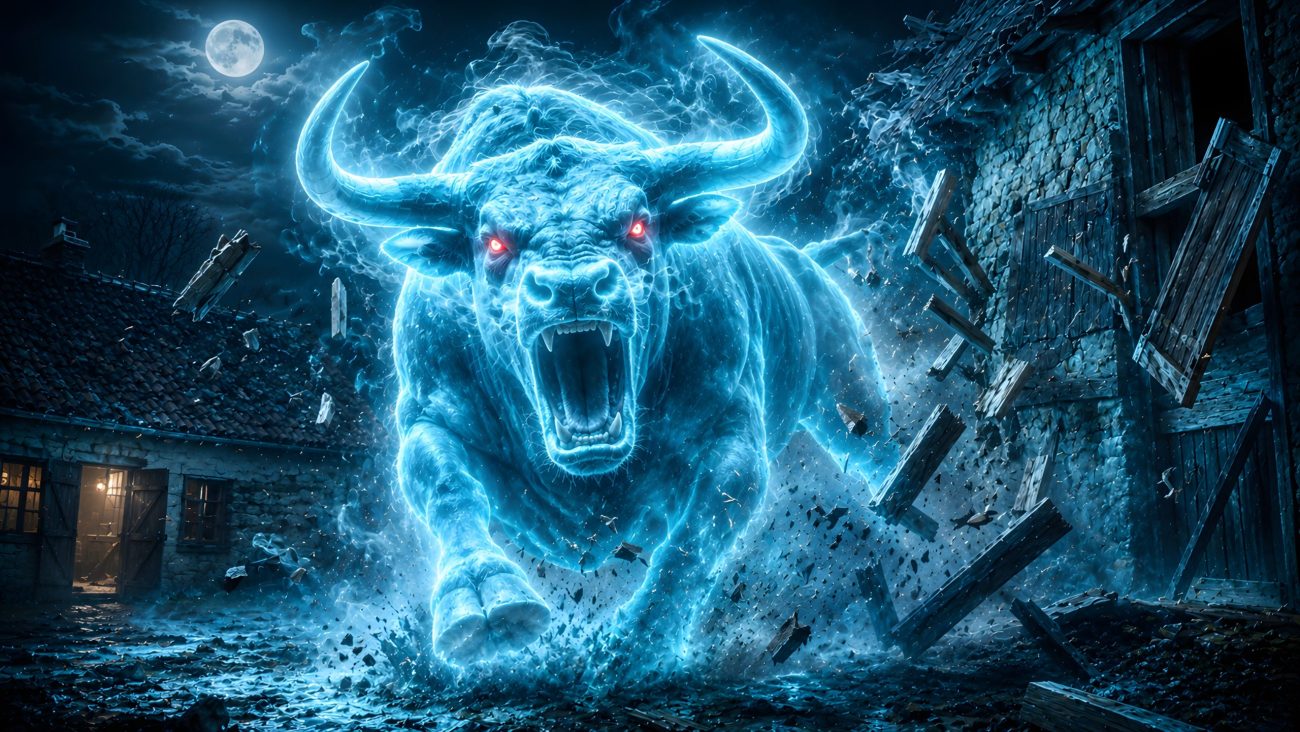
After his death, however, his ghost refused to rest. It began appearing in the buildings at Bagbury Farm in the shape of a bull, where it would roar so violently that boards, shutters, and roof tiles were thrown from the buildings. The haunting became so severe that nobody could live nearby.

The bull originally appeared around nine or ten at night, but eventually became so troublesome that it began arriving as early as seven or eight. Twelve parsons were summoned to lay the ghost. They managed to drive it, still in the form of a bull, toward Hyssington Church, but they struggled to contain it.

One of the twelve priests was an old blind parson who knew the ghost and anticipated its violent charge. He carried his candle inside his top boot. When the bull suddenly rushed at the priests, all their candles were extinguished except his. He then told the others to relight their candles from his.

Inside the church, the bull made such a tremendous burst that it cracked the church wall from top to bottom. According to the storyteller, the crack remained visible for years and was deliberately left unrepaired so that people could see where the supernatural bull had broken the church.

Eventually, the priests succeeded in forcing the bull into a snuff-box. The spirit then requested that it be buried beneath Bagbury Bridge, threatening that every mare passing over the bridge would lose her foal and every woman would lose her child. The priests refused this request and instead cast the bull into the Red Sea for a thousand years.

Even long afterward, people remained frightened of Bagbury Bridge. The storyteller recalled that the old clerk of Hyssington had personally remembered the blind parson. Decades after the bull had supposedly been confined in the Red Sea, people still crossed the bridge cautiously. One man recalled crossing it with horses and deliberately getting down from his horse, walking softly and making as little noise as possible, because he feared that the bull might hear him and emerge from beneath the bridge.


Sources

“Efft60.” Sacred Texts. Accessed August 29, 2026. https://sacred-texts.com/neu/eng/efft/efft60.htm
Riji

Tradition: Chinese mythology
Alternative names: Riji
Category: Cow


The Myth

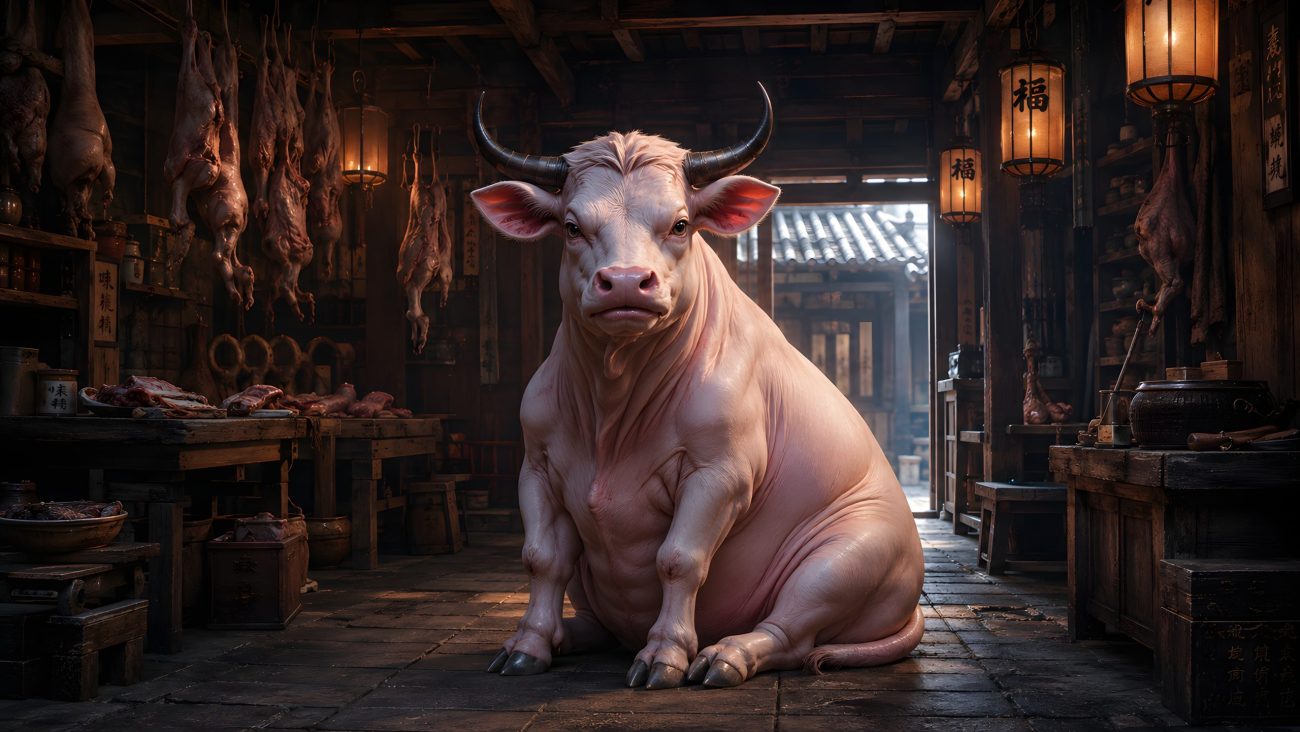
The Riji is a legendary strange ox said to have lived among the Yuezhi of the Western Regions.

The creature possesses an extraordinary ability: if one or two jin of meat are cut from its body, the wound heals by the following day, allowing the flesh to regenerate. According to the Xuanzhongji, when Han people entered the land of the Yuezhi, the inhabitants showed them the Riji as a rare delicacy.

The name Riji is also used for the hibiscus flower. This connection comes from the flower’s unusual daily cycle: it opens in the morning and closes in the evening. Because of this, it was associated with the idea of something that appears anew each day.

The surviving accounts therefore associate the Riji with extraordinary regeneration, although the sources provided here do not give a further description of its appearance beyond identifying it as an unusual ox.


Sources

“日及.” Wikipedia: The Free Encyclopedia (Chinese Wikipedia). Wikimedia Foundation. Accessed August 29, 2026. https://zh.wikipedia.org/wiki/%E6%97%A5%E5%8F%8A