Tradition: Scottish mythology
Alternative Names: Bu-Vinda
Category: Cow
The Myth
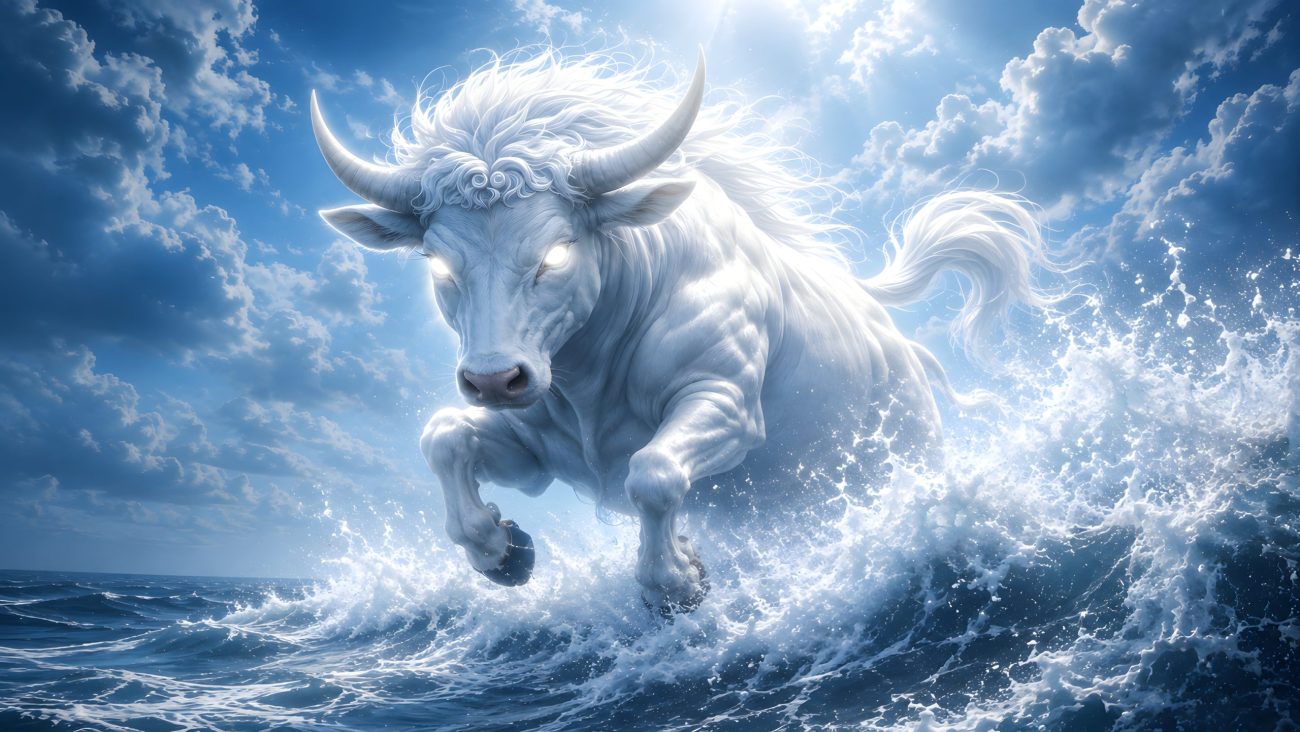
The White Cow of Lewis is a supernatural cow with pure white hair that shines in the moonlight. It can speak like a human being and possesses a miraculous supply of nourishing milk. It is later revealed to be a beautiful woman known as Bu-Vinda, who says that she has many names and is associated with Dagda and Aengus.
During a harsh winter famine on the Isle of Lewis, the harvest had failed and the islanders’ food supplies were running dangerously low. Many people had already been forced to slaughter their cows for food, leaving them without the milk and cheese they depended upon. The people gathered together what remained of their supplies and agreed to share them equally, but the elders soon realized that the food would last only about two weeks, while the growing season was still a month away.
Desperate, the elders led the people to the standing stones, where they prayed to the gods for help and offered special tribute to the father god associated with fertility and the land, whom some called Dagda. As they returned to the village that evening, a storm appeared to be approaching.
Aine, who had been forced to sacrifice her own cow during the famine, noticed something moving near the shore. One of the elders warned her to return home before the storm arrived, but she slipped away and ran toward the sea.
A sudden wind threw Aine onto her back. When she looked up again, the storm had mysteriously vanished. Standing only a few feet away from her was a magnificent white cow, its pure hair shining beneath the moonlight.
The cow spoke to her and told her that it had been sent to help the islanders in their time of need.
Aine led the strange creature back toward the village, where the astonished islanders gathered around it. The White Cow then explained that it had come to help them survive the famine. Each person could receive a pail of milk every day for as long as necessary, and because the milk was a gift from the gods, it would provide all the nourishment they required.
One of the younger elders remained suspicious and asked how they could know that the creature was truly a gift from the gods rather than something evil. The cow told them to meet it at the standing stones at first light. It would fulfill its promise there, and Aine could drink the milk herself to prove that it was genuine.
At first light, Aine stood beside the standing stones with her pail and drank the fresh milk. Her hunger immediately disappeared, and she felt stronger than she had ever felt before.
The other islanders then lined up and received their milk. Each person found that the milk completely satisfied their hunger. Day after day, the White Cow continued to provide its miraculous nourishment, allowing the islanders to survive.
On the final day, the widow who lived in the north came to receive her share. Unlike the others, she was known for keeping herself apart from the community. When she bent down to milk the cow, she placed a sieve beneath it instead of a pail.
The sieve could never become full, and therefore the cow could not fulfill its promise. It realized that the woman was deliberately tricking it and declared that she was a witch who had depleted its strength. Since the pail could not be filled, the cow could provide no more.
The White Cow then told Aine that the islanders had already received enough nourishment to survive the remaining two weeks of winter. They would not starve.
The creature ran toward the ocean and leapt into the sea, disappearing from sight.
That night, Aine saw the White Cow transform into a beautiful woman. The woman thanked her for her help and apologized for having to leave.
When Aine asked who she was, the woman replied that some called her Bu-Vinda, although she had many names. She said that some also knew her as the partner of Dagda and the mother of Aengus, but that she had been many things to many people. To the people of Lewis, she said, she would simply be remembered as the White Cow.
The islanders survived the winter. Soon the crops were growing again, animals emerged from their burrows, lambs were born, fish became plentiful, and food once again filled the islanders’ tables. The White Cow eventually became only a whisper of a legend, but the people remembered the mysterious creature that had appeared from the sea and given them the nourishment they needed to survive.
Sources
White, David. “The White Cow of Lewis.” Folklore Scotland. Accessed August 30, 2026. (folklorescotland.com)
https://folklorescotland.com/the-white-cow-of-lewis/