Tradition: Hurrian mythology, Syrian Mythology
Alternative names: Tilla, Šerišu; dtil-la, gudti-el-la
Category: Cow, Deity
The Myth
Tilla was a Hurrian god who was associated with the form of a bull. He is best known from texts discovered at Nuzi and was worshipped particularly in the kingdom of Arrapha in northern Mesopotamia. His principal cult center was Ulamme, where he appears to have been the chief deity.
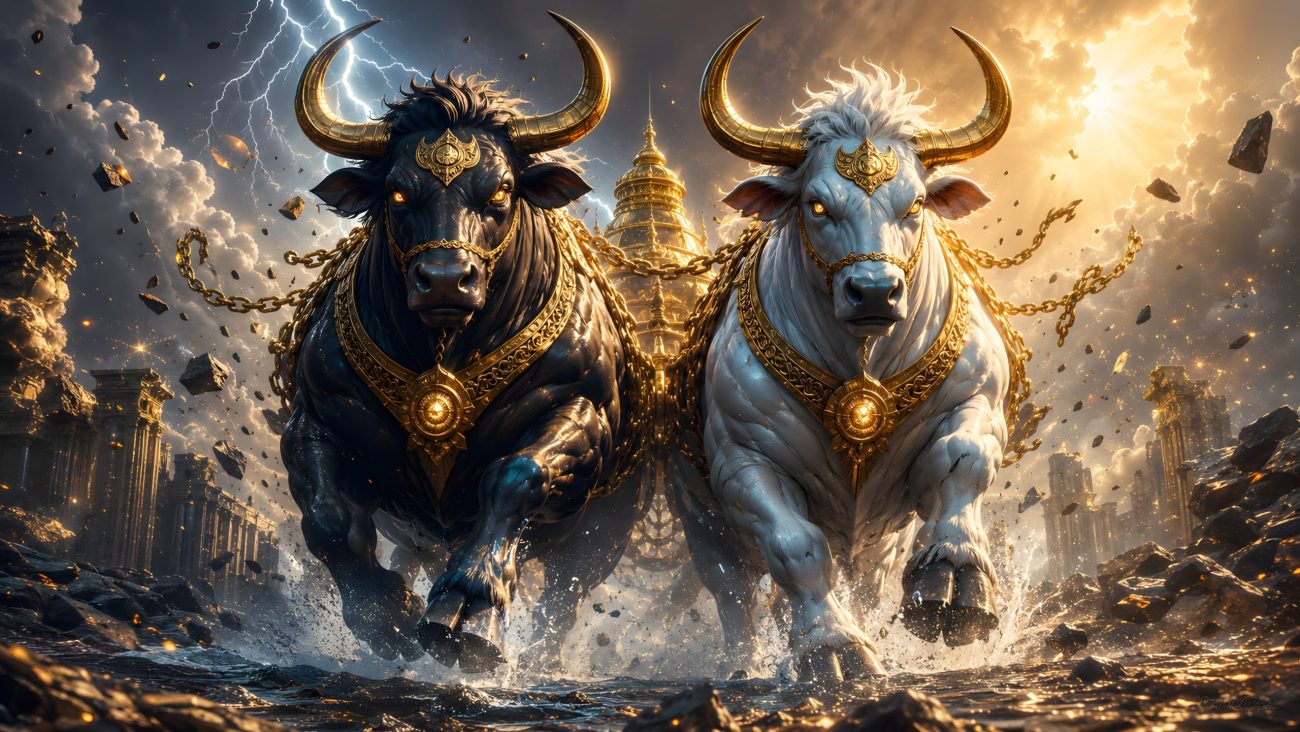
The clearest description of Tilla as a bull occurs in the Song of Ullikummi, part of the mythological cycle surrounding the god Kumarbi. Tilla was one of two divine bulls who pulled the chariot of Teshub, the Hurrian weather god. The other was Šerišu. Before Teshub went into battle against Ullikummi, a gigantic stone being, Teshub ordered that Tilla’s tail be covered with gold.
Tilla and Šerišu were therefore not ordinary cattle, but powerful divine bulls belonging to the entourage of Teshub. Their presence reflects the important connection between bulls and weather gods found throughout the ancient Near East, although the precise origins of this association remain uncertain.
Tilla’s relationship with Teshub may, however, have developed over time. Texts from Nuzi sometimes treat Tilla as an independent deity rather than simply as Teshub’s divine draft animal. Other sources also pair Šerišu with a different bull deity, Hurriš. Scholars have consequently suggested that Tilla, Šerišu, Hurriš and Šarruma belonged to a broader group of bull deities connected with Teshub.
Tilla was widely worshipped in Arrapha and was particularly prominent at Nuzi. He appears frequently in Hurrian theophoric names, including names expressing ideas such as “Tilla helps,” “Tilla frees,” and “Tilla is reliable.” An entu priestess associated with his cult is also attested.
The surviving evidence therefore presents Tilla as a powerful divine bull whose importance extended beyond his role as one of Teshub’s chariot animals. His cult, personal names and association with the weather-god tradition show that the bull could represent an important manifestation of divine power in Hurrian religion.
Sources
Vonbun, Franz Josef. “Die schwarze Kuh.” In Die Sagen Vorarlbergs. Mit Beiträgen aus Liechtenstein, no. 183, p. 141. Reproduced by SAGEN.at. Accessed August 29, 2026. https://www.sagen.at/texte/sagen/oesterreich/vorarlberg/montavon/schwarzekuh.html