Begho Bhoot

Tradition / Region: Bengali Mythology
Alternative Name: –
Category: Tiger, Ghost


The Myth

In the mangrove forests of the Sundarbans, where land and water blur and survival depends on entering dangerous terrain, the Begho Bhoot is believed to arise from those who died by the claws of tigers. The name comes from bāgh (tiger) and bhoot (ghost), marking it as the spirit of a person claimed by the forest’s most feared predator.

The Begho Bhoot is said to haunt jungle paths, riverbanks, and tidal inlets—places where honey gatherers, fishermen, and woodcutters must pass to earn their living. These spirits do not wander into villages or homes. They remain bound to the routes of labor, appearing where people still risk their lives to survive.

Accounts describe Begho Bhoots as frightening travelers, sometimes by imitating the roar of a tiger, other times by whispering or misleading those who are already lost. In doing so, the spirit draws people deeper into danger, reenacting the circumstances of its own death. The ghost does not seek revenge, but repeats the moment of terror endlessly.

The Begho Bhoot is closely tied to Dakshin Rai, the lord of the Sundarbans, who rules over beasts and spirits alike and often appears as a tiger himself. Under his authority, death by tiger is not random—it is an expression of the forest’s law. Those taken by tigers are believed to pass into his domain, becoming part of the forest rather than leaving it.

Within Bengali belief, the Begho Bhoot represents collective loss and shared fear. It is the memory of people who entered the forest out of necessity and never returned. The ghost exists not as a curse upon the living, but as a warning embedded in the landscape itself.

When the forest grows silent and a roar echoes where no tiger is seen, it is said that the Begho Bhoot is near—an echo of lives lost, reminding all who walk the Sundarbans that survival there is never guaranteed, only permitted for a time.


Sources

Wikipedia contributors. (n.d.). Ghosts in Bengali culture. In Wikipedia, from https://en.wikipedia.org/wiki/Ghosts_in_Bengali_culture


Babr

Tradition / Region: Russian mythology
Alternative Name: –
Category: Tiger


The Myth

In Siberian tradition, the Babr is not a creature born from wilderness alone, but from language, memory, and mistake. The name babr originally referred to a tiger—once a real and feared predator of the Siberian forests. In the 17th century, when Irkutsk adopted its coat of arms, the Babr was depicted as this powerful taiga hunter, carrying a sable in its jaws, a symbol of the fur trade that shaped the city’s wealth and survival.

As time passed and tigers vanished from the region, the word babr itself became obscure. Later officials, unfamiliar with the old term, misread it as bobr—“beaver.” Rather than correcting the word or the image, they attempted to reconcile both. From this confusion emerged a creature unlike any known animal: a tiger-bodied beast with a flat beaver’s tail and webbed paws, yet still gripping the sable between its teeth.

Thus the Babr transformed from a real predator into a hybrid symbol. It no longer represented only the raw power of nature, but also the distortions introduced by distance, bureaucracy, and the loss of living memory. Its strange form captured the overlap of wilderness and civilization, commerce and myth, accuracy and error.

Despite its improbable appearance, the Babr endured. It remained the emblem of Irkutsk, appearing on coats of arms, monuments, and civic imagery. Over time, the creature itself became meaningful—not as a mistake to be erased, but as a unique symbol of identity shaped by history’s layers.

In Russian cultural memory, the Babr stands as a reminder that myths do not always arise from ancient gods or terrifying beasts. Sometimes they are born from forgotten words, vanished animals, and human attempts to make sense of what remains. The Babr is the guardian of a city’s past—confused in form, yet powerful in meaning—carrying within its body the story of Siberia itself.


Sources

Bestiary contributors. (n.d.). Бабр (Babr). In Bestiary, from https://www.bestiary.us/babr


Apedemak

Tradition / Region: Kingdom of Kush, Sudan Mythology, Egyptian Mythology
Name: –
Category: Deity, Lion


The Myth

In the lands of Kush, along the life-giving Nile, Apedemak was known as the lion-headed god of war and royal power. He appeared with the body of a man and the head of a lion, radiating strength, authority, and ferocity. In some representations his form was even more fearsome, combining lion, man, and serpent, emphasizing his supernatural nature and his command over chaos and battle.

Apedemak was the divine force behind conquest and kingship. When armies marched and rulers sought to expand their dominion, he was believed to stand behind them, guiding their victories and striking fear into their enemies. He embodied courage, discipline, and the unyielding force of war. To oppose him was to face destruction, for he represented war not as disorder, but as divine judgment.

Yet Apedemak was not solely a god of bloodshed. He was also a giver of life and abundance. In temple reliefs he is shown holding stalks of grain, blessing the land with fertility and ensuring prosperity for those under his protection. Through him, war and life were bound together: victory brought order, and order allowed the land and people to flourish.

His worship was centered at great temple complexes such as Naqa and Musawwarat es-Sufra. These sanctuaries served as places where kings received divine legitimacy. By honoring Apedemak, rulers affirmed that their power flowed not merely from human strength, but from a god who embodied both might and rightful authority.

To the people of Kush, Apedemak was more than a warrior god. He was the living symbol of sovereignty itself—the roar of the lion behind the throne, the unseen hand guiding the fate of kingdoms, and the divine presence that bound war, rule, and fertility into a single, commanding force.


Sources

Wikipedia contributors. (n.d.). Apedemak. In Wikipedia, from https://en.wikipedia.org/wiki/Apedemak


Liiva-Annus

Tradition / Region: Estonian mythology
Alternative name: –
Category: Spirit


The Myth

Liiva-Annus is one of the most widespread names used by Estonians to refer to Death itself, understood not merely as an abstract end, but as an active, personified spirit. Because death was feared as something that could be summoned by name, people avoided calling it directly and instead used substitute names and nicknames. Among these were Mulla-Madis, Kalmu-Kaarel, Haua-Kusta, Toone-Toomas, Death-Peeter, as well as descriptive titles such as the scytheman, boneman, blackman, and coldfoot. Liiva-Annus is one of the most enduring of these euphemisms.

In folk imagination, Liiva-Annus appears as an old man who comes to claim human lives by force. He is said to beat people to death using tools associated with earth and burial—such as a scythe, shovel, pickaxe, or similar implements—linking him closely to the grave, soil, and the labor of digging. His presence is sudden, unavoidable, and final.

The figure of Liiva-Annus belongs to a broader, internationally known image of Death found throughout Christian Europe: the aged reaper who harvests human lives. In Estonian tradition, however, his many names emphasize both fear and familiarity—Death is ever-present, but must be spoken of carefully, indirectly, and with respect.


Külmking

Tradition / Region: Estonian mythology
Category: Sorcerer


The Myth

Külmking is a spirit of the unholy dead, a being that did not find peace after death and now wanders on the margins of the human and forest worlds. It is said to prey upon children, particularly those who disturb or disrespect the spirits of the forest.

In this belief, Külmking acts as a grim enforcer of unseen boundaries. Children who mock, provoke, or ignore the presence of forest spirits risk drawing its attention, and once noticed, the punishment is fatal. The spirit is not described in detail, emphasizing its role rather than its form: it is the consequence of taboo-breaking rather than a creature meant to be clearly seen.

Külmking reflects a warning embedded in Estonian folklore—that the forest is not a place of careless behavior, and that disrespect toward its hidden powers can awaken forces born of death, impurity, and moral transgression.


Rahaaugu Haldjad

Tradition / Region: Estonian mythology
Alternative name: –
Category: Spirit


The Myth

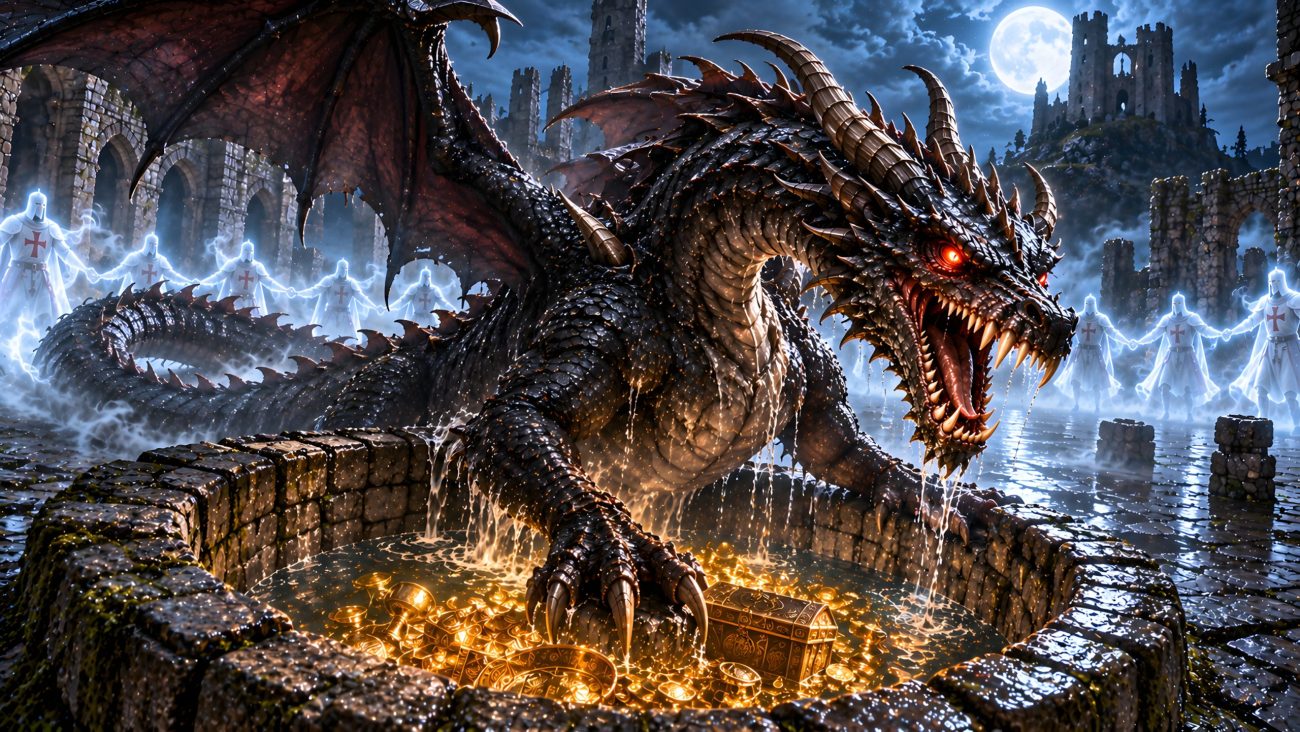
Rahaaugu haldjad, the Fairies of the Money Pit, are spirits believed to guard buried treasure hidden in the earth. In ancient times, money and valuable metal objects were often buried to protect them from war, raids, or theft. When the owners of these treasures died or were unable to return, the wealth remained underground, and the soul of the person who buried it became bound to the site as its guardian.

These spirits are not pagan priests or “old pagans,” despite later confusion in folklore. Their role is specific: they are keepers of wealth, bound to the treasure by death and unfinished responsibility. In some cases, a single money pit may be guarded by several fairies, reflecting that the treasure once had multiple owners, all of whom became its guardians after death.

To those deemed worthy, a fairy of the money pit may appear in a dream, inviting the dreamer to seek the hidden treasure. Yet this invitation is also a trial. Before allowing the treasure to be taken, the fairy tests the seeker’s courage. It may conjure shadowy apparitions, ghosts, or frightening visions, or transform itself into animals such as a dog, goat, wolf, or bear to terrify the human.

Only those who face these trials without fear or hesitation may succeed. In this way, the Rahaaugu haldjad embody the belief that wealth is never freely given, and that courage, resolve, and moral strength are required to claim what lies buried beneath the earth.


Ebajalg

Tradition / Region: Estonian mythology
Category: Spirit, Demon


The Myth

Ebajalg is a being of Estonian folklore that manifests as a violent whirlwind. Rather than a natural phenomenon alone, it is believed to be a malicious spirit or demon moving through the landscape in the form of spinning wind.

Ebajalg is associated with sudden destruction and overwhelming force. When it appears, it may tear through fields, damage buildings, or scatter objects, its strength far beyond that of ordinary wind. Encounters with Ebajalg are not personal or communicative; its presence is felt through impact and chaos rather than speech or form.

In Estonian belief, Ebajalg represents the dangerous animation of nature itself—an unseen will acting through the air, embodying the fear that destruction may arise suddenly, without warning, and without human cause.


Jeekim

Tradition / Region: Estonian Mythology
Alternative Name: –
Category: Spirit


The Myth

Jeekim is a penitent cemetery spirit found in Estonian legends and myths. The name Jeekim refers to a spirit bound to burial grounds, associated with repentance and unrest rather than active malevolence.

In traditional belief, Jeekim dwells among graves as a presence marked by penitence, suggesting a soul unable to leave the cemetery due to unresolved guilt or unfinished atonement. No detailed deeds or encounters are preserved, and the spirit is known primarily through its association with the place of the dead.

Jeekim belongs to a group of Estonian cemetery spirits whose existence is attested in folklore sources but whose myths survive only in fragmentary form, emphasizing presence and state rather than narrative action.


Kigutilik

Tradition / Region: Inuit mythology
Category: Monster spirit · Failed helping spirit


The Myth

Kigutilik, whose name means “the one with the giant teeth,” is a terrifying spirit encountered during a spring sealing expedition. It rose suddenly from an opening in the ice, described as being as large as a bear but even taller, with long legs swollen at the joints. The creature had two tails, a single enormous ear attached only by a fold of skin, and a mostly bare body with hair growing only in ragged fringes. Its teeth were immense, likened to the tusks of a walrus.

When Kigutilik emerged, it released a thunderous roar—“Ah—ah—ah!”—so overwhelming that the man fled in terror, abandoning the encounter. Because of this fear, he failed to secure Kigutilik as a helping spirit, losing the chance to bind its power.

Kigutilik stands as an example of unclaimed spiritual force in Inuit tradition: a being whose power can only be gained through courage and composure, and which vanishes from those who recoil in fear.


Interpretive Lenses

Religious Readings
Philosophical Readings
Psychological Readings
Esoteric Deep Dive
  • Hermetic Deep Dive
Political / Social Readings
Other

Nålaqnaq

Tradition / Region: Inuit mythology
Category: Spirit


The Myth

Nålaqnaq, known as the Listener, is a strange and unsettling spirit distinguished by its exaggerated sensory features. It is described as having a large, gaping mouth, two prominent teeth, and a tongue that protrudes outward, emphasizing its nature as a being that listens, hears, and perceives beyond ordinary limits. Its hands are shapeless, each bearing six fingers, marking it unmistakably as non-human.

Nålaqnaq is said to move at a run, suggesting constant alertness and restless awareness, as though it is forever attuned to sounds, words, or cries that escape human notice. Rather than embodying physical strength, it represents heightened perception—a spirit whose power lies in attention and awareness of the unseen.

As the Listener, Nålaqnaq reflects an Inuit understanding that nothing spoken—or unspoken—passes unheard. Its presence reinforces the importance of caution, respect, and mindfulness in speech and behavior, reminding people that words, intentions, and hidden actions may always be perceived by forces beyond the human world.


Interpretive Lenses

Religious Readings
Philosophical Readings
Psychological Readings
Esoteric Deep Dive
  • Hermetic Deep Dive
Political / Social Readings
Other