Raigōin

Tradition: Japanese Mythology
Alternative Names: 頼豪院, Raigō仙人 (Raigō Sennin)
Category: Rat


The Myth

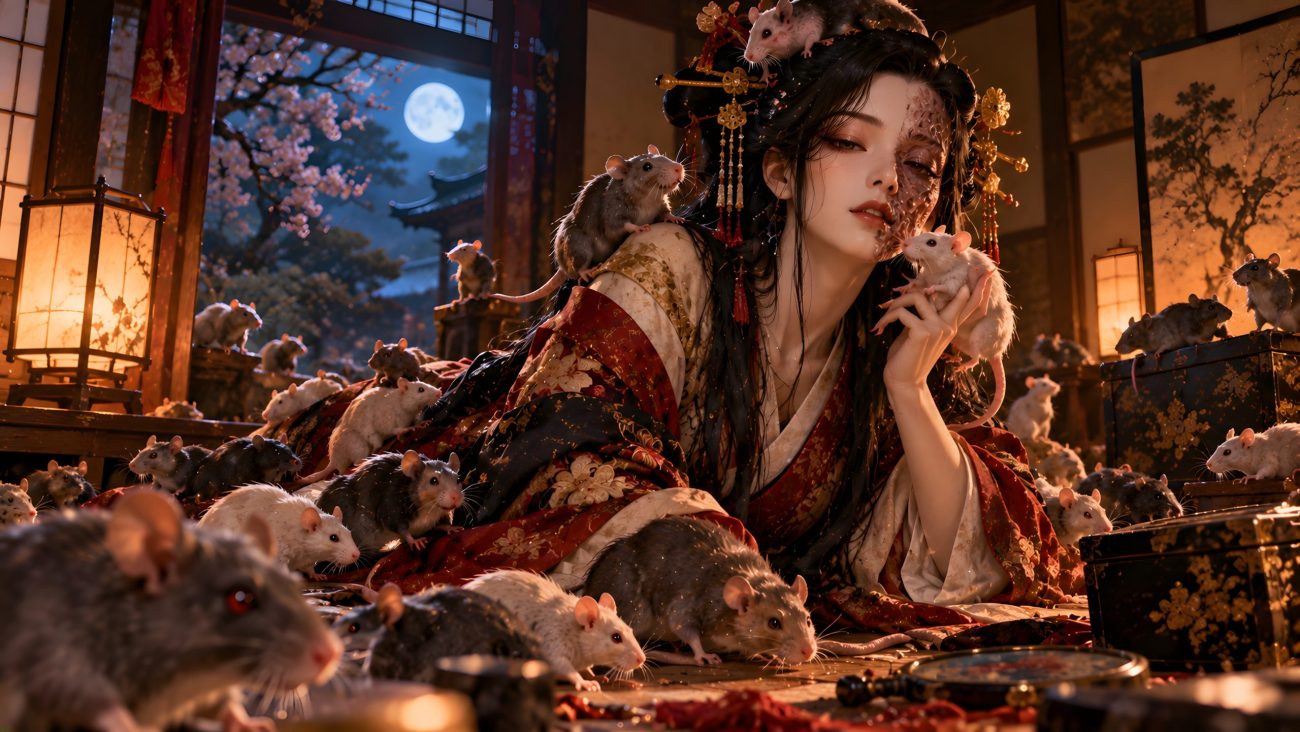
Raigōin is a sorcerer and practitioner of black magic in Santō Kyōden’s historical fantasy novel Mukashigatari Inazuma Byōshi. Set during the Chōroku era (1457–1460), the story follows the intrigues of the Sasaki family, where powerful retainers plot to control the family inheritance. Raigōin is hired by the corrupt steward Fuwa Dōken to curse Tsukiwaka, the young heir to the family estate.

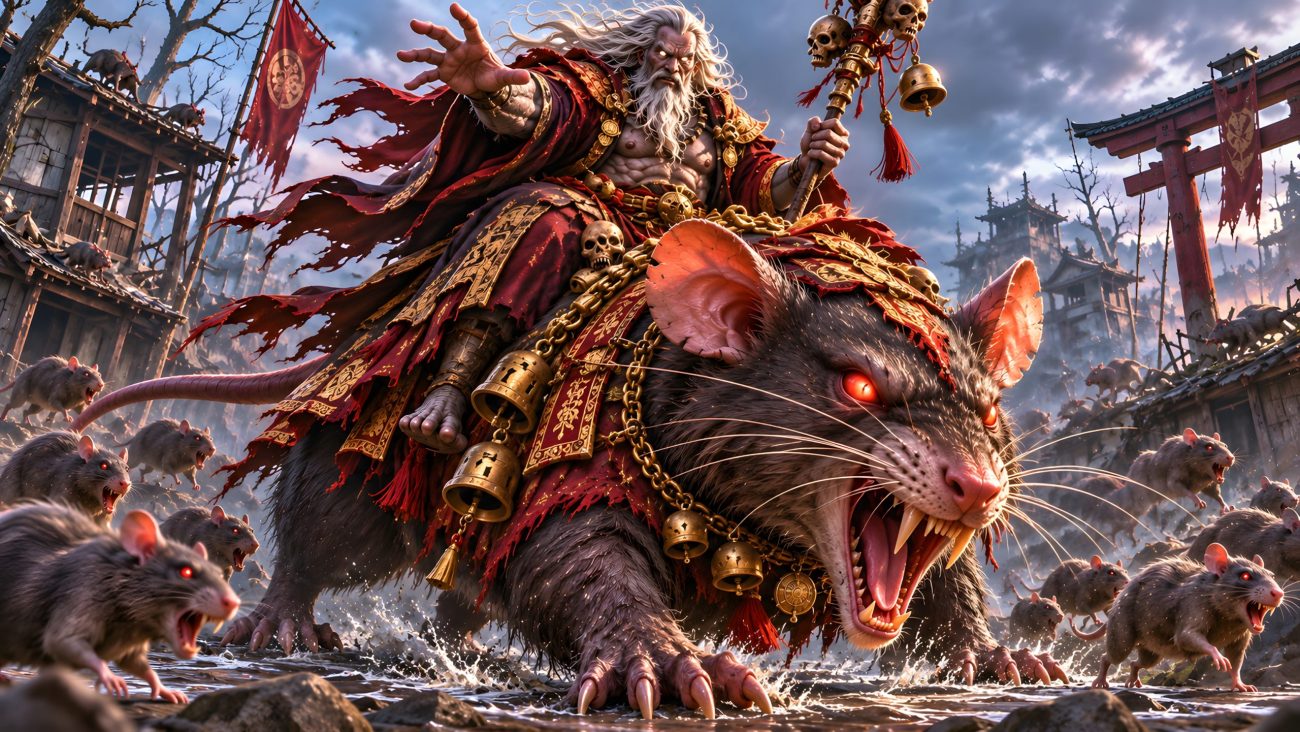
After Raigōin performs his rituals, Tsukiwaka falls gravely ill and suffers terrifying attacks by swarms of rats. The creatures first appear at night, while his attendants fall asleep, but eventually invade his room even during the day. They gnaw away his hair and scalp, leaving painful, poisonous sores. One night, the warrior Yamazaburō witnesses a gigantic rat, as large as a dog, attacking the boy. He strikes it with a small blade, whereupon the rat releases smoke and transforms into Raigōin. The sorcerer escapes by chanting spells, unleashing a violent wind, and spitting dozens of rats from his mouth to attack his pursuer. With the sorcerer wounded, Tsukiwaka begins to recover.

Raigōin later helps Dōken and his ally, Kuchide no Kata, frame Tsukiwaka and his mother, Ginnan no Mae, for using curses against the family. Their conspiracy leads to the mother and son being condemned, but they are rescued by loyal retainers. Eventually, Raigōin is captured and forced to confess his involvement in the plot, exposing the conspirators and bringing about their downfall. The character draws inspiration from the historical monk Raigō of Miidera, whose legend tells of his transformation after death into a swarm of rats. Stories about this monk often depict him becoming a giant rat or spewing rats from his mouth. Raigōin’s confrontation with Yamazaburō also echoes theatrical scenes in which the villainous Niki Danjō or Suganuma Kosuke reveals himself after taking the form of a rat.


Sources

“Raigouin.” 新版TYZ 妖怪図鑑 (New TYZ Yokai Encyclopedia). https://tyz-yokai.blog.jp/archives/1077252077.html
Mǎbànshé

Tradition: Chinese Mythology
Alternative Names: 馬絆蛇, 馬絆, Maban, Hooked Snake
Category: Rat


The Myth

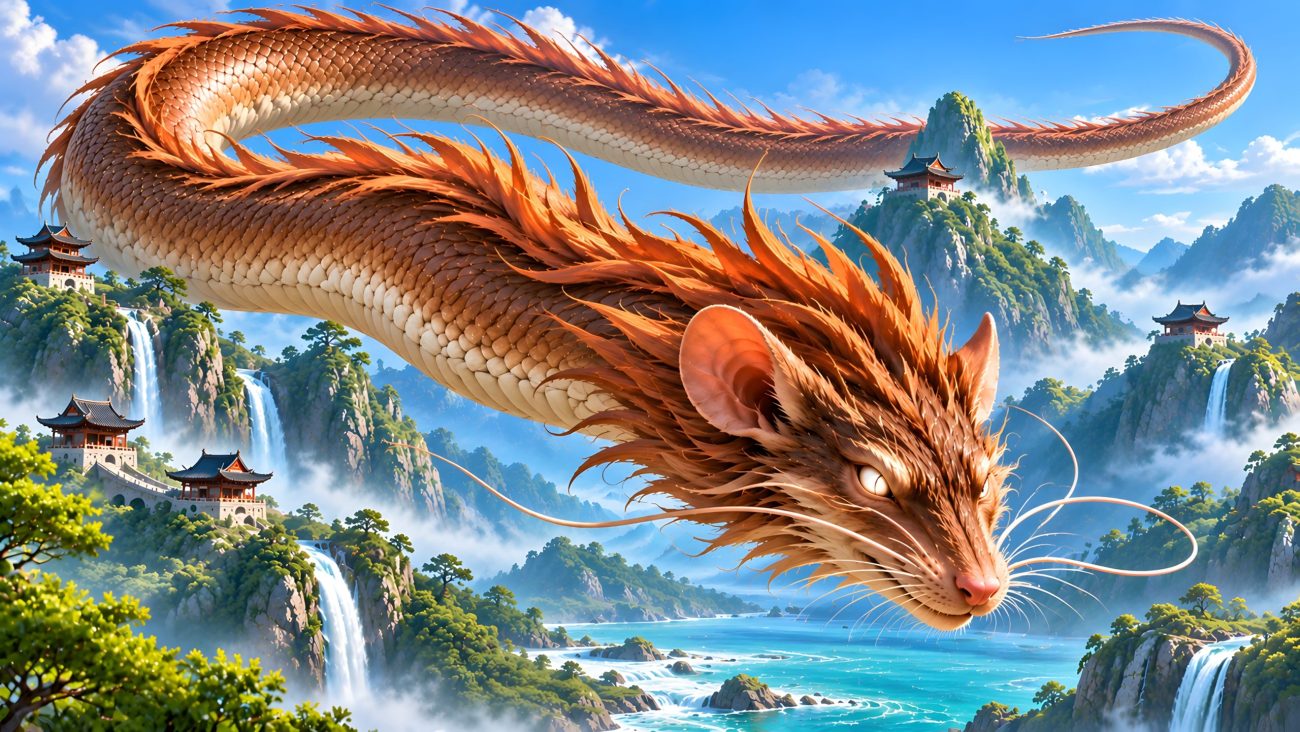
Mǎbànshé, also known as Mǎbàn, is a dangerous aquatic creature from Chinese folklore, particularly associated with rivers in Sichuan and Yunnan. Recorded in the Taiping Guangji, it is described as a type of jiao, a dragon-like water creature. One account compares its body to a leech, while another describes a creature with a head resembling that of a cat or rat and a body marked with patches of white. It is said to inhabit a deep pool at the ancient city of Hanzhou and to attack people who venture near its waters.

Because Mǎbànshé was considered a threat to local communities, villagers reportedly sought brave individuals willing to confront and kill it. The name itself was said to be a regional Shu term for a jiao, reflecting the varied names given to dangerous aquatic beings in Chinese tradition.

Other accounts identify Mǎbànshé with the goushe, or Hooked Snake, another legendary aquatic creature. These differing descriptions suggest that the name may have referred to more than one kind of dangerous water monster, with its exact appearance and identity varying between sources.


Sources

“馬絆蛇 (Mǎ bàn shé).” Chinese Wikipedia. Wikimedia Foundation. https://zh.wikipedia.org/wiki/%E9%A6%AC%E7%B5%86%E8%9B%87


Múshveli

Tradition: Icelandic Mythology
Alternative Names: Múshveli, Mousewhale
Category: Rat


The Myth

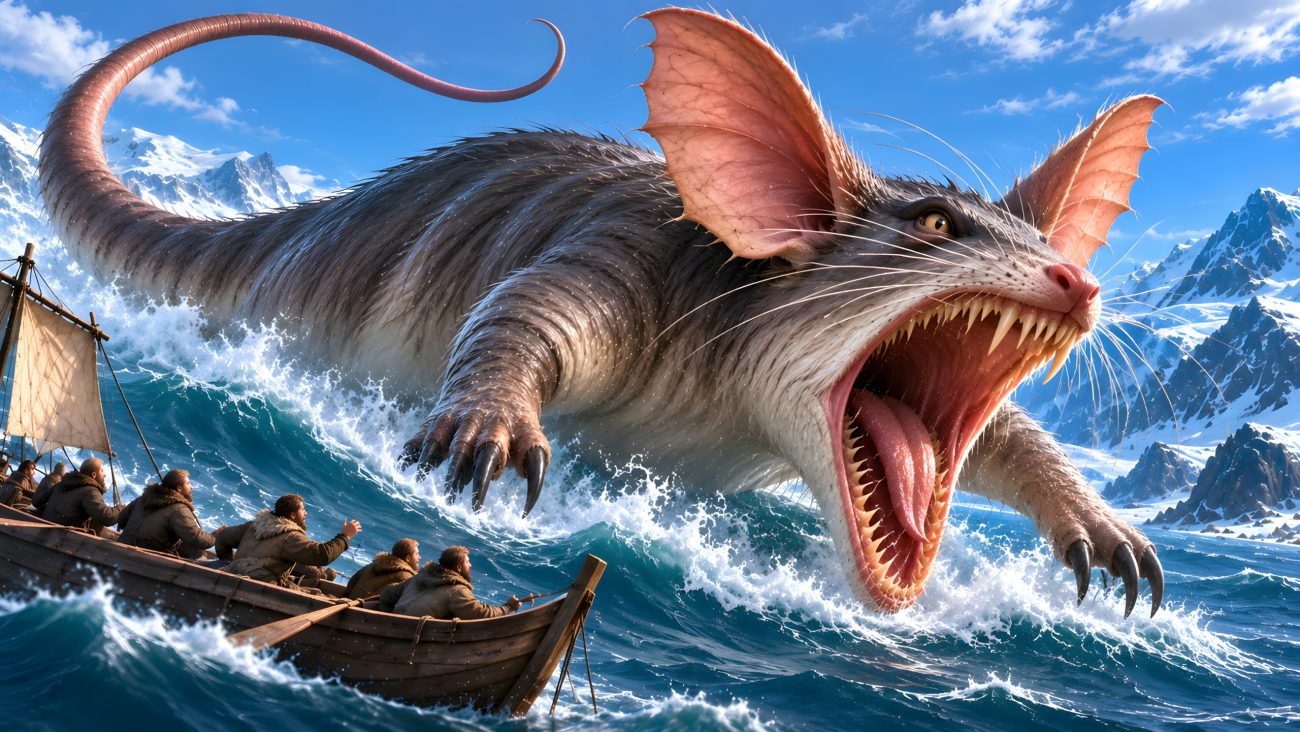
The Múshveli, meaning “mousewhale,” is a monstrous sea creature in Icelandic folklore. It belongs to the illhveli, or “evil whales,” a group of dangerous marine beasts believed to cause death and destruction. Despite sharing its name with the real chimaera fish (Chimaera monstrosa), also known as the ratfish or rabbitfish, the legendary Múshveli is an enormous and highly aggressive monster. It is inedible and feared by sailors for its destructive behaviour.

Múshvelis are said to exceed ten metres in length and have an unusual appearance dominated by an enormous, deeply split mouth, prominent ears resembling sails, and a long, whip-like tail without a fin. Their bodies are light grey or brownish-black, and instead of ordinary fins they possess two short, hoofed legs. Their mouths are large enough to swallow a small rowboat whole, while their powerful tails propel them through the water at terrifying speed, churning the sea ahead of them.

These monsters attack vessels by ramming them or rising from the water and pressing their feet against the gunwales until the boats capsize. Sailors who encounter a Múshveli are advised to flee towards shore and seek higher ground, as the creatures can crawl onto beaches with their stubby legs, although they soon struggle outside the water. One account describes a Múshveli pursuing sailors onto land and shrugging off three bullets before retreating with the next high tide.

Large ships are generally better able to withstand their attacks. In one tale, two Icelandic fishermen were saved when a French fishing schooner deliberately intercepted a Múshveli charging towards their small boat. The monster struck the schooner with such force that the vessel listed heavily, but it remained afloat. While the sea monster continued attacking the larger ship, the Icelandic fishermen were rescued. Eventually, the Múshveli abandoned its assault and disappeared beneath the waves.


Sources

“Múshveli.” A Book of Creatures. https://abookofcreatures.com/2015/07/03/mushveli/


Ka En So

Tradition: Japanese Mythology
Alternative Names: かえんそ, 火炎鼠, Flame Rat
Category: Rat


The Myth

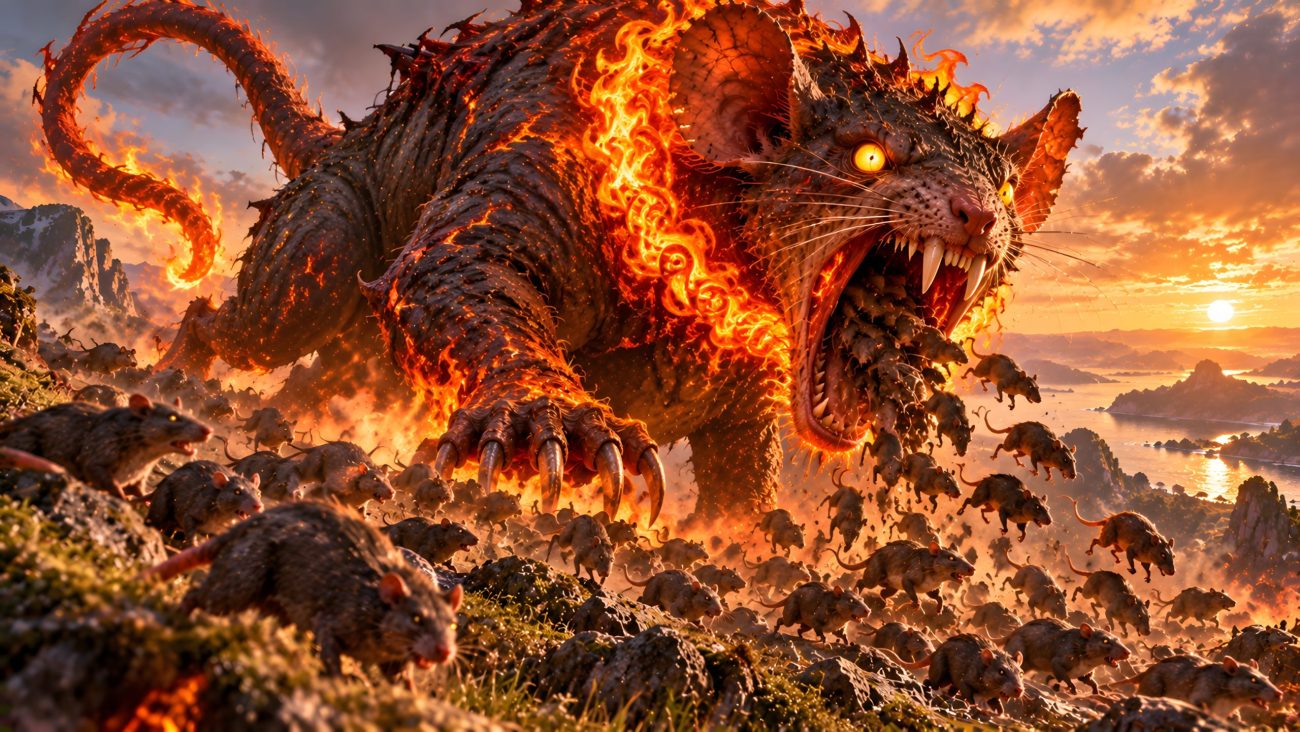
The Kaenso is a terrifying supernatural creature whose body burns with flames. Its most distinctive and frightening ability is to spew countless rats from its charred mouth, unleashing swarms of rodents to attack people.

According to legend, anyone who kills a rat will become a Kaenso after death. This curse transforms the rat-killer into a fiery monster, condemned to spread terror through the same creatures they once killed.

The Kaenso combines the destructive power of fire with the unsettling image of endless rats pouring from a monstrous mouth. Its appearance evokes a creature consumed by flames, while its ability to unleash swarms of rodents makes it a particularly disturbing yokai.

A similar creature, the Nezumi Onna, or “Rat Woman,” is described as possessing nearly identical characteristics. Both figures are associated with the terrifying image of supernatural beings that spew countless rats from their mouths.


Sources

“Kaenso.” 新版TYZ 妖怪図鑑 (New TYZ Yokai Encyclopedia). https://tyz-yokai.blog.jp/archives/1077180999.html


Ugjuknarpak

Tradition: American Mythology
Alternative Names: Ugjuknarpak, Giant Mouse of the Colville River
Category: Rat


The Myth

Ugjuknarpak is a gigantic, mouse-like monster from Inuit folklore in Alaska. It was said to inhabit an island in a long, narrow lake near the source of the Colville River. Although resembling an ordinary field mouse, it possessed impenetrably thick skin that could withstand even the largest harpoons, knives, and arrows. Its long, prehensile tail could coil around its prey, making it a terrifying predator.

The Inuit travelling by umiaqs to trade with the people of Point Barrow feared Ugjuknarpak greatly. Any noise near its island could alert the monster, which would rush at passing boats, capsize them with its powerful tail, and kill and devour their occupants. Despite this danger, travellers had to journey downriver to obtain blubber and return before winter froze the river, when caribou hunting became essential. In one tragic incident, a girl survived because her father placed her in a quieter boat ahead of the main fleet. A dog’s snarl alerted Ugjuknarpak, which attacked the other boats and killed her parents and brothers.

The girl eventually married and had a son, whom she named Kugshavak, meaning “Woodpecker.” She deliberately told him that he would never be strong enough to avenge his murdered relatives, knowing that this challenge would inspire him to prove her wrong. He was later joined by his brother Hagáneq, meaning “Fellow,” whose hands resembled the flippers of a bearded seal. Together, the brothers grew into powerful heroes and eventually set out to kill the monster.

Approaching the island silently, the brothers discovered Ugjuknarpak waking with jaws so enormous that they could see the dawn through its open mouth. They lured it towards a riverside plain, dodging its attacks while searching for a weakness. Eventually, they noticed a wrinkled patch of skin on its neck. Armed with flint knives mounted on long spears, they repeatedly stabbed this vulnerable spot until the monster collapsed and died. The brothers severed its head and displayed it at Ivnaq, where passing travellers could see the remains of the once-terrifying beast. Although the head eventually decayed, its enormous size, long fangs, and gristly mouse-like snout continued to frighten travellers, who passed it in whispers and restrained their dogs to prevent them from making noise.


Sources

“Ugjuknarpak.” A Book of Creatures. https://abookofcreatures.com/?s=Ugjuknarpak


Ebigane

Tradition: Fang Mythology, Cameroon Mythology, Gabon Mythology, Equatorial Guinea Mythology
Alternative Names: Ebigane
Category: Rat


The Myth

The Ebigane is a mysterious supernatural creature in the folklore of the Fang people of Central Africa. It can appear as an animal, a human, or a combination of both. Ebigane feature in heroic legends and sagas performed by mvett players, traditional storytellers and musicians who recount the adventures of legendary heroes.

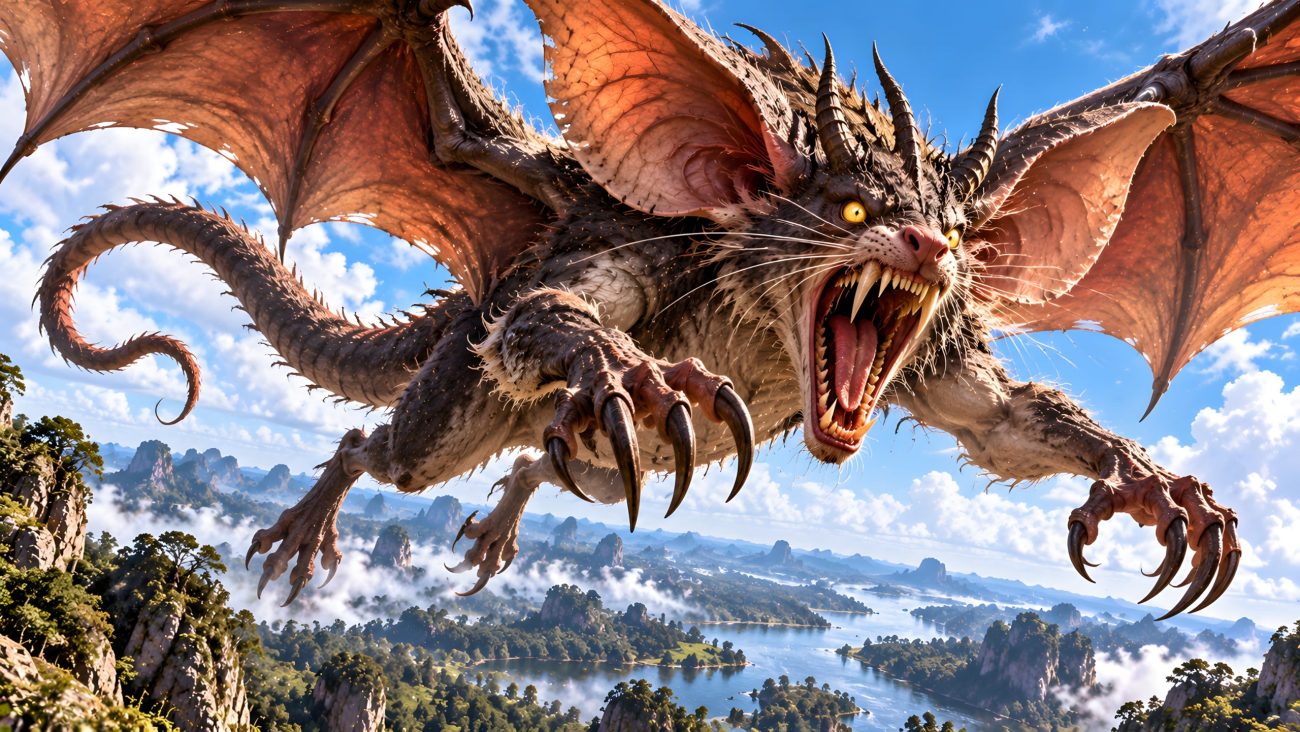
In a heroic tale told by Tsira Ndong Ndoutoume, the hero Mefoumou Mba Foumou encounters a bridge formed from twisted, knotted pythons. To overcome this obstacle, he takes a mouse from his satchel and spits on its head. The tiny animal transforms into a monstrous Ebigane: its ears expand like the petals of a gigantic flower, horns emerge from its head, its legs lengthen, its claws sharpen, and its enormous tail stretches behind it. It develops powerful fangs and great bat-like wings, becoming a terrifying hybrid resembling a bat, a buffalo, and a vampire.

Mefoumou Mba marks the creature’s head with a red line running from the base of its skull to the tip of its nose, then commands it to attack the python bridge, promising enough meat to feed it for two years. The Ebigane responds with loud, flapping ears and a whinny before taking to the air like a bird of prey. It dives upon the pythons, seizes one in its claws and teeth, and carries it away to Mount Bèghlé to devour at its leisure. In this tale, the Ebigane serves as a formidable supernatural ally, transformed from an ordinary mouse into a powerful predator capable of overcoming an otherwise impassable obstacle.


Sources

“Ebigane.” A Book of Creatures. https://abookofcreatures.com/?s=Ebigane


Yin Shu

Tradition: Chinese Mythology
Alternative Names: 陰鼠, Hidden Rodent, Hidden Mouse
Category: Rat


The Myth

Yin Shu, meaning “Hidden Rodent” or “Hidden Mouse,” is a legendary subterranean creature described in Chinese writings, including the Li Ji (Book of Rites) in some accounts. It dwells in dark caves and underground passages, rarely emerging into the open. Similar beliefs were recorded in Siberia, where mammoth fossils were interpreted as the remains of enormous mole-like beasts that tunneled beneath the earth, tearing up riverbanks as they moved. These creatures were believed to die when exposed to daylight.

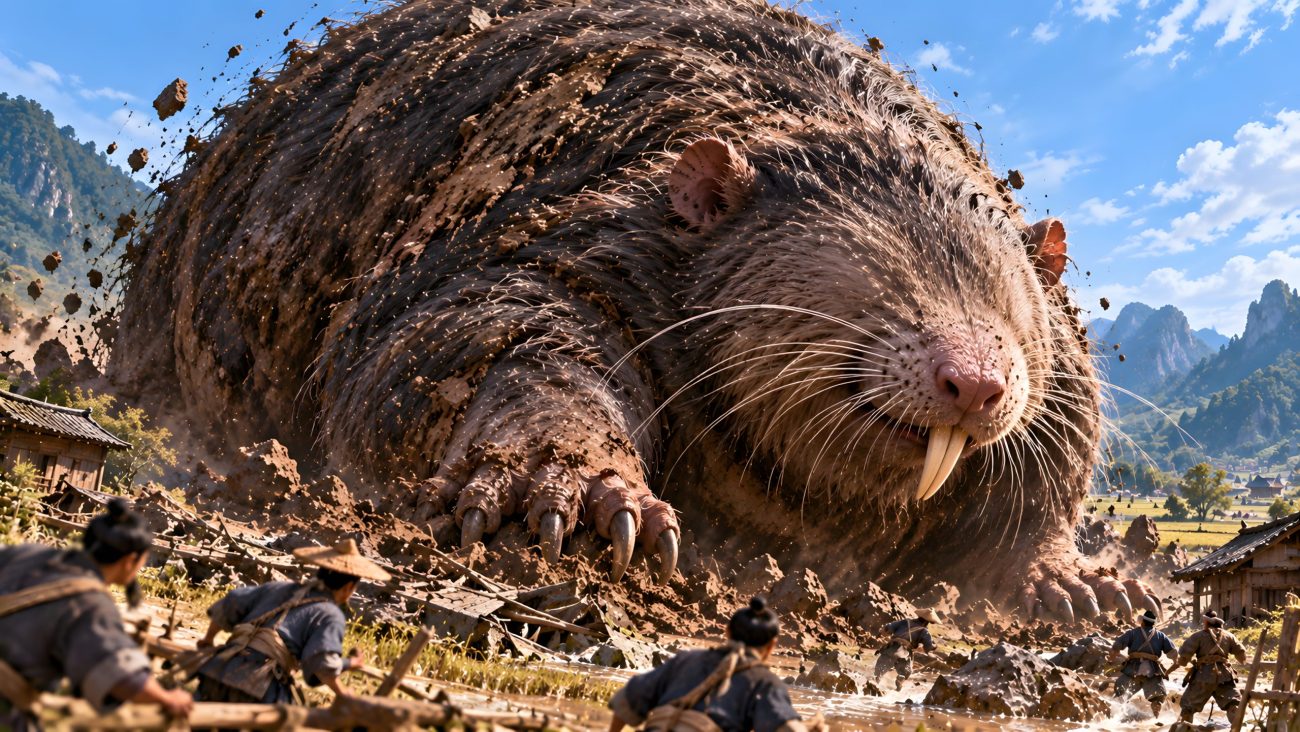
Descriptions of the Yin Shu vary between sources. It is generally portrayed as a gigantic, dark, mouse-like animal, with accounts from Manchurian manuscripts claiming it can grow from the size of a buffalo to that of an elephant. It has short legs, a short neck, small eyes, and either no tail or only a stub. Despite its immense strength, it is said to be slow-moving and unintelligent, digging extensive underground chambers in places where the fu-kia plant grows. Floods that inundate plains were sometimes believed to drive these hidden beasts into view, where sunlight would kill them.

The legend became associated with the discovery of prehistoric remains. Mammoth bones were reportedly sold in Chinese drugstores under the name Yin Shu, reflecting the belief that such enormous fossils belonged to giant rodents living beneath the earth. The creature therefore represents a folkloric explanation for the mysterious bones of extinct animals, combining subterranean monster traditions with early interpretations of paleontological discoveries.


Sources

“Yin Shu.” A Book of Creatures. https://abookofcreatures.com/?s=Yin+Shu


Nezumi Daimyōjin

Tradition: Japanese Mythology
Alternative Names: 鼠大明神, Great Rat Deity
Category: Rat


The Myth

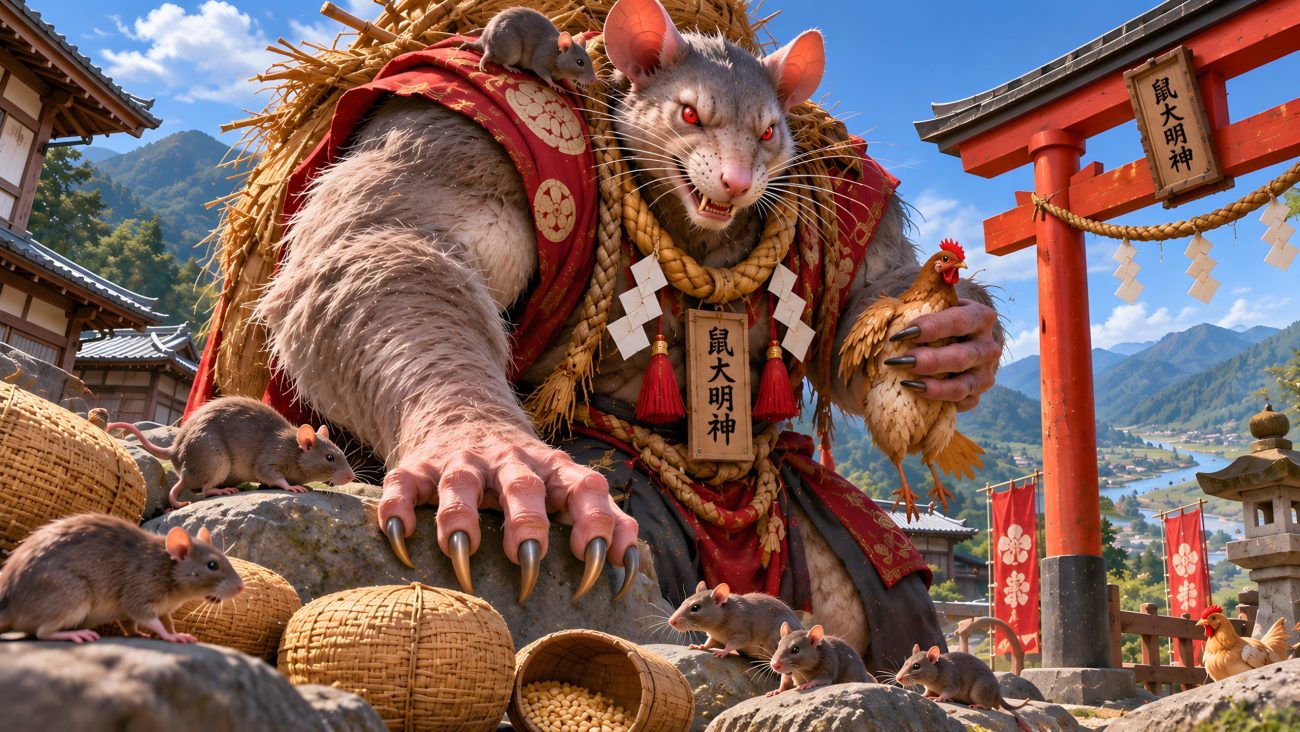
Nezumi Daimyōjin is a legendary giant rat associated with Sakaki in Hanishina District, Nagano Prefecture. Its story is connected to local place names, including Nezumi and Iwahana. According to tradition, a dangerous infestation of tsutsugamushi, or mites associated with scrub typhus, once plagued the village of Nezumi-juku. Seeking a solution, the villagers asked a gigantic rat living in a nearby cave to eliminate the pests. The rat agreed and devoured them all within three days.

Grateful for its service, the villagers offered the rat rice and fish every day. Growing ever larger, however, it eventually began roaming the village openly and devouring rabbits and chickens. Matters reached a crisis when it bit off an elderly woman’s wrist. Although the villagers remembered its earlier help, they decided the creature had become too dangerous to tolerate. Unable to find a cat capable of confronting it, they sent a representative across the sea to Tang China to seek a gigantic, tiger-like cat.

The great Tang cat agreed to help and travelled to the village, where it fought the rat in a battle whose roars echoed across the surrounding region. The cat eventually prevailed, and the rat struck its head against a projecting rock called Iwahana before dying. A nearby lake then burst its banks, and the rat was swept away by the raging flood. The victorious cat was also carried off by the waters; although it managed to crawl ashore, it soon died from exhaustion. In gratitude, the villagers established Karane-ko Shrine in honour of the cat and built a small shrine to the fallen rat, commemorating it as Nezumi Daimyōjin.


Sources

“Nezumi Daimyojin.” 新版TYZ 妖怪図鑑 (New TYZ Yokai Encyclopedia). https://tyz-yokai.blog.jp/archives/1077214312.html


Oiwa no Nezumi

Tradition: Japanese Mythology
Alternative Names: お岩の鼠, Oiwa’s Rats, Rats of Yotsuya Kaidan
Category: Rat


The Myth

Oiwa no Nezumi refers to the supernatural rats that appear throughout Tōkaidō Yotsuya Kaidan, the famous ghost story and kabuki play written by Tsuruya Nanboku IV. Oiwa, who is traditionally said to have been born in the Year of the Rat, becomes a vengeful spirit after being poisoned and betrayed by her husband, Tamiya Iemon. Rats serve as her supernatural agents, tormenting those responsible for her suffering and helping bring about their downfall.

After Oiwa dies, a gigantic rat appears and kills a cat before disappearing in a flash of spiritual fire. Later, swarms of rats attempt to carry away Oiwa’s infant, gather around the severed head of Iemon’s second wife, Oume, and steal a protective amulet entrusted to Oume’s nurse, O-Maki. When the nurse pursues the rat that has taken the amulet into a river, she falls in and drowns. In another episode, a rat carrying Oiwa’s comb appears before Naosuke, indirectly revealing her death to her sister, Osode.

The rats continue to haunt Iemon as Oiwa’s revenge unfolds. They appear in his dreams, transform his surroundings into terrifying visions, destroy an important document by gnawing through it, and swarm over those who have wronged Oiwa. During the final confrontation, numerous rats cling to Iemon’s sword, causing him to drop it and allowing Osode’s betrothed, Sato Yomoshichi, to strike him down. Even as Iemon struggles against his fate, the rats continue to torment him alongside Oiwa’s vengeful spirit. In the play, they become recurring manifestations of her wrath, turning the ordinary rat into an instrument of supernatural retribution.


Sources

“Oiwa.” 新版TYZ 妖怪図鑑 (New TYZ Yokai Encyclopedia). https://tyz-yokai.blog.jp/archives/1077209622.html


Xishu

Tradition: Chinese Mythology
Alternative Names: 奚鼠, 磎鼠, 鼷鼠
Category: Rat


The Myth

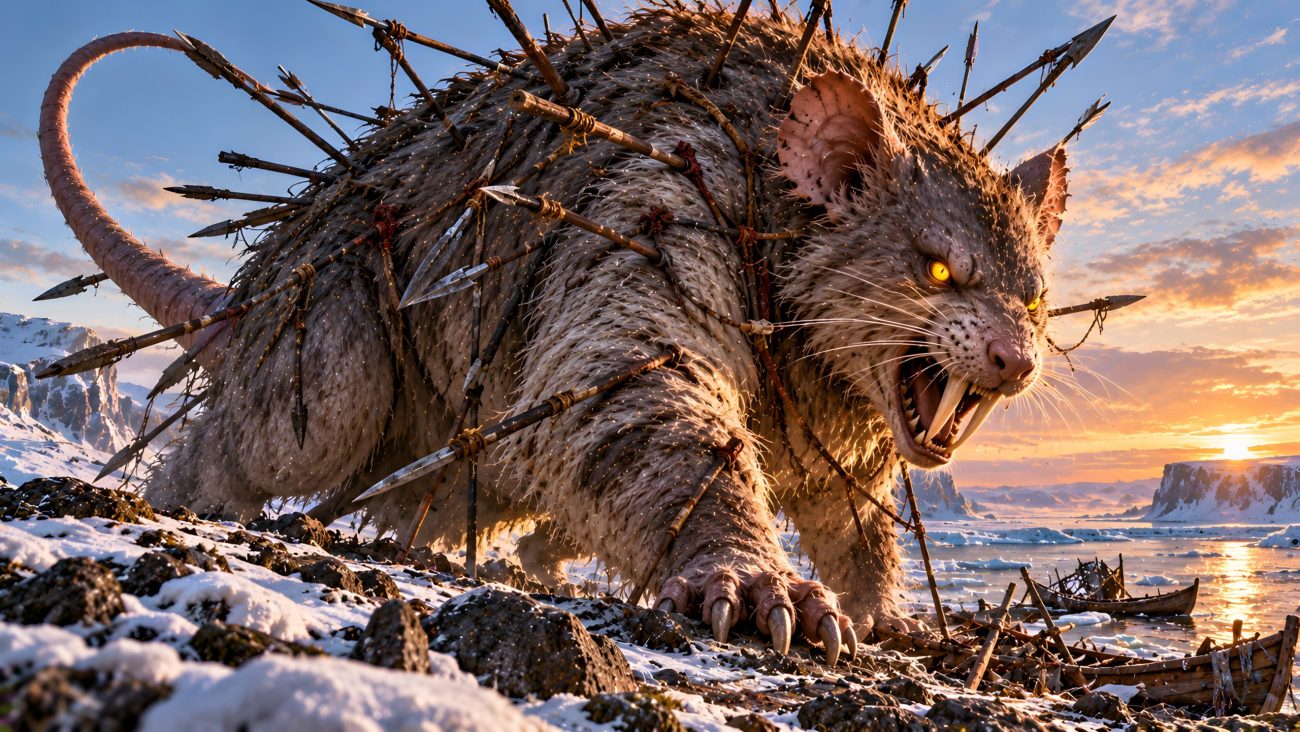
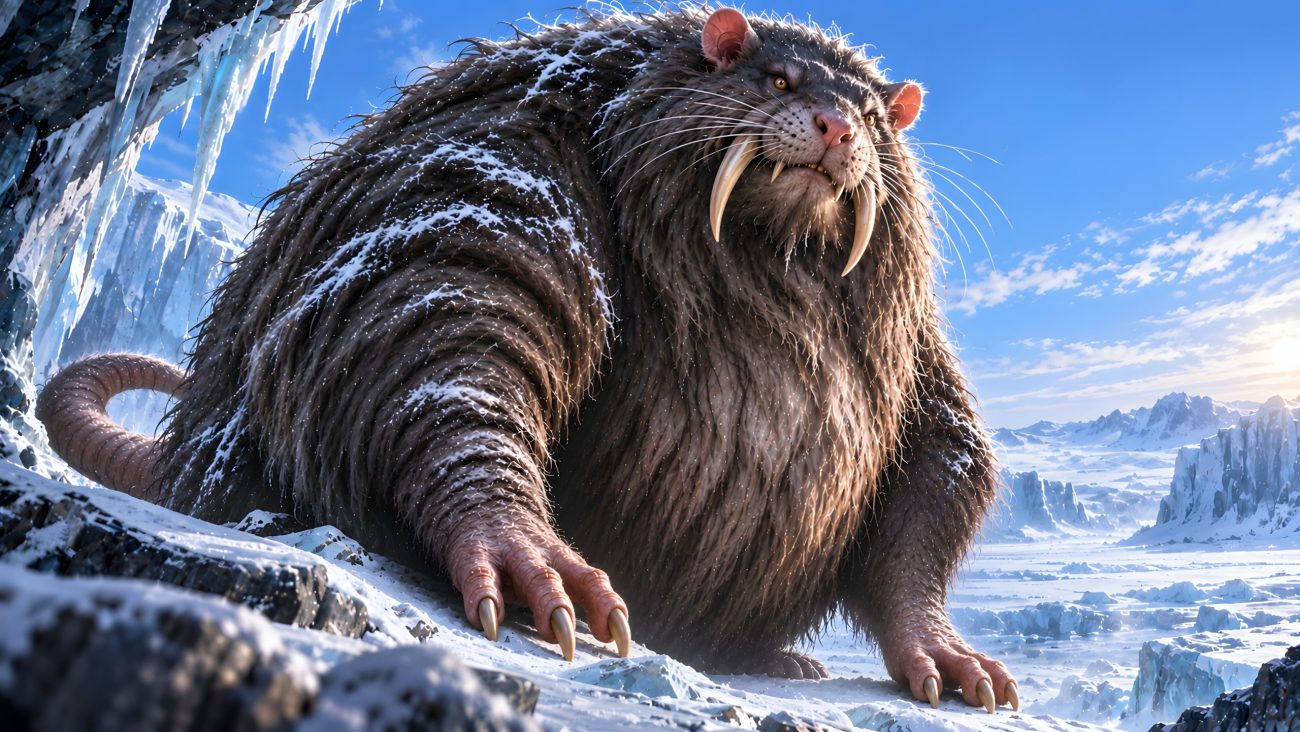
Xishu is a gigantic, rat-like creature described in the Chinese text Shenyi Jing (Classic of Divine Marvels). It is said to live underground beneath an enormous northern ice sheet, reportedly stretching for thousands of miles and reaching a thickness of hundreds of zhang. There, it feeds on the grass, trees, and roots growing around the ice.

Accounts describe Xishu as weighing hundreds or even thousands of jin, with some versions claiming that its flesh alone weighs ten thousand jin. Its meat is said to provide warmth when eaten, making it particularly valuable in the freezing northern regions. Its thick fur can be fashioned into clothing and blankets that offer exceptional protection against the cold.

Xishu possesses other remarkable properties: a drum made from its hide is said to produce a sound audible a thousand miles away, while its hairs can be used to summon other rats. Some modern interpretations suggest that the creature may have been inspired by the woolly mammoth or possibly the musk ox, although neither identification is certain. Its enormous size, insulating fur, and association with the frozen north make it a striking example of a legendary animal adapted to an extreme environment.


Sources

“鼷鼠 (Xīshǔ).” Chinese Wikipedia. Wikimedia Foundation. https://zh.wikipedia.org/wiki/%E9%BC%B7%E9%BC%A0