Ebibi

Tradition / Region: Gabon Mythology
Alternative names: Ebibi Ogres
Category: Giant


The Myth

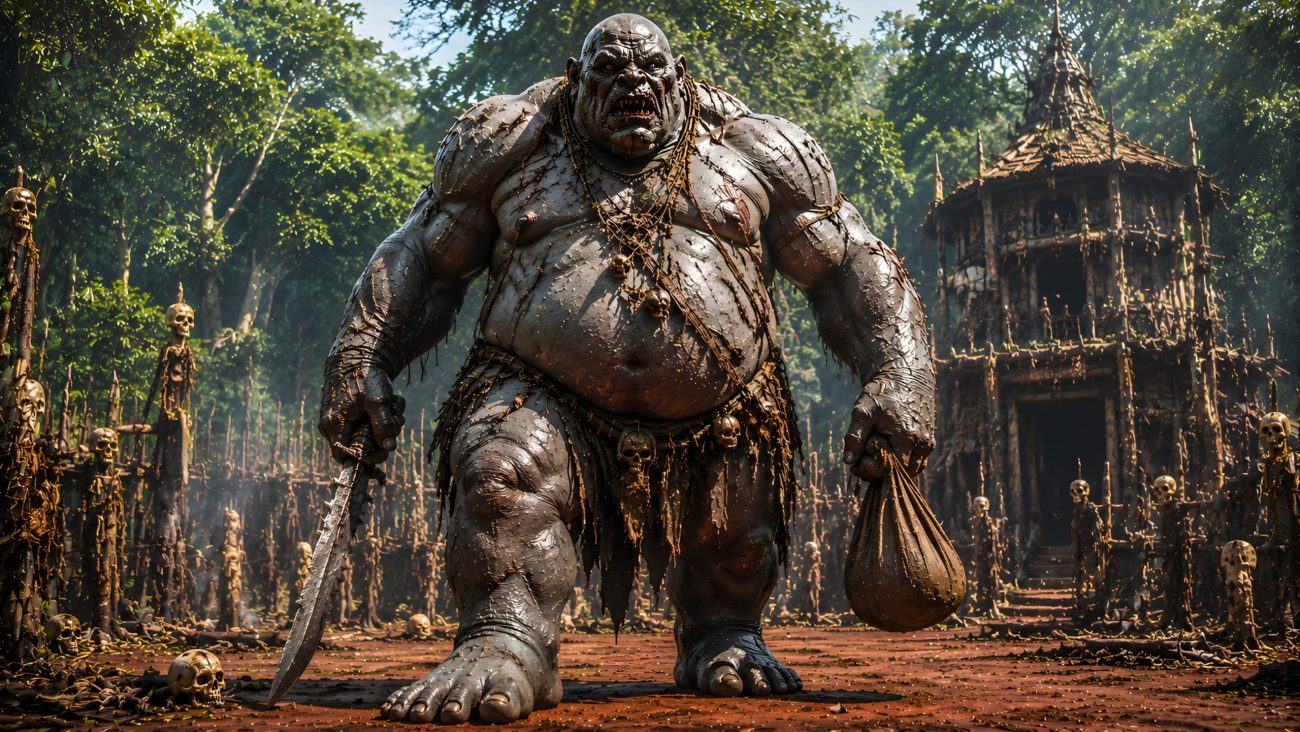
The Ebibi were monstrous ogres in Fang mythology feared even more than ordinary man-eating creatures. They were described as powerful supernatural beings who ruled through terror, magic, and cannibalism.

According to the legends, the Ebibi lived together in a distant village where they enslaved surrounding tribes. In the center of their settlement stood a massive house filled with prisoners — men, women, and children captured from many different peoples. Every day the Ebibi devoured human victims in enormous numbers.

Unlike ordinary monsters, the Ebibi used dark magical powers and fetishes. One of their most feared weapons was the ozolikwé powder, a supernatural substance capable of forcing people into an unnatural sleep so deep that they could not be awakened.

The Ebibi entered the story after hearing about the legendary strength of the three brothers Etarane, Mendore, and Bisonge, hunters famous for slaying giant beasts and monsters. Fearing the brothers’ growing power, the Ebibi decided to destroy them.

One of the ogres visited the brothers’ home pretending to seek hospitality. While inside, he secretly threw enchanted ozolikwé powder into the fire. A strange smoke filled the house, and all three brothers immediately fell into a magical sleep.

Their mother Ada desperately tried to wake them, shaking them, burning their skin with fire, and calling their names, but nothing could break the spell.

The Ebibi then attacked the sleeping brothers. Etarane and Mendore were killed while their house was burned to the ground. Only the youngest brother, Bisonge, survived because Ada carried him away into the forest before the ogres arrived.

When Bisonge awoke and learned what had happened, he swore revenge.

Armed with his great knife and magical hunting net, Bisonge traveled to the village of the Ebibi. There he discovered countless prisoners locked inside the ogres’ great house waiting to be eaten. He secretly freed them, then trapped the returning Ebibi inside their own home using his enchanted net, whose threads were said to be as hard as iron.

The trapped ogres tried to escape but failed. One by one, Bisonge dragged them out, beheaded them, and cut open their stomachs. According to the legend, the people the Ebibi had recently devoured escaped alive from inside the monsters’ bodies and fled back into the forest.

After defeating the Ebibi, Bisonge became a great chief and protector of the people. His victory symbolized the triumph of wisdom, spiritual strength, and true maturity over monstrous violence, greed, and chaos.

In Fang mythology, the Ebibi often represent destructive supernatural forces tied to death, domination, fear, and spiritual corruption.


Sources

Mvé Ondo, B. (2011). Wisdom and initiation in Gabon: A philosophical analysis of Fang tales, myths, and legends (J. F. Barnes, Trans.). Lanham, MD: Lexington Books.


Dzun

Tradition / Region: Gabon Mythology
Alternative names: Dzoun
Category: River Dweller


The Myth

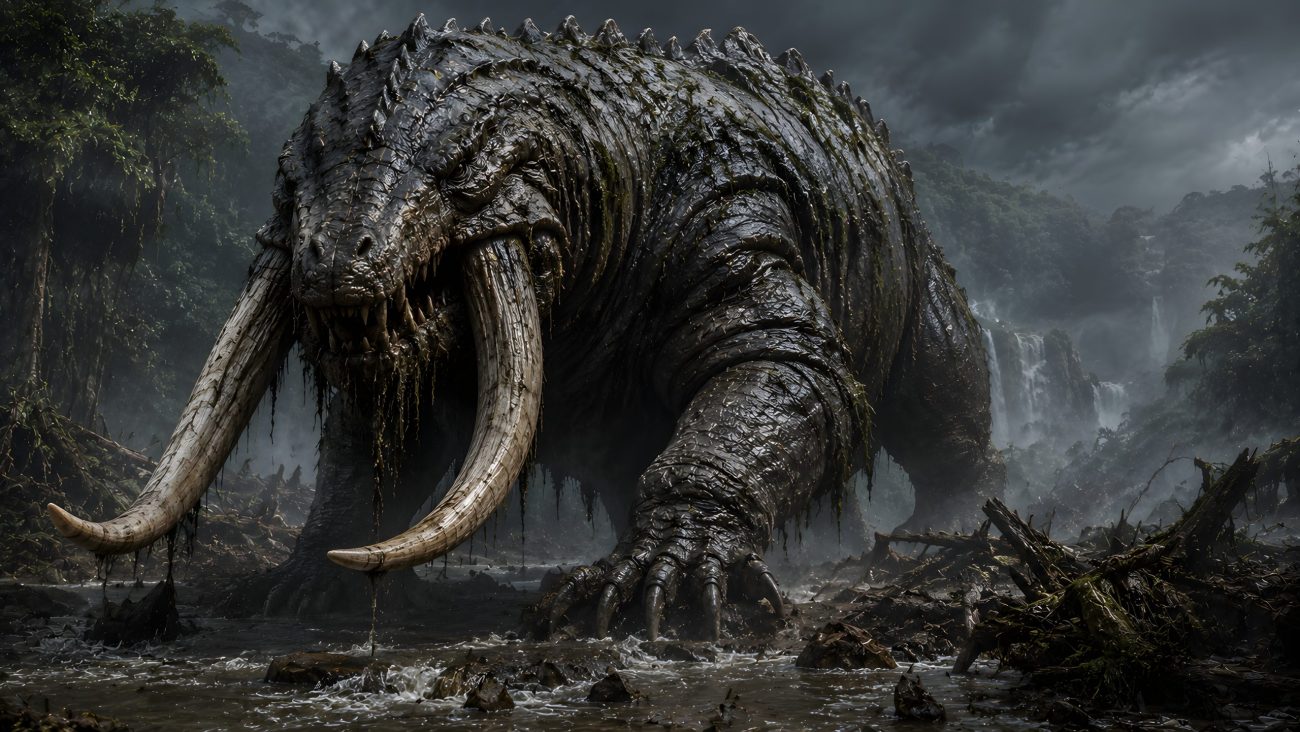
Dzun was a terrifying monster from Fang mythology, remembered as one of the deadliest creatures ever faced by the legendary brothers Etarane, Mendore, and Bisonge. The creature lived near the rivers and forests and was described as a gigantic beast of overwhelming strength and fury.

According to the stories, the Dzun was so massive that every step it took shook the earth and left holes deep enough for a man to hide inside. Trees snapped beneath its body like grass, while its enormous tusks were said to be as long as a human body. The monster could hurl giant rocks through the air as if they were small stones and charged with the force of a storm.

Only the bravest hunters dared approach such a creature.

The legend begins with Ada and her three extraordinary sons: Etarane, Mendore, and Bisonge. After eating the magical fruit of the angonlongo tree, the brothers grew into gigantic hunters with superhuman strength. Etarane became a master fisherman who could dam entire rivers, Mendore became a mighty elephant hunter, and Bisonge became a master trapper whose nets could imprison even the largest beasts.

One day, while fishing at the river, Etarane suddenly encountered the Dzun.

Terrified but determined, he rushed back to warn his brothers and called them to battle the monster. The three hunters armed themselves and hurried toward the riverbank where the creature waited.

When the Dzun saw them, it charged immediately.

The beast thundered across the earth, uprooting trees and shaking the ground beneath its enormous paws. But the brothers stood their ground. As the monster attacked, Etarane struck it with a harpoon, Mendore blinded one of its eyes with his spear, and Bisonge cast his giant net around the creature’s massive body.

The enraged beast fought violently, but the three brothers overwhelmed it together. Mendore destroyed its second eye, Etarane pierced its heart, and finally Bisonge cut off its head with his machete.

Victorious, the brothers carried the gigantic corpse back to their home.

Nothing from the Dzun was wasted. Its skull became a chair, its bones were transformed into magical whistles used against evil spirits, its skin became shields, its ears were turned into enormous drums, and its tusks became ritual instruments and hunting tools.

The defeat of the Dzun spread the fame of the brothers across the land. They became feared as unmatched hunters capable of killing monsters, elephants, and even supernatural beasts that ordinary men could never face.

In Fang tradition, the Dzun represented more than a giant animal. It symbolized terrifying chaos, destructive power, and the dangerous trials a person must overcome before becoming a complete and powerful adult.


Sources

Mvé Ondo, B. (2011). Wisdom and initiation in Gabon: A philosophical analysis of Fang tales, myths, and legends (J. F. Barnes, Trans.). Lanham, MD: Lexington Books.


Ngi Nzame

Tradition / Region: Gabon Mythology
Alternative names: Ngi
Category: Monkey


The Myth

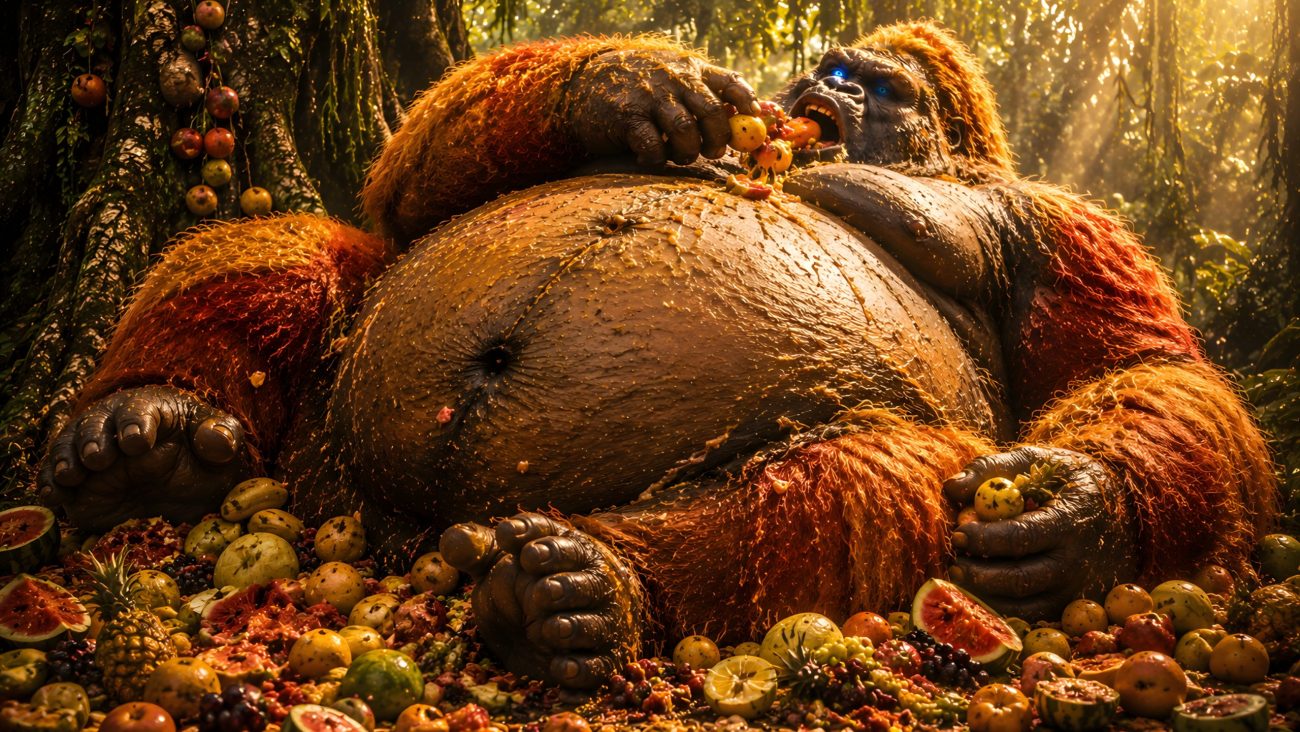
Ngi Nzame was one of the seven sons of Essamnyambogë in Fang mythology. His name meant “Gorilla, Child of God,” and he represented the powerful but instinctive side of human nature. Like his brothers Woa the chimpanzee and Zoak the elephant, Ngi was connected to the wilderness, hunger, and the untamed forces of the forest.

Long ago, the creator Nzame left his seven sons alone in their village. Without him they had no fire, no food, and no guidance. Worried and desperate, the eldest brother Mot a Nzame ordered his brothers one by one to journey into the great forest and search for their divine father.

After Woa disappeared into the wilderness and never returned, Mot sent Ngi Nzame to continue the search.

Ngi entered the forest determined to find Nzame, but the deeper he traveled, the stronger the temptations of the wilderness became. Soon hunger overtook him. Seeing fruit hanging from the trees, he stopped and devoured it greedily, forgetting the purpose of his journey.

Continuing deeper into the forest, Ngi eventually reached a riverbank surrounded by thick vegetation and shade. There, instead of searching further for his father, he abandoned the path entirely and disappeared into the bush.

Like his brothers before him, Ngi became lost to instinct and desire.

He never returned home.

The Fang viewed this story as more than a tale about a gorilla-like being wandering into the forest. Ngi symbolized the dangerous pull of appetite, distraction, and animal instinct inside human beings themselves. His failure showed how easily one could lose sight of wisdom, purpose, and spiritual truth when consumed by hunger and earthly desires.

Unlike Mot a Nzame — who resisted temptation and ultimately found the creator — Ngi remained trapped in the wilderness, becoming part of the untamed forest forever.


Sources

Mvé Ondo, B. (2011). Wisdom and initiation in Gabon: A philosophical analysis of Fang tales, myths, and legends (J. F. Barnes, Trans.). Lanham, MD: Lexington Books.


Evus

Tradition / Region: Gabon Mythology
Alternative names: Evu
Category: Forest Dweller


The Myth

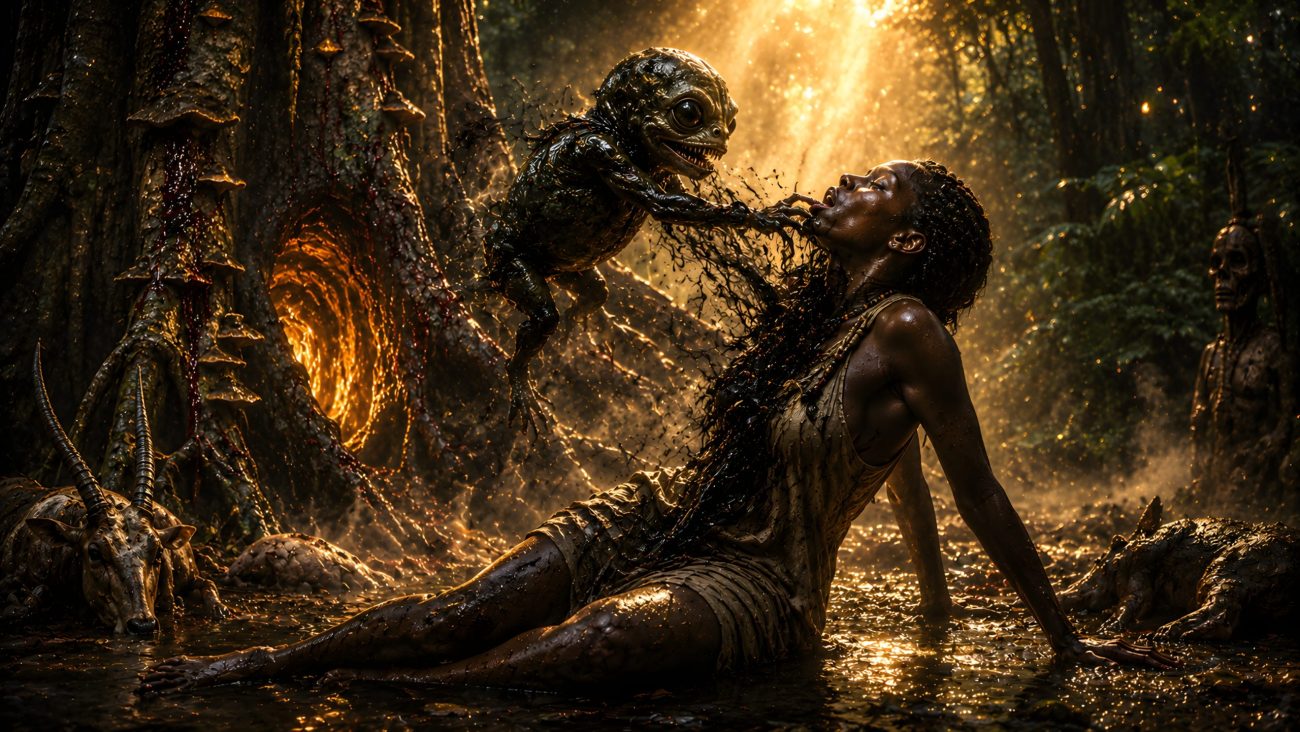
Evus was a feared being in Fang mythology, associated with witchcraft, death, hunger, corruption, and destructive desire. Stories described him as a strange creature living deep inside swamps and forests, sometimes appearing as a giant toad, a frog-like beast, or a mysterious child hidden inside hollow trees. He fed on raw meat and lived far from human villages in dark wilderness untouched by civilization.

Long ago, during the first age of humanity, the creator Zamba lived among humans and protected them. At that time people did not know true death, sickness, or suffering. Zamba warned his wife never to enter a forbidden part of the forest where Evus lived hidden among the swamps.

But curiosity overcame her.

After Zamba left on a journey, the woman secretly entered the forbidden forest. There she found piles of freshly killed animals and heard a voice calling from the swamp. Soon Evus revealed himself — an ugly, unnatural creature who promised endless meat and prosperity if she brought him back to the village.

Because Evus could not openly travel among humans, he instructed the woman to squat down. The creature then entered her body through her vagina and lodged himself inside her stomach.

From that moment onward, disaster entered the world.

Once inside the village, Evus constantly demanded food. First he devoured goats and sheep. Then chickens. Soon all the domestic animals were gone, but his hunger never stopped growing.

Finally, Evus demanded human flesh.

The woman’s daughter became his first human victim, and through this act death entered human existence forever. Bodies began to decay, suffering appeared among mankind, and the peaceful world created by Zamba collapsed.

When Zamba returned and saw what had happened, he became furious. Seeing that Evus now lived inside humanity itself, he abandoned mankind and left humans alone with death, evil, and suffering.

From then onward, the Fang believed Evus remained hidden within certain people, feeding dark desires such as greed, jealousy, violence, sorcery, and destruction. He became a symbol of the dangerous force hidden inside the human heart — a hunger that can never truly be satisfied.


Sources

Mvé Ondo, B. (2011). Wisdom and initiation in Gabon: A philosophical analysis of Fang tales, myths, and legends (J. F. Barnes, Trans.). Lanham, MD: Lexington Books.