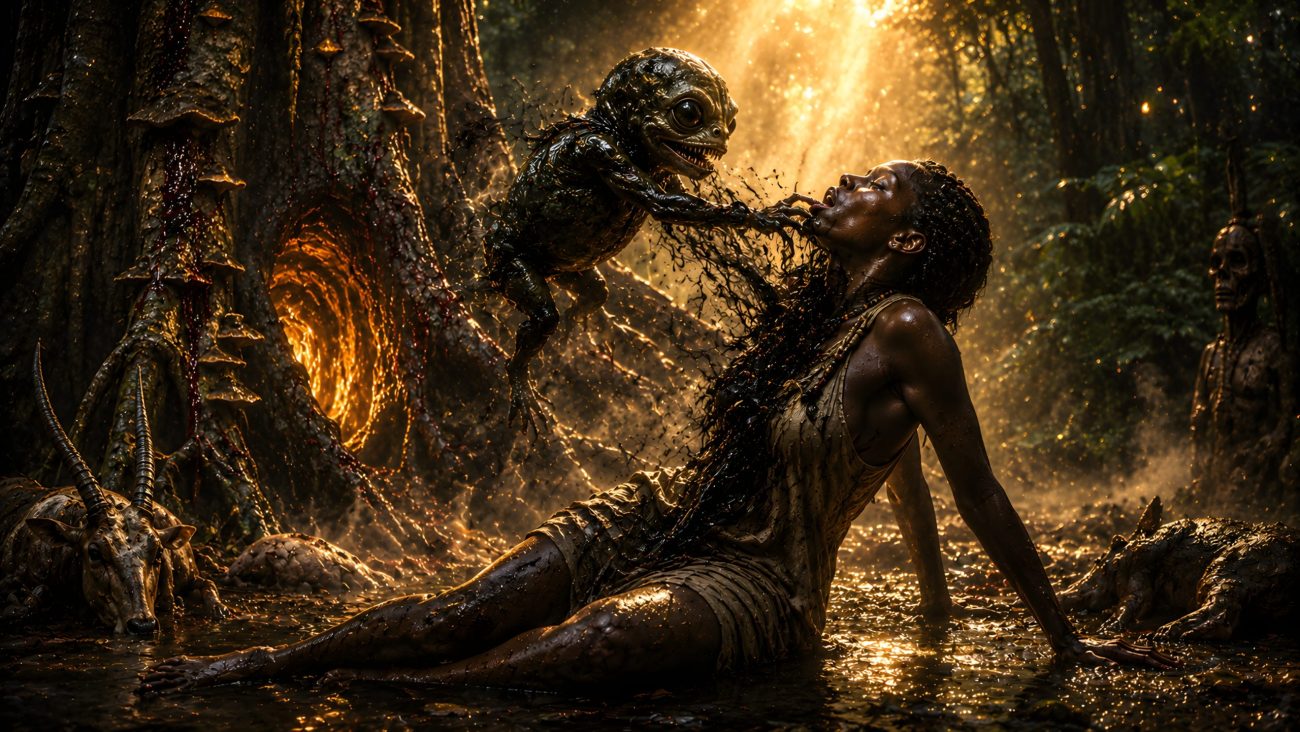
Tradition / Region: Gabon Mythology
Alternative names: Evu
Category: Forest Dweller
The Myth
Evus was a feared being in Fang mythology, associated with witchcraft, death, hunger, corruption, and destructive desire. Stories described him as a strange creature living deep inside swamps and forests, sometimes appearing as a giant toad, a frog-like beast, or a mysterious child hidden inside hollow trees. He fed on raw meat and lived far from human villages in dark wilderness untouched by civilization.
Long ago, during the first age of humanity, the creator Zamba lived among humans and protected them. At that time people did not know true death, sickness, or suffering. Zamba warned his wife never to enter a forbidden part of the forest where Evus lived hidden among the swamps.
But curiosity overcame her.
After Zamba left on a journey, the woman secretly entered the forbidden forest. There she found piles of freshly killed animals and heard a voice calling from the swamp. Soon Evus revealed himself — an ugly, unnatural creature who promised endless meat and prosperity if she brought him back to the village.
Because Evus could not openly travel among humans, he instructed the woman to squat down. The creature then entered her body through her vagina and lodged himself inside her stomach.
From that moment onward, disaster entered the world.
Once inside the village, Evus constantly demanded food. First he devoured goats and sheep. Then chickens. Soon all the domestic animals were gone, but his hunger never stopped growing.
Finally, Evus demanded human flesh.
The woman’s daughter became his first human victim, and through this act death entered human existence forever. Bodies began to decay, suffering appeared among mankind, and the peaceful world created by Zamba collapsed.
When Zamba returned and saw what had happened, he became furious. Seeing that Evus now lived inside humanity itself, he abandoned mankind and left humans alone with death, evil, and suffering.
From then onward, the Fang believed Evus remained hidden within certain people, feeding dark desires such as greed, jealousy, violence, sorcery, and destruction. He became a symbol of the dangerous force hidden inside the human heart — a hunger that can never truly be satisfied.
Sources
Mvé Ondo, B. (2011). Wisdom and initiation in Gabon: A philosophical analysis of Fang tales, myths, and legends (J. F. Barnes, Trans.). Lanham, MD: Lexington Books.