Vila of Butkove Stijene

Tradition / Region: Bosnian Mythology
Alternate Names: Butkove Vila
Category: Fairy


The Myth

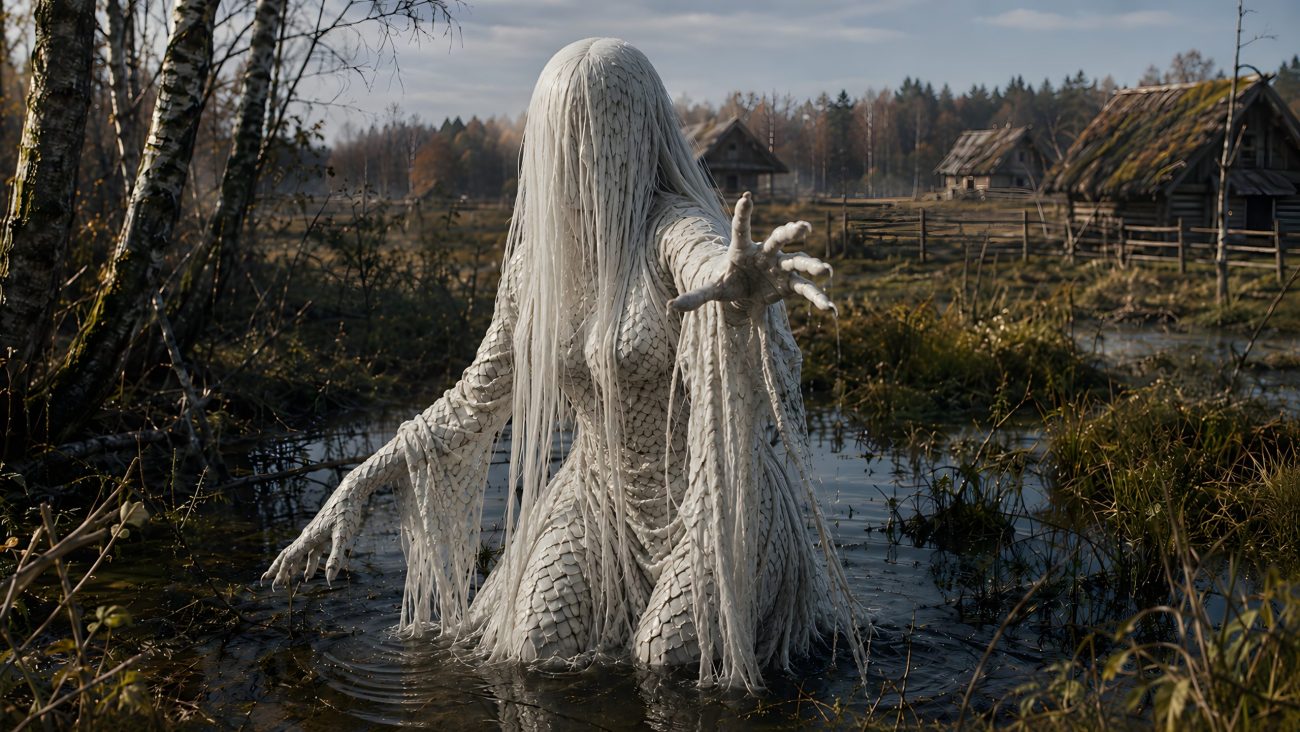
The Vila of Butkove Stijene is a mountain and river spirit connected to the cliffs above the Drina, near Višegrad. Like other Balkan vile, she is a powerful and dangerous supernatural being tied to wild nature, especially water and rocky heights.

During the construction of the bridge on the Drina, commissioned by Sokollu Mehmed Pasha, the master builder Mitre encountered her while testing whether the river could be crossed. As his horse reached the middle of the river, it suddenly froze, unable to move forward.

At that moment, the vila appeared and tried to drown both Mitre and his horse. However, the horse broke free and leapt back onto dry land, carrying the vila with it. Mitre drew his sword to kill her, but she stopped him by invoking a sacred bond, calling him her brother and begging for mercy.

In exchange for her life, she promised to help him build the bridge. Trusting her, Mitre released her back into the cliffs of Butkove Stijene.

But when the construction repeatedly failed—everything built during the day collapsing by night—Mitre called upon the vila for help. She answered from the rocks, explaining that she could not assist him directly because other vile forbade it. Instead, she revealed the harsh condition required for success: living humans had to be built into the structure.

Following her instruction, two people were immured within the bridge, and only then did the construction succeed.

The Vila of Butkove Stijene reflects the dual nature of vile in Balkan folklore—beautiful and knowledgeable, yet bound by harsh supernatural laws. She does not lie, but her guidance leads to sacrifice, showing that dealing with such beings always comes at a cost.


Sources

Hormann, K. (1976). Narodne pjesme muslimana u BiH – Knjiga 1. In Bosna i Hercegovina (collected 1888–1889).


Ravenmill Demon

Tradition / Region: Czech Mythology
Alternate Names: Demon of the Rabenmühle
Category: Demon


The Myth

The Ravenmill Demon is associated with the infamous Rabenmühle, a mill feared by locals for its connection to dark forces and witchcraft. The miller himself was said to be deceitful and corrupt, while his wife was a practicing witch who cursed nearby farmers and their livestock if they refused to use the mill.

Because of its sinister reputation, travelers would make the sign of the cross when passing the mill, fearing the presence of evil forces tied to it.

The true horror revealed itself through the miller’s three daughters, who were described as even more wicked than their parents. One night, after a gathering, they swore that they would dance no matter what—even if it meant dancing with the devil.

Soon after, mysterious strangers arrived, appearing as elegant musicians and noble men adorned with gold. They began dancing with the daughters, at first slowly and gracefully, but the dance quickly turned wild and unnatural.

As the music grew shrill and disturbing, the dancers revealed their true forms—horns sprouted from their heads, and their feet transformed into hooves. These were no humans, but demonic beings.

The dance reached a frenzy until suddenly the demons carried the daughters away into the air. At that very moment, the Ravenmill burst into flames and vanished, as if consumed by infernal forces.

The Ravenmill Demon represents a classic motif in Central European folklore: the devil answering reckless invitations. The daughters’ oath opened the door, and the demons came not merely to dance—but to claim what had been offered.


Sources

sagen.at contributors. (n.d.). Die Rabenmühle. In sagen.at, from https://www.sagen.at/texte/sagen/tschechien/watzlik/rabenmuehle.html


Three-Legged Rabbit

Tradition / Region: Czech Mythology
Alternate Names: –
Category: Rabbit


The Myth

The Three-Legged Rabbit appears as a strange and unsettling creature tied to a tragic rural legend. It is not described as a natural animal, but as something uncanny that manifests at a critical moment.

In a village, a group of boys argued whether a person could hang themselves from a simple straw if fate—or the devil—willed it. One boy, determined to prove it, tied a straw to a beam and hanged himself, telling the others to cut him down if he began to suffocate.

At that exact moment, a rabbit with only three legs suddenly ran through the barn. Its unnatural appearance startled the boys, who chased after it in confusion and excitement, completely forgetting their friend.

By the time they returned, it was too late—the boy had died.

The three-legged rabbit is not directly identified as a demon, but its timing and abnormal form strongly suggest a supernatural role. It functions as a distraction or omen, appearing precisely when needed to lead the boys away from the hanging.

In this way, the creature is often interpreted as a manifestation of dark fate or a subtle agent of evil—possibly linked to the devil mentioned earlier—ensuring that the tragic outcome could not be prevented.


Sources

sagen.at contributors. (n.d.). Der Dreifüßige. In sagen.at, from https://www.sagen.at/texte/sagen/tschechien/watzlik/derdreifuessige.html


Reus te Hammen

Tradition / Region: Belgian Mythology
Alternate Names: Giant of Hamme
Category: Giant


The Myth

The Reus te Hammen refers to a legendary giant or giants associated with the town of Hamme in Flanders. The most tangible element of the legend is a massive bone kept in the local church, believed by the people to be the thigh bone of a giant.

According to tradition, this enormous bone was pulled from the river Durme long ago and preserved in the church, where it came to be treated almost like a sacred relic. Its unusual size reinforced the belief that giants once lived in the region.

Older accounts speak of two giants who lived on opposite sides of the river. They argued over who was taller and went to prove their size by reaching the roof of a church under construction, each able to place stones without the need for scaffolding.

In other versions, there were three giants who built a church in Hamme themselves, their height allowing them to work directly at roof level. One of them was said to cross the river simply by walking through it, unaffected by its depth.

Local traditions also preserve traces of their presence in the landscape. Certain paths and features, such as “giants’ roads,” were believed to mark where they once moved, and these places were treated with caution and respect.

The giant of Hamme was not just a distant myth but a figure tied to physical evidence, local geography, and enduring popular belief, linking the land, the people, and the memory of beings of immense size who once walked there.


Sources

de Cock, A. (1921). Vlaamsche sagen uit den volksmond. In Amsterdam: Maatschappij voor goede en goedkoope lectuur p. 154.


Gort Dev

Tradition / Region: Armenian Mythology
Alternate Names: —
Category: Toad


The Myth

The Gort Dev is a toad-like demonic being in Armenian belief, associated with night, disease, and harmful forces. It is linked to the broader class of dark creatures connected with evil powers and is regarded as unclean and dangerous.

Toads were seen as part of a group of evil animals that act especially at night, alongside snakes, scorpions, ants, and other harmful creatures. These beings were believed to pursue humans in darkness, either alone or together.

The Gort Dev was specifically associated with illness. It was thought to cause warts on the hands and was considered responsible for certain physical afflictions. Because of this, it was not to be killed with a stone.

Encounters with it required protective actions. When a person saw a toad, especially at night, they would spit on their hands and feet as a way to guard against its harmful effects and against other evil beings.

It was also believed that seeing a toad could cause harm to the body, such as making a person lose their teeth, which is why one was expected to immediately close the mouth upon seeing it.


Sources

Abeghyan, M. (1899). Der armenische Volksglaube (English translation: Armenian Folk Beliefs). In Leipzig. Translated by Bedrosian, R. p. 25.


Torx

Tradition / Region: Armenian Mythology
Alternate Names: Torch
Category: Giant


The Myth

Torch is a powerful giant-like being in Armenian mythology, associated with a class of supernatural craftsmen similar to dwarfs and ancient smith-spirits. He is known for great strength as well as skill in crafting and working materials.

He was described as having a massive and rough body, an ugly face, a flat nose, and deep-set, harsh eyes. He belonged to a race connected to ancient beings of great physical power and was believed to dwell in the western regions of Armenia, near the Black Sea.

Torch was renowned not only for his strength but also for his ability as a craftsman. He could shape hard stone, smoothing it and carving figures into it with his fingernails, and was known as both an artisan and an artist.

In one account, he encountered his enemies on the shores of the Black Sea. At the sight of him, they fled by ship and put great distance between themselves and the giant. Torch responded by hurling enormous rocks toward them. The stones struck the sea with such force that some ships were swallowed by the waters, while others were driven far away by the waves caused by the impact.


Sources

Ananikian, M. H. (1925). Armenian Mythology. In The Mythology of All Races, Vol. 7. Published by the Archaeological Institute of America p. 85-86.


Nhang

Tradition / Region: Armenian Mythology
Alternate Names: —
Category: Water spirit, Demonic being


The Myth

The Nhang is a malevolent water spirit in Armenian mythology, associated with rivers and deep waters. Although the word originally meant “crocodile,” it came to refer to a supernatural being believed to inhabit certain waterways.

These spirits were said to dwell in specific rivers, including the Euphrates and the river Aragani, where they remained and caused harm. They were regarded as incorporeal beings rather than ordinary animals.

The Nhang could take different forms. At times it appeared as a woman in the water, resembling a mermaid-like figure. At other times it took the shape of a seal-like creature that attacked swimmers, seizing them by the feet and dragging them beneath the surface.

It was also said to prey on animals, feeding in a blood-drinking manner and leaving them dead afterward.

Its nature was not clearly defined in tradition, as some described it as a beast while others considered it a type of Dev.


Sources

Ananikian, M. H. (1925). Armenian Mythology. In The Mythology of All Races, Vol. 7. Published by the Archaeological Institute of America p. 89-90.


Phlachal

Tradition / Region: Armenian Mythology
Alternate Names: Elephant-Goat
Category: Sheep, Elephant, Hybrid


The Myth

The Phlachal is a rare and obscure creature in Armenian mythology, described simply as an “elephant-goat.” It belongs to a class of chimeric beings—monsters formed by combining traits of different animals.

Very little detailed information survives about the Phlachal, but its name suggests a hybrid of immense size and unnatural composition, likely blending the strength and mass of an elephant with the agility or form of a goat. Like other chimeras in regional folklore, it would have been perceived as unnatural and unsettling.

It appears in the same context as other hybrid creatures such as the sea-bull, indicating that it was part of a broader mythological tradition of monstrous animals that defied natural order. These beings were often associated with fear, unpredictability, and the boundaries between land, sea, and the supernatural.


Sources

Ananikian, M. H. (1925). Armenian Mythology. In The Mythology of All Races, Vol. 7. Published by the Archaeological Institute of America p. 92.


Kaches

Tradition / Region: Armenian Mythology
Alternate Names: Devs (popular belief), “The Brave Ones”
Category: Fairy


The Myth

The Kaches are incorporeal spirits in Armenian mythology, forming a link between dragons and the later concept of Devs. Their name, meaning “the brave ones,” is a euphemistic title used to appease them, reflecting a common tradition of referring to dangerous spirits with respectful names.

They are similar to European fairies or kobolds—unpredictable supernatural beings that are not inherently evil but can be harmful. Though considered good in essence by some traditions, they were often instruments of punishment or misfortune.

Kaches were believed to inhabit stony and mountainous places, especially Mount Massis, though they could appear almost anywhere. Many locations were associated with them, indicating a widespread belief in their presence across the landscape.

Like dragons, they were said to have palaces in high or remote places. They were also connected to legendary figures, holding captives such as Artavazd, Alexander the Great, and King Erwand in hidden or supernatural realms.

Their behavior closely resembled that of wild or primitive communities. They hunted, waged wars, and lived in organized groups. At the same time, they interfered with human life by stealing grain and wine, disrupting agriculture, and causing hardship.

They could also be directly hostile. People believed they beat, dragged, or tormented humans, sometimes driving them to madness through their influence.

Kaches were associated with magic and occult practices. Practitioners of magic were said to travel to them, even across water, to gain knowledge or serve them, suggesting that these spirits acted as hidden masters of forbidden knowledge.

They were also known for music. Their singing could be heard by humans, reinforcing their connection to other fairy-like beings in global folklore.

Overall, the Kaches represent a class of elusive and ambivalent spirits—neither fully benevolent nor entirely malevolent—existing between the natural and supernatural worlds, and deeply embedded in the mythological landscape of Armenia.


Sources

Ananikian, M. H. (1925). Armenian Mythology. In The Mythology of All Races, Vol. 7. Published by the Archaeological Institute of America p. 77–79.


Urvakan

Tradition / Region: Armenian Mythology
Alternate Names: Ghost, Phantom (from “uru”)
Category: Ghost


The Myth

The Urvakan is a ghostly being in Armenian belief, representing the spirit of a deceased person after death. The term derives from an older word meaning soul or phantom, which over time came to signify a visible or perceptible ghost.

In early Armenian thought, a human being consisted of a body and a soul, the latter originally understood as “breath.” At death, this soul was believed to leave the body—often imagined as exiting through the mouth in a painful process—becoming a separate, wandering entity.

After death, the Urvakan did not immediately depart to another realm. It remained near the body until burial, lingering in a transitional state between the living world and the afterlife. This period was considered dangerous and sacred, which is why candles and incense were used around the corpse—to protect the spirit and ward off harmful influences.

These ghostly beings were not merely feared but also, in earlier times, received forms of reverence or worship. The existence of the term for “ghost-worshippers” indicates that the Urvakan once held a recognized place in spiritual practices, possibly linked to ancestor veneration.

The Urvakan reflects a broader fatalistic worldview in which human life was tied to cosmic forces. The soul itself was sometimes associated with stars, and it was believed that when a star fell, a human life ended—suggesting a deep connection between human existence and the heavens.

Though not always malevolent, the Urvakan inspired fear and respect. The presence of the dead was considered polluting and powerful, requiring ritual care. Improper handling of death or burial could disturb the spirit, potentially leaving it restless.

Overall, the Urvakan embodies the Armenian conception of the soul after death: a lingering, perceptible presence caught between worlds, shaped by ritual, belief, and the cosmic order governing human fate.


Sources

Ananikian, M. H. (1925). Armenian Mythology. In The Mythology of All Races, Vol. 7. Published by the Archaeological Institute of America p. 94.