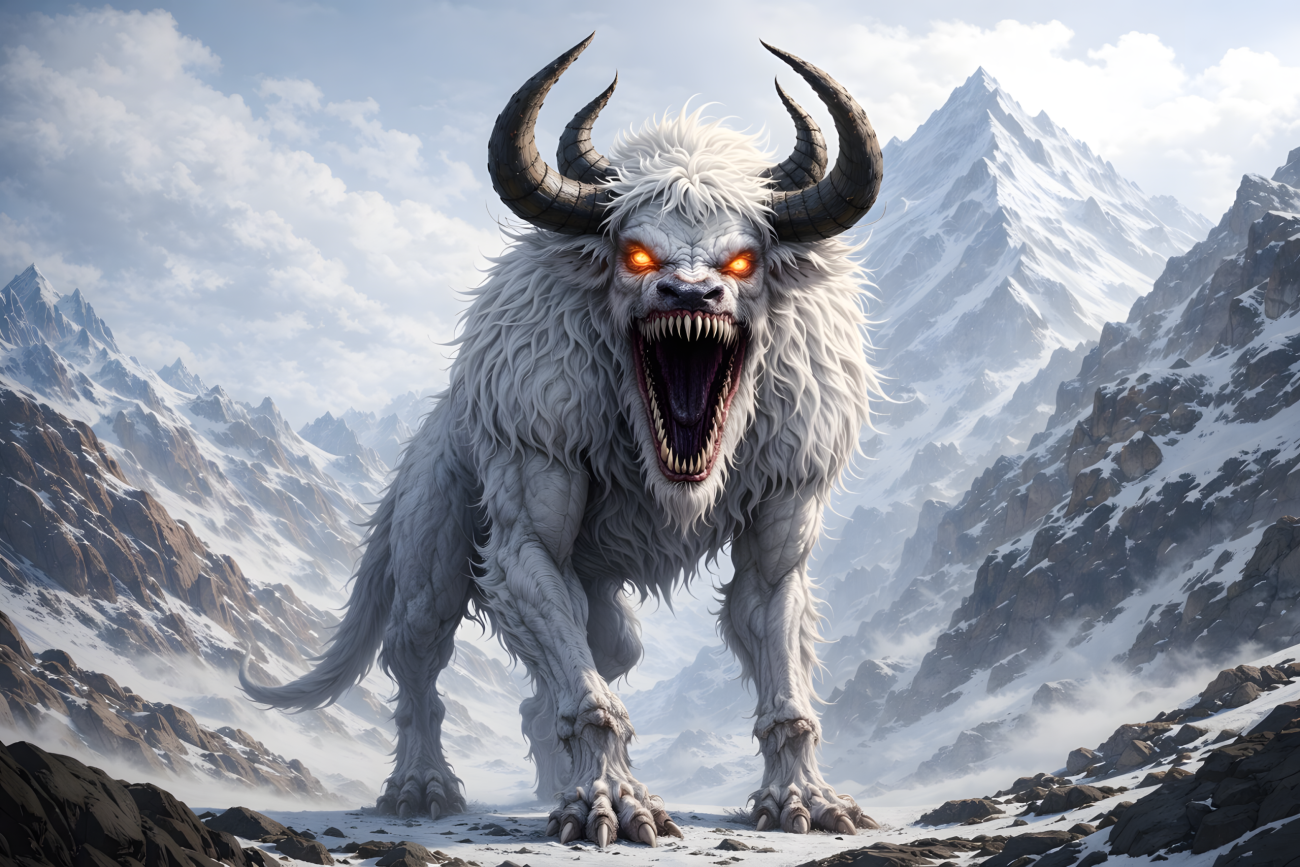
Aoyin

Tradition / Region: Chinese mythology
Alternate Names:
Category: Cow, Mountain dweller


The Myth

Far to the west, beyond the reach of familiar roads, rises Three-Dangers Mountain, a place long feared by travelers. The mountain spans a hundred li around, and its three peaks are known to shelter beings both strange and deadly.

There lives a monster called Aoyin.

Its body is shaped like that of an ox, yet its hide is white as bone. Four horns rise from its head, and its body is covered in long, coarse hair like straw woven into rain capes. Though it bears the form of cattle, Aoyin is no gentle beast. It feeds on human flesh, preying on those who cross the mountain or linger too long beneath its peaks.

Three Green Birds are also said to dwell upon Three-Dangers Mountain. In later times they would be known as divine messengers, but here they share the heights with the man-eating Aoyin, marking the mountain as a place where sacred forces and mortal peril exist side by side.

Some say that Three-Dangers Mountain was also a land of exile. After rebelling against the ancient ruler Shun, the Three-Sprouts People were driven there and cast out to the edge of the world. Surrounded by barren land and deadly creatures, they disappeared from history.

Thus Aoyin became the living terror of Three-Dangers Mountain—a white, four-horned ox-beast that devours humans, standing as a warning that not all creatures shaped like cattle are meant to sustain life.


Gallery


Sources

Strassberg, R. E. (2002). A Chinese bestiary: Strange Creatures from the Guideways Through Mountains and Seas. Univ of California Press, p. 112.


Interpretive Lenses

Religious Readings
  • Christian Ascetic Deep Dive
Philosophical Readings
  • Nietzschean Deep Dive
Psychological Readings
  • Jungian Deep Dive
Esoteric Deep Dive
  • Hermetic Deep Dive
Political / Social Readings
  • Marxist Deep Dive
Other
  • How to Invite The Aoyin

Akshit

Tradition / Region: Egyptian mythology
Alternate Names:
Category: Cow, Goddess


The Myth

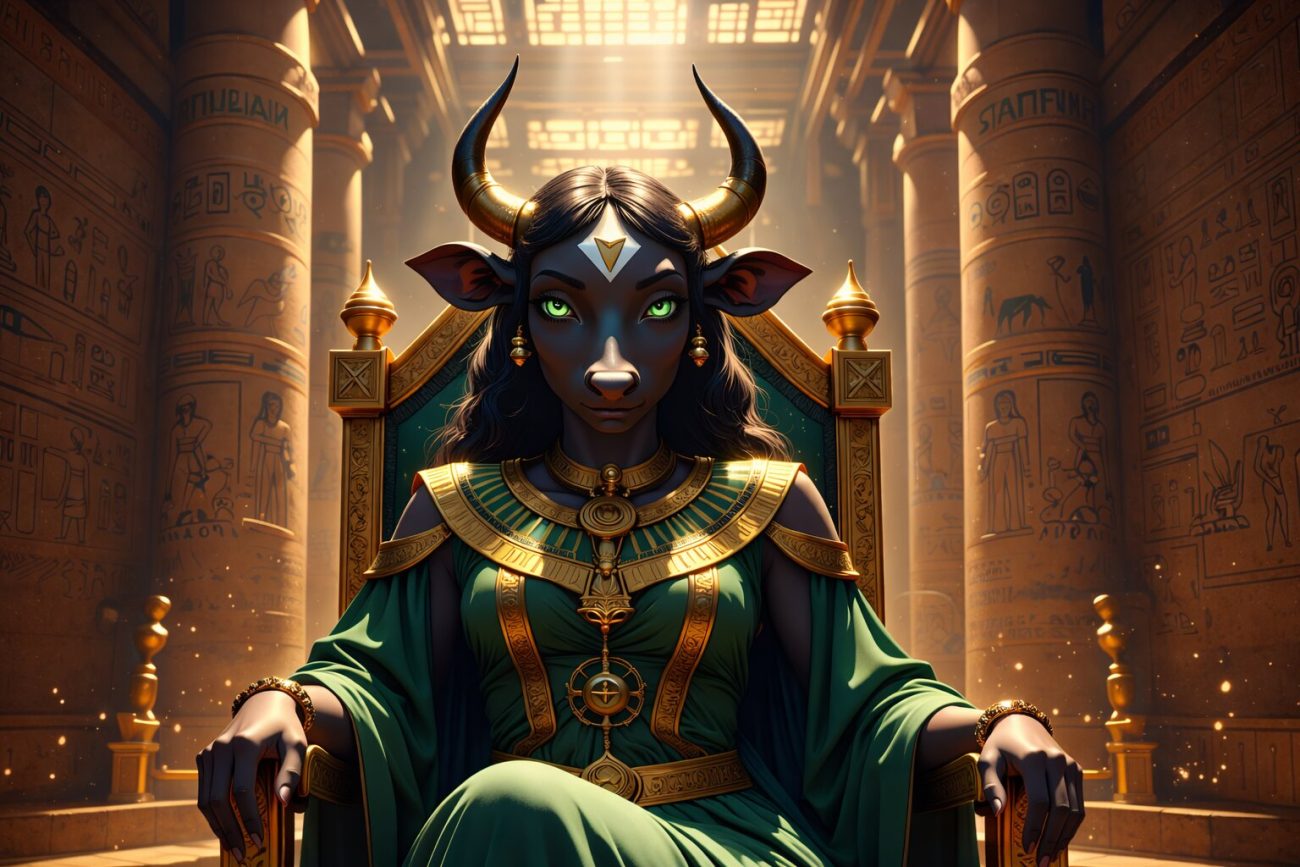
In the city of Oxyrhynchus there was honored a quiet goddess named Akshit, a sacred cow whose destiny was bound to the gods themselves. From her body was born Apis, the holy bull, chosen to walk among humans as a living sign of divine power.

Akshit nurtured her son knowing he was more than a calf. Within him lived fertility, strength, and the will of the gods. As Apis grew, he became the center of reverence: temples rose for him, offerings were brought, and the people watched his movements for meaning. Through him, the gods spoke without words.

Akshit remained in the background of this sacred life, yet everything depended on her. Without her care, the divine bull could not exist. As his mother, she guarded the passage by which divine force entered the world in living form.

Thus Akshit was remembered not for command or spectacle, but for creation itself—the sacred mother who gave the gods a body through which they could dwell among humankind.


Gallery


Sources


Budge, E. A. W. (1920). An Egyptian hieroglyphic dictionary : with an index of English words, king list and geological list with indexes, list of hieroglyphic characters, coptic and semitic alphabets, etc. (p. 95) J. Murray.


Interpretive Lenses

Religious Readings
  • Christian Ascetic Deep Dive
Philosophical Readings
  • Nietzschean Deep Dive
Psychological Readings
  • Jungian Deep Dive
Esoteric Deep Dive
  • Hermetic Deep Dive
Political / Social Readings
  • Marxist Deep Dive
Other
  • How to Invite The Akshit

Akabeko

Tradition / Region: Japanese mythology
Alternate Names: Red Cow
Category: Cow


The Myth

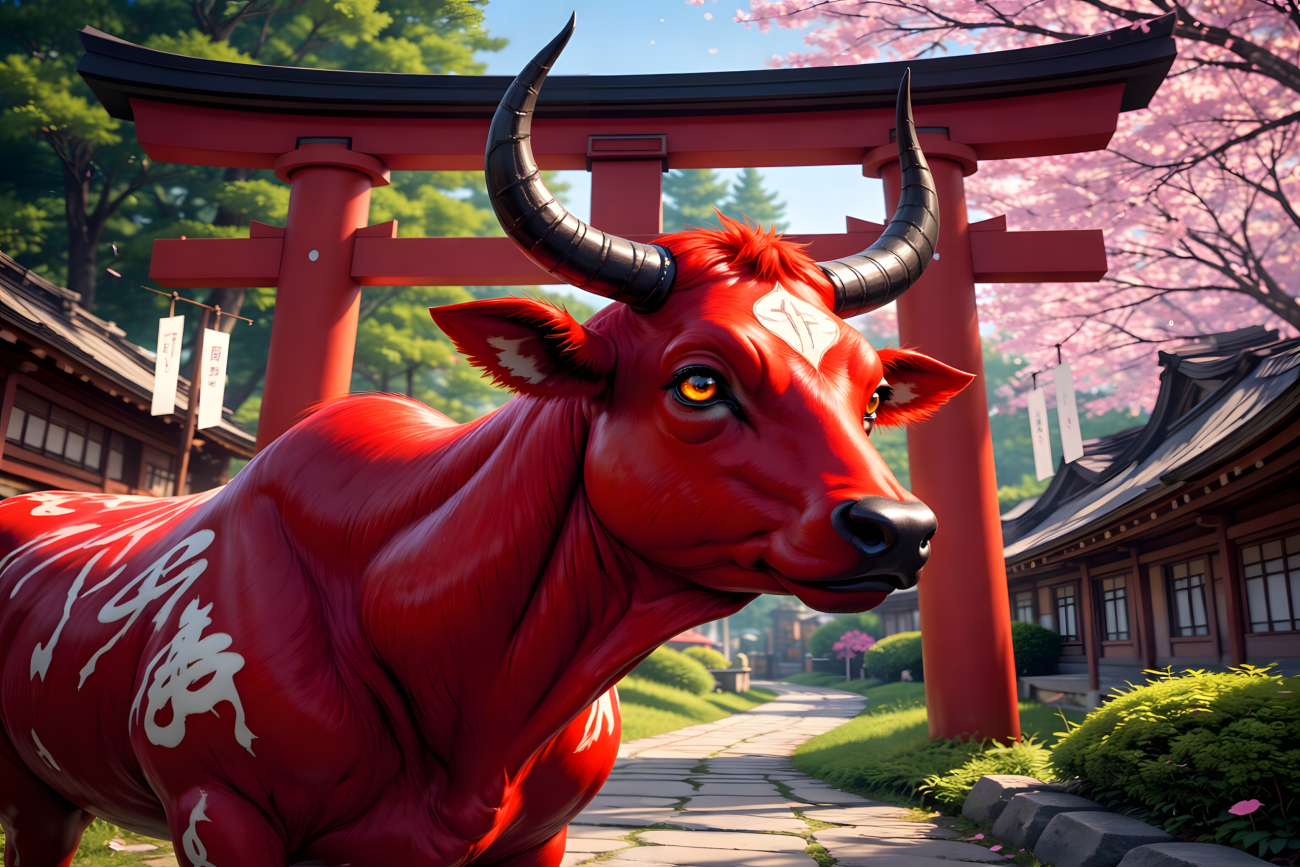
Long ago, during the early ninth century, monks were building Enzō-ji temple in the town of Yanaizu. The work was heavy, and the task of carrying stone and timber up to the site was exhausting. One day, a powerful red ox appeared and began helping the monk Tokuitsu Daishi, hauling construction materials tirelessly as if it understood the sacred purpose of the work.

The red ox labored until the temple was complete. When the final stone was set, it did not return to the wild. Some say it turned to stone on the temple grounds; others say it simply chose to remain there forever, watching over the place it had helped create. From then on, it was known as Akabeko—the Red Cow.

Generations later, people remembered Akabeko not only for its strength, but for its devotion. Small figures of the red cow were made in its image, and it was said that Akabeko protected children from sickness and misfortune. Its red color was believed to drive illness away, just as the living cow had once driven fatigue and hardship from the builders of the temple.

To this day, Akabeko endures as a gentle guardian. Those who visit its likeness at Enzō-ji rub it for luck, honoring the red cow that gave its strength freely and chose to remain behind as a silent protector of the faithful.


Gallery


Sources

TYZ Yokai Encyclopedia. (2021, March 3). 赤べこ (Akabeko), from https://tyz-yokai.blog.jp/archives/1078437861.html

Wikipedia contributors. (n.d.). Akabeko. In Wikipedia, The Free Encyclopedia, from https://en.wikipedia.org/wiki/Akabeko


Interpretive Lenses

Religious Readings
  • Christian Ascetic Deep Dive
Philosophical Readings
  • Nietzschean Deep Dive
Psychological Readings
  • Jungian Deep Dive
Esoteric Deep Dive
  • Hermetic Deep Dive
Political / Social Readings
  • Marxist Deep Dive
Other
  • How to Invite The Akabeko

Ahtin Taikahärkä

Tradition / Region: Finnish mythology
Alternate Names: Ahti’s Magic Bull
Category: Cow


The Myth

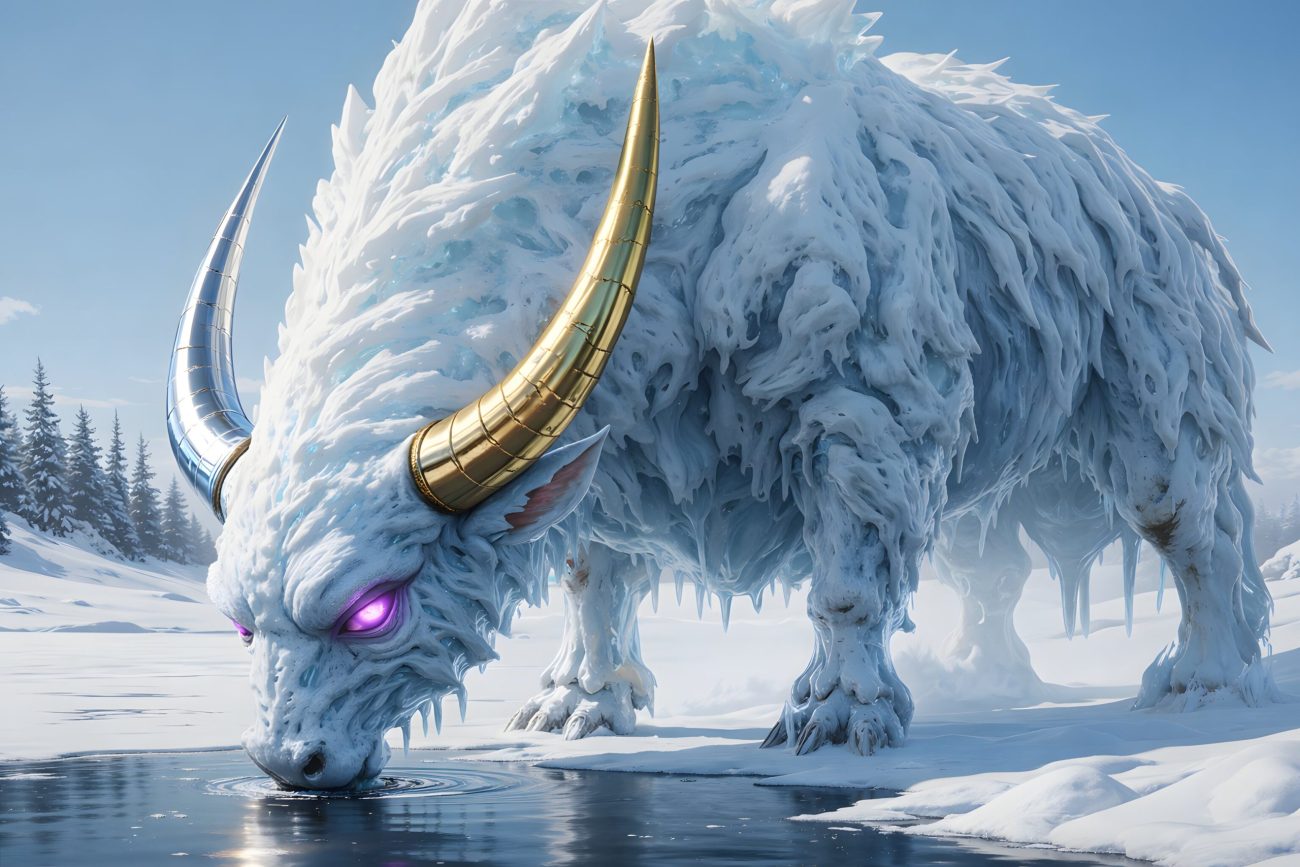
By the will of Ahti, King of the Islands, a wondrous creature was brought fully into the world. It was no spirit or illusion, but a living bull of immense size and strength. Its horns shone like gold and silver, and its body pressed heavily upon the earth as though the land itself struggled to bear it.

The bull wandered in quiet majesty. When it came upon a small lake, it lowered its great head and drank deeply, lingering at the water’s edge as if bound to that place. Its breath was slow and powerful, and the world seemed to pause around it.

Far away in the northern land of Pohjola, its ruler became aware of the bull’s existence. In response, he created a wolf—lean, fierce, and driven by a single purpose—and sent it forth to hunt the magical beast.

In time, bull and wolf met.

Their clash was brief and violent, and the outcome was already woven into fate. The wolf brought the bull’s life to an end, and the creature with horns of gold and silver vanished from the world.

What remained was only the memory of its creation: a life summoned by divine power, brilliant and real, yet destined to endure only for a moment before being reclaimed by the forces set against it.


Gallery


Sources


Kalevala: The Epic Poem of Finland: RUNE XXVII, the Unwelcome Guest
(J. M. Crawford, Trans.). (1888).


Interpretive Lenses

Religious Readings
  • Christian Ascetic Deep Dive
Philosophical Readings
  • Nietzschean Deep Dive
Psychological Readings
  • Jungian Deep Dive
Esoteric Deep Dive
  • Hermetic Deep Dive
Political / Social Readings
  • Marxist Deep Dive
Other
  • How to Invite The Ahtin Taikahärkä

Aatxe

Tradition / Region: Basque mythology, Spanish Mythology, French Mythology
Alternate Names: Etsai, Aatxegorri
Category: Cow


The Myth

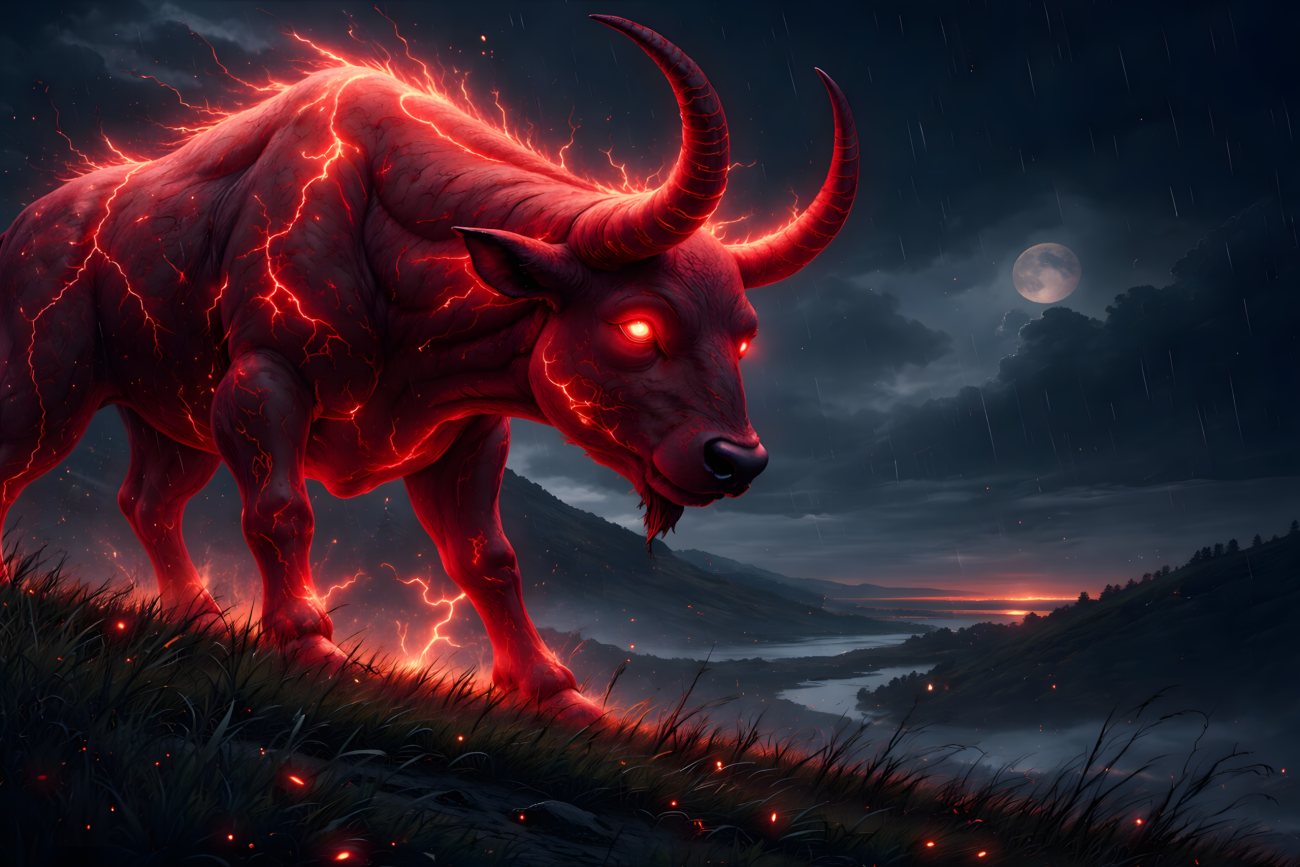
Aatxe is a spirit in Basque folklore whose name means “young bull.” He is a cave-dwelling shapeshifter most often appearing as a young red bull, but he may also take the form of a man, cow, or calf. He emerges at night, especially during storms, from caves or hollows where he lives. He attacks criminals and other malevolent people and protects others by making them stay home when danger is near. He is considered a representative or enforcer of Mari.

In the ancient Basque lands, justice was not written in books or spoken by judges. It lived in the land itself. It moved through mountains, valleys, and storms, watching quietly. One of its strongest forms was the Aatxe.

The Aatxe did not live among people. He dwelled deep within caves carved into the earth—dark places where the world opens inward. These caves were not empty hollows but living thresholds, places where the human world touched something far older. From there, the Aatxe kept watch, standing between humanity and the forces beneath the ground.

He did not emerge without reason.

The Aatxe came forth only when rain fell. When storms covered the land, villages grew quiet and honest people stayed inside by their fires. Only those with secrets, ill intent, or guilt walked abroad in such weather. Rain stripped the world of witnesses and noise, leaving only the sound of water and footsteps. It was then, in the blurred paths and empty roads, that the Aatxe appeared.

Those who encountered him knew why he had come.

The Aatxe did not need to question or accuse. He did not bargain, hesitate, or explain. His presence alone was judgment. The guilty felt it immediately—an inescapable certainty that no excuse could undo what had already been done. Fear came not from violence, but from inevitability.

He was not an independent being, but a form taken by Mari, the great power of earth and storm. Through wind and rain, she shaped the conditions of justice, and through the Aatxe she made it visible. The storm was not a warning—it was the space in which judgment could occur.

Thus the people believed that morality was part of nature itself. To act wrongly was not merely to break a rule, but to step out of harmony with the world. And when that happened, the land would answer—quietly, patiently, and without mercy—through the coming of rain and the silent watch of the Aatxe.


Gallery


Sources

Bane, T. (2016). Encyclopedia of spirits and ghosts in world mythology (p. 13). McFarland.

Barandiaran Ayerbe, J. M. D. (n.d.). Aatxe. Auñamendi Eusko Entziklopedia. Retrieved, from https://aunamendi.eusko-ikaskuntza.eus/artikuluak/artikulua.php?id=eu&ar=5626

Julien, D. H. U. Y., and Jean-Loïc LE QUELLEC. “Les Ihizi: et si un mythe basque remontait à la préhistoire?.”

Rose, C. (1998). Spirits, Fairies, Leprechauns and Goblins. Norton.


Interpretive Lenses

Religious Readings
  • Christian Ascetic Deep Dive
Philosophical Readings
  • Nietzschean Deep Dive
Psychological Readings
  • Jungian Deep Dive
Esoteric Deep Dive
  • Hermetic Deep Dive
Political / Social Readings
  • Marxist Deep Dive
Other
  • How to Invite The Aatxe

Chipfalamfula

Tradition / Region: Bantu mythology, Mozambique Mythology
Alternate Names: River-Shutter
Category: Fish


The Myth

In the rivers and bays of the south lives Chipfalamfula, the River-Shutter—an enormous being whose true shape is uncertain, said by some to be a whale and by others a colossal catfish. It rules the waters completely, opening and closing them at will, bringing floods or drought as it pleases. Its body is so vast that its belly is a world of its own, filled with fertile land, cattle, and people who live there in peace, lacking nothing.

Once there was a girl named Chichinguane, the youngest daughter of Chief Makenyi. She was dearly loved by her father and bitterly hated by her older sisters. One day, when the sisters went to the river to gather clay, the eldest ordered Chichinguane to climb down into the pit and pass the clay up to her. Chichinguane obeyed, but when the tide rose, her sister abandoned her, leaving her to die in the flooding pit.

As Chichinguane lost hope, Chipfalamfula surfaced beside her and opened its immense mouth. Gently it spoke, telling her to come inside, promising safety and comfort. Chichinguane entered its body and lived there for many years, sharing in the abundance of the world within the River-Shutter.

Time passed, and one day the daughters of Makenyi came again to the river, singing as they carried water. Among them was a new youngest daughter, now treated with the same cruelty Chichinguane had once suffered. When the girl wept by the riverbank, Chichinguane emerged from the water, her body transformed and covered in shining silver scales. Angry at the song that told of her murder, she struck the girl, but seeing that the child did not recognize her, she relented and helped her carry the water. Then she returned to the river.

The two sisters met secretly after that, and Chichinguane finally revealed who she was. The youngest told their mother, who came to the river and tried to embrace her lost child. Chichinguane warned her not to hold her, for she now belonged to the water, and slipped from her grasp like an eel, vanishing beneath the surface.

Though she longed for her family, Chichinguane could not return until Chipfalamfula allowed it. At last, the River-Shutter released her and gave her a magic wand for protection. She returned home, and as she stepped onto land her silver scales fell away and became silver coins. She told her family of her betrayal and of the rich world inside Chipfalamfula.

Chichinguane pleaded for mercy for her eldest sister, but the woman soon betrayed her again, abandoning Chichinguane and the youngest sister in a tree. When monstrous ogres began cutting it down, Chichinguane used the wand to heal the tree again and again until the ogres grew tired. The sisters escaped and fled to the river, where Chichinguane struck the water with the wand and commanded Chipfalamfula to shut it. The river parted, and they crossed safely. When the ogres followed, the waters closed and drowned them.

The sisters returned home laden with riches taken from the ogres’ cave. But treachery could not be undone, and despite Chichinguane’s pleas, the eldest sister was put to death.

Thus Chipfalamfula remains in the deep—guardian, devourer, and master of water—opening and closing the river as fate demands.


Gallery


Sources

A Book of Creatures contributors. (n.d.). Chipfalamfula. In A Book of Creatures, from https://abookofcreatures.com/2017/02/20/chipfalamfula/


Interpretive Lenses

Religious Readings
  • Christian Ascetic Deep Dive
Philosophical Readings
  • Nietzschean Deep Dive
Psychological Readings
  • Jungian Deep Dive
Esoteric Deep Dive
  • Hermetic Deep Dive
Political / Social Readings
  • Marxist Deep Dive
Other
  • How to Invite The Chipfalamfula

Tenchishindousai

Tradition / Region: Japanese Mythology
Alternate Names: Tenshin Dōsai; Shindōsai
Category: Catfish, Fish, Yokai


The Myth

One night, during the Ansei era, a wandering rōnin arrived at a guardhouse in Edo and begged for shelter and food. He was tall, powerfully built, and strange in appearance, like a man hardened by severe training. The guards refused him, saying the guardhouse was not a place for lodging, and told him to seek an inn elsewhere.

At this, the man’s face grew pale.

He declared, “I am Tenchishindousai. There is none who does not know my name. Yet because the land has been calm for many years, people have grown contemptuous. They catch my kin, roast them, stew them, and kill them without cause. I have come to avenge them.”

He spoke of his journey: how he had shaken people to death at temple gatherings, how he had passed through province after province—mountains, capitals, and ports—causing the earth to tremble beneath his feet. Now, he said, he had arrived in Edo.

When the guards realized he claimed to be the Earthquake itself, they tried to seize him. Enraged, Tenchishindousai vanished on the spot.

At once, heaven and earth roared. The ground convulsed violently. Houses collapsed, storehouses fell, fires erupted across the city, and countless people were crushed or burned. Amid the devastation, Tenchishindousai spoke again, saying that the gods were absent from the land—and that if the deity who pins the earth were to arrive, the destruction would grow even greater.

With that, he fled north.

Those who saw his true form said his face was that of a giant catfish, the ancient creature that writhes beneath the land and shakes the world when angered. Thus the people believed the great earthquake was not chance, but revenge—carried out by Tenchishindousai, the living will of the trembling earth.


Gallery


Sources

TYZ-Yokai Blog contributors. (n.d.). 添地震大歳 (Tenchishindōsai). In TYZ-Yokai Blog, from https://tyz-yokai.blog.jp/archives/1069000650.html


Interpretive Lenses

Religious Readings
  • Christian Ascetic Deep Dive
Philosophical Readings
  • Nietzschean Deep Dive
Psychological Readings
  • Jungian Deep Dive
Esoteric Deep Dive
  • Hermetic Deep Dive
Political / Social Readings
  • Marxist Deep Dive
Other
  • How to Invite The Tenchishindousai

Hyakutou

Tradition / Region: Buddhist Lore, Japanese Mythology
Alternate Names: Hyaku-headed Fish
Category: Fish


The Myth

Long ago, Shakyamuni Buddha traveled with his monks along the banks of a great river. There, fishermen hauled up an enormous fish from the water. It was so vast that hundreds of people were needed to drag it ashore. When the crowd gathered, they saw that the fish bore the heads of one hundred beasts—camel, cow, horse, boar, sheep, dog, and many more—each head crying out in suffering.

The Buddha approached the fish and spoke to it. He asked where the one who had guided it now resided. The fish answered that she had fallen into the hell of unending torment. Those who heard this trembled, and Ananda asked the Buddha what sin could have brought such a fate.

The Buddha then told of the fish’s former life.

In an earlier age, there lived a brilliant youth born into a learned family. Though gifted with wisdom, he followed his mother’s urging to deceive his teacher. When he failed to complete his studies, he returned to the monk who had taught him and repaid kindness with cruel words, mocking and humiliating the one who had guided him, likening his teacher’s head to that of an animal.

For these words, heavy karma was formed.

After death, the mother fell into hell, and the son was reborn as a monstrous fish, bearing upon his body the animal heads he had spoken in insult. Each head was the echo of a word once uttered in contempt.

When asked whether the fish could escape this form, the Buddha answered that even across vast ages and countless rebirths, such punishment was not easily shed. Words spoken in cruelty return in kind, and speech, like action and thought, shapes destiny.

Thus the Hyakutou is remembered—a living sermon of flesh and scale, drifting through the waters, bearing one hundred faces of suffering as the weight of its past words.


Gallery


Sources

TYZ-Yokai Blog contributors. (n.d.). ヒャクトウ (Hyakutou). In TYZ-Yokai Blog, from https://tyz-yokai.blog.jp/archives/1022878715.html


Interpretive Lenses

Religious Readings
  • Christian Ascetic Deep Dive
Philosophical Readings
  • Nietzschean Deep Dive
Psychological Readings
  • Jungian Deep Dive
Esoteric Deep Dive
  • Hermetic Deep Dive
Political / Social Readings
  • Marxist Deep Dive
Other
  • How to Invite The Hyakutou

Kun

Tradition / Region: Chinese mythology
Alternate Names: Peng; Dapeng; Pengniao; Kunpeng
Category: Fish


The Myth

In the Northern Sea there lives a fish called Kun. It is so vast that no one knows how many thousands of miles it spans. Its body fills the deep, and when it moves, the waters of the sea are set in motion.

When the time comes, Kun rises from the depths and transforms.

Its scales become feathers, and it becomes the great bird Peng. The Peng’s back is immeasurable, and when it spreads its wings they hang across the sky like drifting clouds. With a single beat of those wings, storms are born and the sea churns below.

When the oceans surge, the Peng takes flight, leaving the Northern Sea behind and journeying toward the Southern Sea, the Heavenly Pool. As it ascends, the small birds of the world laugh and mock it, unable to comprehend a being whose path stretches beyond the horizon. Yet the Peng does not answer them. It rises higher and higher, until earth and sky fall away beneath it.

Thus Kun and Peng are one being—fish and bird, depth and height—moving freely between sea and sky, embodying boundless transformation and the vastness of the world itself.


Gallery


Sources

Wikipedia contributors. (n.d.). 鯉魚. In Wikipedia, The Free Encyclopedia, from https://zh.wikipedia.org/wiki/%E9%AF%A4%E9%B5%AC


Interpretive Lenses

Religious Readings
  • Christian Ascetic Deep Dive
Philosophical Readings
  • Nietzschean Deep Dive
Psychological Readings
  • Jungian Deep Dive
Esoteric Deep Dive
  • Hermetic Deep Dive
Political / Social Readings
  • Marxist Deep Dive
Other
  • How to Invite The Kun

Abarga Zagakhan

Tradition / Region: Mongolian Mythology, Buryat Mythology
Alternate Names:
Category: Fish


The Myth

In the deepest waters of the world lives Abarga Zagakhan, the first of all fish and their eternal king. Vast beyond measure, it is said to dwell at the bottom of Lake Baikal, where no light reaches and no human can follow.

Abarga Zagakhan is shaped like a colossal burbot, yet its size surpasses all creatures of water. Thirteen great fins spread from its body, and its mouth is so immense that it can swallow not only people, but entire herds of animals in a single gulp. Even the fearsome Mangatkhai monsters, terrors in their own right, were devoured by Abarga Zagakhan when they strayed too close to its domain.

From this ancient fish all other fish are said to descend. It rules them silently from the depths, unseen but ever-present, a living force beneath the waters. When currents shift or the lake grows restless, some say it is Abarga Zagakhan turning in its sleep.

Thus the people speak of it with awe and fear, as the ancestor, devourer, and sovereign of all that swims.


Gallery


Sources

Bestiary.us contributors. (n.d.). Abarga-Zagakhan. In Bestiary.us, from https://www.bestiary.us/abarga-zagakhan/


Interpretive Lenses

Religious Readings
  • Christian Ascetic Deep Dive
Philosophical Readings
  • Nietzschean Deep Dive
Psychological Readings
  • Jungian Deep Dive
Esoteric Deep Dive
  • Hermetic Deep Dive
Political / Social Readings
  • Marxist Deep Dive
Other
  • How to Invite The Abarga Zagakhan