Tradition: Basque mythology, Spanish Mythology
Alternative Names: Herensuge
Category: Dragon
The Myth
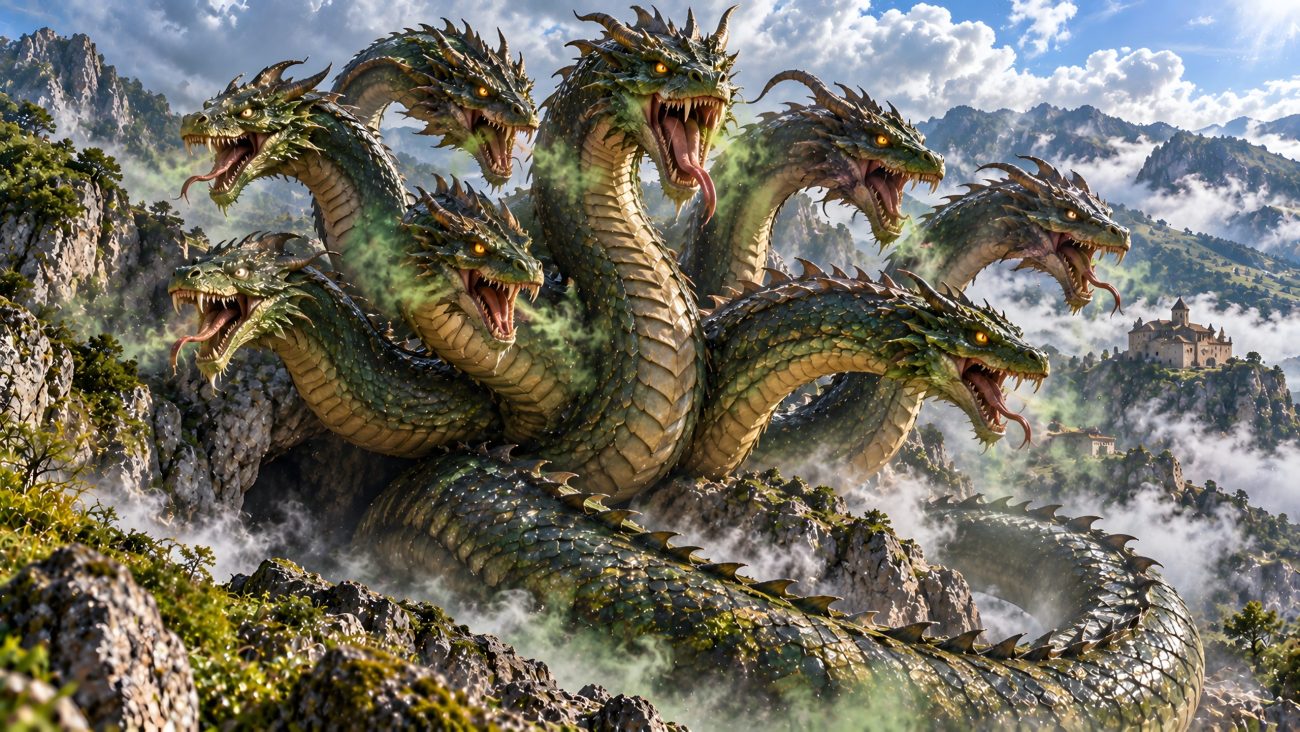
Herensuge is a fearsome Basque dragon that often takes the form of an enormous serpent. Some Herensuge have seven heads, with the seven young dragons believed to grow from the creature’s heads before eventually falling away when they become fully grown. The creature is associated with Sugaar, who is more commonly depicted as a serpent.
One of the most famous tales tells of the Navarrese knight Teodosio de Goñi, who was performing penance for killing his own parents in the Aralar Mountains. There he encountered a woman who had been given to the dragon as a ransom. Teodosio attempted to save her, but the dragon bit through the chains binding his ankles, leaving him unable to escape or fight it.
With no way to defeat the creature, Teodosio prayed to Saint Michael for salvation. In heaven, the archangel heard his plea, but would not enter the battle without God. Saint Michael finally descended with God above him and confronted the dragon. He struck off the Herensuge’s head, freeing Teodosio from his chains and bringing his long penance to an end.
The dragon also appears in tales of seven-headed serpents and princesses condemned to sacrifice. In one story, a prince falls in love with a king’s youngest daughter, only to learn that she has been chosen as the sacrifice to a seven-headed Herensuge. With help from the one-eyed giant Tartalo, the disguised prince battles the dragon three times and finally kills it, winning the princess’s hand.
Another tale tells of a young man who receives a magical stick from an old woman after generously giving her his entire cake. The stick can kill with a single blow. Eventually he reaches a kingdom where the people draw lots to determine who must be sacrificed to a Herensuge, and the king himself loses the drawing, meaning his daughter must die. The young man accompanies her to the dragon’s mountain and uses the magical stick to kill all seven of its heads. As a reward for saving the princess, he marries her.
Herensuge can also appear as a cursed human being. A young woman wandering through the countryside is captured by a serpent and held in a forest for three years. Eventually the creature tells her that he is actually a prince who was transformed into a Herensuge as punishment and will soon regain his human form. He gives her a distaff, spindle, and silk handkerchief and promises to marry her when his punishment ends.
When the young woman returns home, her father prevents her from leaving again, delaying her journey back to the prince. She eventually escapes and travels a great distance to his city, only to discover that he is about to marry another woman. She presents the objects he had given her, proving their earlier promise. The prince abandons the new marriage and instead marries the woman he had promised to wed.
Sources
“Herensuge.” Wikipedia: The Free Encyclopedia. Wikimedia Foundation. Accessed September 26, 2026. https://en.wikipedia.org/wiki/Herensuge