Dead Bride

Tradition: Swiss Mythology
Alternative Names: The Bride of Windegg Castle, Berta von Windegg
Category: Ghost


The Myth

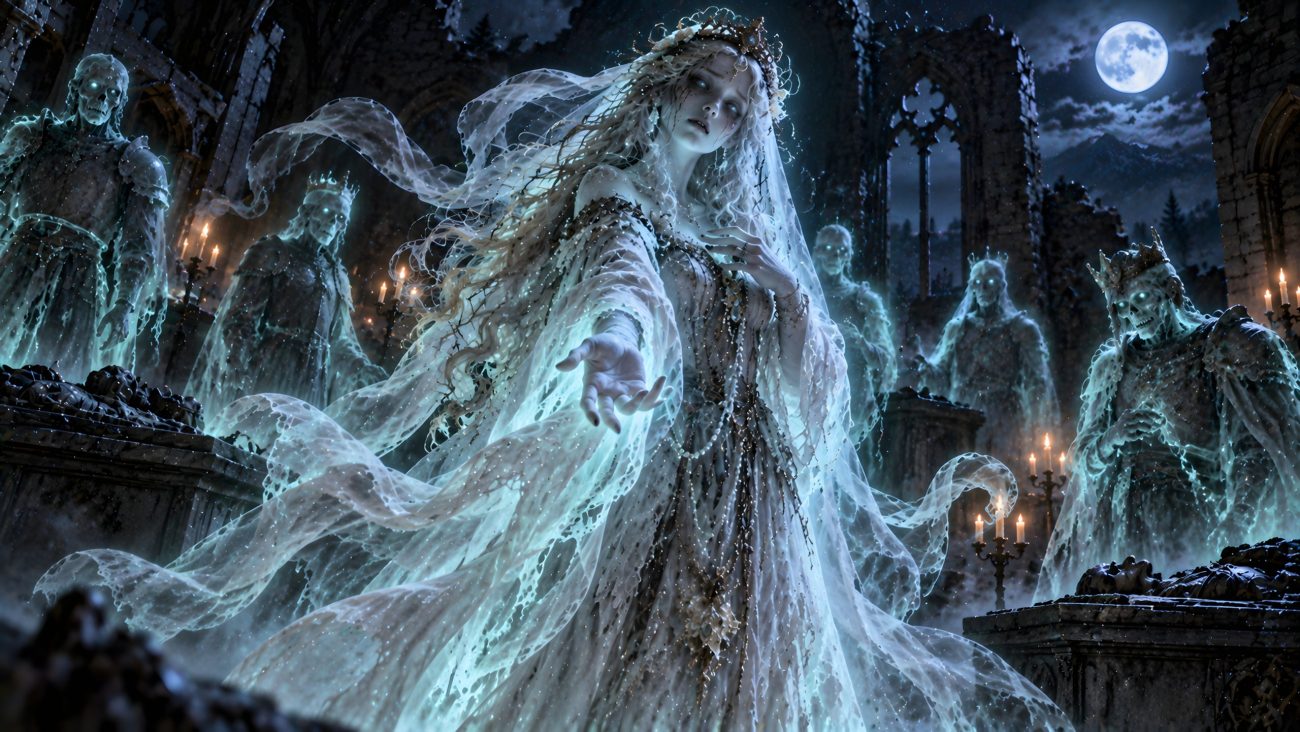
Berta von Windegg is the ghostly bride of Windegg Castle in the Glarus region of Switzerland. She appears as a beautiful, pale maiden with curly hair and an enigmatic silence. Although she wears the appearance of a living noblewoman, her hands are ice-cold, and her true nature becomes apparent when she leads a prospective bridegroom into the castle chapel, where the tombs of her dead ancestors awaken. Berta is the last of her noble line and remains trapped in the ruined castle, waiting for someone who can finally redeem her.

One night, a poor knight named Kunz von Stein arrives at Windegg Castle seeking shelter. Despite its ruined exterior, he discovers an illuminated ballroom filled with splendid decorations, fine food, and wine. There he meets Berta, who silently welcomes him to the table. She answers his questions only by nodding, but Kunz learns that she is unmarried and appears to possess the entire estate. Hoping to gain both a wealthy wife and a noble inheritance, he declares his love and asks her to marry him. Berta agrees, places a golden ring on his finger, and accepts the ring he gives her in return. Although her icy hands make him shudder, Kunz suppresses his unease and follows her through dark corridors into the castle chapel.

Inside, the knight witnesses a terrifying spectacle. Berta approaches the tombs of her ancestors and touches the stone effigies lying upon them. One after another, the figures rise from their sarcophagi, their armor rattling and their garments rustling as they gather around the altar. An aged priest appears and asks Kunz whether he will take Berta von Windegg, the last of her line, as his wife. Paralyzed by terror, Kunz cannot answer. As the priest prepares to bless the couple, a rooster crows nearby. Berta cries out that she has not yet been redeemed, and the assembled knights and noblewomen immediately return to their tombs, becoming stone once more.

A sudden gust of wind carries Kunz out of the castle, where he collapses beside his horse. When he awakens, Windegg has become nothing more than an empty, crumbling ruin in the morning light. Unable to forget Berta or the bride he had failed to save, Kunz renounces worldly life and enters a monastery, placing his golden betrothal ring on the altar. He eventually dies at a very old age, but Berta remains at Windegg Castle, still waiting for the savior who will release her from her ghostly existence.


Sources

“Die tote Braut.” SAGEN.at – Schweizer Sagen. Reproduced by SAGEN.at. https://www.sagen.at/texte/sagen/schweiz/allgemein/tote_braut.html
Bloody Mary

Tradition: American Mythology
Alternative Names: Hell Mary, Mary Worth
Category: Ghost


The Myth

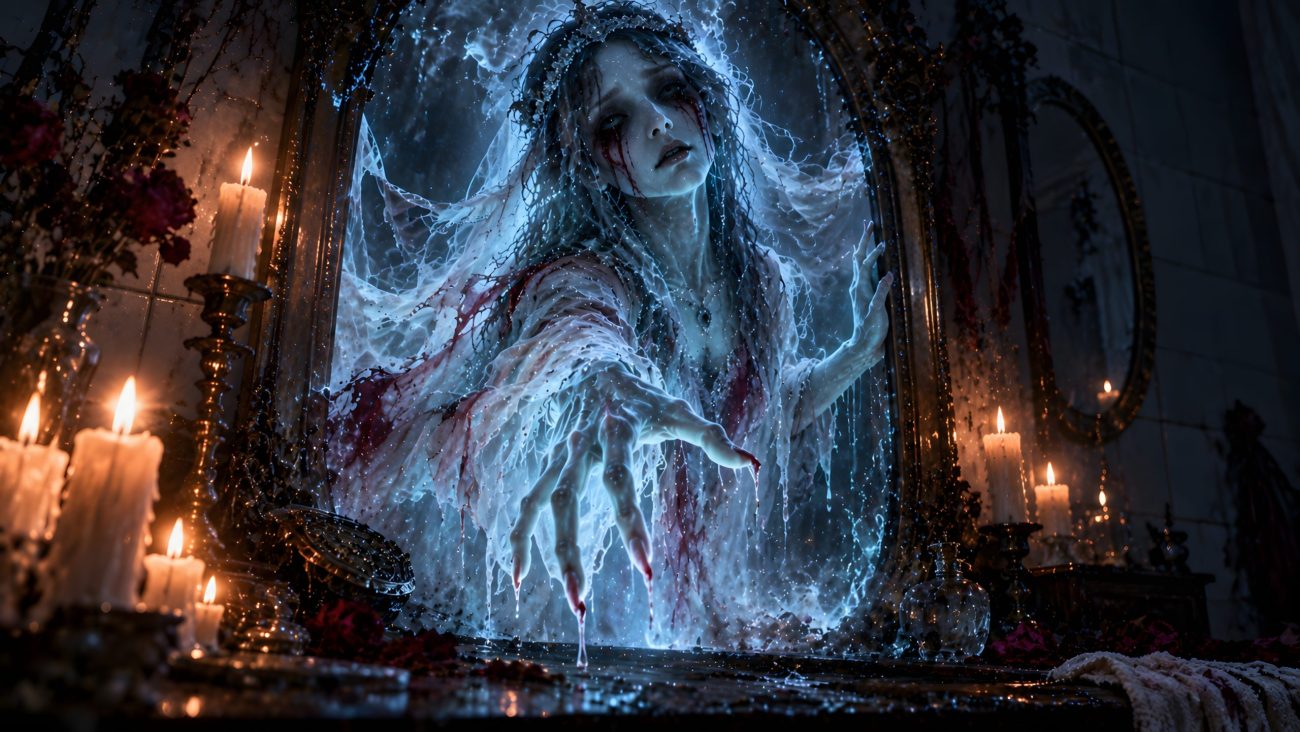
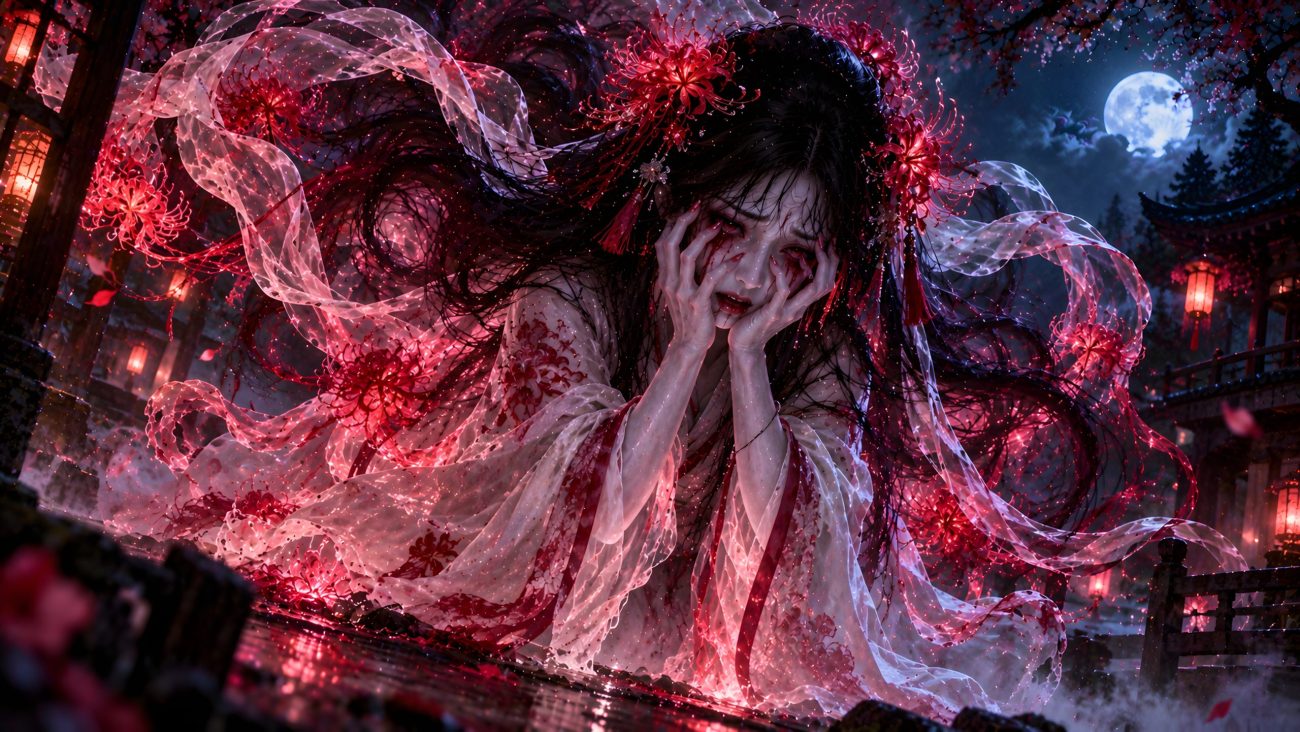
Bloody Mary is a ghostly apparition, witch, or supernatural spirit said to appear in a mirror when her name is repeatedly chanted in a ritual. She is best known through a frightening game played by groups of young people, who summon her in a dimly lit room, often using a bathroom mirror and candles. Depending on the version of the legend, Bloody Mary may be a malevolent spirit, a terrifying witch, or a more benevolent apparition capable of revealing glimpses of the future. Her appearance varies between stories, but she is sometimes described as a corpse-like figure or a ghost covered in blood, from which her name derives.

The legend has connections to older mirror-divination customs practiced by young women seeking knowledge of their future husbands. In one traditional ritual, a woman walked backward up a flight of stairs in a darkened house while holding a candle and a hand mirror. Looking into the mirror, she might see the face of the man she would eventually marry. However, if she saw a skull or the face of the Grim Reaper instead, it was taken as a sign that she would die before marriage. These practices associated mirrors with the mysterious boundary between the present and the future, allowing supernatural visions to reveal a person’s fate.

The modern Bloody Mary ritual became established as a group-participation game during the late twentieth century. Participants stand before a mirror in a darkened or candle-lit room and repeatedly chant her name, commonly three times, although some versions prescribe different numbers, including forty-seven repetitions. When she appears, Bloody Mary may scream, curse, or attack those who summoned her. More terrifying versions claim that she can strangle participants, drink their blood, steal their souls, or scratch out their eyes. Other accounts portray her as a demonic spirit or a corpse emerging from the mirror. The precise ritual and the apparition’s behavior differ between tellings, but the central fear remains the same: by speaking her name before a mirror, ordinary people risk inviting a dangerous supernatural presence into their world.


Sources

“Bloody Mary (folklore).” Wikipedia: The Free Encyclopedia. Wikimedia Foundation. Accessed October 16, 2026. https://en.wikipedia.org/wiki/Bloody_Mary_(folklore)


Song Gaksi

Tradition: Korean Mythology
Alternative Names: Song Gaksi, Cheonyeo Gwis​in, Cheonyeogwis​in, Cheonyeo gwisin (처녀귀신), Malmyeong, Cheonyeo, Song Gaksi (송각시), Song Gaksi Ghost
Category: Ghost


The Myth

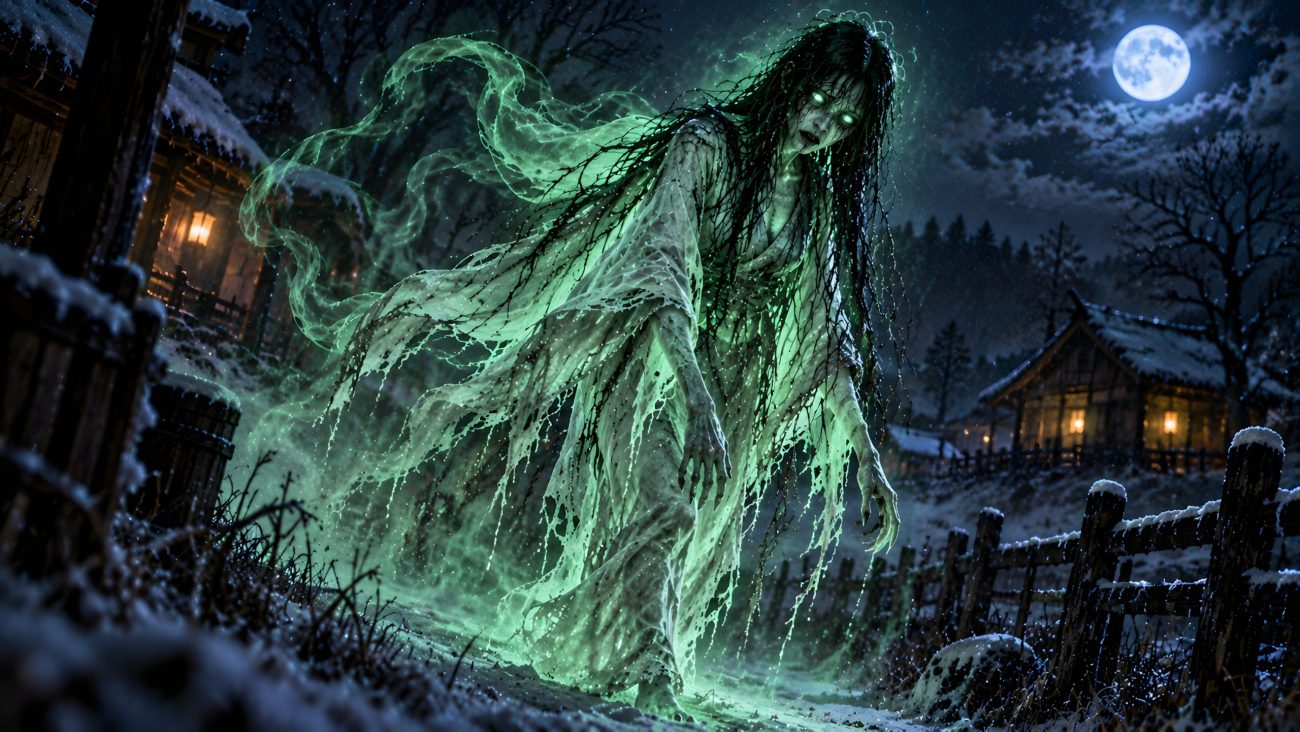
Song Gaksi, also known as Cheonyeo Gwis​in, is one of the most famous ghosts in Korean folklore. She is the spirit of a young woman who died before marriage, often after being abandoned by her lover or suffering the grief of an unfulfilled romance. In some accounts, she takes her own life after being rejected. The name Cheonyeo Gwis​in literally means “virgin ghost,” reflecting the belief that a woman who dies unmarried may become a restless spirit burdened by the life and marriage she never experienced. Song Gaksi is a type of wongwi, a Korean vengeful spirit associated with resentment and an untimely or unjust death.

Song Gaksi is commonly depicted as a young woman with long, disheveled black hair, dressed in a white traditional Korean funeral garment. Her face is pale, with dark circles beneath her eyes and bloody streaks running from the corners of her mouth. Some depictions show traces of blood or present her as an almost indistinguishable human figure. She is often associated with abandoned buildings, hospitals, schools, bathhouses, cemeteries, and dark roads or forests. According to tradition, she may appear during the darkest hours of the night, from midnight until dawn, and is believed to bring illness or misfortune. Her presence may be accompanied by a sudden change in temperature or wind direction, and she can appear in dreams as well as in waking life.

Stories of Song Gaksi appear in Korean folklore, including tales associated with the historical figures Sin Rip and Aran. In one account, Sin Rip saves a young woman from ghosts near the Munyeong-jae mountain pass. She asks to accompany him, but he refuses, and she takes her own life shortly before his eyes. Later, when Sin Rip faces danger during a military campaign, her ghost appears to him in a dream and advises him to go to Thangmyondae. He follows her advice but is ultimately killed. Another tale tells of a newly appointed mayor of Miryang who dies at the hands of a ghost on his first night in office. When the ghost appears to a brave new official, it explains its grievance, allowing the official to identify and punish the criminal responsible. In this story, revealing the truth behind the ghost’s suffering brings peace to her soul.


Sources

“Son Gaksi.” New Bestiary (Bestiary.us). https://www.bestiary.us/son-gaksi


Dungarvon Whooper

Tradition: Canadian Mythology
Alternative Names: The Whooper, Ghost of the Dungarvon River, Ryan Garvon
Category: Ghost, Cat


The Myth

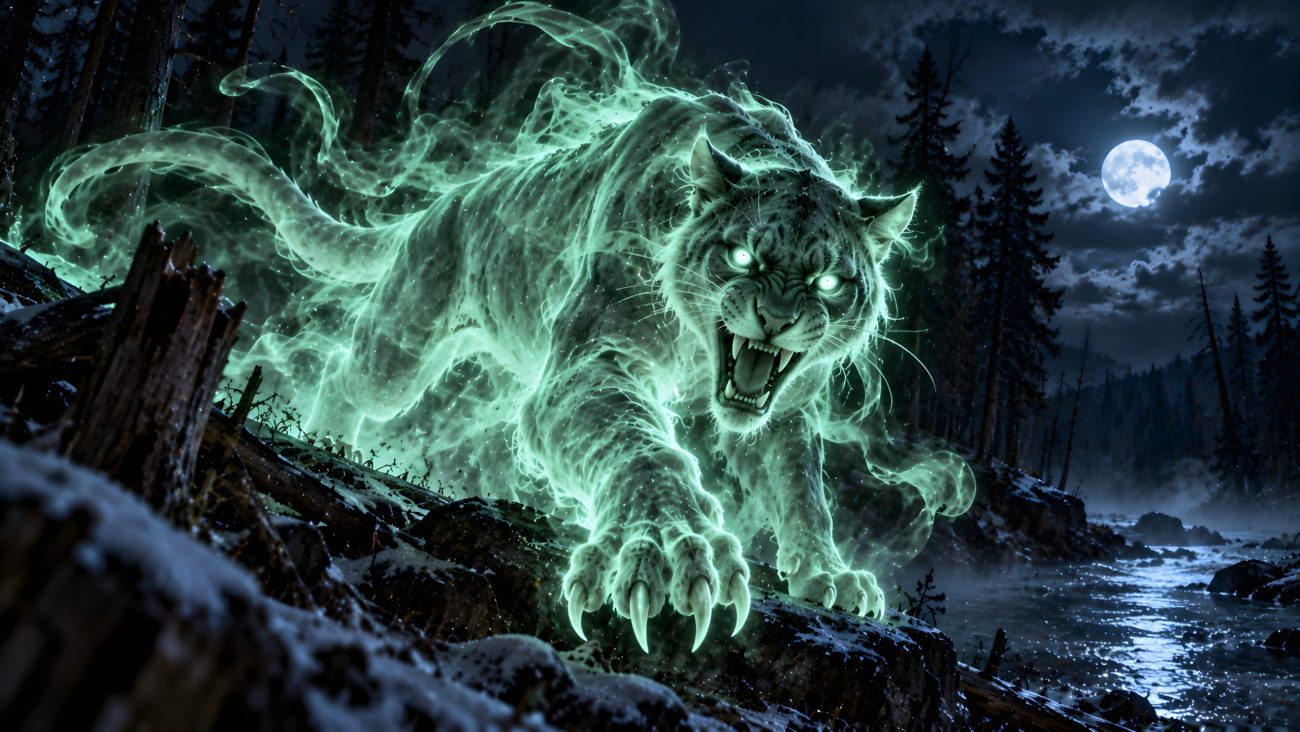
The Dungarvon Whooper is a terrifying ghost associated with the Dungarvon River in central New Brunswick, Canada. It is said to be the spirit of a young cook who was murdered in a lumber camp during the nineteenth century. In many versions of the legend, the victim was an Irishman named Ryan or Ryan Garvon, who had emigrated to Canada during the period of Irish migration following the Great Famine. Some tellings add that he had a sick mother whom he hoped to support. Although the ghost is usually invisible, certain accounts describe it as a wildcat- or puma-like creature capable of knocking down small trees with its powerful movements.

According to the best-known version of the story, the young cook was left alone at a lumber camp with the camp’s boss while the other lumberjacks were away. The boss allegedly murdered him and stole the money kept in his money belt. When the crew returned, they discovered the cook’s lifeless body, and the missing money aroused suspicions of foul play. The boss claimed that the young man had suddenly fallen ill and died before anything could be done. Because heavy snowfall made it impossible to transport the body to a distant graveyard, the lumberjacks buried him in the forest. That night, the camp was filled with terrifying whoops and screams. Believing the place to be haunted, the frightened men resolved to abandon it before dawn.

The ghost’s cries continued to haunt the woods around the young man’s grave, terrifying even the bravest lumberjacks. The supernatural sounds were interpreted as the murdered cook’s spirit protesting the injustice of his death and seeking peace. In some versions, a Roman Catholic priest named Edward Murdoch arrived from Renous and performed an exorcism at the supposed gravesite near Whooper Spring. In Michael Whelan’s celebrated 1912 song, a priest’s prayers finally quiet the haunting, allowing the region to return to peace. The story became a lasting part of New Brunswick’s lumbering folklore, passed down among woodsmen throughout the twentieth century. Although the legend’s precise origins remain uncertain, its central themes are the murder of an innocent worker, the guilt of the perpetrator, and the restless dead demanding justice before they can find peace.


Sources

“Dungarvon Whooper.” Wikipedia: The Free Encyclopedia. Wikimedia Foundation. Accessed October 16, 2026. https://en.wikipedia.org/wiki/Dungarvon_Whooper


Queen Esther’s Ghost

Tradition: Haudenosaunee, American Mythology
Alternative Names: Queen Esther, Esther Montour, The Weeping Maiden of Queen Esther’s Pond
Category: Ghost


The Myth

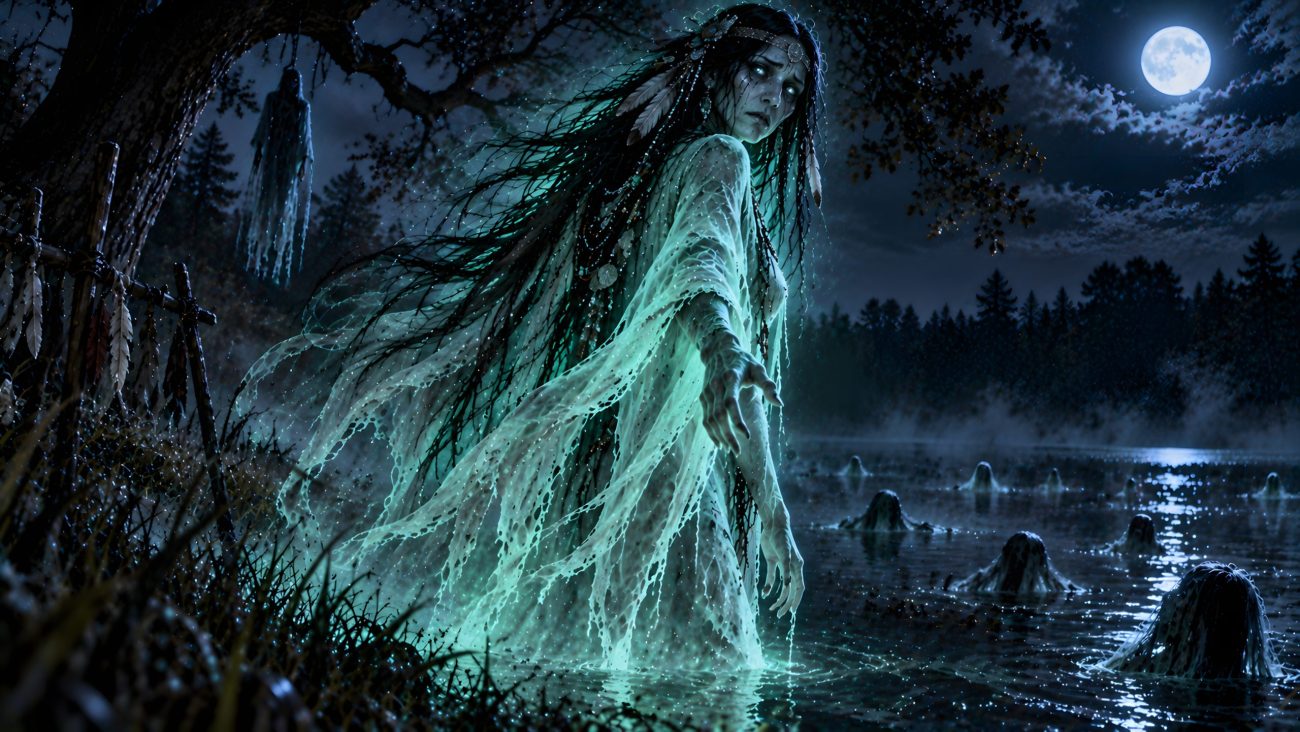
Queen Esther’s Ghost is a haunting figure associated with the legend of Esther Montour, a Haudenosaunee leader who lived in colonial Pennsylvania during the eighteenth century. According to local tradition, Esther’s village stood near the present-day communities of Sayre, Athens, and Waverly, and was home to hundreds of people. Her story became connected to the violence of the American Revolutionary War and the destruction of her community. Although historical accounts of the events differ, local legend remembers Queen Esther as a tragic figure whose death and the killing of her people left a lasting supernatural curse upon the land.

According to the legend, Queen Esther sought revenge after her son was killed during a violent confrontation with a drunken settler. A raid followed in September 1778, during which Arthur van Rossum and his wife Janna were reportedly killed and scalped. In response, a military expedition led by Colonel Thomas Hartley advanced up the Susquehanna River toward Tioga Point. After fierce fighting, the Haudenosaunee warriors were defeated, and Queen Esther attempted to escape into the surrounding forests with the women and children of her village. The widely repeated version of the story claims that Hartley’s men captured the fleeing villagers and brought them to a nearby pond, where the women and children were executed. Their bodies were thrown into the water, denying them the proper burial rites practiced by their people. Queen Esther was allegedly lynched from an oak tree, dismembered, and thrown into the pond alongside the other victims.

The legend of Queen Esther’s curse claims that, before her death, she pronounced a curse upon white settlers who would later occupy the land. During the early nineteenth century, residents of the surrounding community reportedly began hearing unexplained screams from the nearby forests, believed to be the cries of the massacred villagers. Hunters have also told stories of encountering a young girl weeping as she hangs from the branches of an oak tree. When they approach her, the apparition suddenly vanishes, leaving no trace behind. Some hunters believe that their weapons subsequently fail to fire unless carefully checked, interpreting these malfunctions as the spirit’s attempt to prevent further deaths. The haunting remains part of local legend, linking the landscape to memories of violence, dispossession, and the restless spirits of those who died there.


Sources

“Ghost of Queen Esther.” Wikipedia: The Free Encyclopedia. Wikimedia Foundation. Accessed October 16, 2026. https://en.wikipedia.org/wiki/Ghost_of_Queen_Esther


Fear Gorta

Tradition: Irish Mythology
Alternative Names: Fear Gortach, Man of Hunger, Man of Famine
Category: Ghost


The Myth

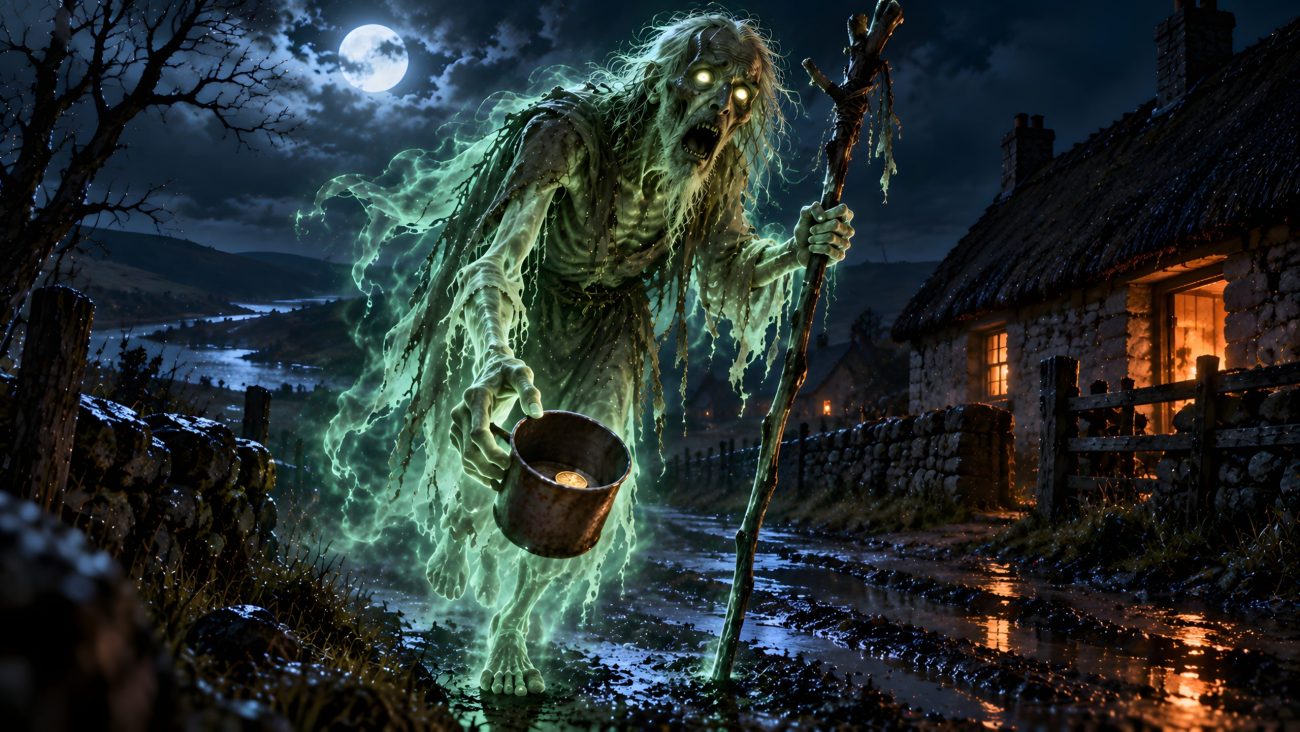
The Fear Gorta, whose name means “Man of Hunger” or “Man of Famine” in Irish, is a phantom that resembles an emaciated human being. He wanders the roads during times of famine, seeking food from those he encounters. His appearance is gaunt and starving, and he carries a long staff and a tin cup containing a single coin. He rattles the coin inside the cup to announce his presence as he approaches travelers and houses, asking for food from anyone who crosses his path.

Those who encounter the Fear Gorta are expected to offer him something to eat. If he approaches a house, its inhabitants should leave a scrap of food on the doorstep. Travelers who meet him on the road must likewise provide an offering. Those who refuse risk misfortune or even death, while those who show generosity receive blessings and good fortune. The phantom thus embodies both the terror of starvation and the moral importance of helping the hungry, making compassion a matter of survival as well as virtue.

One account describes the Fear Gorta as a harbinger of famine who emerges from a patch of hungry grass, known in Irish as Féar Gortach. In the region of Kiltubbrid, the term is also associated with a sudden, overwhelming hunger that can strike people traveling through the mountains. If this hunger is not quickly satisfied, it can prove fatal. The precise origins of the Fear Gorta are uncertain, although the familiar version of the figure is believed to have developed during or shortly after the Great Irish Famine of 1845–1852. The offerings made to him also resemble offerings associated with the Tuatha Dé Danann, suggesting that the figure may preserve elements of older supernatural traditions.


Sources

“Fear Gorta.” Wikipedia: The Free Encyclopedia. Wikimedia Foundation. Accessed October 16, 2026. https://en.wikipedia.org/wiki/Fear_gorta


Ghost Creek Spirit

Tradition: Sioux Mythology, American Mythology
Alternative Names: Ghost of Ghost Creek, Wandering Warrior Spirit
Category: Ghost


The Myth

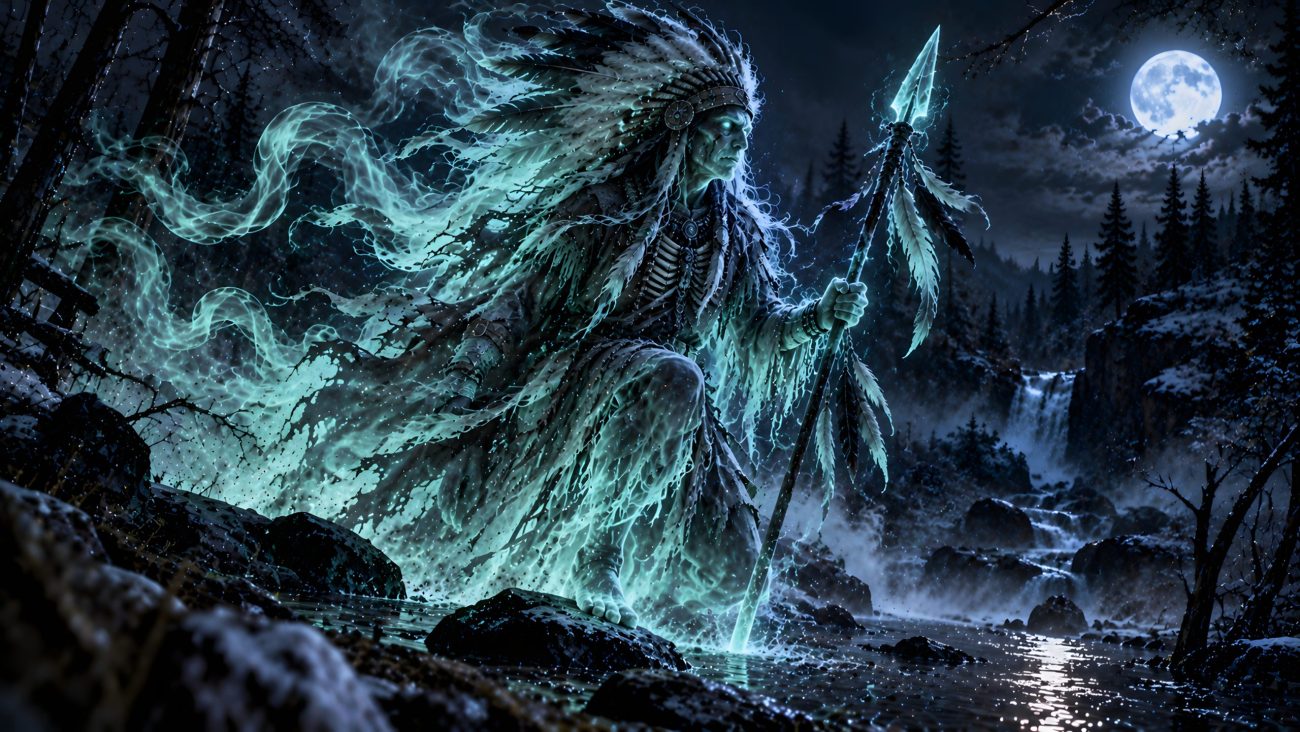
The Ghost Creek Spirit is the restless ghost of a great Sioux warrior who was killed by an enemy while hiding in the woods. According to the story, the warrior was ambushed and shot before he could defend himself. Because he was killed through treachery rather than in open battle, his spirit could not join his fallen companions in the Happy Hunting Grounds. Instead, he was condemned to wander the woods around a creek known as Ghost Creek, waiting for a brave person willing to listen to his story and help him obtain vengeance. The place was feared by travelers, for those who camped there were said to be disturbed by the ghost during the night, and those who fled from him or attacked him never returned home.

One cold autumn evening, two young warriors named Hake and Chaske sought shelter at Ghost Creek while traveling through enemy territory. A heavy snowstorm was approaching, and the thick woods offered protection from the wind. They built a small shelter from willow branches, prepared a meal of dried buffalo meat and buffalo tallow, and were about to eat when a man silently entered and sat beside them. Hake welcomed the stranger, offered him food and tea, and Chaske passed him a pipe. After eating and smoking, the stranger revealed that he was not a living man but the wandering spirit of a warrior slain in those woods. Unlike earlier travelers, who had fled or attacked him, the two young men had treated him with courage and hospitality.

The spirit asked Hake and Chaske to avenge his death by killing the enemy responsible and bringing him the man’s scalp. He explained that the killer lived in a large winter village beyond the hills and described how the two warriors could recognize him: an old man who rode a white horse, led a black horse, and drove a herd of approximately one hundred horses. After killing and scalping this man, the young warriors were to attack two additional enemies at the hunting grounds and then meet the spirit on a high knoll, where he would show them the location of the horses. Once they gave him the scalp of his killer, he promised, his spirit would finally disappear. He also warned them that snow would begin falling after his departure and conceal their trail, but they must travel for three days and nights without stopping to escape pursuit. The spirit further revealed that he was the grandfather of Pretty Feather, the young woman Hake hoped to marry, and the father of the great Medicine Man. In the surviving passage, the two friends follow his instructions by hiding in the brush and watching the enemy hunting party pass, preparing to carry out the spirit’s demand for vengeance.


Sources

McLaughlin, Marie L. Myths and Legends of the Sioux. Bismarck, N.D.: Bismarck Tribune Co., 1916. https://archive.org/search.php?query=creator%3A%22McLaughlin%2C+Marie+L.%2C+1842-%22


Plachka

Tradition: Belarusian Mythology
Alternative Names: Plachka
Category: Ghost


The Myth

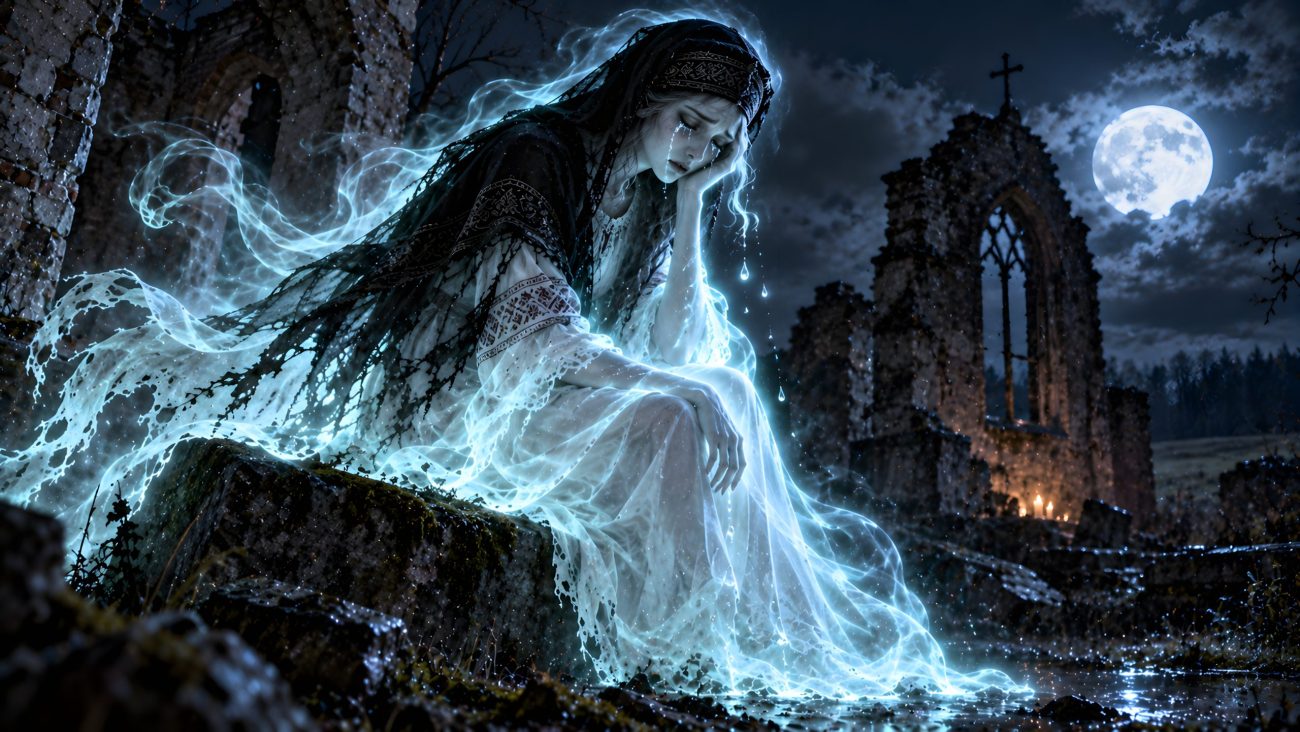
Plachka is a ghostly female figure from Belarusian folklore, particularly associated with the northern and northwestern regions of the country. She appears as an extraordinarily beautiful woman dressed in white, with a black headdress and a black kerchief draped over her shoulders. Her clothing is as white as snow, making the dark garments around her head and shoulders especially striking. Although she appears human, her presence is supernatural, and her beauty conceals a sorrowful and unsettling nature.

Plachka is known for her constant tears and mournful voice. Her face, tanned by the sun and wind, is described as beautiful and expressive, yet her eyes are always filled with emotion, and tears are perpetually falling from them. She most often appears in houses where no one lives anymore, in empty churches, and among ruins. She may also be seen beneath trees or in the middle of a field. When she sits on a stone, laments, or approaches people, she speaks in a plaintive voice and bursts into tears.

Those who encounter Plachka may hear her warn them not to trust the secret of their hearts to anyone. Her sorrowful appearance and mysterious words make her a haunting figure associated with abandoned places, loneliness, grief, and the dangers of revealing one’s innermost thoughts.


Sources

“Plachka.” New Bestiary (Bestiary.us). https://www.bestiary.us/plachka


Zimnica

Tradition: Polish Mythology
Alternative Names: Malaria
Category: Ghost


The Myth

Zimnica is a disease-causing specter in Slavic beliefs associated with fever, chills, and other painful ailments that could sometimes lead to death. It dwells in desolate wastelands but occasionally ventures into human settlements to attack their inhabitants. The spirit is difficult to escape or hide from, and even when seemingly captured, it vanishes into thin air, only to reappear moments later somewhere else.

Zimnica was associated with two distinct forms of illness. One caused bone pain and fractures in the joints, while the other, known as ograżka, brought intense chills and shaking. These manifestations made the specter a feared presence, particularly during periods of sickness.

Small children were considered especially vulnerable to Zimnica. To protect them during cold weather and illness, people would place a glass of honey beside a child’s bed as an offering intended to appease the spirit and prevent it from causing harm.


Sources

“Zimnica (mitologia).” Wikipedia, wolna encyklopedia. Wikimedia Foundation. Accessed October 16, 2026. https://pl.wikipedia.org/wiki/Zimnica_(mitologia)


Bhoota

Tradition: Indian Mythology
Alternative Names: Bhūta, Bhoots, Bhut
Category: Ghost


The Myth

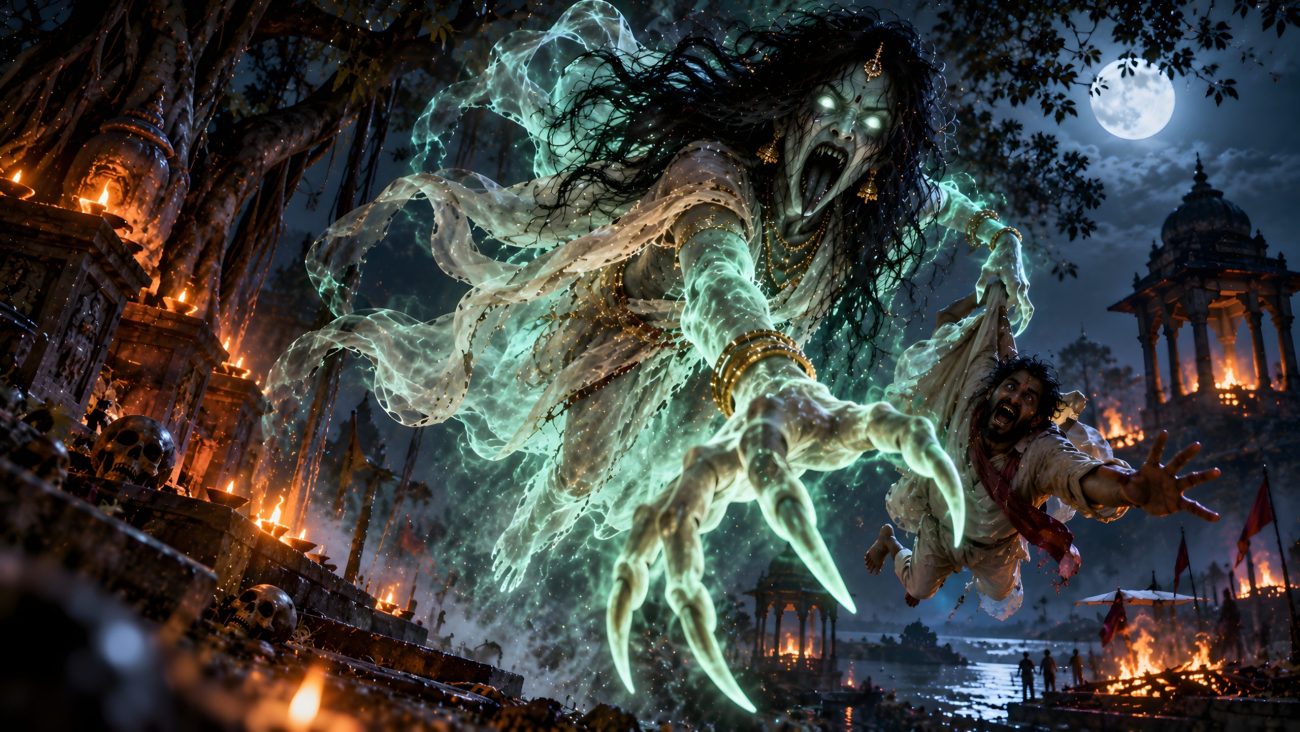
A bhoota is a supernatural being in the traditions and popular culture of the Indian subcontinent, usually understood as the ghost of a deceased person whose spirit cannot find rest. The reasons for a spirit becoming a bhoota vary between regions and communities. A violent death, unresolved matters from life, or the failure of surviving relatives to perform proper funeral rites may prevent the dead from moving on to their next existence. Consequently, bhootas are often restless and troubled spirits that linger among the living, haunting places connected to their deaths or former lives. They are particularly associated with cremation grounds, abandoned buildings, ruined palaces, old forts, and deserted houses.

Bhootas can usually appear in human form but are also capable of transforming into animals. Despite their convincing appearances, they may reveal their supernatural nature through distinctive features: their feet face backwards, they cast no shadows, and they often float above the ground to avoid touching the earth, which is considered sacred or semi-sacred in many traditions. They are frequently described as wearing white clothing, speaking in nasal voices, and lurking among the branches of particular trees. Some haunt specific houses, especially places where they were killed or which hold deep personal significance. They may also seek out milk, and consuming milk believed to have been contaminated by a bhoota is associated with spirit possession.

Stories about bhootas often involve travelers encountering an apparently ordinary stranger at night. A person might offer a lift to a beautiful woman standing beside a road or accompany someone walking through a forest, only gradually noticing that their companion wears white, speaks strangely, and never quite touches the ground. The realization that the stranger’s feet are reversed or that they cast no shadow reveals their true identity. Such tales portray bhootas as deceptive and unsettling beings whose human appearance conceals their supernatural nature.

A particular type of female bhoota is the churel, the spirit of a woman who died during pregnancy or childbirth. Churels may appear as ordinary women, but their feet or other features are reversed or unnaturally oriented. They can change their appearance and are said to lure young men at crossroads, in fields, and in other isolated places. Men who fall under their influence may be led to their deaths, although some stories describe relationships or even marriages between humans and churels. The broader concept of the bhoota also extends beyond the Indian subcontinent: in parts of Southeast Asia, related terms derived from Sanskrit refer to malevolent spirits or demonic giants, while in Pakistan the word may be used for both human ghosts and jinn-like beings.


Sources

“Bhoota (ghost).” Wikipedia: The Free Encyclopedia. Wikimedia Foundation. Accessed October 16, 2026. https://en.wikipedia.org/wiki/Bhoota_(ghost)