Giant Jordan

Tradition: Austrian Mythology
Alternative Names: Jordan, The Wild Man of the Kohlhütte
Category: Giant


The Myth

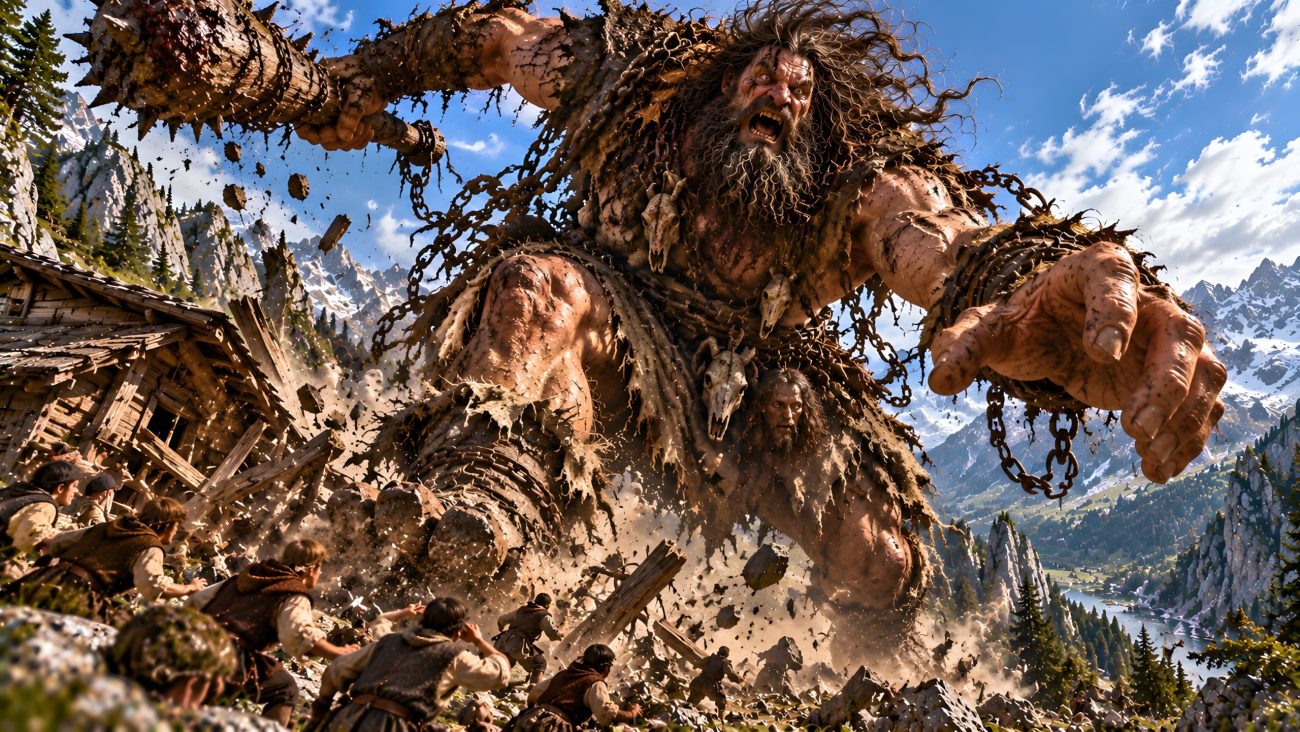
Jordan is a savage giant who once lived with his wife, Fangga, in the Kohlhütte, a remote hut situated high in the mountains near the Ungarkopf, above the cavern known as Eggerskeller. Surrounded by steep grey cliffs and a dangerous rocky chasm, the hut served as the lair of the monstrous couple. Jordan was notorious for stealing children and livestock to devour. He also hunted fairies, capturing and killing them or imprisoning them in underground cells.

One day, Jordan brought home a badly wounded fairy, intending to kill her. His wife, however, decided that the captive could be useful as a servant. The couple kept the fairy in their hut and called her Hitte Hatte. Forced to wear servants’ clothes and perform domestic chores, she worked so efficiently that Fangga was satisfied with her. Hitte Hatte also befriended a huge black cat that Jordan had previously captured in the mountains and given to his wife. She fed the animal regularly, allowed it to sleep in her bed, and grew deeply attached to it. Although she gradually adopted the habits of a human being, she longed to escape her captors.

When Jordan was away and Fangga was asleep, Hitte Hatte fled down into the valley, taking the black cat with her. She eventually reached the Seehaus farm near the village of Strad in the Gurgl Valley, where a kind but financially struggling farming couple named Krapf employed her without asking about her origins. Hitte Hatte proved to be an exceptionally capable and diligent servant, organizing the household with remarkable skill. She remained quiet and modest, and her only great attachment was to the cat. Although she feared that Jordan would come looking for her, she was protected in the valley by its Christian boundaries, which were blessed annually by the priest and marked by small crosses and chapels. The pagan giants were said to fear these sacred protections.

Jordan’s downfall began when two boys from Strad climbed the Ungarkopf to gather strawberries and accidentally approached his hut. Hungry and tired, they saw smoke rising from the chimney and hoped to obtain something to eat. Fangga invited them inside but, fearing her husband, instructed them to hide inside the stove. When Jordan returned, he immediately smelled human flesh and demanded to know where the boys were. Fangga angrily dismissed his suspicions, but the frightened children jumped out of their hiding place. Jordan seized them, locked them in a cupboard, and left to search for a missing goat. Although Fangga was cruel, she eventually took pity on the boys and forced the cupboard door open so they could escape.

When Jordan discovered their escape, he swore to kill them and pursued them through the mountains. The boys eventually reached a roaring torrent and crossed to the other side. Jordan, deceived by their directions, searched far upstream for a plank crossing and fell into the rushing water while attempting to cross a weak, bending board. He survived and continued the chase, eventually catching sight of the boys beyond a large lake. Unable to swim, he asked them how they had crossed it. The boys told him that they had tied large stones around their necks and used them to swim across. Jordan followed their instructions, tied a heavy rock around his own neck, and jumped into the lake. The weight dragged him under, and he drowned.

Some days later, Lorenz Mayrhofer, a friend of the Seehaus farmer, returned from the market at Imst. He recounted hearing a mysterious voice from the mountains telling him to inform Hitte Hatte that Jordan was dead and that she could now return home. When Hitte Hatte heard the news, she rejoiced, thanked the farmers for their kindness, and wished them good fortune. Before disappearing through the door, she urged them to take good care of the “hairy house-worm,” referring to her beloved black cat. She was never seen again.

The farmers regretted that they had not asked Hitte Hatte more about herself, believing that she might have revealed further secrets about the supernatural world. Her disappearance left the people of Strad wondering about the fairy who had lived among them, while Jordan’s death brought an end to the terror of the savage giant.


Sources

Von Günther, Amalia, Countess. Tales and Legends of the Tyrol. London: Chapman and Hall, 1874.

Fasolt

Tradition: German Mythology
Alternative Names: Fasold, Vasolt
Category: Giant


The Myth

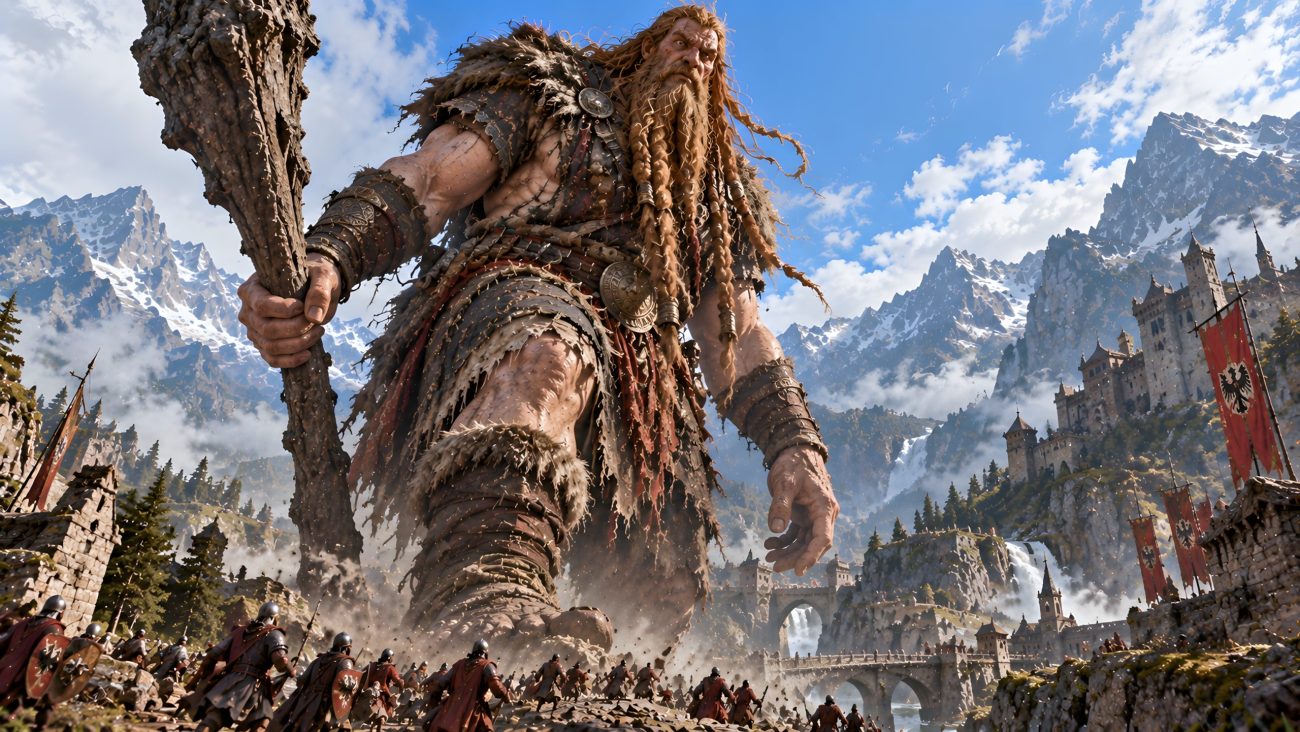
Fasolt, also known as Fasold or Vasolt, is a giant or formidable knight who appears in several medieval works of Germanic legend. He features in the Middle High German heroic poem Eckenlied, dating to around 1230, and the Old Norse Thidrekssaga, a compilation of Germanic legends from approximately 1250. He later appeared in Richard Wagner’s opera Das Rheingold, first performed in 1869.

The name Fasolt may derive from a root related to the Old High German word faso, meaning “thread.” This interpretation is thought to refer to the long, braided hair attributed to him in the Eckenlied. His appearance and role vary across literary traditions, in which he is remembered as a formidable figure belonging to the world of giants and legendary warriors.

Fasolt may also preserve traces of an older supernatural tradition. A seventeenth-century prayer associated with witches on Jochgrimm, a mountain near Bolzano in the Italian Alps, invoked “ffasolt” to send storms far away. This reference has led to the suggestion that Fasolt may originally have been a storm demon, a being associated with violent weather and the power of the elements. Although his precise origins remain uncertain, the surviving accounts connect him with both medieval heroic literature and older beliefs about supernatural forces.


Sources

“Fasolt.” Wikipedia: The Free Encyclopedia. Wikimedia Foundation. Accessed October 16, 2026. https://en.wikipedia.org/wiki/Fasolt


Talos

Tradition: Greek Mythology
Alternative Names: Talus, Talon, Tálōs (Τάλως), Tálōn (Τάλων)
Category: Giant


The Myth

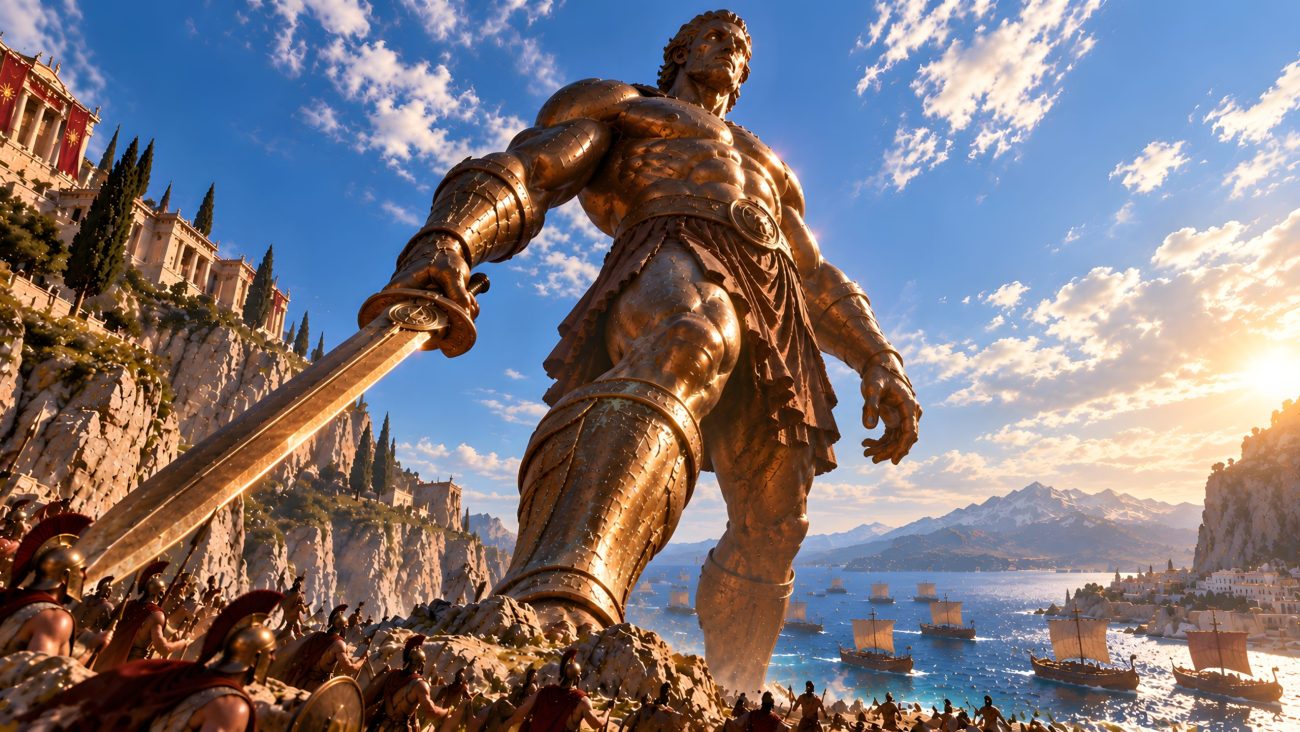
Talos was a mysterious bronze being who protected the island of Crete from pirates and invading forces. In Greek mythology, he was an extraordinary guardian who circled the island three times each day, watching its shores for approaching enemies. Although he is popularly depicted as a gigantic bronze automaton, ancient accounts do not explicitly establish that he was a giant. His origins and nature vary between literary traditions: he was described either as a bronze man or as a bull, and some accounts identified him as a member of the ancient Bronze Race.

According to the Argonautica by Apollonius of Rhodes, Talos belonged to the Bronze Race, whose members were said to have sprung from ash trees. He was made entirely of bronze and was nearly invulnerable, with only a vulnerable vein running from his neck to his ankles. This vein was sealed at the ankle by a thin layer of skin. Zeus gave Talos to Europa to protect Crete, while other traditions state that the god Hephaestus created him and gave him to King Minos.

Talos fulfilled his duty by patrolling the entire island three times daily. When the Argonauts returned from their quest for the Golden Fleece and approached Crete aboard the Argo, the bronze guardian prevented them from landing. He hurled enormous boulders at their ship, threatening to destroy it if the crew attempted to come ashore. His strength and tireless vigilance made him a formidable obstacle, and the Argonauts could not easily overcome him through ordinary force.

The sorceress Medea eventually brought about Talos’s destruction. In Apollonius’s account, she summoned the keres, female spirits of death, and caused Talos to injure his vulnerable ankle. His precious ichor, the divine fluid flowing through his bronze body, poured out through the wound. As the life drained from him, Talos collapsed like a great pine tree being felled, and Crete lost its powerful guardian.

Other ancient accounts offer different explanations for his death. According to Pseudo-Apollodorus, Medea either drove Talos mad with drugs or deceived him by promising immortality before removing the bronze nail that sealed his ankle. Once the nail was removed, his ichor flowed out and he died. A third version claims that the Argonaut Poeas killed him by shooting an arrow into his ankle.

Talos’s legend presents him as an extraordinary guardian whose immense strength concealed a single fatal weakness. His bronze body made him nearly invulnerable, but the vulnerable point at his ankle allowed his enemies to defeat him. Through his tireless patrol of Crete and his confrontation with the Argonauts, Talos became one of the most memorable protective figures in Greek mythology, embodying both the power of an artificial guardian and the limits of even the strongest supernatural beings.


Sources

“Talos.” Wikipedia: The Free Encyclopedia. Wikimedia Foundation. Accessed October 16, 2026. https://en.wikipedia.org/wiki/Talos


Jack-in-Irons

Tradition: English Mythology
Alternative Names: Jack in Irons
Category: Giant


The Myth

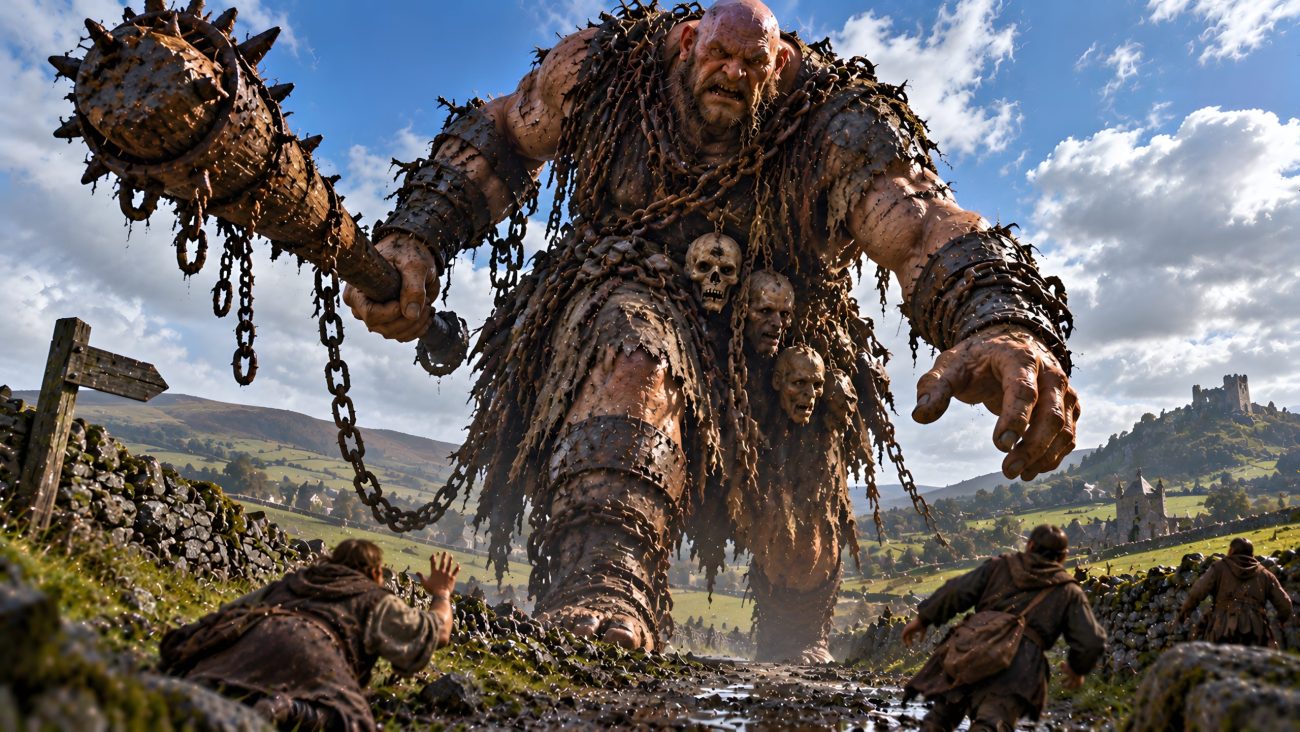
Jack-in-Irons is a terrifying giant from the folklore of Yorkshire, England, said to haunt lonely roads and isolated paths. His body is covered in heavy chains, and he is described as wearing the severed heads of his victims. He carries a large club studded with spikes, making him a formidable and deadly presence for anyone unfortunate enough to encounter him while travelling through the countryside.

The origin of his name is uncertain. Although he is called Jack-in-Irons, the name Jack may not refer to a specific individual. In English folklore, Jack is sometimes used as a generic name for an unknown man, much like the modern expression John Doe. The name may therefore identify him as an unnamed or mysterious figure rather than reveal his true identity.

Jack-in-Irons has also appeared in modern fantasy literature. In Laurell K. Hamilton’s Merry Gentry series, a character belonging to this monstrous type is named Uther Squarefoot. He is described as thirteen feet tall, with a head resembling a pig more than a human, and two curling tusks on either side of his snout. This literary portrayal expands upon the fearsome image of the chain-covered giant, although these particular physical details belong to the modern fictional depiction rather than necessarily to the traditional Yorkshire legend.


Sources

“Jack-in-Irons.” Wikipedia: The Free Encyclopedia. Wikimedia Foundation. Accessed October 16, 2026. https://en.wikipedia.org/wiki/Jack-in-Irons


Gurumāpā

Tradition: Nepal Mythology
Alternative Names: Gurumapa, गुरुमापा
Category: Giant


The Myth

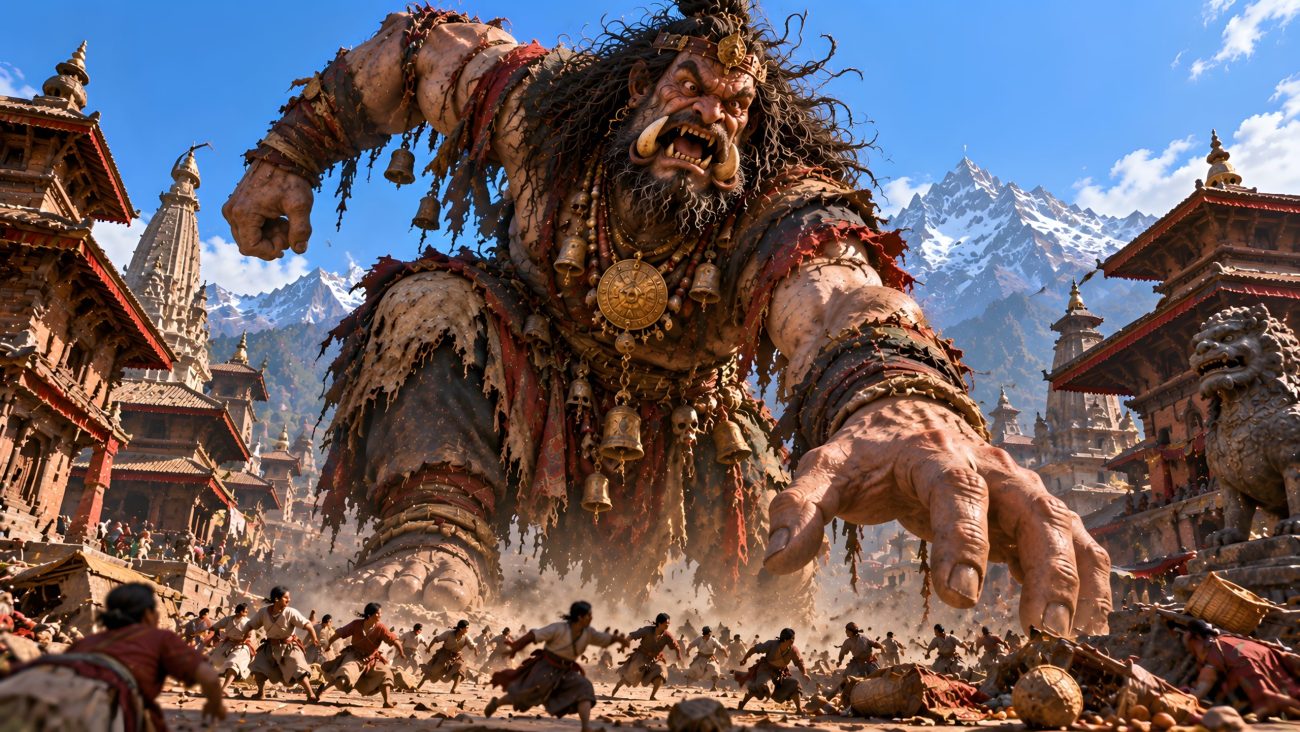
Gurumāpā is a terrifying man-eating giant in the folklore of Nepal Mandala, particularly among the Newar people of the Kathmandu Valley. He is depicted with a frightening face and protruding fangs and is feared for carrying away disobedient children. According to tradition, he was eventually banished from the residential neighborhoods of Kathmandu to Tundikhel, a large open field in the city.

The legend of Gurumāpā begins with Kesh Chandra, an inveterate gambler who lived at Itumbaha, a sacred courtyard in central Kathmandu. After gambling away all his possessions, he went to live with his sister. When he even stole the plate on which she served his lunch to gamble with it, she decided to teach him a lesson by serving his rice directly on the floor. Deeply hurt, Kesh Chandra gathered the food in a handkerchief and walked into the woods outside the city. When he eventually stopped to eat, he discovered that the rice had spoiled and was crawling with maggots. He spread it out in the sun to dry and fell asleep.

While Kesh Chandra slept, pigeons ate the food. When he awoke and saw what had happened, he began to cry. Taking pity on him, the pigeons left droppings that miraculously turned into gold. There was so much gold that he could not carry it all himself. As he wondered what to do, Gurumāpā appeared, attracted by the scent of potential prey. Kesh Chandra calmed the giant by addressing him as his uncle and persuaded him to carry the gold home. In return, he promised Gurumāpā a great feast and permission to take away children whenever their parents called upon him to punish their disobedience.

Kesh Chandra brought Gurumāpā to his home in Itumbaha and allowed him to live in the attic. Over the years, children began disappearing whenever their parents threatened them with the giant. Eventually, the local residents decided that Gurumāpā was too dangerous to remain in their neighborhood. They persuaded him to move to the field of Tinkhya, now known as Tundikhel, by promising him an annual feast of boiled rice and buffalo meat.

The tradition continues through a ceremonial offering made on the night of Holi. People from the locality prepare a feast for Gurumāpā and leave it for him at Tundikhel, which today serves as a large parade ground. The legend thus explains both the giant’s association with the disappearance of disobedient children and the ritual through which the community maintains its relationship with this fearsome supernatural being.


Sources

“Gurumapa.” Wikipedia: The Free Encyclopedia. Wikimedia Foundation. Accessed October 16, 2026. https://en.wikipedia.org/wiki/Gurumapa


Adamastor

Tradition: Portuguese Mythology
Alternative Names: The Giant of the Cape of Storms, The Spirit of the Cape of Good Hope
Category: Giant


The Myth

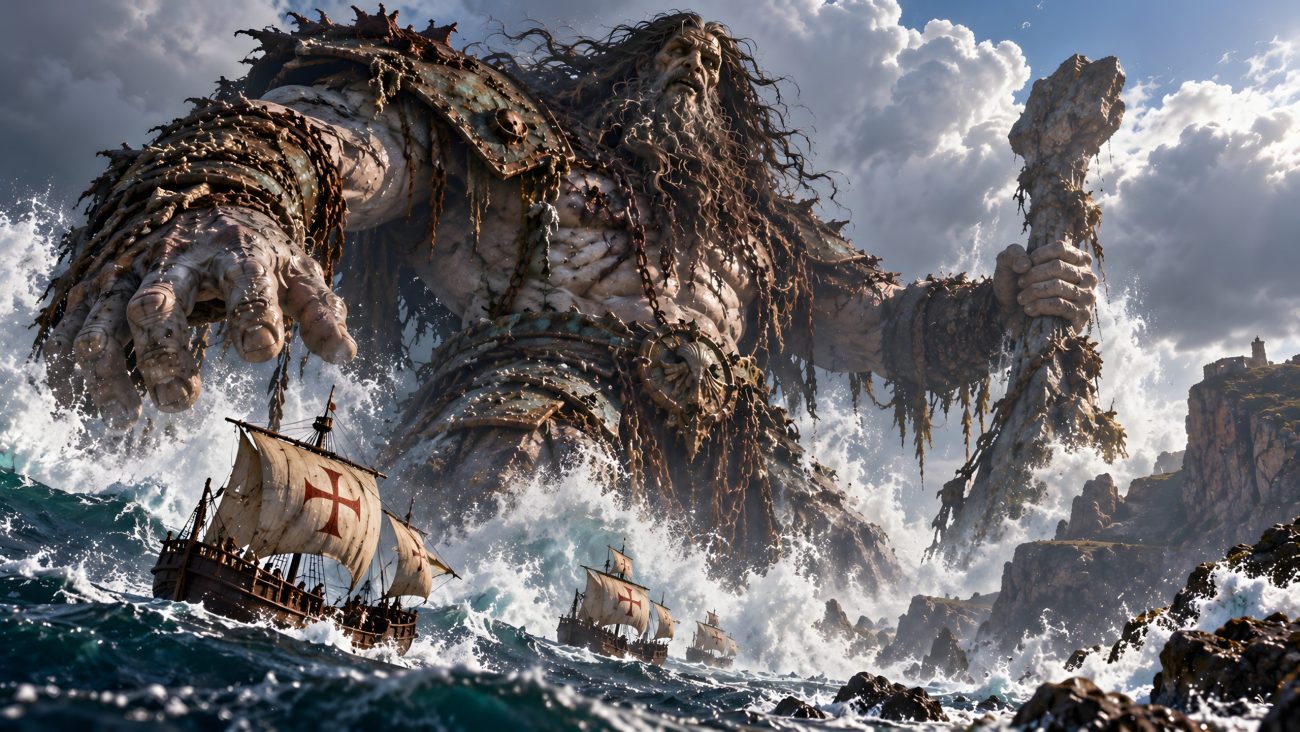
Adamastor is a fearsome giant created by the Portuguese poet Luís de Camões in his epic poem Os Lusíadas, first published in 1572. He personifies the Cape of Good Hope and the dangers faced by Portuguese sailors during the Age of Discovery. Appearing from a storm cloud, Adamastor embodies the formidable forces of nature that threatened ships attempting to sail around the southern tip of Africa and enter the Indian Ocean.

In Camões’s poem, Adamastor is one of the giants of Greek mythology, banished to the Cape of Good Hope by the sea goddess Doris after falling in love with her daughter, Thetis. Condemned to remain at the edge of Africa, he becomes the supernatural guardian of the surrounding waters. He threatens to destroy any sailors daring enough to cross his domain, using violent storms and the terrifying power of the sea to challenge their passage.

Adamastor appears before the Portuguese expedition led by Vasco da Gama as the fleet approaches the Cape. He manifests as an enormous, grotesque figure with an unnaturally pale complexion, hollow eyes, a tangled beard, matted hair, and decaying yellow teeth. His terrifying appearance reflects the dangers of the unexplored ocean. When Vasco da Gama demands to know his identity, the giant declares himself the vast promontory that the Portuguese call the Cape of Storms, a place unknown to the ancient geographers and a boundary that their daring expedition has challenged.

The giant’s anger is intertwined with his tragic personal history. His love for Thetis brought him into conflict with the divine powers, resulting in his punishment and transformation into the spirit of the Cape. His story reveals that beneath his threatening appearance lies a being condemned to an existence of frustration and loss. After recounting his fate, Adamastor is deeply moved and eventually disappears, the storm clouds disperse, and the sea grows calm. The Portuguese ships are then able to continue their voyage toward India.

Adamastor became a powerful literary symbol of the dangers of maritime exploration. Through him, Camões personified the storms, uncertainty, and immense natural forces that Portuguese sailors confronted when rounding the Cape of Storms, later known as the Cape of Good Hope. Although the giant ultimately fails to prevent their passage, his appearance dramatizes the courage required to cross the ocean and the formidable challenges that stood between Portugal and its expanding maritime ambitions.


Sources

“Adamastor.” Wikipedia: The Free Encyclopedia. Wikimedia Foundation. Accessed October 16, 2026. https://en.wikipedia.org/wiki/Adamastor


Busya

Tradition: Udmurt Mythology, Russian Mythology
Alternative Names: Busy, Бусе
Category: Giant


The Myth

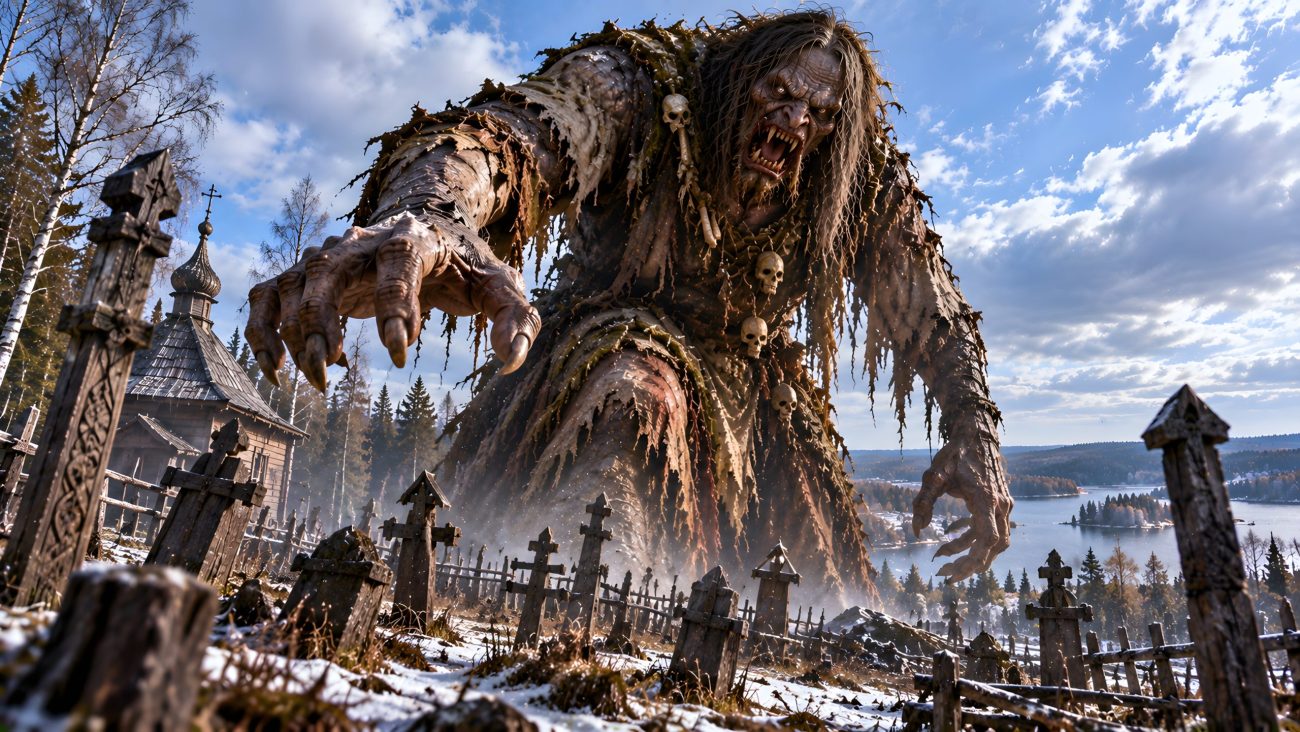
Busya is an evil spirit in Udmurt mythology, particularly associated with the belief that it preys upon the souls of the dead. It is described as a frightening supernatural being that attacks people and animals, especially in places where the dead are buried. The name also appears in the variant spelling Busy.

According to traditional accounts, Busya may appear in the form of a large, fearsome creature with prominent teeth and claws. It is associated with graveyards and places connected to death, where it is believed to attack or devour the souls of the deceased. Its terrifying appearance and predatory behavior make it a dangerous presence in the supernatural world.

Despite its frightening nature, Busya is not considered invulnerable. Traditional accounts advise people to remain cautious and avoid confronting the spirit carelessly. The creature belongs to a broader body of Udmurt beliefs about malevolent beings that threaten the living and the dead, reflecting anxieties surrounding death, burial places, and the fate of the soul.


Sources

“Busije.” New Bestiary (Bestiary.us). https://www.bestiary.us/busije


Ojáncanu

Tradition: Cantabrian Mythology, Spanish Mythology
Alternative Names: Ojancanu, Ojáncana (female counterpart)
Category: Giant


The Myth

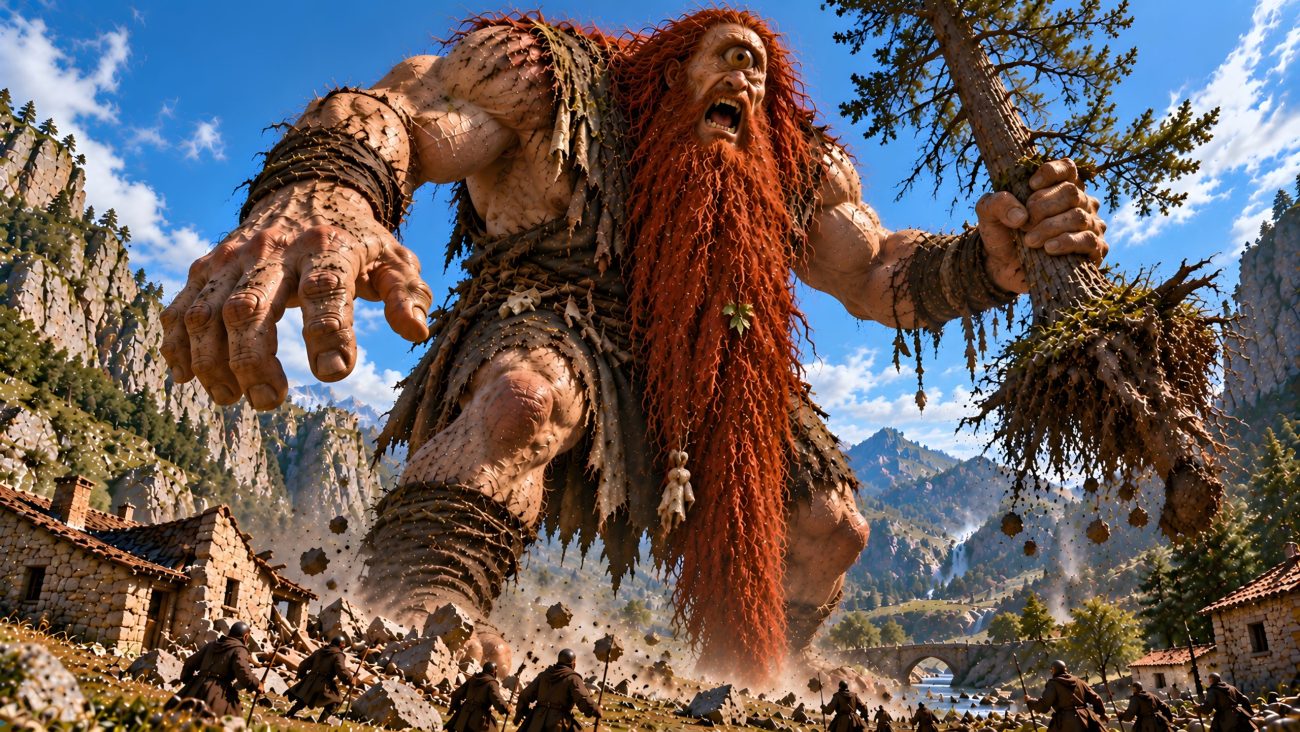
The Ojáncanu is a monstrous, one-eyed giant in Cantabrian mythology, embodying cruelty, brutality, and destructive power. It stands approximately ten to twenty feet tall and possesses superhuman strength, ten digits on each hand and foot, and two rows of teeth. Its appearance is wild and beast-like, with a long mane of red hair and an enormous beard that can nearly reach the ground.

The Ojáncanu constantly performs acts of destruction. It uproots rocks, demolishes huts, tears down trees, and blocks water sources, bringing hardship to the people who live nearby. It also fights Cantabrian brown bears and Tudanca bulls, defeating them through its extraordinary strength. Among the supernatural beings of Cantabria, it represents a violent and uncontrollable force that threatens both human settlements and the natural landscape.

Despite its immense power, the Ojáncanu has a peculiar weakness. Hidden among the tangled hair of its beard is a single white hair, and pulling it is said to be the easiest way to kill the giant. The creature therefore possesses a vulnerability that can be exploited by someone who knows its secret.

The female counterpart, known as the Ojáncana, resembles the male but has no beard. Instead, she has long, drooping breasts that reach the ground. When she runs, she must carry them over her shoulders. The Ojáncanu and Ojáncana also have an unusual reproductive tradition: when an old male dies, the other giants distribute his internal organs and bury his corpse beneath an oak or yew tree.

The Ojáncanu fears only the Anjanas, the benevolent fairies of Cantabrian mythology. These good supernatural beings stand in opposition to the giant’s cruelty and destructive nature, representing one of the few forces capable of inspiring fear in this otherwise formidable monster.


Sources

“Ojáncanu.” Wikipedia: The Free Encyclopedia. Wikimedia Foundation. Accessed October 16, 2026. https://en.wikipedia.org/wiki/Oj%C3%A1ncanu


Tartaro

Tradition: Basque Mythology, Spanish Mythology
Alternative Names: Tartalo, Tartaroa, Torto, Alarabi, Anxo, Ancho
Category: Giant


The Myth

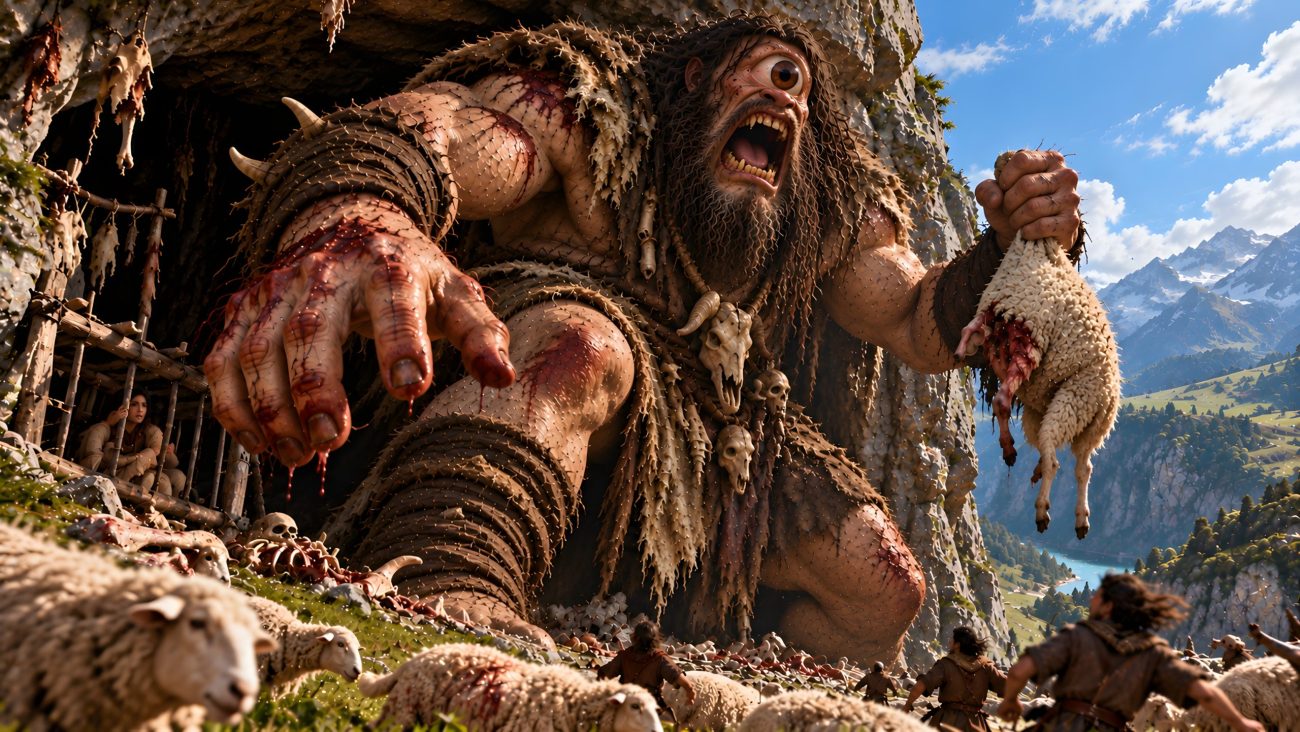
Tartaro is a gigantic, immensely strong, one-eyed monster in Basque mythology. He is commonly described as a cave-dwelling giant who captures and devours young people, especially those who wander into his lair or seek shelter there. In some accounts, he also eats sheep, consuming an entire sheep each day. His single eye and man-eating nature make him closely resemble the Greek Cyclops Polyphemus, encountered by Odysseus in Homer’s Odyssey.

In traditional tales, Tartaro lives in caves in the mountains, where he waits for unsuspecting victims. Stories about him often involve a captive who must find a way to escape the giant’s lair. Some versions closely parallel the story of Odysseus and Polyphemus: the giant is blinded with a heated spit, and the captive escapes by concealing himself beneath a sheep’s fleece. These similarities have led to comparisons between the Basque monster and the Greek Cyclops, although a direct derivation from Homer’s epic has not been established.

The creature’s name appears in several forms across Basque storytelling. Tartaro and Tartaroa occur in translated tales and older commentary, while Torto, Alarabi, and Anxo are recorded as regional names. Tartalo is particularly associated with the Zegama region. The name Anxo or Ancho is sometimes identified with Tartaro, although other accounts treat it as an alternative name for Basajaun, another supernatural being in Basque folklore.

Tartaro also appears in Basque adaptations of European fairy tales. In some versions of stories resembling Cinderella, Hop-o’-My-Thumb, and Donkeyskin, a giant called Tartaroa takes the role of the man-eating ogre. In one account, instead of smelling fresh meat, he detects the presence of Christians, whom he intends to eat. These variations show how the figure could be incorporated into stories beyond the traditional cave-monster narrative.

The origin of the name Tartaro remains uncertain. One nineteenth-century explanation connected it with the Tatar peoples, while other commentators compared the name with the European word “ogre.” These theories remain speculative. Across the different versions of the tradition, Tartaro is chiefly remembered as a powerful, one-eyed man-eater whose victims must rely on courage and cunning to escape him.


Sources

“Tartalo.” Wikipedia: The Free Encyclopedia. Wikimedia Foundation. Accessed October 16, 2026. https://en.wikipedia.org/wiki/Tartalo


Datsueba

Tradition: Japanese Mythology
Alternative Names: Sōzugawaba, Shōzukaba, The Old Woman Who Strips Clothes, The Old Woman with the Cotton
Category: Giant


The Myth

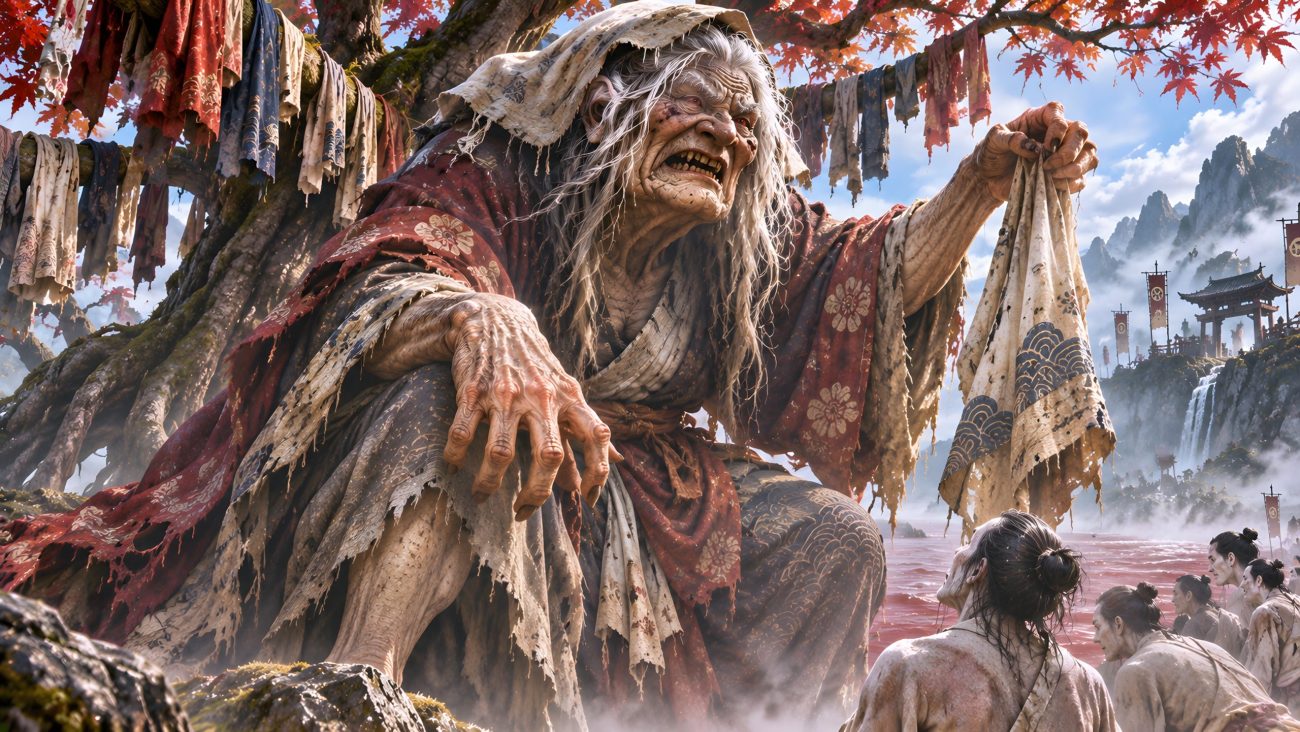
Datsueba is an elderly demon who dwells beside the Sanzu River, the boundary between the world of the living and the world of the dead in Japanese Buddhist tradition. When the deceased arrive at the riverbank, she strips them of their clothes. She is also known as Sōzugawaba or Shōzukaba and is commonly depicted as a terrifying old woman associated with the judgment of the dead.

According to the Jizō Bosatsu Hoshin In’en Jūō Kyō, a Buddhist text concerning the Ten Kings of the underworld, government offices stand along the banks of Hatsue, in front of which flows the great river Sōzugawa, another name associated with the Sanzu River. A large tree called Eryōju grows before these offices, beneath which Datsueba lives alongside another demon named Ken’eō, also known as Kenneō.

Datsueba removes the garments of the dead, while Ken’eō hangs them on the branches of the Eryōju tree. The degree to which the branches bend under the garments reveals the severity of the sins committed by the deceased. Their actions therefore form part of the supernatural process through which the dead are assessed after crossing into the afterlife.

In traditional depictions of hell, Datsueba often sits beneath a tree with one knee raised, clutching a garment in one hand and wearing a frightening expression. Some images portray her with her breasts exposed. Statues of the demon can be found at temples throughout Japan, where she is represented with similar features.

One particularly famous statue is enshrined at Shōjuin Temple in Shinjuku. It became popular around 1849, when rumours spread that it could grant wishes. Alongside other religious figures that attracted devotion during the same period, Datsueba became a subject of woodblock prints. The statue was especially associated with curing coughs and warding off epidemics. Worshippers who recovered from coughs offered cotton to the statue, placing it over her head like a hood. This custom gave her the additional name “the Old Woman with the Cotton.”


Sources

“Datsueba.” 新版TYZ 妖怪図鑑 (New TYZ Yokai Encyclopedia). https://tyz-yokai.blog.jp/archives/1010655131.html