Tradition: Portuguese Mythology
Alternative Names: The Giant of the Cape of Storms, The Spirit of the Cape of Good Hope
Category: Giant
The Myth
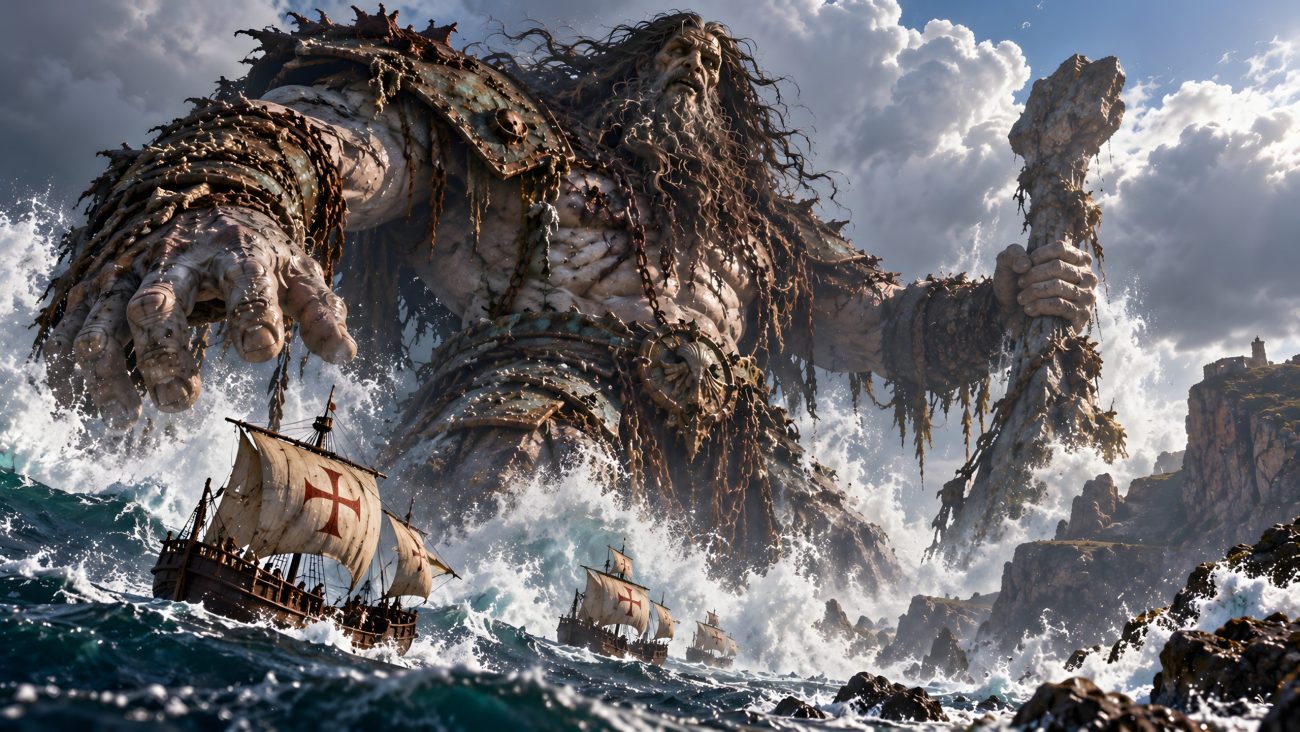
Adamastor is a fearsome giant created by the Portuguese poet Luís de Camões in his epic poem Os Lusíadas, first published in 1572. He personifies the Cape of Good Hope and the dangers faced by Portuguese sailors during the Age of Discovery. Appearing from a storm cloud, Adamastor embodies the formidable forces of nature that threatened ships attempting to sail around the southern tip of Africa and enter the Indian Ocean.
In Camões’s poem, Adamastor is one of the giants of Greek mythology, banished to the Cape of Good Hope by the sea goddess Doris after falling in love with her daughter, Thetis. Condemned to remain at the edge of Africa, he becomes the supernatural guardian of the surrounding waters. He threatens to destroy any sailors daring enough to cross his domain, using violent storms and the terrifying power of the sea to challenge their passage.
Adamastor appears before the Portuguese expedition led by Vasco da Gama as the fleet approaches the Cape. He manifests as an enormous, grotesque figure with an unnaturally pale complexion, hollow eyes, a tangled beard, matted hair, and decaying yellow teeth. His terrifying appearance reflects the dangers of the unexplored ocean. When Vasco da Gama demands to know his identity, the giant declares himself the vast promontory that the Portuguese call the Cape of Storms, a place unknown to the ancient geographers and a boundary that their daring expedition has challenged.
The giant’s anger is intertwined with his tragic personal history. His love for Thetis brought him into conflict with the divine powers, resulting in his punishment and transformation into the spirit of the Cape. His story reveals that beneath his threatening appearance lies a being condemned to an existence of frustration and loss. After recounting his fate, Adamastor is deeply moved and eventually disappears, the storm clouds disperse, and the sea grows calm. The Portuguese ships are then able to continue their voyage toward India.
Adamastor became a powerful literary symbol of the dangers of maritime exploration. Through him, Camões personified the storms, uncertainty, and immense natural forces that Portuguese sailors confronted when rounding the Cape of Storms, later known as the Cape of Good Hope. Although the giant ultimately fails to prevent their passage, his appearance dramatizes the courage required to cross the ocean and the formidable challenges that stood between Portugal and its expanding maritime ambitions.
Sources
“Adamastor.” Wikipedia: The Free Encyclopedia. Wikimedia Foundation. Accessed October 16, 2026. https://en.wikipedia.org/wiki/Adamastor