Tradition: Nepal Mythology
Alternative Names: Gurumapa, गुरुमापा
Category: Giant
The Myth
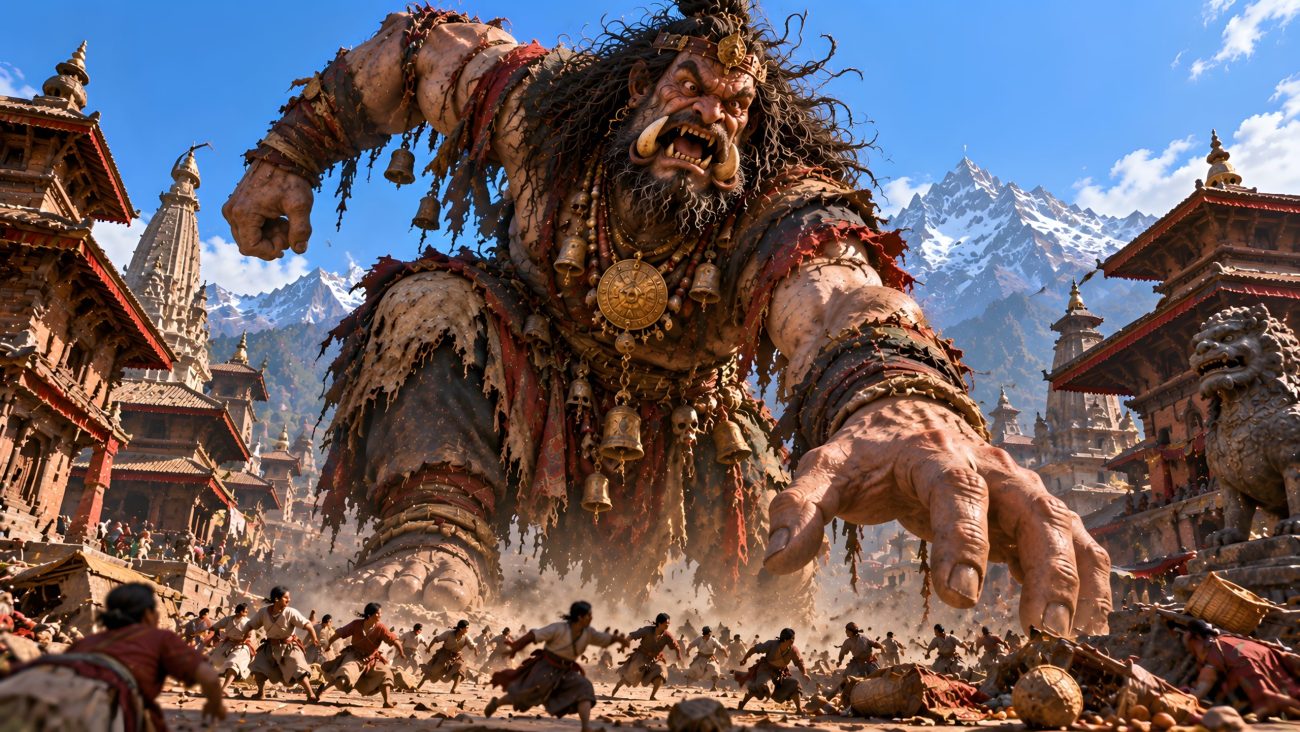
Gurumāpā is a terrifying man-eating giant in the folklore of Nepal Mandala, particularly among the Newar people of the Kathmandu Valley. He is depicted with a frightening face and protruding fangs and is feared for carrying away disobedient children. According to tradition, he was eventually banished from the residential neighborhoods of Kathmandu to Tundikhel, a large open field in the city.
The legend of Gurumāpā begins with Kesh Chandra, an inveterate gambler who lived at Itumbaha, a sacred courtyard in central Kathmandu. After gambling away all his possessions, he went to live with his sister. When he even stole the plate on which she served his lunch to gamble with it, she decided to teach him a lesson by serving his rice directly on the floor. Deeply hurt, Kesh Chandra gathered the food in a handkerchief and walked into the woods outside the city. When he eventually stopped to eat, he discovered that the rice had spoiled and was crawling with maggots. He spread it out in the sun to dry and fell asleep.
While Kesh Chandra slept, pigeons ate the food. When he awoke and saw what had happened, he began to cry. Taking pity on him, the pigeons left droppings that miraculously turned into gold. There was so much gold that he could not carry it all himself. As he wondered what to do, Gurumāpā appeared, attracted by the scent of potential prey. Kesh Chandra calmed the giant by addressing him as his uncle and persuaded him to carry the gold home. In return, he promised Gurumāpā a great feast and permission to take away children whenever their parents called upon him to punish their disobedience.
Kesh Chandra brought Gurumāpā to his home in Itumbaha and allowed him to live in the attic. Over the years, children began disappearing whenever their parents threatened them with the giant. Eventually, the local residents decided that Gurumāpā was too dangerous to remain in their neighborhood. They persuaded him to move to the field of Tinkhya, now known as Tundikhel, by promising him an annual feast of boiled rice and buffalo meat.
The tradition continues through a ceremonial offering made on the night of Holi. People from the locality prepare a feast for Gurumāpā and leave it for him at Tundikhel, which today serves as a large parade ground. The legend thus explains both the giant’s association with the disappearance of disobedient children and the ritual through which the community maintains its relationship with this fearsome supernatural being.
Sources
“Gurumapa.” Wikipedia: The Free Encyclopedia. Wikimedia Foundation. Accessed October 16, 2026. https://en.wikipedia.org/wiki/Gurumapa