Tradition: Basque Mythology, Spanish Mythology
Alternative Names: Tartalo, Tartaroa, Torto, Alarabi, Anxo, Ancho
Category: Giant
The Myth
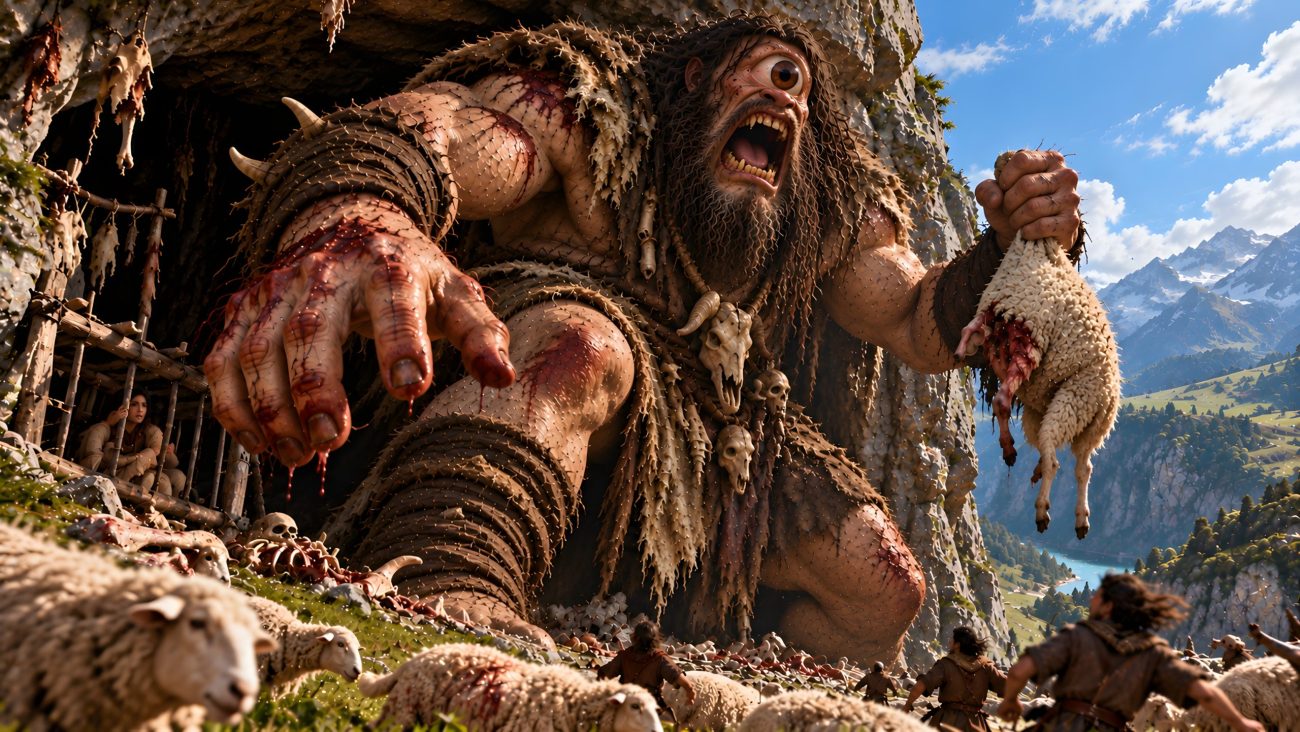
Tartaro is a gigantic, immensely strong, one-eyed monster in Basque mythology. He is commonly described as a cave-dwelling giant who captures and devours young people, especially those who wander into his lair or seek shelter there. In some accounts, he also eats sheep, consuming an entire sheep each day. His single eye and man-eating nature make him closely resemble the Greek Cyclops Polyphemus, encountered by Odysseus in Homer’s Odyssey.
In traditional tales, Tartaro lives in caves in the mountains, where he waits for unsuspecting victims. Stories about him often involve a captive who must find a way to escape the giant’s lair. Some versions closely parallel the story of Odysseus and Polyphemus: the giant is blinded with a heated spit, and the captive escapes by concealing himself beneath a sheep’s fleece. These similarities have led to comparisons between the Basque monster and the Greek Cyclops, although a direct derivation from Homer’s epic has not been established.
The creature’s name appears in several forms across Basque storytelling. Tartaro and Tartaroa occur in translated tales and older commentary, while Torto, Alarabi, and Anxo are recorded as regional names. Tartalo is particularly associated with the Zegama region. The name Anxo or Ancho is sometimes identified with Tartaro, although other accounts treat it as an alternative name for Basajaun, another supernatural being in Basque folklore.
Tartaro also appears in Basque adaptations of European fairy tales. In some versions of stories resembling Cinderella, Hop-o’-My-Thumb, and Donkeyskin, a giant called Tartaroa takes the role of the man-eating ogre. In one account, instead of smelling fresh meat, he detects the presence of Christians, whom he intends to eat. These variations show how the figure could be incorporated into stories beyond the traditional cave-monster narrative.
The origin of the name Tartaro remains uncertain. One nineteenth-century explanation connected it with the Tatar peoples, while other commentators compared the name with the European word “ogre.” These theories remain speculative. Across the different versions of the tradition, Tartaro is chiefly remembered as a powerful, one-eyed man-eater whose victims must rely on courage and cunning to escape him.
Sources
“Tartalo.” Wikipedia: The Free Encyclopedia. Wikimedia Foundation. Accessed October 16, 2026. https://en.wikipedia.org/wiki/Tartalo