Tradition: English Mythology
Alternative Names: The Giant of Penhill, The Penhill Giant
Category: Giant
The Myth
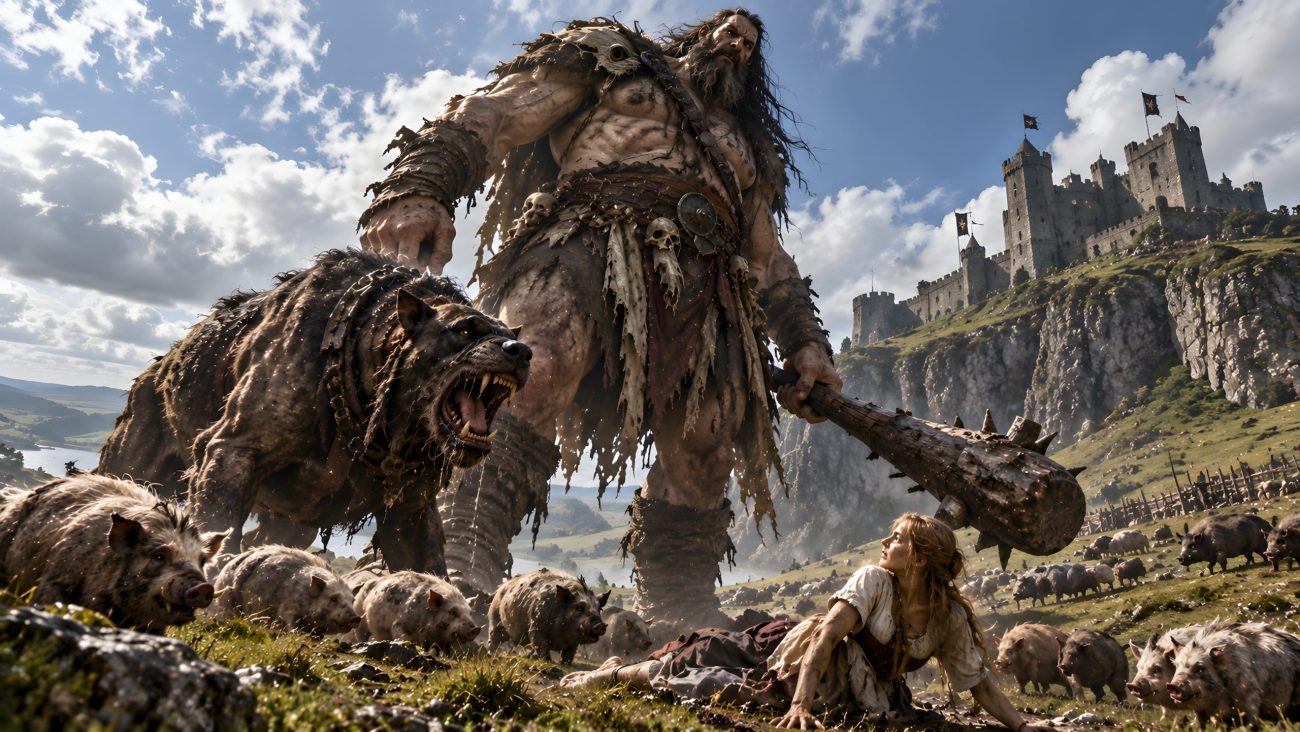
The Wicked Giant of Penhill was a monstrous figure said to have terrorized the countryside around Penhill and Bolton Castle in Yorkshire before the Norman Conquest. According to the legend, he was descended from Thor, the Norse god of thunder and storms, and retained a fierce, violent nature worthy of his divine ancestry. He lived in a castle on Penhill and devoted himself to raising a vast herd of pigs. His closest companion was Wolfhead, a powerful boarhound that helped him guard his livestock. The giant’s enormous strength and cruel temperament made him a source of fear throughout the surrounding countryside.
One day, the giant encountered a flock of sheep belonging to a young shepherdess named Gunda. Finding amusement in the animals’ helplessness, he ordered Wolfhead to attack them. As the hound tore through the flock, Gunda begged the giant to spare her father’s sheep, which represented everything her family possessed. Rather than show mercy, the giant delighted in her distress and attempted to assault her. Gunda managed to escape his grasp, but the enraged giant sent Wolfhead after her. When she struck the hound on the nose with a stone to defend herself, the giant caught up with her and killed her with his club.
Some weeks later, the giant discovered that one of his young boars had been killed by an arrow. Furious, he demanded that every man in the dale who could draw a bow appear before him on Penhill within a week. When Wolfhead tracked down the dead boar but failed to return promptly, the giant threatened the hound and eventually killed his only companion with an arrow. The giant then confronted the assembled men, demanding that they identify the person responsible for killing his boar. When nobody could answer, he ordered every father to return the following day carrying his youngest child, threatening to spill the blood of the entire community if they continued to defy him.
An elderly hermit confronted the giant and warned him that the following day was Thor’s day. If the giant spilled blood or caused any child to cry from pain or fear, the hermit declared, he would never enter his castle again, whether alive or dead. The giant dismissed the warning and prepared to torment the villagers. Meanwhile, a servant who had long endured his master’s cruelty tried to warn him about ominous dreams and the ravens and crows circling the castle. The giant responded by kicking the servant so violently that he left him for dead. In desperation, the servant dragged straw, wood, and peat into the castle’s main hall and set them alight.
As the giant approached the gathering of villagers and their children, he discovered dead boars lying along his path, with another nine appearing after every nine steps. Enraged, he threatened to slaughter the children and stain the hillside with the blood of every living person present. The hermit refused to submit to him and challenged him to look behind. There, the giant saw his castle engulfed in flames. But an even more terrible sight awaited him: Gunda, the shepherdess he had murdered, stood beside Wolfhead, the hound he had killed. She held the hound on a long rope before releasing it. As Wolfhead sprang at the giant’s throat, the giant stumbled backward over the edge of Penhill cliff. Both plunged over the precipice and were never seen again. The wicked giant’s reign of terror thus ended through the return of those he had wronged.
Sources
“The Wicked Giant of Penhill.” Yorkshire Folk Tales, March 4, 2019. https://yorkshirefolktales.home.blog/2019/03/04/the-wicked-giant-of-penhill/