Tradition / Region: Chinese mythology Category: Fish
The Myth
The Dan fish is a legendary fish surrounded by a red, glowing aura. When it appears, its body shines as if lit by fire, and the light rises above the water. It is said to live in deep pools and only comes close to the surface at certain times.
According to belief, if a person cuts the Dan fish and smears its blood on their feet, they gain the power to walk across the surface of water. Because of this ability, the fish is regarded as extraordinary and dangerous to approach.
In some stories, people who see the glowing fish are filled with awe and fear. They believe it is not an ordinary creature, and many refuse to touch or eat it, considering it a sacred or divine being.
Tradition / Region: Chinese mythology Category: Fish, Carp
The Myth
The Red Carp is a strange and unusual fish described in Chinese legend. It has the body of a fish but the face of a human, making it both familiar and unsettling in appearance. The creature is said to live in the Winged Marsh, a remote and mysterious wetland.
When the Red Carp cries out, its voice is said to resemble the call of a mandarin duck. Despite its uncanny form, the fish is associated with healing rather than danger. According to tradition, eating the Red Carp can cure scabies.
The Red Carp is recorded in the Classic of Mountains and Seas, specifically in the Southern Mountains Classic, where it appears as one of the many strange beings inhabiting distant and mythical landscapes.
The Rubberado is a strange and comical creature known for its unusual body and peculiar way of moving. It cannot leap, fly, jump, climb, swim, run, walk, creep, or crawl. Instead, the Rubberado moves in only one way: it bounces.
From the moment it begins moving, the Rubberado bounces endlessly from place to place. Each time it lands, it laughs, and then springs up again, continuing this motion without pause. Its movement is uncontrollable and repetitive, as though its body were made entirely of rubber.
The Rubberado is said to have a tasty smell, though it is not edible. Anyone foolish enough to try to eat it is warned of the consequences. If a person does so, they will begin to bounce and laugh uncontrollably, just like the Rubberado itself. This condition does not pass quickly—the victim will continue to bounce and laugh for days and days, unable to stop.
Because of this, the Rubberado is regarded less as a dangerous creature and more as a source of endless trouble and ridicule. Its presence brings chaos not through violence, but through uncontrollable motion and laughter, turning anyone who interferes with it into a living reflection of its own absurd nature.
The Rubberado remains a reminder that not all monsters threaten with teeth or claws—some punish curiosity with laughter that never ends.
Gallery
Sources
Schwartz, A., & Rounds, G. (1978). Kickle Snifters and Other Fearsome Critters.
The Tote-Road Shagamaw is a strange forest creature spoken of by loggers and woodsmen from the Rangeley Lakes to the Allagash, and across into New Brunswick. Its existence is said to explain a long-standing mystery that has caused confusion, arguments, and even fistfights among experienced men of the woods.
The trouble begins with tracks. One day, men swear they have found bear tracks near camp. Soon after, these reports are denied and replaced by claims that the tracks belong to a moose instead. Such disagreements are taken seriously, since accusing a woodsman of confusing bear and moose tracks is considered a grave insult. Only a few old timber cruisers and rivermen are said to know the true explanation.
One such man was Gus Demo of Oldtown, Maine, who had hunted, trapped, and logged in the woods for forty years. While traveling through the forest, he came upon tracks that were clearly those of a moose. After following them for about eighty rods, the tracks abruptly became unmistakable bear tracks. After another eighty rods, they changed back again into moose tracks. Gus soon noticed that this change occurred exactly every quarter of a mile, and that the tracks always followed a tote road or blazed survey line through the forest.
Eventually, Gus came close enough to see the creature itself. He observed that it had front feet like a bear’s and hind feet like those of a moose. It moved with great care, pacing steadily and taking exactly one yard per step. After walking for a time, the creature suddenly stopped, looked all around, and then turned sharply as if pivoting on a point. It then inverted itself, walking on its front feet alone, and continued on its measured path.
By examining the witness trees, Gus realized that the place where the Shagamaw inverted itself was a section corner. From this, he reasoned that the creature must once have been a highly imitative animal. By watching surveyors, timber cruisers, and trappers patiently follow straight lines through the forest, it had taken on the same habit.
According to this explanation, the Shagamaw can count only as high as 440, which equals a quarter of a mile measured in yards. When it reaches that limit, it must turn itself over to continue counting again from the beginning. Thus, the creature endlessly walks the tote roads, confusing men by leaving alternating bear and moose tracks, and quietly measuring the forest one quarter-mile at a time.
The Tote-Road Shagamaw remains a symbol of the woods’ ability to deceive even experienced eyes, and a reminder that not every mystery in the forest can be solved by tracks alone.
Gallery
Sources
Cox, W. T. (1910). Fearsome Creatures of the Lumberwoods: With a Few Desert and Mountain Beasts.
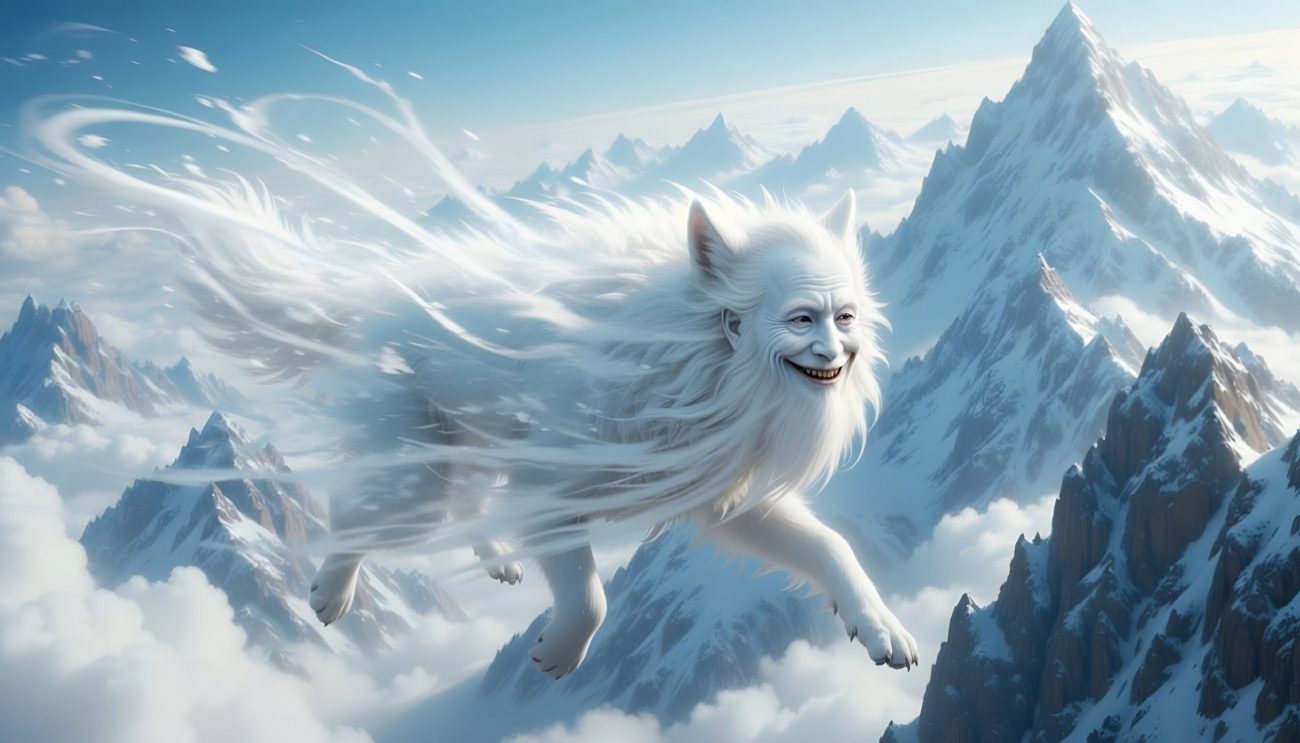
Belun is a field spirit in Belarusian mythology, most often described as a kind and benevolent being. He appears in the form of an old man with a long white beard, dressed in white and carrying a white staff. Though his appearance is humble and sometimes odd, Belun is associated with good fortune, guidance, and quiet help.
According to common belief, Belun appears to poor people working or walking in rye fields. He is said to show himself as an elderly man with snot running from his nose and a bag hanging around his neck. When he meets someone, he asks them to wipe his nose. If the person agrees and does so, gold pours from Belun’s bag, after which he immediately disappears. The amount of money received depends on what is used to wipe his nose: wiping it with the hand yields only a small amount, while using a scarf, hat, or the hem of a coat allows more gold to spill out—only as much as the chosen cloth can hold.
This belief is reflected in Belarusian sayings. The phrase “Posyabrivsya z Belunom”—“I became friends with Belun”—means that someone has suddenly become wealthy or fortunate. Another saying, “It’s dark in the forest without Belun,” expresses the belief that Belun serves as a guide for those who lose their way.
Beyond granting wealth, Belun is also believed to help travelers who are lost in forests. Without speaking or revealing himself clearly, he is said to lead people back to the right path, guiding them safely to roads or villages. During harvest time, Belun is thought to be present in the fields, silently helping reapers work successfully.
In one story, a man spent the night sleeping in a rye field within a forest clearing. At dawn, he awoke to find a short, gray-haired old man bending a stalk of rye and brushing its ear against his face. The old man squinted and smiled slyly, and a large drop of dew glistened on the tip of his nose. The man immediately realized this was Belun and prepared to wipe his nose to gain wealth. But before he could act, the old man dissolved into a light cloud of pollen and vanished into the clear morning sky.
Thus, Belun remains a figure of quiet generosity and elusive fortune—a spirit who helps the humble, rewards kindness, and disappears as suddenly as he appears.
Loviduch is a forest demon found in the folklore of the Lasowiaks, a subethnic group of the Lesser Poles living on the Tarnobrzeg Plain in southeastern Poland. According to beliefs recorded in the 19th century, the loviduch dwelled in the Sandomierz Forest, where it lay in wait for restless souls wandering far from their proper place.
In appearance, the loviduch was described as strange and unsettling. It resembled a tuberous or onion-shaped body, set upon spiny, five-toed feet. Its limbs were short and thin, ending in long fingers armed with sharp claws. Though small and misshapen, it was considered fearsome because of its purpose rather than its strength.
The loviduch did not prey upon the living. Instead, it hunted ghosts and wandering spirits, capturing those restless souls that lingered in wastelands far from human settlements. Its dwelling was said to be the desolate, empty places, where such spirits were believed to roam. Once it seized a soul, the loviduch tormented it relentlessly, mocking it and making it cry, though it never destroyed it outright.
Despite its cruel treatment of spirits, the loviduch posed no danger to living people. Humans were not its concern, and it did not attack or harm them. Its role was limited entirely to the supernatural realm, acting as a tormentor of the dead who failed to find rest.
Over time, the name loviduch came to be applied jokingly or disparagingly to certain medical workers, though this usage bore no resemblance to the original being. Unlike these human namesakes, the true loviduch of folklore remained a creature concerned only with ghosts and spirits, dangerous solely to the dead and invisible to the living.
Bolts are malicious forest or field demons known in the folk tales of Eastern Lesser Poland. They are believed to lure people away from proper paths, drawing travelers into wilderness, fields, or unfamiliar terrain where they lose their sense of direction.
These beings are closely associated with confusion and delusion, and are sometimes described as manifestations of madness or devilish influence. In local belief, bolts often appeared to people returning at night—especially those walking home from inns or taverns—leading them astray and preventing them from finding their way.
In the region of the Rzeszów Foothills, bolts were closely related to another figure known as the error, a demon said to sit at crossroads, sometimes beneath stones. Like the bolt, this being led nighttime travelers through open fields, causing spatial disorientation and helpless wandering. Because of these beliefs, people erected roadside shrines at such places and held special processions there, hoping to protect themselves from being misled.
Bolts were thought to nest near roads and highways, choosing places where travelers were most vulnerable. By means unknown, they caused sudden loss of orientation, making familiar routes feel unfamiliar. They seemed to take particular pleasure in confusing those who had spent the evening drinking, and many tales describe people arriving home at dawn ragged, bruised, and without their belongings, claiming that a bolt had led them astray.
In popular explanation, such misfortune was attributed not to human error, but to the direct action of these demons. To say that “a bolt went wild” became a way of explaining unexplained wandering, exhaustion, and loss.
Though later generations joked that the demon itself may have vanished, folklore preserves the belief that the experience of confusion in the night—of losing one’s way without knowing how—has never entirely disappeared.
Shatans are strange, odd-looking beings known in Belarusian folklore. They are not considered evil or dangerous, but are instead symbols of idleness and laziness, representing a life without purpose or direction.
Shatans live in a mindless and aimless way. From morning until night, they wander about without any clear goal, never engaging in useful work. Their constant roaming serves no purpose, and those who encounter them may feel drawn into the same pointless drifting, becoming distracted or restless themselves.
They are unable to communicate properly, even among their own kind. When shatans meet one another, they do not form friendships or cooperation. In moments of danger or difficulty, they do not help each other, nor do they attempt to offer rescue or support. Each shatan exists alone, isolated even when surrounded by others.
In folklore, more aggressive supernatural beings—such as witches or other angry spirits—are said to mock, torment, or harass shatans. Being timid and cowardly, shatans usually flee or hide rather than defend themselves. In some tales, they are even killed by hostile spirits, unable or unwilling to protect themselves.
When shatans grow tired of their endless wandering, they sometimes sit down to spin bast shoes. These shoes, however, wear out very quickly, as the shatans soon return to their ceaseless roaming. The repeated making and wearing out of shoes reflects the futility of their existence—work done without meaning, undone almost as soon as it is completed.
Through the figure of the shatan, folklore presents a quiet warning: a life spent without effort, purpose, or responsibility leads only to exhaustion, vulnerability, and emptiness.
Tradition / Region: British Mythology Alternate Names: The Mordiford Dragon Category: Dragon, Wyvern
The Myth
Near the village of Mordiford, where the River Lugg meets the River Wye, there once lived a dragon whose story is closely bound to a young girl named Maud.
Maud was a child who longed deeply for a companion of her own. One day, while wandering in the woodland near her village, she discovered a small, bright creature among the flowers. It had a narrow snout and tiny, translucent wings, and it moved with curious life. Delighted, Maud took the creature home, believing she had finally found the pet she desired.
Her parents, however, recognized the truth at once. The creature was no harmless animal but a young wyvern, and they warned Maud that it would bring danger upon the village. They ordered her to return it to the forest immediately. Though she pretended to obey, Maud could not bear to part with it. Instead, she hid the wyvern in a secluded place in the woods and secretly returned to it each day.
Maud fed the creature milk, played with it, and watched as it grew stronger, learning to stretch and beat its wings. Month by month, it grew larger, its body taking on a deep emerald color, its wings becoming broad and powerful. What had once been small enough to cradle soon became something vast and dangerous.
In time, the dragon’s hunger changed. Milk no longer satisfied it, and it began to crave meat. It descended upon nearby farms, killing sheep and cattle. When the farmers tried to stop it, the dragon turned on them as well, discovering a taste for human flesh. The countryside fell into fear.
Maud continued to visit the dragon, begging it to stop its violence. The beast ignored all pleas. Though it spared Maud—its first and only friend—it killed everything else in its path, until the people of Mordiford could endure no more.
At last, a man from the Garstone family armed himself and went into the forest to confront the dragon. When he found it, the wyvern unleashed fire upon him, but he pressed forward and drove his weapon through its throat, killing it where it lay among the trees.
Hearing the struggle, Maud rushed from the forest. She arrived too late. The dragon lay dead, and Maud fell beside it, overwhelmed with grief for the creature she had raised and loved.
Thus ended the dragon of Mordiford—born of wonder, nurtured in secrecy, and destroyed when its nature could no longer be contained. The tale remains a reminder that affection alone cannot tame what is meant to grow beyond human control.
Tradition / Region: Japan Mythology Category: Yōkai, Crab
The Myth
Kebō is a strange yōkai said to have appeared in the fields of Hama in Satsuma Province. It is described as being about the size of a four- or five-year-old child, small but unsettling in form.
Its body is covered in red hair, giving it a wild, unkempt appearance. Kebō has a human-like head and torso, with two arms and four legs, each ending in black, sharp, claw-like tips. Around its waist, thick hair hangs down like a coarse skirt.
Although it resembles a small humanoid, Kebō is also compared to an aged ebi-gani, a creature likened to a shrimp or crab that has lived far beyond its time. This gives it an uncanny, half-human, half-creature quality.
Kebō is said to feed on small fish. It does not cry out or speak, remaining silent at all times. When encountered by people, it does not attack. Instead, it is described as smiling quietly, watching without expression or sound.
Because of its silence, its strange smile, and its unnatural form, Kebō is remembered not as a violent yōkai, but as an eerie presence—one that appears briefly, observes, and disappears without explanation.