Tradition / Region: British Mythology Category: – Related figures: Mermaid, Swamp dweller
The Myth
In the marshes and stagnant ponds of northern England, something waits beneath the surface.
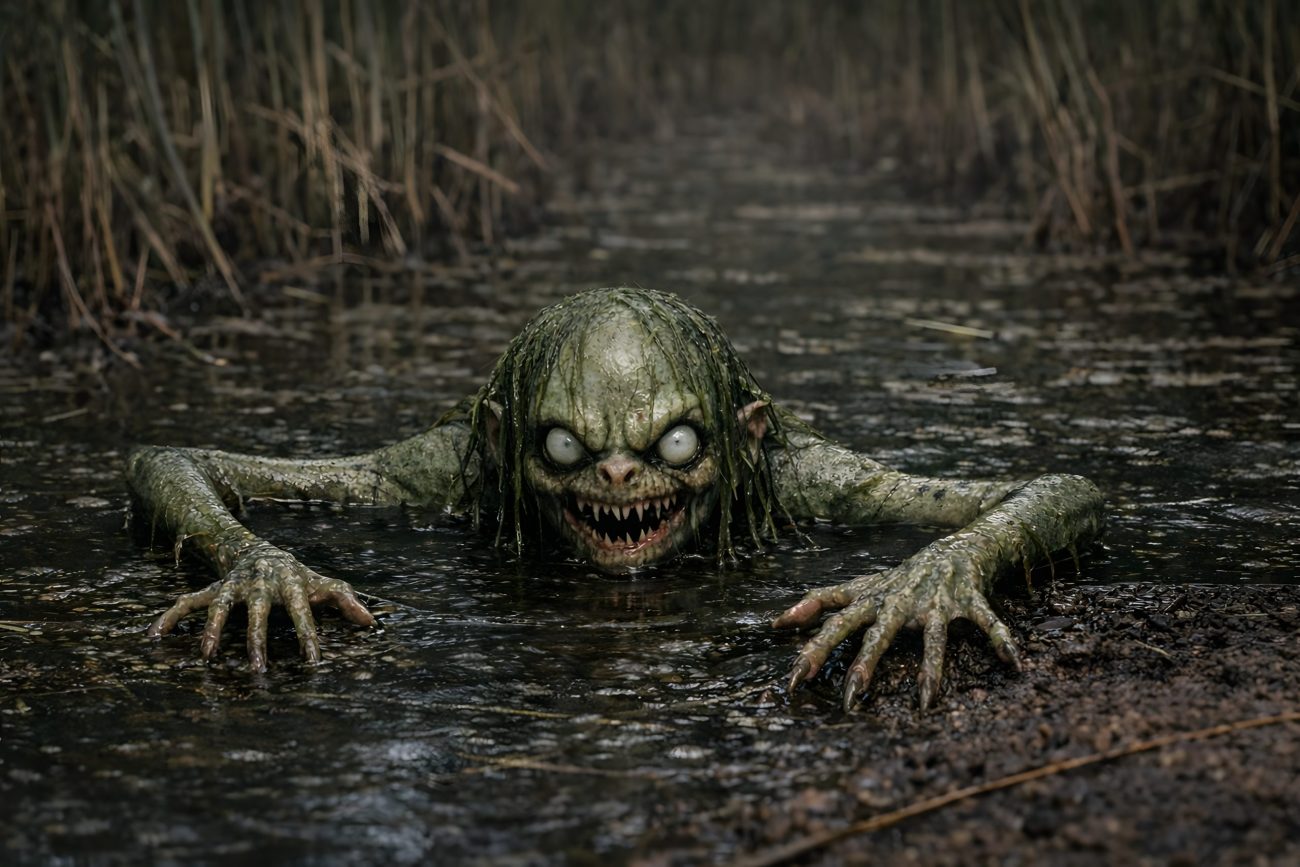
The Grindylow is said to dwell in meres, bogs, and reed-choked pools—especially in Yorkshire and Lancashire. It is described as a small, humanoid creature with scaly green skin, sharp claws, pointed teeth, and long, sinewy arms ending in unnaturally long fingers. Those arms are its most feared feature.
The Grindylow does not roam far from water. It hides below the murky surface, patient and unseen. When a child wanders too close to a pond’s edge, when small feet slip on wet stones or lean too far over still water, the creature strikes. With its powerful grip, it seizes the victim and drags them down into the dark.
Few tales describe what happens beneath the water. The horror lies in the suddenness—the splash, the grasp, the disappearance.
Tradition / Region: British Mythology Alternate Names: — Category:Gnome, House dweller
The Myth
In the borderlands between England and Scotland, old mills were said not to work by human hands alone. Hidden among the gears, beams, and sacks of grain lived a strange spirit known as the Kilmoulis.
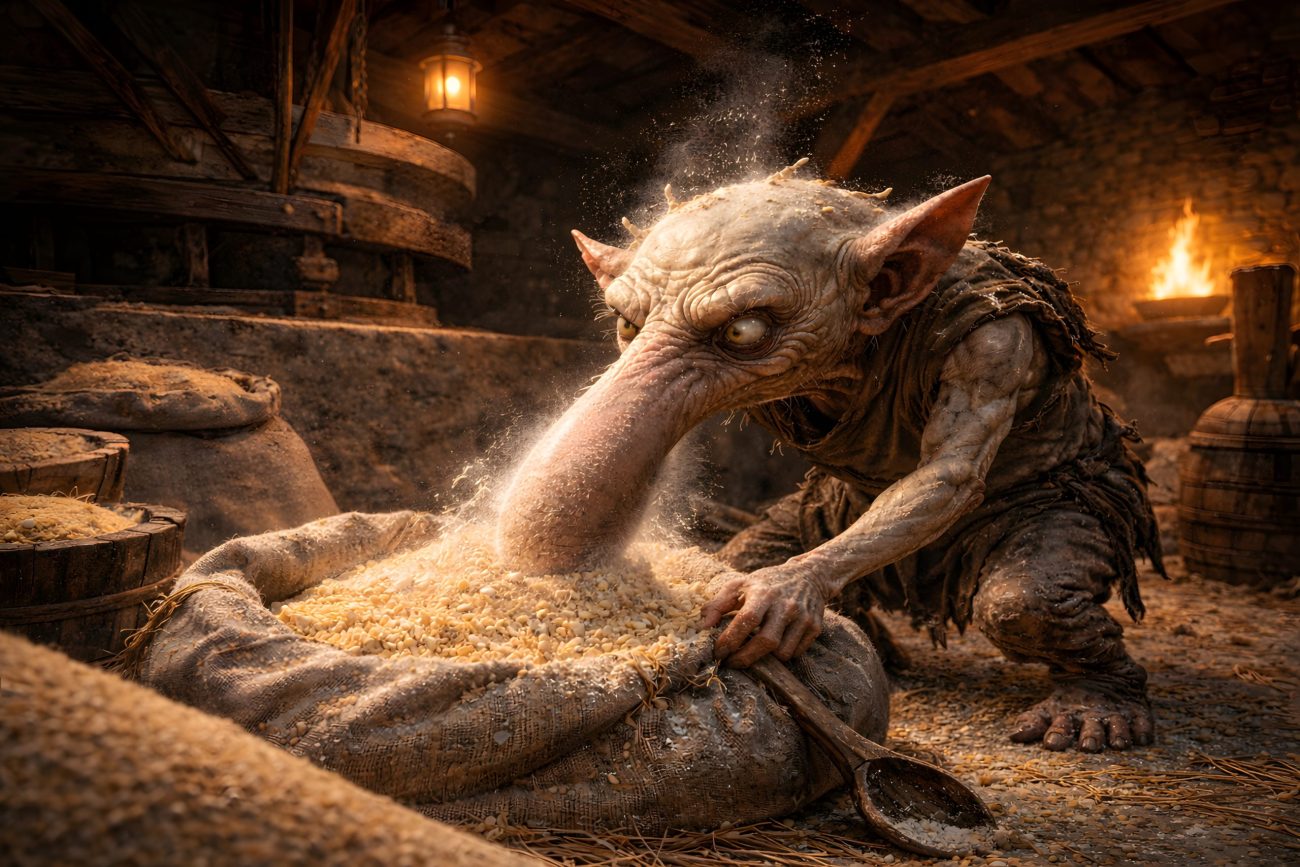
The Kilmoulis was a cousin to the brownie, but far uglier. He was described as having an enormous nose and no mouth at all. Because of this, he could not eat in any ordinary way. Instead, he inhaled his food through his nose, drawing in meal, porridge, or scraps left behind in the mill. This grotesque habit made his presence unmistakable to those who knew the signs.
Despite his appearance, the Kilmoulis was a diligent worker. By night, when the mill was quiet, he labored tirelessly—turning wheels, cleaning stones, and keeping the machinery in order. Millers who treated their mills with respect often found their work mysteriously eased, grain ground faster, and breakdowns fewer.
Yet the Kilmoulis was also a trickster. He delighted in pranks: hiding tools, scattering grain, making strange noises, or confusing workers by rearranging things overnight. These tricks could be maddening, but they were rarely malicious. The spirit’s mischief was part of his nature, as inseparable from him as his labor.
So long as the miller tolerated the disturbances and left small offerings of food, the Kilmoulis remained a net blessing. His work outweighed his trouble. But if insulted, mocked, or driven away, the mill might fall into disrepair, its luck souring as suddenly as it once flourished.
Thus the Kilmoulis was remembered as both nuisance and necessity: an ugly, nose-sniffing mill spirit whose hard work and mischief turned endlessly together, like the millstone itself.
Gallery
Sources
Wikipedia contributors. (n.d.). Kilmoulis. In Wikipedia, The Free Encyclopedia, from https://en.wikipedia.org/wiki/Kilmoulis
Tradition / Region: British Mythology Alternate Names: The Mordiford Dragon Category: Dragon, Wyvern
The Myth
Near the village of Mordiford, where the River Lugg meets the River Wye, there once lived a dragon whose story is closely bound to a young girl named Maud.
Maud was a child who longed deeply for a companion of her own. One day, while wandering in the woodland near her village, she discovered a small, bright creature among the flowers. It had a narrow snout and tiny, translucent wings, and it moved with curious life. Delighted, Maud took the creature home, believing she had finally found the pet she desired.
Her parents, however, recognized the truth at once. The creature was no harmless animal but a young wyvern, and they warned Maud that it would bring danger upon the village. They ordered her to return it to the forest immediately. Though she pretended to obey, Maud could not bear to part with it. Instead, she hid the wyvern in a secluded place in the woods and secretly returned to it each day.
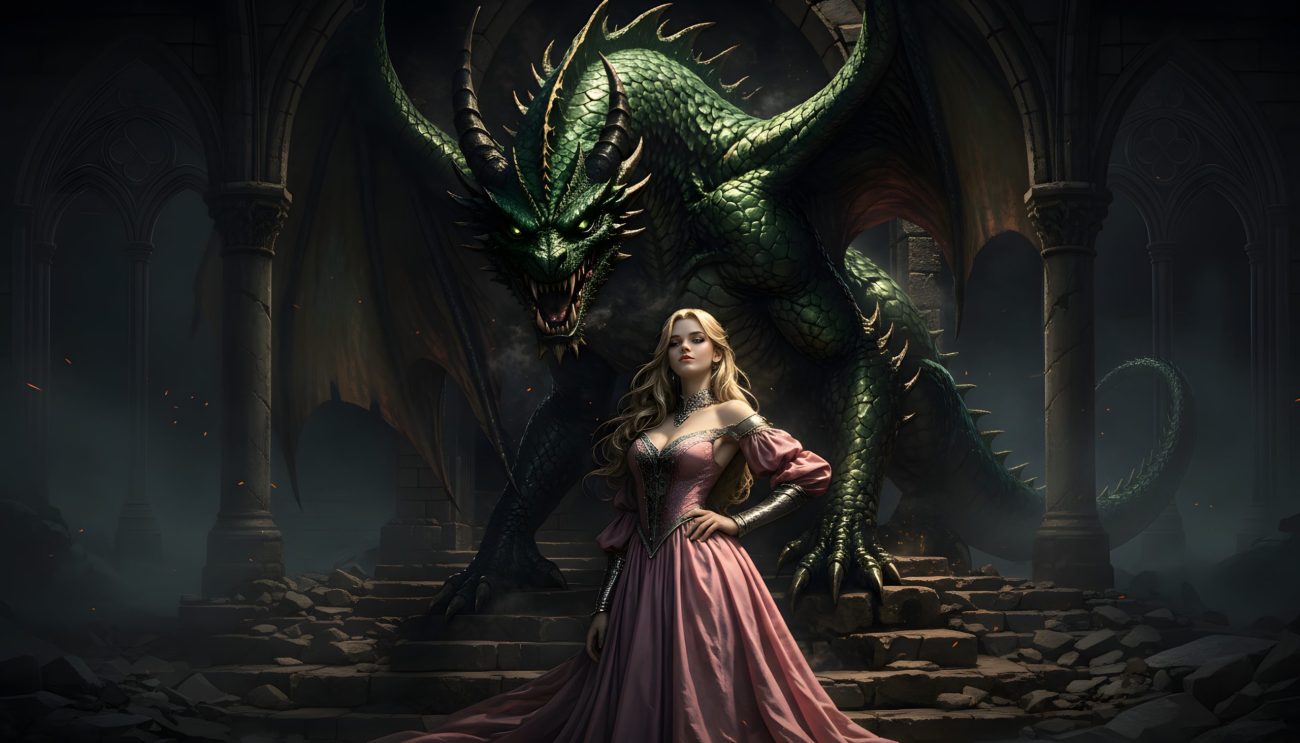
Maud fed the creature milk, played with it, and watched as it grew stronger, learning to stretch and beat its wings. Month by month, it grew larger, its body taking on a deep emerald color, its wings becoming broad and powerful. What had once been small enough to cradle soon became something vast and dangerous.
In time, the dragon’s hunger changed. Milk no longer satisfied it, and it began to crave meat. It descended upon nearby farms, killing sheep and cattle. When the farmers tried to stop it, the dragon turned on them as well, discovering a taste for human flesh. The countryside fell into fear.
Maud continued to visit the dragon, begging it to stop its violence. The beast ignored all pleas. Though it spared Maud—its first and only friend—it killed everything else in its path, until the people of Mordiford could endure no more.
At last, a man from the Garstone family armed himself and went into the forest to confront the dragon. When he found it, the wyvern unleashed fire upon him, but he pressed forward and drove his weapon through its throat, killing it where it lay among the trees.
Hearing the struggle, Maud rushed from the forest. She arrived too late. The dragon lay dead, and Maud fell beside it, overwhelmed with grief for the creature she had raised and loved.
Thus ended the dragon of Mordiford—born of wonder, nurtured in secrecy, and destroyed when its nature could no longer be contained. The tale remains a reminder that affection alone cannot tame what is meant to grow beyond human control.