Pazuzu

Tradition: Mesopotamian Mythology, Iraqi Mythology
Alternative Names: Pazuzu, Pà.zu.zu
Category: Lion


The Myth

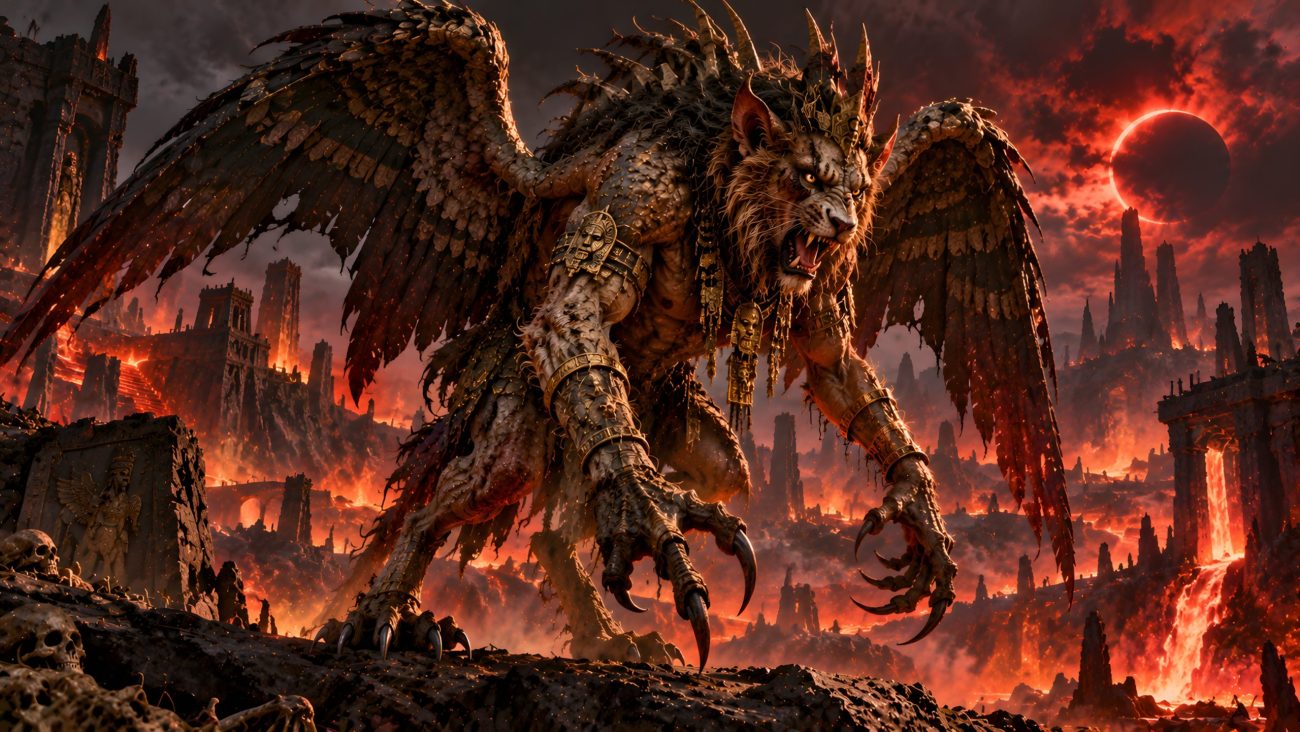
Pazuzu was a powerful demonic deity worshipped in ancient Assyria and Babylonia. He had a grotesque, hybrid appearance, with a canine-like face, bulging eyes, a scaly body, the talons of a bird, and usually a pair of wings. His body also included a serpent-headed penis. He was regarded as the son of Hanbi and was associated with destructive winds that swept down from the mountains, carrying disease and suffering. In an incantation, Pazuzu describes ascending mighty mountains and encountering evil winds, whose wings he breaks to prevent them from spreading harm.

Although Pazuzu was feared as a dangerous wind demon, he could also be invoked as a protector against other supernatural threats. His most important rival was Lamashtu, a malevolent demoness who endangered pregnant women, caused miscarriages, and attacked infants. Pazuzu was believed to be capable of driving her back into the underworld, making his frightening appearance a source of protection against evil. His image was therefore used in protective magic, particularly to safeguard pregnant women, mothers, and young children from illness and demonic attacks.

Amulets bearing Pazuzu’s head were worn as necklaces, especially by pregnant women, while larger figures and stone charms were placed inside homes or near entrances to repel harmful spirits. These objects were made from materials including bronze, terracotta, gold, glass, and bone. Some depicted him standing or crouching, with his gaze directed outward toward supernatural enemies. Rituals and incantations also invoked his power to banish sickness and prevent Lamashtu from entering a home. Pazuzu thus embodied a dangerous but useful supernatural force: a destructive demon whose terrifying power could be turned against other demons and used to protect the living.


Sources

“Pazuzu.” Wikipedia: The Free Encyclopedia. Wikimedia Foundation. Accessed October 21, 2026. https://en.wikipedia.org/wiki/Pazuzu
Maahes

Tradition: Egyptian Mythology
Alternative Names: Maches, Michos, Miysis, Mios, Maeches
Category: Lion, Deity


The Myth

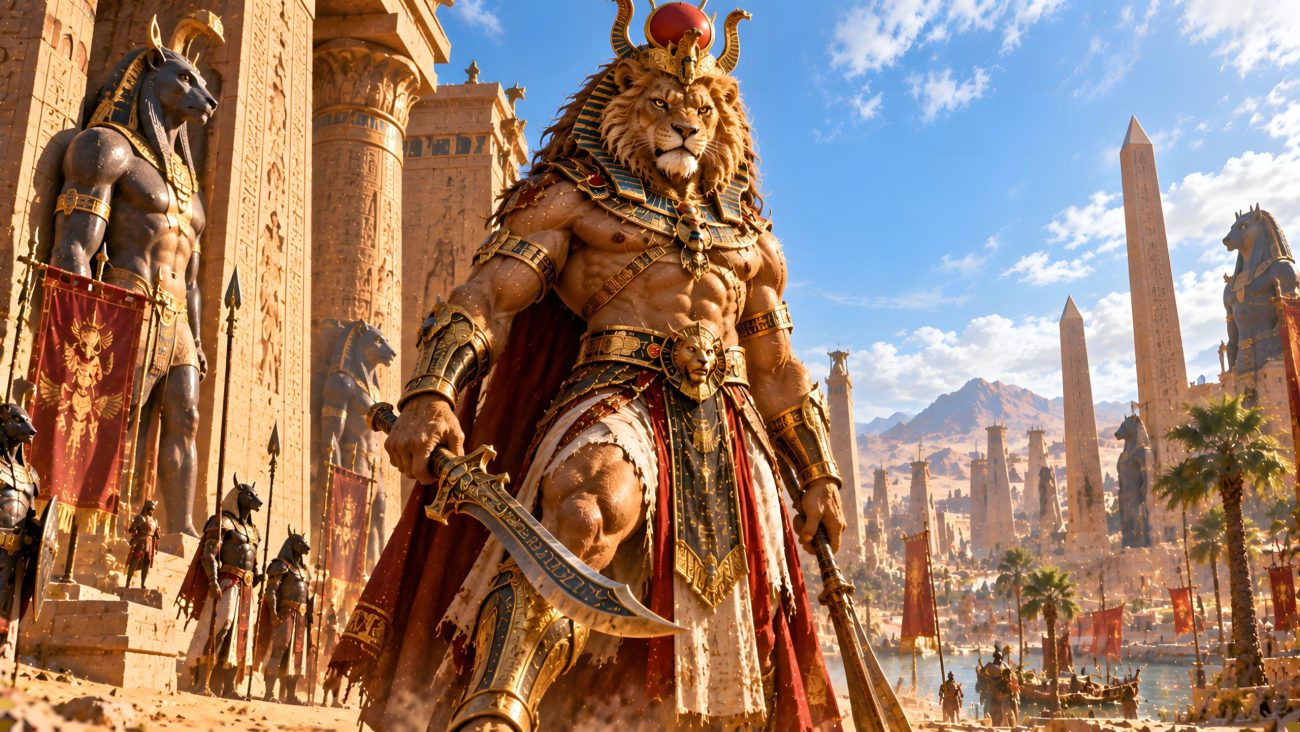
Maahes was an ancient Egyptian lion-headed god associated with war, protection, and the weather. He was usually depicted as a man with the head of a male lion, sometimes wearing a crown decorated with two uraei and carrying knives. In other representations, he held a bouquet of lotus flowers, reflecting his connection with Nefertem, a deity symbolized by the lotus. His name has been interpreted as meaning “he who is true beside her.” As a powerful feline deity, Maahes embodied the strength and ferocity of the lion, an animal associated with royal power and authority in ancient Egypt.

Maahes was regarded as the son of the creator god Ptah and either Bastet, worshipped especially in Lower Egypt, or Sekhmet, associated with Upper Egypt. Both goddesses were lion-like or feline deities whose fierce qualities Maahes shared. His principal cult centres were Taremu and Per-Bast, important religious centres associated with Sekhmet and Bastet. He was also sometimes connected with Nefertem, another son of Sekhmet, and his attributes included knives, lotuses, and the devouring of captured enemies.

As a god of war and protection, Maahes played a role in defending the divine order against its enemies. During the nightly journey of Ra through the underworld, he was said to fight Apep, the great serpent who threatened the sun god. Through his association with battle, royal power, and divine protection, Maahes represented the destructive force of the lion turned against the enemies of the gods and Egypt.


Sources

“Maahes.” Wikipedia: The Free Encyclopedia. Wikimedia Foundation. Accessed October 21, 2026. https://en.wikipedia.org/wiki/Maahes


Nemean Lion

Tradition: Greek Mythology
Alternative Names: Lion of Nemea, Leo Nemeaeus
Category: Lion


The Myth

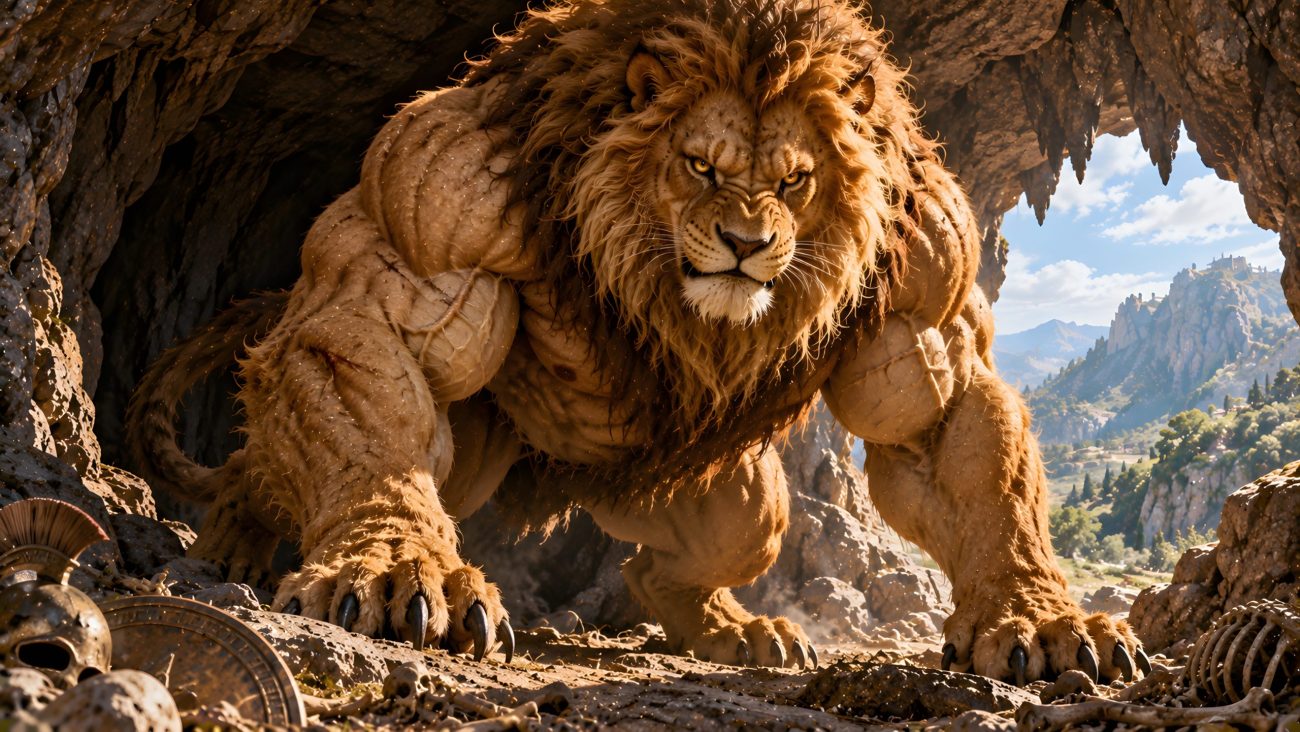
The Nemean Lion was a monstrous lion that terrorized the hills around Nemea in Greece. Its golden fur was impervious to weapons, making it impossible to kill with ordinary arrows or blades, while its claws were sharper than mortal swords and could pierce even the strongest armour. Its origins vary between traditions: some accounts describe it as the offspring of Orthus and a monstrous female, while others name Typhon as its father. Another tradition claims that the lion was born from the Moon, when the goddess Selene cast it down at Hera’s request. Hera allowed the beast to roam her lands, knowing that it would become a formidable challenge for Heracles.

The Nemean Lion became the target of the first of Heracles’ twelve labours, imposed upon him by King Eurystheus. When Heracles first attacked the creature with his bow, his arrows bounced harmlessly off its golden hide. Realizing that ordinary weapons could not harm the beast, the hero drove it into its cave and blocked one of its two entrances. He then entered through the other opening and stunned the lion with his club. Finally, Heracles strangled the monster with his bare hands.

After killing the lion, Heracles discovered that he could not cut through its hide with his knife. According to tradition, the goddess Athena advised him to use one of the lion’s own claws to remove its skin. Heracles thereafter wore the impenetrable pelt as armour and its head as a helmet, making the lion’s hide a lasting symbol of his extraordinary strength. When he returned with the carcass, Eurystheus was so terrified that he ordered Heracles to present the results of his future labours outside the city gates. The king even had a large bronze jar made in which he could hide whenever the hero returned.


Sources

“Nemean Lion.” Wikipedia: The Free Encyclopedia. Wikimedia Foundation. Accessed October 21, 2026. https://en.wikipedia.org/wiki/Nemean_lion


Kenreijishi

Tradition: Japanese Mythology
Alternative Names: Kenrei Jishi, 建礼獅子
Category: Lion


The Myth

The Kenreijishi is a sacred mythical beast depicted on ceremonial hangings used during great imperial ceremonies in Japan, including the enthronement of an emperor. These decorations, known as kemono-gata bokaku, were displayed beneath the eaves at important palace buildings, including the Daigokuden and the Shishinden. Their imagery showed supernatural creatures proceeding through a heavenly scene beneath a central sun, surrounded by flowing auspicious clouds.

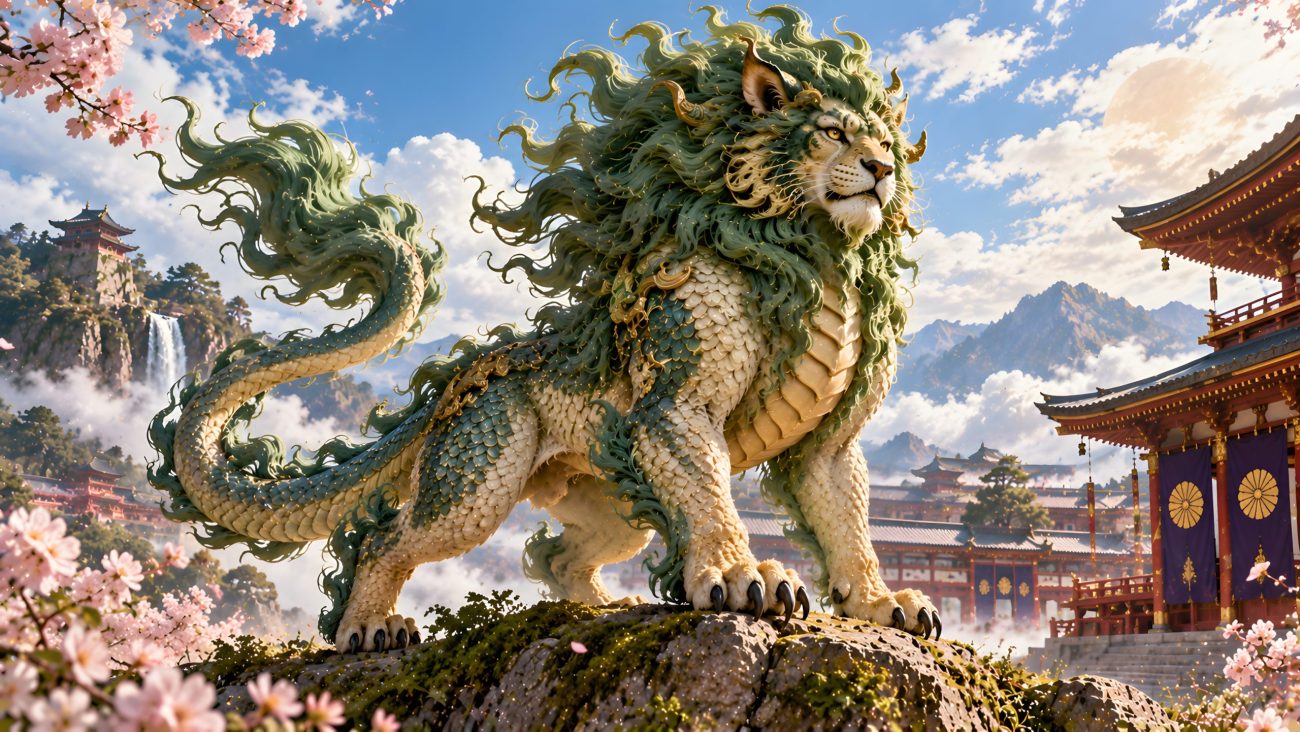
Following the dragons and phoenixes in this procession appears the Kenreijishi, a fantastic lion-like creature with a green or bluish mane. Although its overall appearance resembles a lion, its body is covered in scales, and its belly features the segmented appearance of a serpent. Its tail stretches out long behind it, resembling the tail of a dragon or snake. This unusual combination of leonine and serpentine characteristics distinguishes the Kenreijishi from an ordinary lion.

The Kenreijishi belongs to the procession of auspicious supernatural beasts associated with imperial ceremonial imagery. Its depiction on historical designs of the ceremonial hangings reflects the elaborate menagerie of mythical creatures used to adorn and dignify Japan’s most important court rituals.


Sources

“Kenrei-jishi.” 新版TYZ 妖怪図鑑 (New TYZ Yokai Encyclopedia). https://tyz-yokai.blog.jp/archives/1074485004.html


Yaoshou

Tradition: Chinese Mythology
Alternative Names: Medicine Beast, Yao Shou (药兽)
Category: Lion


The Myth

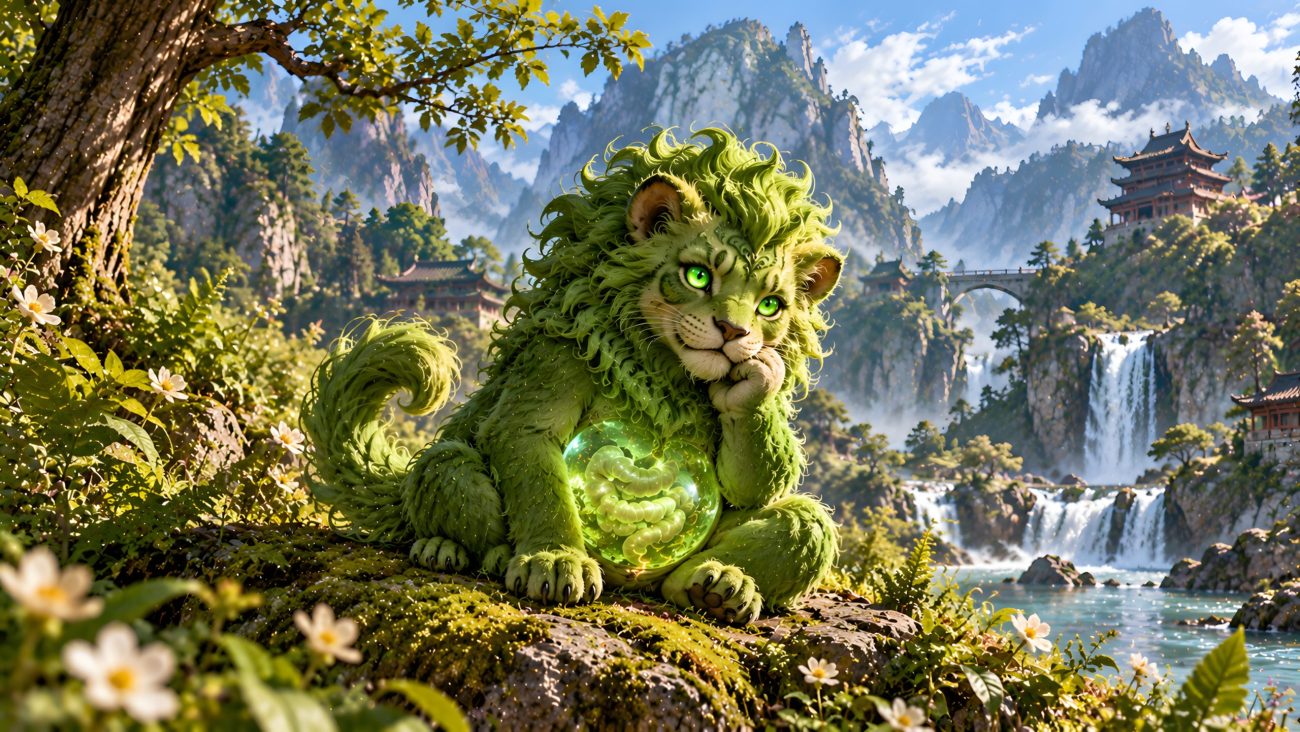
The Yaoshou is a legendary medicinal beast in Chinese mythology, described as resembling a small lion with a transparent, glowing belly. Its translucent abdomen reveals its intestines clearly, allowing observers to see whether the plants and insects it consumes are poisonous. Unlike ordinary lions, the Yaoshou is associated with healing and the discovery of medicinal remedies.

According to legend, the Yaoshou lived during the time of Shennong, the legendary divine ruler associated with agriculture and medicine. When someone became ill, they could approach the beast, explain the cause of their sickness, and speak to it in a mysterious language. After listening, the Yaoshou would run into the wilderness and return carrying a blade of grass in its mouth. The plant could then be crushed to extract its juice, which the sick person would drink to recover.

The tradition further relates that the Yellow Emperor instructed Fenghou to record which plants cured particular illnesses. Over time, these observations supposedly produced a reliable record of medicinal remedies. According to this account, the Yellow Emperor learned medicine from the Yaoshou rather than discovering medicinal plants solely by tasting them himself.


Sources

“Yao Beast” (药兽). Chinese Wikipedia. Wikimedia Foundation. Accessed October 21, 2026. https://zh.wikipedia.org/wiki/%E8%8D%AF%E5%85%BD


Anzû

Tradition: Mesopotamian Mythology, Iraqi Mythology
Alternative Names: Imdugud, Anzu, Zû, Anzud
Category: Lion


The Myth

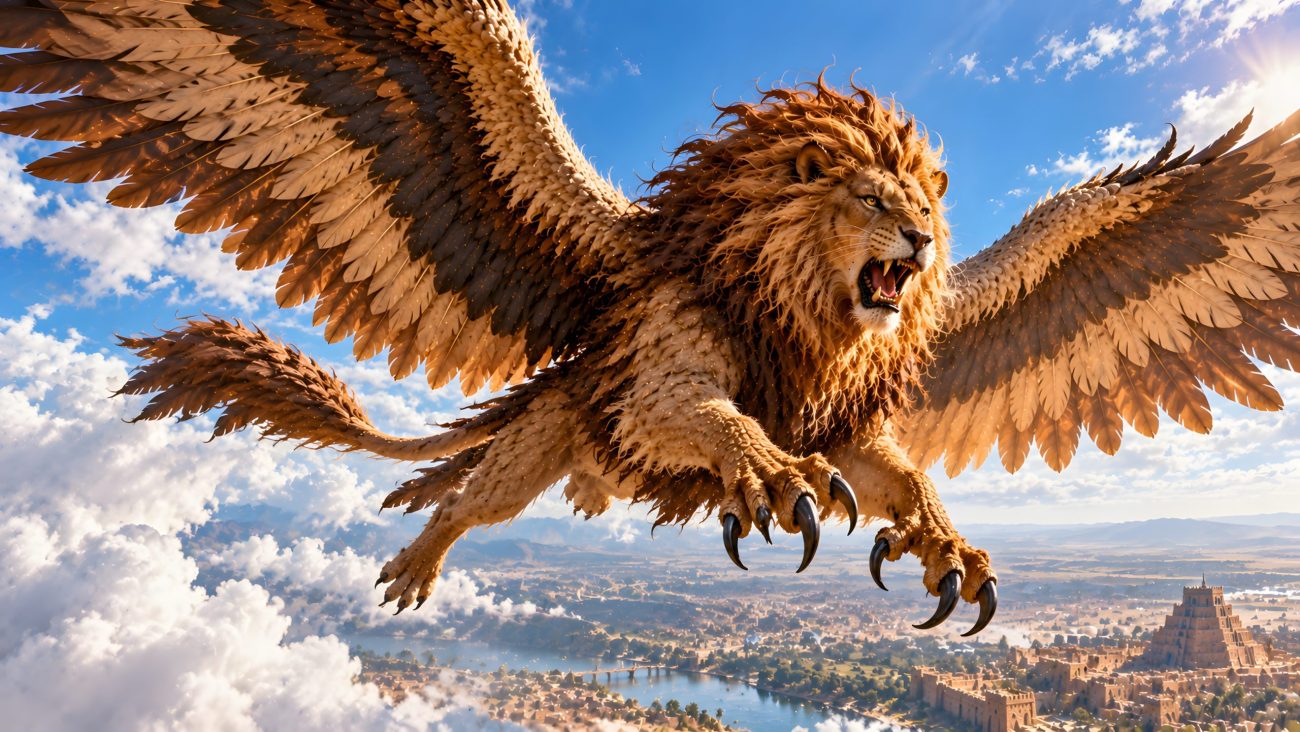
Anzû was a monstrous divine storm-bird in Mesopotamian mythology, depicted as an enormous bird or as an eagle with the head of a lion. Some traditions portrayed him as a half-human, half-bird creature capable of breathing both fire and water. He was associated with the southern wind and thunderclouds and was regarded as a powerful supernatural being. His origins vary between traditions: he was described as the offspring of the cosmic freshwater ocean Abzu and Mother Earth Mami, while other accounts named Siris as his parent.

Anzû is best known for stealing the Tablet of Destinies from Enlil, the god who held authority over the divine order. By taking the tablet, Anzû challenged Enlil’s power and threatened the organization of the gods and the world they governed. The other gods feared the formidable storm-bird, and Anu ordered them to recover the stolen object. Anzû concealed the tablet on a mountaintop, making its retrieval a dangerous undertaking.

Different versions of the myth describe Anzû’s defeat in different ways. In one account, the god Marduk killed the monstrous bird, while another tells how Ninurta pursued and slew him with arrows. His story reflects the struggle to preserve divine authority against a powerful creature capable of challenging the established cosmic order. Anzû also appears in the Sumerian tale of Lugalbanda and the Anzud Bird, as well as in the story of Inanna and the Huluppu Tree.


Sources

“Anzû.” Wikipedia: The Free Encyclopedia. Wikimedia Foundation. Accessed October 21, 2026. https://en.wikipedia.org/wiki/Anz%C3%BB


Lamashtu

Tradition: Mesopotamian Mythology, Iraqi Mythology, Deity
Alternative Names: Lamaštu, Dimme, Kamadme
Category: Lion


The Myth

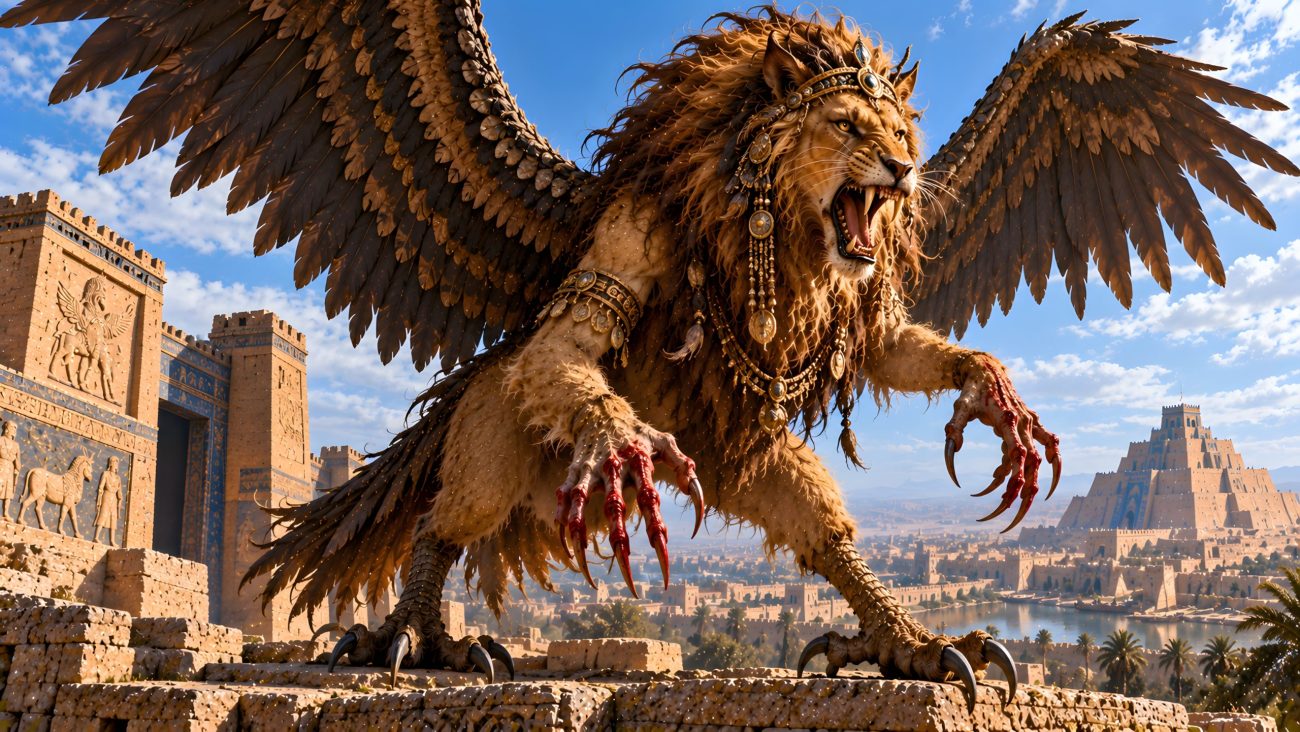
Lamashtu was a fearsome demonic goddess in Mesopotamian mythology, the daughter of Anu, the god of the sky. She had the head of a lion, the teeth of a donkey, a hairy body, and long fingers tipped with sharp fingernails. Her feet belonged to Anzû, a monstrous bird-like creature. She was depicted with bare breasts and hands stained with blood, giving her a terrifying appearance. Unlike many other malevolent beings, Lamashtu acted according to her own will rather than carrying out the commands of other gods.

Lamashtu was especially feared by pregnant women and families with newborn children. She was blamed for miscarriages, the deaths of infants, and illnesses that afflicted people of all ages. According to tradition, she could touch a pregnant woman’s stomach seven times to kill the unborn child or steal a baby from its wet nurse. Her victims were not limited to infants, as she could also bring disease and suffering to adolescents, adults, and the elderly.

To protect themselves against Lamashtu, people used amulets and talismans intended to ward off her attacks. She was also associated with donkeys and was believed to travel in a boat along the river of the underworld. Although regarded as a demoness, her ability to cause harm independently of the other gods marked her as a powerful and autonomous divine figure.


Sources

“Lamashtu.” Wikipedia: The Free Encyclopedia. Wikimedia Foundation. Accessed October 21, 2026. https://en.wikipedia.org/wiki/Lamashtu


Chimera

Tradition: Greek Mythology
Alternative Names: Chimaera, Khimaira
Category: Lion


The Myth

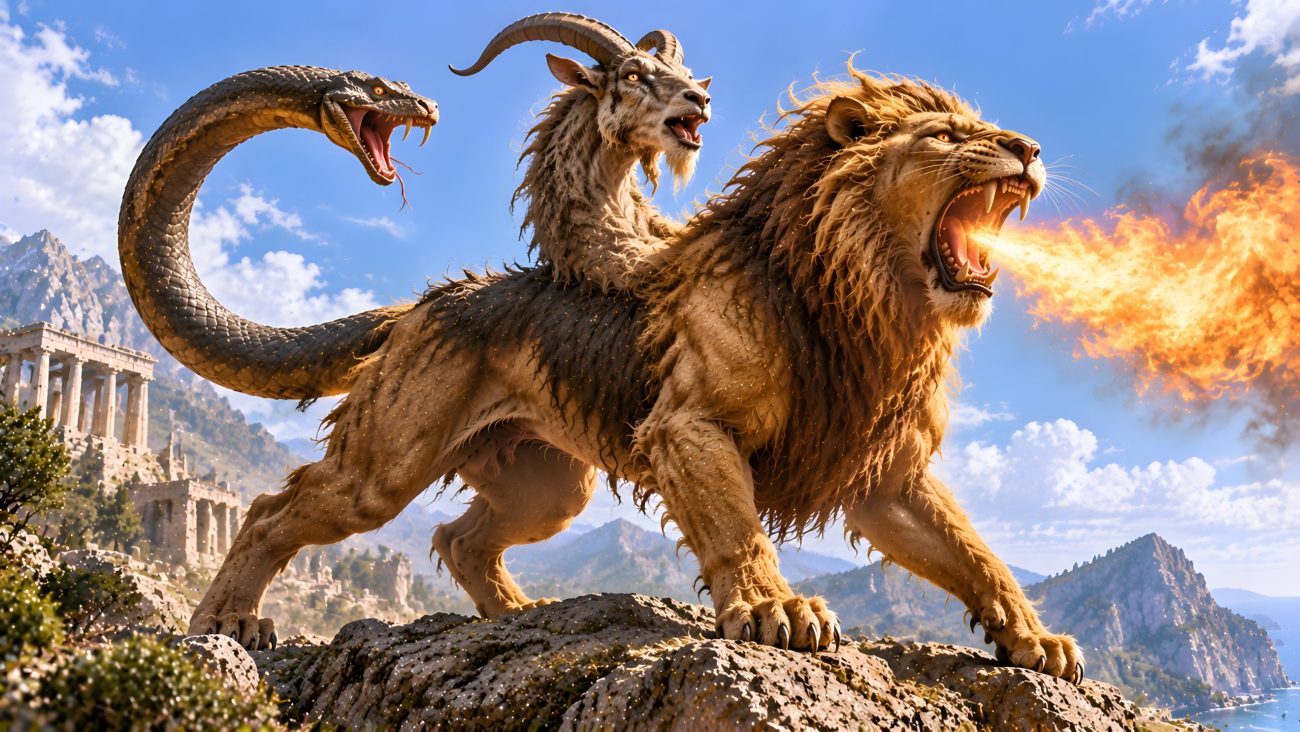
The Chimera was a monstrous, fire-breathing hybrid that terrorized the land of Lycia in Asia Minor. Its body combined several fearsome animals: it had the head and forequarters of a lion, a goat’s head rising from its back, and a serpent for a tail. Some descriptions portray it as having three heads, with a lion at the front, a goat in the middle, and a serpent at the rear. The creature breathed blazing fire and was considered a terrible threat to both people and livestock. It was said to be the offspring of Typhon and Echidna, making it a sibling of other famous monsters, including Cerberus and the Lernaean Hydra.

The Chimera brought destruction to Lycia, killing cattle and devastating the countryside. King Iobates therefore ordered the hero Bellerophon to slay the monster, hoping that the dangerous task would lead to his death. Bellerophon, however, undertook the challenge with the help of Pegasus, the winged horse. Mounted on Pegasus, he soared above the Chimera and attacked it from the air, eventually killing the beast with his weapons.

The Chimera became one of the best-known monsters of Greek mythology, representing the terrifying union of different animals into a single creature. Its image appeared in ancient art, including pottery, sculptures, and mosaics depicting its battle with Bellerophon and Pegasus. Its name later came to describe any fantastic creature formed from parts of different animals.


Sources

“Chimera.” Wikipedia: The Free Encyclopedia. Wikimedia Foundation. Accessed October 21, 2026. https://en.wikipedia.org/wiki/Chimera_(mythology)


Sphinx

Tradition: Greek Mythology
Alternative Names: Phix, Theban Sphinx
Category: Lion


The Myth

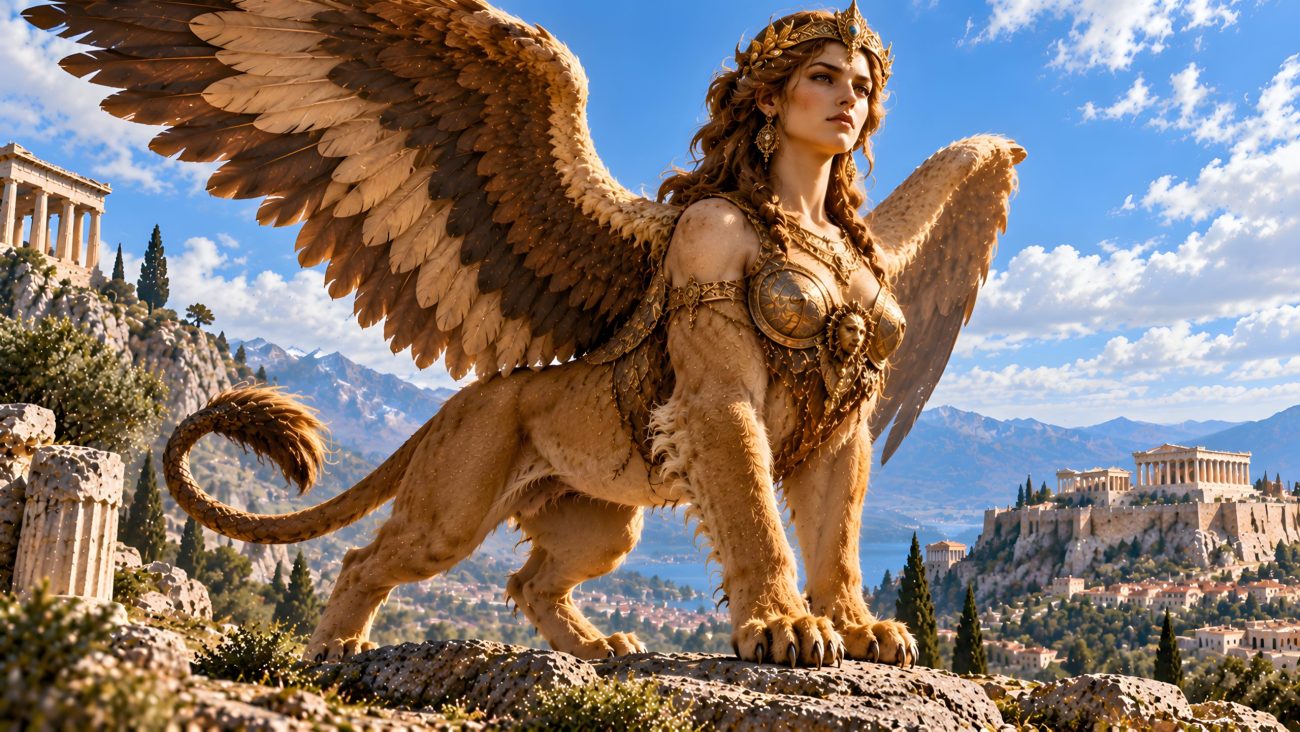
The Sphinx was a fearsome female monster with the body of a lion, the head and breast of a woman, and the wings of an eagle. Some traditions also gave her a serpent’s tail. She dwelled on Mount Phicium near Thebes, where she terrorized the surrounding land and preyed upon travelers. According to different accounts, she was sent by the goddess Hera to punish Thebes for an ancient wrongdoing, although other traditions attributed her arrival to different gods. Her parentage also varies, with some accounts naming Typhon and Echidna, while others describe her as the offspring of Orthus and the Chimera.

The Sphinx challenged those who approached her to solve a mysterious riddle: what creature walks on four feet in the morning, two at midday, and three in the evening? Anyone who failed to answer correctly was seized and devoured. Many people perished, including Haemon, the son of King Creon. Desperate to free Thebes from the monster, Creon promised the kingdom and the hand of Queen Jocasta to whoever could solve the riddle and defeat her.

Oedipus accepted the challenge and answered that the creature was a human being. As an infant, a person crawls on four limbs; as an adult, they walk on two legs; and in old age, they may use a staff as a third support. Realizing that her riddle had been solved, the Sphinx cast herself from a high cliff and died. Her defeat ended the terror she had brought upon Thebes, and Oedipus received the promised reward. The Sphinx’s image also appeared in Greek art, including sculptures placed upon the tombs of those who died young.


Sources

“The Sphinx.” Theoi Greek Mythology. https://www.theoi.com/Ther/Sphinx.html


Fantastic Hybrid of Thun Castle

Tradition: Swiss Mythology
Alternative Names: Lion Hybrid of Thun Castle
Category: Lion


The Myth

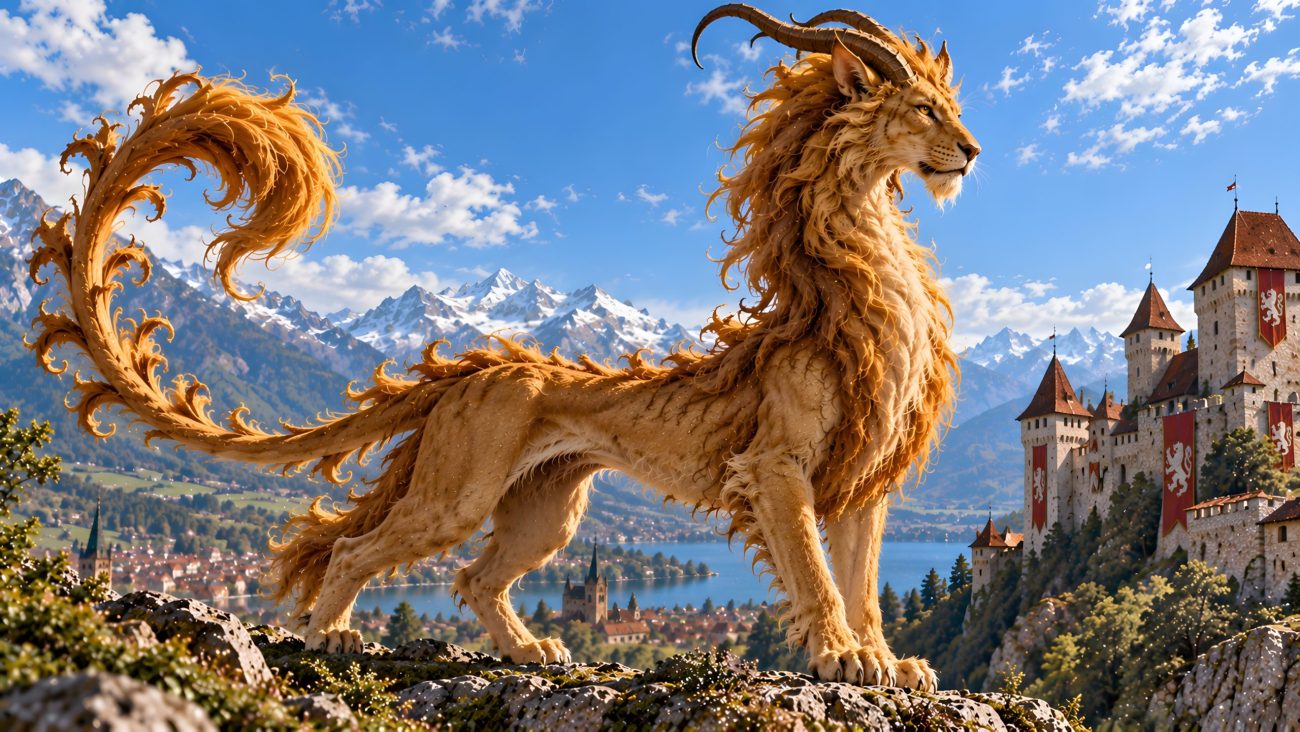
The Fantastic Hybrid of Thun Castle is a mythical creature depicted in a decorative textile at Thun Castle in Switzerland. It has the body of a lion, a pair of horns, pointed ears, and a long, curling tail. Its golden figure stands out against a dark blue circular background, surrounded by an ornate red-and-white pattern.

The creature symbolizes both evil and the triumph over evil. Its combination of a lion’s body, horns, and unusual features gives it a fantastic and potentially threatening appearance, while its religious symbolism transforms it into a representation of the struggle between good and evil and the ultimate victory of Christ.


Sources

informational display at Thun Castle, Observed during a visit to Thun Castle.