Nemean Lion

Tradition: Greek Mythology
Alternative Names: Lion of Nemea, Leo Nemeaeus
Category: Lion


The Myth

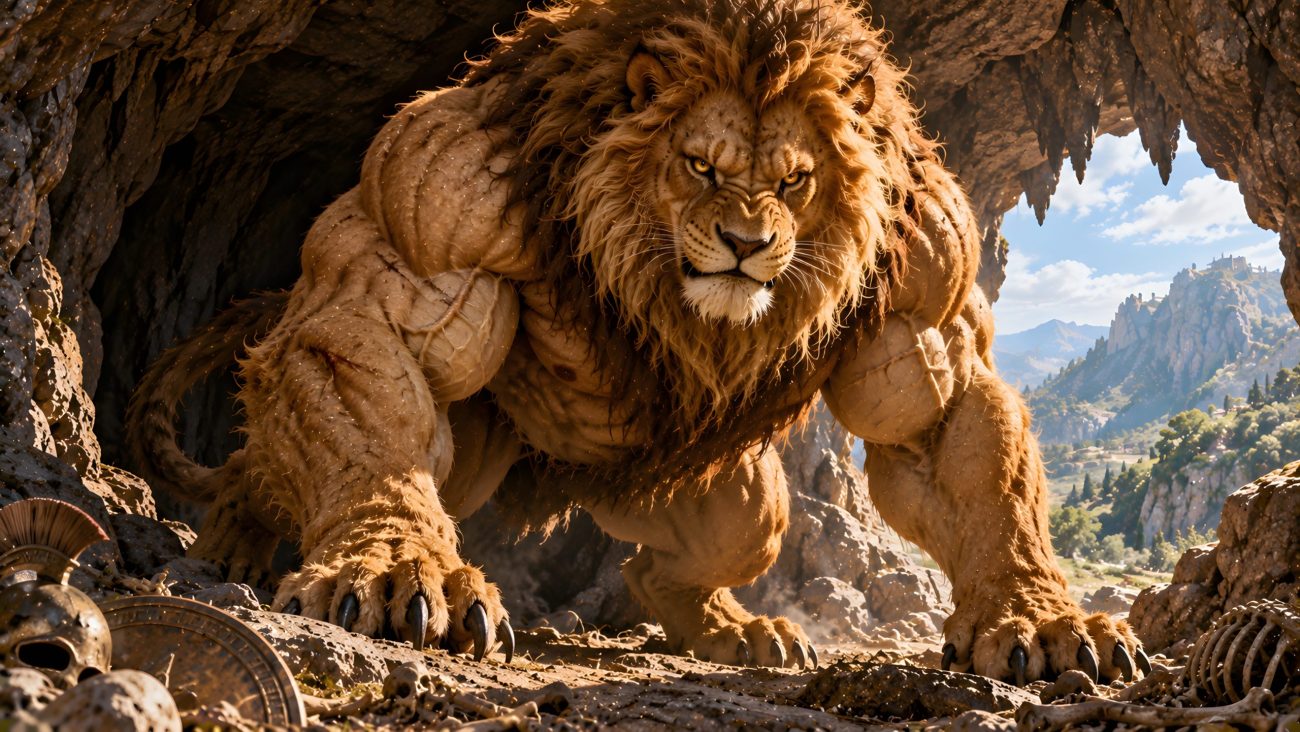
The Nemean Lion was a monstrous lion that terrorized the hills around Nemea in Greece. Its golden fur was impervious to weapons, making it impossible to kill with ordinary arrows or blades, while its claws were sharper than mortal swords and could pierce even the strongest armour. Its origins vary between traditions: some accounts describe it as the offspring of Orthus and a monstrous female, while others name Typhon as its father. Another tradition claims that the lion was born from the Moon, when the goddess Selene cast it down at Hera’s request. Hera allowed the beast to roam her lands, knowing that it would become a formidable challenge for Heracles.

The Nemean Lion became the target of the first of Heracles’ twelve labours, imposed upon him by King Eurystheus. When Heracles first attacked the creature with his bow, his arrows bounced harmlessly off its golden hide. Realizing that ordinary weapons could not harm the beast, the hero drove it into its cave and blocked one of its two entrances. He then entered through the other opening and stunned the lion with his club. Finally, Heracles strangled the monster with his bare hands.

After killing the lion, Heracles discovered that he could not cut through its hide with his knife. According to tradition, the goddess Athena advised him to use one of the lion’s own claws to remove its skin. Heracles thereafter wore the impenetrable pelt as armour and its head as a helmet, making the lion’s hide a lasting symbol of his extraordinary strength. When he returned with the carcass, Eurystheus was so terrified that he ordered Heracles to present the results of his future labours outside the city gates. The king even had a large bronze jar made in which he could hide whenever the hero returned.


Sources

“Nemean Lion.” Wikipedia: The Free Encyclopedia. Wikimedia Foundation. Accessed October 21, 2026. https://en.wikipedia.org/wiki/Nemean_lion
Chimera

Tradition: Greek Mythology
Alternative Names: Chimaera, Khimaira
Category: Lion


The Myth

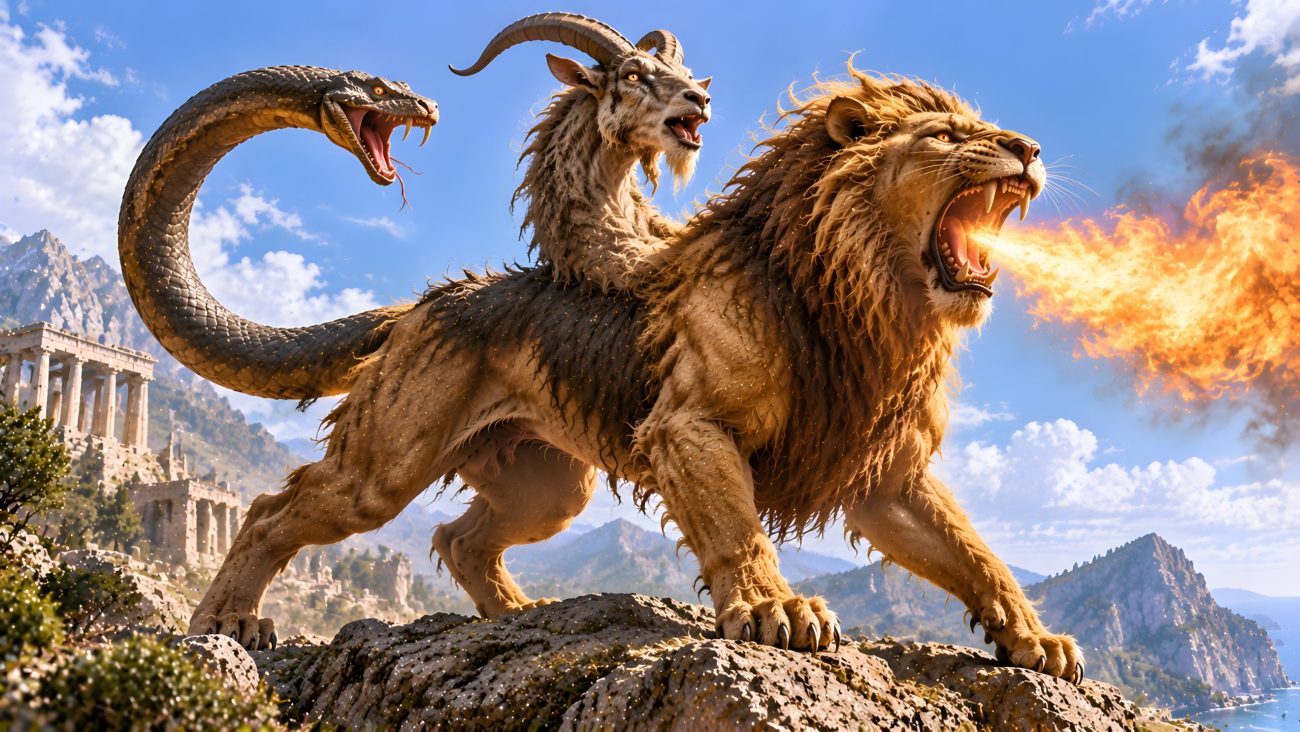
The Chimera was a monstrous, fire-breathing hybrid that terrorized the land of Lycia in Asia Minor. Its body combined several fearsome animals: it had the head and forequarters of a lion, a goat’s head rising from its back, and a serpent for a tail. Some descriptions portray it as having three heads, with a lion at the front, a goat in the middle, and a serpent at the rear. The creature breathed blazing fire and was considered a terrible threat to both people and livestock. It was said to be the offspring of Typhon and Echidna, making it a sibling of other famous monsters, including Cerberus and the Lernaean Hydra.

The Chimera brought destruction to Lycia, killing cattle and devastating the countryside. King Iobates therefore ordered the hero Bellerophon to slay the monster, hoping that the dangerous task would lead to his death. Bellerophon, however, undertook the challenge with the help of Pegasus, the winged horse. Mounted on Pegasus, he soared above the Chimera and attacked it from the air, eventually killing the beast with his weapons.

The Chimera became one of the best-known monsters of Greek mythology, representing the terrifying union of different animals into a single creature. Its image appeared in ancient art, including pottery, sculptures, and mosaics depicting its battle with Bellerophon and Pegasus. Its name later came to describe any fantastic creature formed from parts of different animals.


Sources

“Chimera.” Wikipedia: The Free Encyclopedia. Wikimedia Foundation. Accessed October 21, 2026. https://en.wikipedia.org/wiki/Chimera_(mythology)


Sphinx

Tradition: Greek Mythology
Alternative Names: Phix, Theban Sphinx
Category: Lion


The Myth

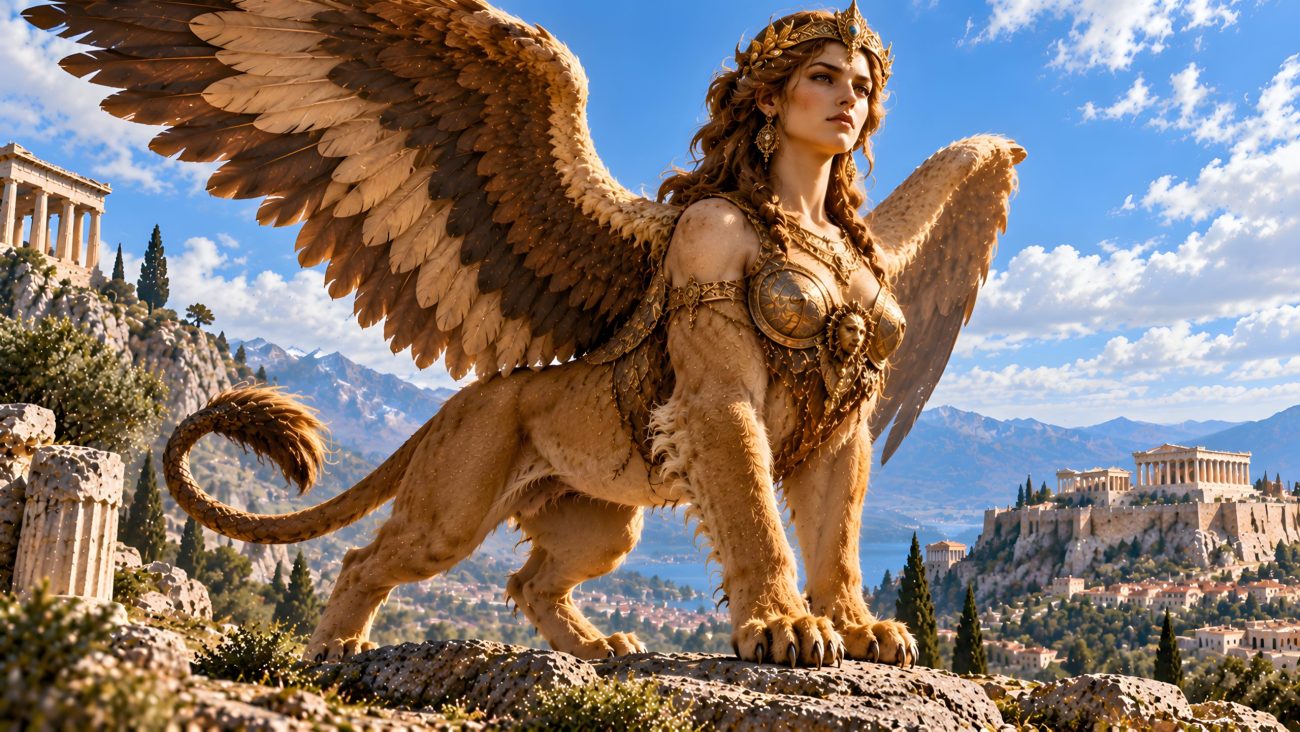
The Sphinx was a fearsome female monster with the body of a lion, the head and breast of a woman, and the wings of an eagle. Some traditions also gave her a serpent’s tail. She dwelled on Mount Phicium near Thebes, where she terrorized the surrounding land and preyed upon travelers. According to different accounts, she was sent by the goddess Hera to punish Thebes for an ancient wrongdoing, although other traditions attributed her arrival to different gods. Her parentage also varies, with some accounts naming Typhon and Echidna, while others describe her as the offspring of Orthus and the Chimera.

The Sphinx challenged those who approached her to solve a mysterious riddle: what creature walks on four feet in the morning, two at midday, and three in the evening? Anyone who failed to answer correctly was seized and devoured. Many people perished, including Haemon, the son of King Creon. Desperate to free Thebes from the monster, Creon promised the kingdom and the hand of Queen Jocasta to whoever could solve the riddle and defeat her.

Oedipus accepted the challenge and answered that the creature was a human being. As an infant, a person crawls on four limbs; as an adult, they walk on two legs; and in old age, they may use a staff as a third support. Realizing that her riddle had been solved, the Sphinx cast herself from a high cliff and died. Her defeat ended the terror she had brought upon Thebes, and Oedipus received the promised reward. The Sphinx’s image also appeared in Greek art, including sculptures placed upon the tombs of those who died young.


Sources

“The Sphinx.” Theoi Greek Mythology. https://www.theoi.com/Ther/Sphinx.html


Lion of Cithaeron

Tradition: Greek Mythology
Alternative Names: Thespian Lion, Ravine Lion
Category: Lion


The Myth

The Lion of Cithaeron was a monstrous lion that descended from Mount Cithaeron to prey upon cattle and terrorize the surrounding lands. It threatened the herds belonging to King Amphitryon and King Thespius, while other traditions associated it with King Megareus of Megara. The beast was so dangerous that it became the target of a hunt by heroes seeking to end its reign of terror.

When Heracles was eighteen years old, King Thespius tasked him with killing the lion. The hunt lasted fifty days, as Heracles pursued the beast through its territory. At last, he succeeded in slaying it. Heracles then took the lion’s hide for himself and wore its scalp as a helmet, making the slain predator’s own strength and fearsome appearance part of his heroic equipment. In this tradition, the Lion of Cithaeron was one of the great beasts Heracles overcame before his famous battle with the Nemean Lion.

Another account tells of the lion’s destruction by Alcathous. According to the people of Megara, the beast had killed many victims, including Euippus, the son of King Megareus. The king promised his daughter’s hand and succession to the throne to whoever could kill the monster. Alcathous accomplished the deed, winning the reward and eventually becoming king. In commemoration of the victory, he established sanctuaries dedicated to Artemis the Huntress and Apollo the Hunter.


Sources

“Lion of Cithaeron.” Wikipedia: The Free Encyclopedia. Wikimedia Foundation. Accessed October 21, 2026. https://en.wikipedia.org/wiki/Lion_of_Cithaeron


Myrmecoleon

Tradition: Greek Mythology
Alternative Names: Ant-Lion, Myrmicioleon, Formicaleon, Formicaleun, Mirmicioleon
Category: Lion


The Myth

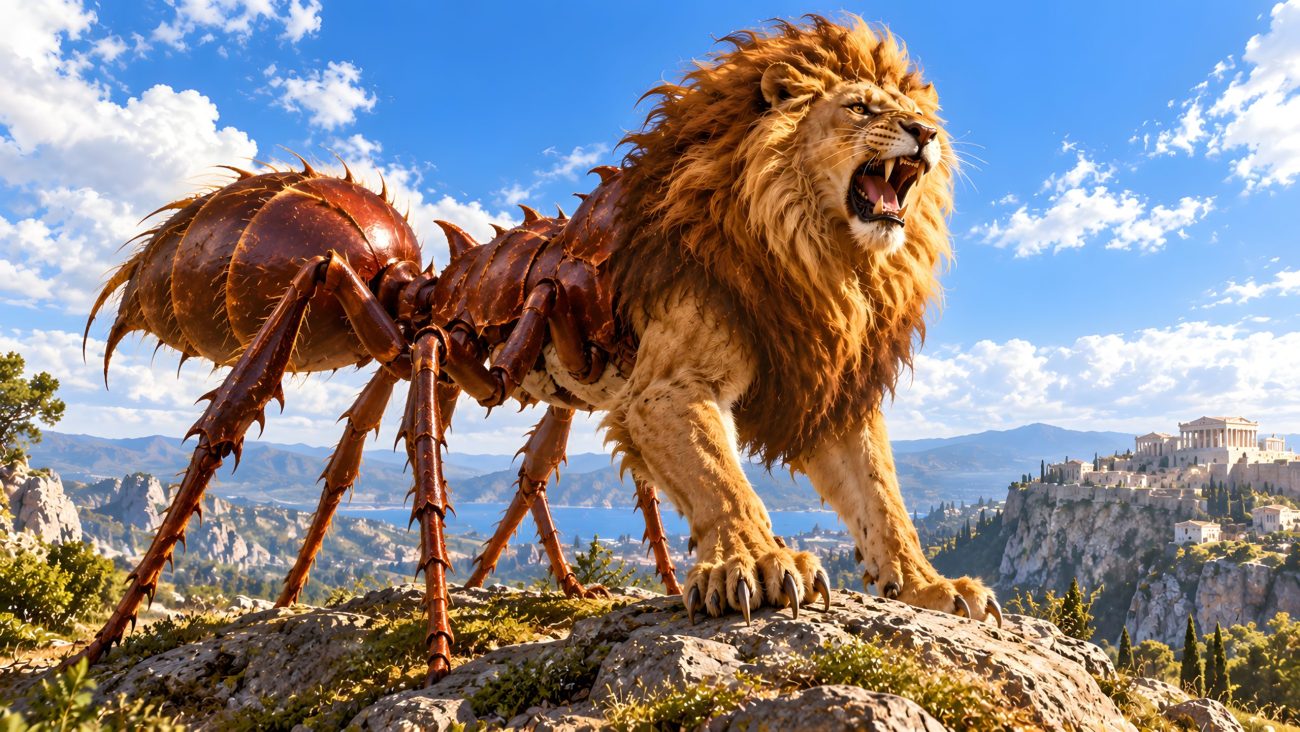
The Myrmecoleon, or Ant-Lion, is a fantastical creature combining the ant and the lion. Its name comes from the Greek words myrmex, meaning ant, and leon, meaning lion. The creature appears in ancient and medieval Christian bestiaries, where it became a strange symbol of the natural world’s contradictions. Its name may have originated from a translation error in the Greek version of the Book of Job, before the creature appeared in the Physiologus, an early Christian collection of stories about animals and their spiritual meanings.

The Myrmecoleon was preserved in medieval bestiaries, including the Hortus Sanitatis of 1491. Its identity as an ant-lion made it a curious creature of the bestiary tradition, linking the small ant with the mighty king of beasts. It was also known by several alternative names, including Formicaleon and Formicaleun.

A separate description in the Aberdeen Bestiary gives the name mermecoleon to a remarkable sea stone. Hollow and round, the stone is divided into two parts that can close together. It rests on the seabed and comes alive in the early morning, rising toward the surface and opening its mouth to collect heavenly dew. As sunlight shines upon it, the dew develops inside the stone into a precious, radiant pearl. In this account, the creature’s name is associated not with a hybrid animal, but with a wondrous marine object that produces a pearl through the meeting of heavenly moisture and sunlight.


Sources

“Myrmecoleon.” Wikipedia: The Free Encyclopedia. Wikimedia Foundation. Accessed October 21, 2026. https://en.wikipedia.org/wiki/Myrmecoleon