Noderabō

Tradition / Region: Japanese Mythology
Alternative names: Noderabo
Category: Ghost


The Myth

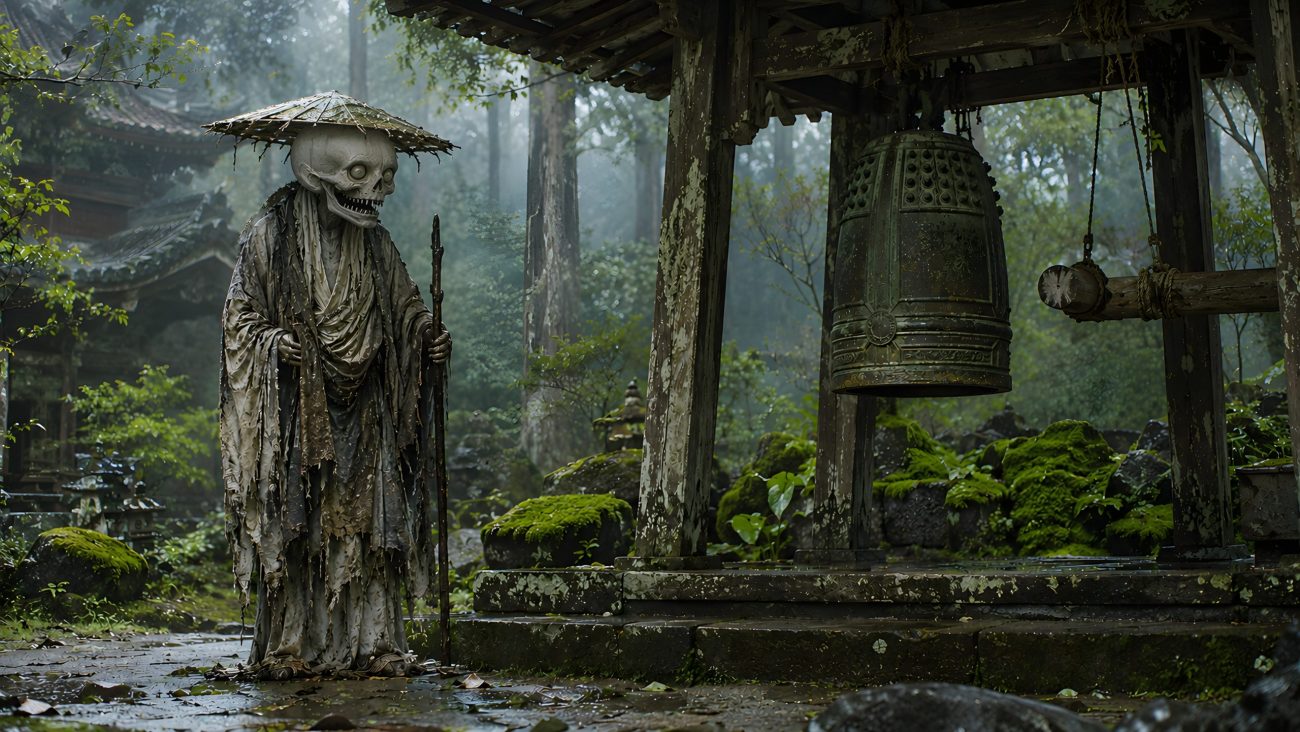
The Noderabō appears as a silent monk dressed in worn, tattered robes and a weathered kasa hat. It is most often depicted standing alone beside an old temple bell in an abandoned, crumbling temple. Though outwardly resembling an ordinary Buddhist monk, it is an eerie and unnatural figure whose true face and intentions remain unknown.

The Noderabō is one of the more mysterious yōkai depicted by Toriyama Sekien in the Gazu Hyakki Yagyō. Sekien provided no explanation for the creature, leaving later generations to speculate about its nature.

According to later folklore, the Noderabō haunts deserted temples that have fallen into ruin. As evening falls, the lonely sound of a temple bell echoes through the mountains despite no living monk remaining to ring it. The ghostly monk is said to wander the abandoned grounds in silence, appearing only briefly before disappearing once more into the darkness.

Some traditions claim the Noderabō is the restless spirit of a head priest whose temple fell into decay after the villagers ceased making offerings. Unable to abandon the place he once served, he continues to watch over the empty temple and ring its bell forever.

Other interpretations suggest the Noderabō represents corrupt monks who abandoned Buddhist discipline through greed and worldly desires, eventually becoming yōkai after death. In this reading, the silent monk serves as a warning against spiritual corruption and attachment.

Another tradition connects the Noderabō with mysterious bells heard echoing from mountains where no temple exists. Children who heard these unexplained chimes were told that the Noderabō was ringing its lonely bell deep within the wilderness, although others believed the sounds were merely echoes carried by the mountains.

Because Sekien never explained the creature, its true origin remains uncertain. Whether it is the ghost of a forgotten priest, the embodiment of an abandoned temple, or simply an eerie guardian of sacred ruins, the Noderabō remains one of Japan’s most enigmatic yōkai—a solitary monk forever standing beside the bell of a temple that time has long since forgotten.


Sources

Wikipedia contributors. (n.d.). Noderabō. In Wikipedia. Retrieved June 21, 2026, from https://en.wikipedia.org/wiki/Noderab%C5%8D
Hone-onna

Tradition / Region: Japanese Mythology
Alternative names: Boneless Woman, Jellyfish Woman
Category: Ghost


The Myth

The Hone-onna, or Boneless Woman, is a strange ghost said to originate from Habayama Mountain in Shioe. According to tradition, she was once a jellyfish that lived for so long that it transformed into a woman, though one without any bones.

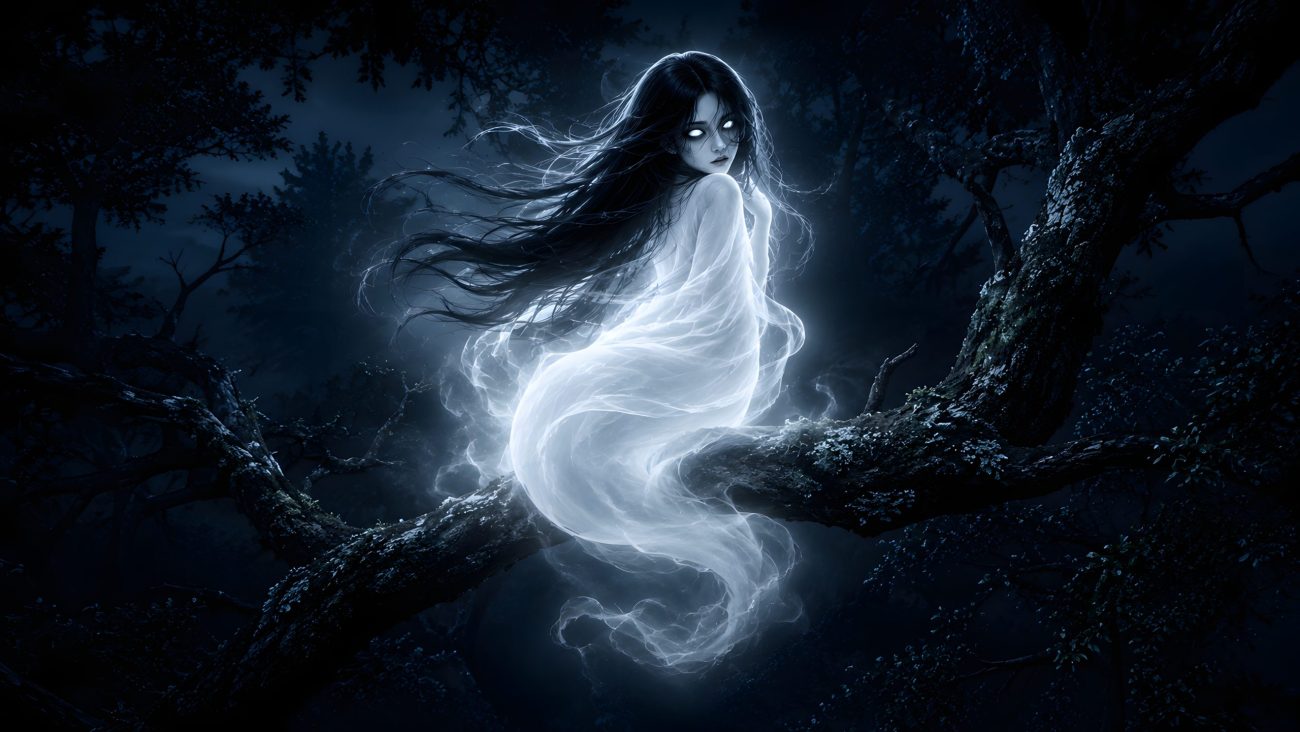
The creature is associated with death and mourning. Whenever someone dies, the Hone-onna is said to visit the house of the deceased. Night after night, she appears in the garden, clinging to the branches of trees.

There she plays by herself and laughs, seemingly unaware of the living around her. Her eerie laughter echoes through the darkness while she sways among the trees, returning again and again to places touched by death.

Unlike many violent spirits, the Hone-onna is not known for attacking people. Instead, she is remembered as a strange and unsettling apparition—a boneless woman who arrives whenever death enters a household and spends the night laughing alone among the garden trees.


Sources

TYZ. (n.d.). Hone-Onna [骨女]. In 新版TYZ 妖怪図鑑. Retrieved June 20, 2026, from https://tyz-yokai.blog.jp/archives/1010654275.html


Goninzowai

Tradition / Region: Japanese Mythology
Alternative names: Five-Men Shoal, Goninzowai
Category: Ghost


The Myth

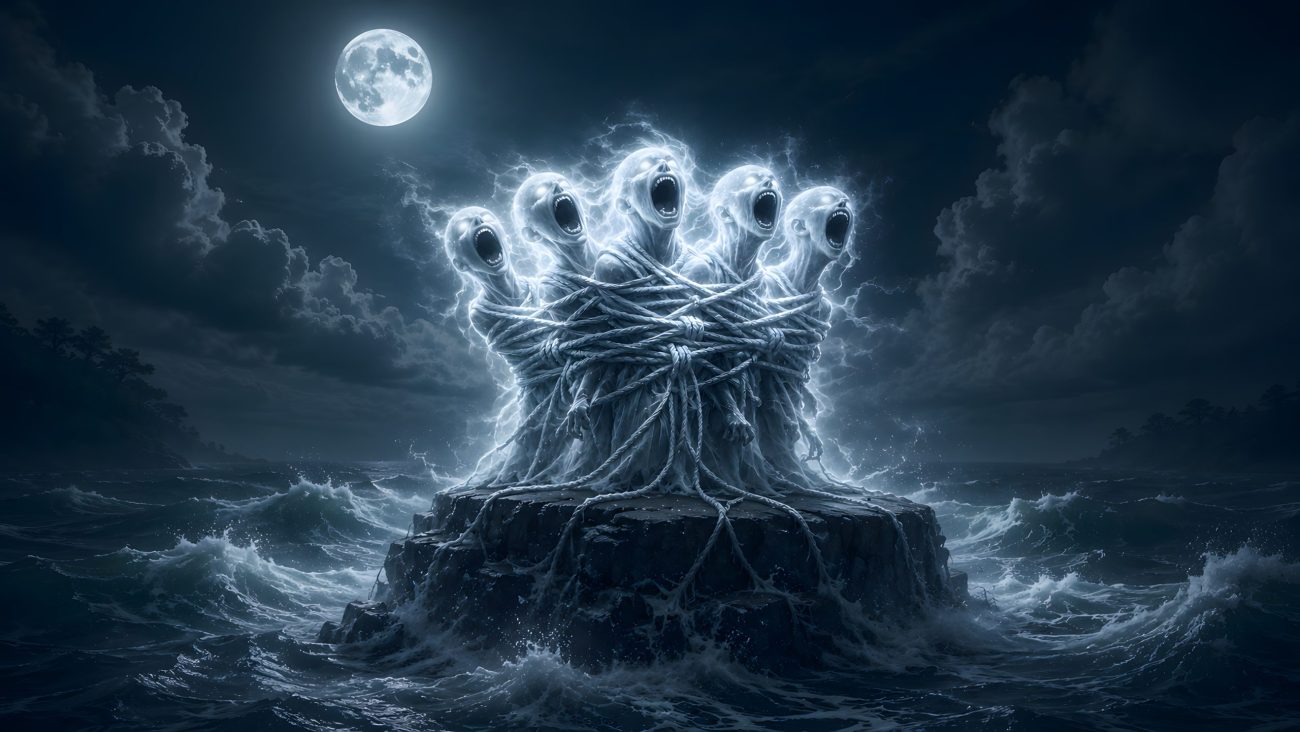
Goninzowai is the name given to the restless spirits of five blind men who perished on a lonely shoal near Uno Port. Their ghosts are said to haunt the sea and can still be heard on dark and rainy nights.

According to tradition, five wealthy blind men arrived in Bingo Province while traveling to the capital to receive the rank of Kengyō, the highest title granted to blind people. A boatman offered to take them to Osaka and they gladly boarded his vessel.

As evening approached, the boatman told them that he needed to empty water from the ship and asked them to wait on a small rocky island. Trusting him, the five men disembarked and sat peacefully listening to the sound of the waves.

But the boat never returned.

When they realized they had been abandoned, they called desperately for the boatman. No answer came. The tide slowly rose around them. Clinging to one another so that they would not be separated, the five men cried for help, but no vessel passed by. Eventually the sea swallowed them, and they drowned together.

From that time onward, fishermen avoided the area. On rainy nights voices, sobbing, and cries are said to rise from beneath the water. Strange balls of fire sometimes appear above the rocks, circling through the darkness.

The place became known as Goninzowai, meaning “Five-Men Shoal.” The name refers to the small reef that disappears beneath the sea at high tide. One story claims that a diver once descended there and found countless human bones piled among the submerged rocks.

Another version says that one of the blind men managed to wash ashore and was rescued by villagers. In gratitude and sorrow, he later traveled to Mount Kōya and erected a tomb for his four companions, praying for the peace of their souls.

Yet even today, the voices of the dead are said to remain beneath the waves, and the haunted shoal of Goninzowai is remembered as the resting place of the five blind men betrayed by the sea.


Sources

TYZ. (n.d.). Goninzowai [五人増悪]. In 新版TYZ 妖怪図鑑. Retrieved June 20, 2026, from https://tyz-yokai.blog.jp/archives/1010654266.html


Ubume

Tradition / Region: Japanese Mythology
Alternative names: Ubume, Ubugame, Guhuo Bird (姑獲鳥)
Category: Ghost, Bird


The Myth

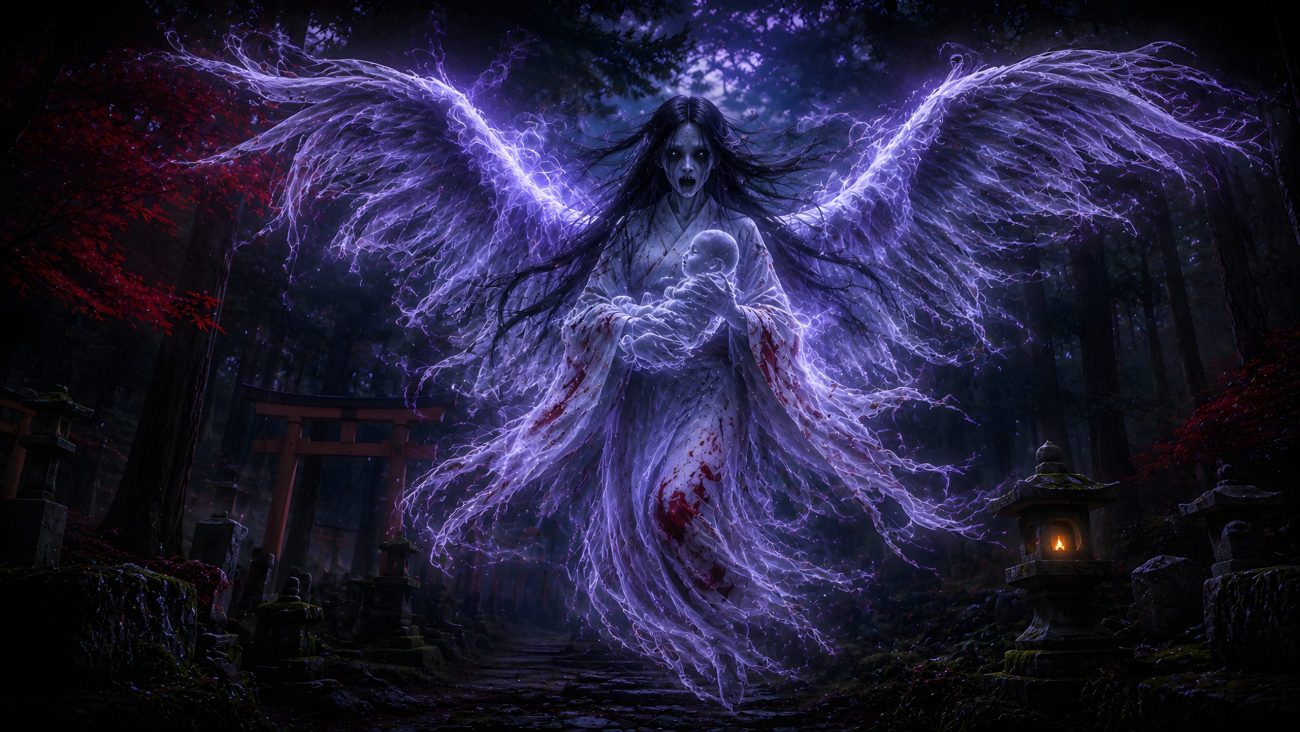
The Ubume is the restless spirit of a woman who died during childbirth. She appears at night along lonely roads, bridges, and riverbanks, carrying an infant in her arms. Dressed in blood-stained clothing, she weeps and asks passersby to hold her child for a moment while she fixes her hair or prays for salvation.

Anyone who accepts the baby soon discovers that it grows heavier and heavier. In some tales, the child eventually transforms into a stone or a bundle wrapped around a straw hammer. Other stories say that a person who fulfills the Ubume’s request and faithfully carries the child receives extraordinary physical strength as a reward. In Akita Prefecture, this supernatural power was known as Obōjikara.

The Ubume is one of Japan’s oldest ghostly beings and was already known during the time when the Konjaku Monogatari-shū was compiled. During the Edo period, it became closely associated with the Chinese Gu Huo Bird, since both were believed to originate from women who had died while pregnant or giving birth. Because of this connection, the two creatures gradually became confused with one another.

Most depictions portray the Ubume as a sorrowful woman holding a baby while wearing blood-soaked garments. Some illustrations, however, give her bird-like features, with wing-shaped arms wrapped protectively around the child.

Though feared, the Ubume is not considered a malicious spirit. She is remembered as a tragic mother unable to abandon her child, forever wandering the night and seeking someone willing to carry the burden she herself could no longer bear.


Sources

TYZ. (n.d.). Ubume [産女]. In 新版TYZ 妖怪図鑑. Retrieved June 20, 2026, from https://tyz-yokai.blog.jp/archives/1010652594.html


Taraaka

Tradition / Region: Japanese Mythology
Alternative names: Taraaka Dragon
Category: Dragon


The Myth

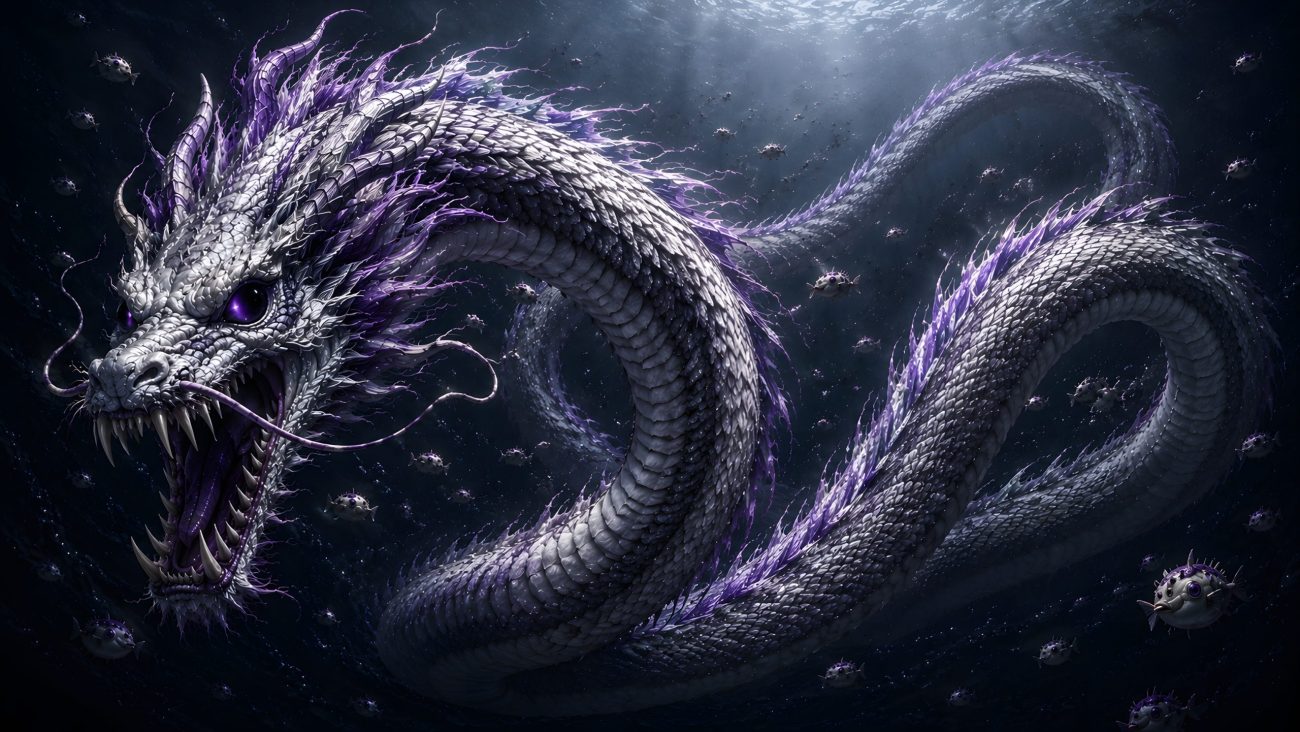
Taraaka was a gigantic evil dragon that invaded the seas ruled by Princess Otohime, mistress of the Dragon Palace. Accompanied by an army of monstrous poisonous fish and marine creatures, Taraaka seized the Shell Palace and spread terror throughout the ocean.

His followers included the Laughing Shark, a sawshark possessed by a vengeful spirit, the Tiger Pufferfish, giant crabs, sea snakes, octopuses, killer whales, sea otters, and many other fearsome creatures. Together they raided the seas and sought to steal the magical jewels that controlled the tides.

The Dragon Palace itself had long been ruled by Princess Otohime, but Taraaka’s growing power threatened her kingdom. The wicked dragon desired the Thousand Jewel and Ten Thousand Jewel, sacred treasures that governed the ebb and flow of the sea.

At that time, the wandering samurai Ōhara Takejirō Takematsu was rescued from drowning by a turtle he had once saved and was brought to the Dragon Palace. Trusting in his courage, Princess Otohime asked him to destroy Taraaka.

Believing the monster to be a type of mizuchi, an aquatic dragon, Takejirō devised a plan based upon ancient legends. Remembering how Susanoo defeated the eight-headed serpent through intoxication, he prepared a powerful sake brewed from fermented swallow meat, which dragons were believed to favor.

When five barrels of the strange wine were completed, they were delivered to Taraaka’s palace. The dragon, delighted by false news that Princess Otohime wished to marry him, opened the barrels and celebrated with his followers.

The magical drink quickly overwhelmed Taraaka and his entire court. While the monsters lay drunken and helpless, Princess Otohime’s servants recovered the stolen jewels and escaped.

Soon the evil fish awoke and pursued them, only to encounter Takejirō. Armed with a sword given to him by Otohime, he slaughtered the Laughing Shark, split the Tiger Pufferfish in half, and killed the other monstrous servants.

Enraged, Taraaka himself appeared, raising enormous waves and storms as he charged into battle. Takejirō drew his bow and released a single arrow. It struck the dragon in the throat and neck, and the gigantic creature collapsed like a falling tree.

When the monster’s true form was revealed, it measured more than twenty fathoms in length. It resembled a terrifying lizard with four legs, looking much like a gigantic crocodile. Takejirō believed it to be a kind of mizuchi, the rain dragon of ancient legends.

After its death, Princess Otohime ordered the bodies of Taraaka and his chief followers burned. Their ashes were buried beneath a mound to calm their vengeful spirits and prevent them from causing further harm.

Having restored peace to the seas, Otohime rewarded Takejirō with a sacred jewel bestowed by the Buddha and returned him to the world of men.

Thus Taraaka was remembered as one of the great evil dragons of Japanese legend, a monstrous ruler of the seas whose reign ended through cunning, sacred treasures, and the courage of a single warrior.


Sources

TYZ. (n.d.). Taraaka [タラーアカ]. In 新版TYZ 妖怪図鑑. Retrieved June 13, 2026, from https://tyz-yokai.blog.jp/archives/1070683103.html


Katawaguruma Nyūdō

Tradition / Region: Japanese Mythology
Alternative names: One-Wheeled Monk / Flaming Wheel Monk
Category: Yokai, Flame


The Myth

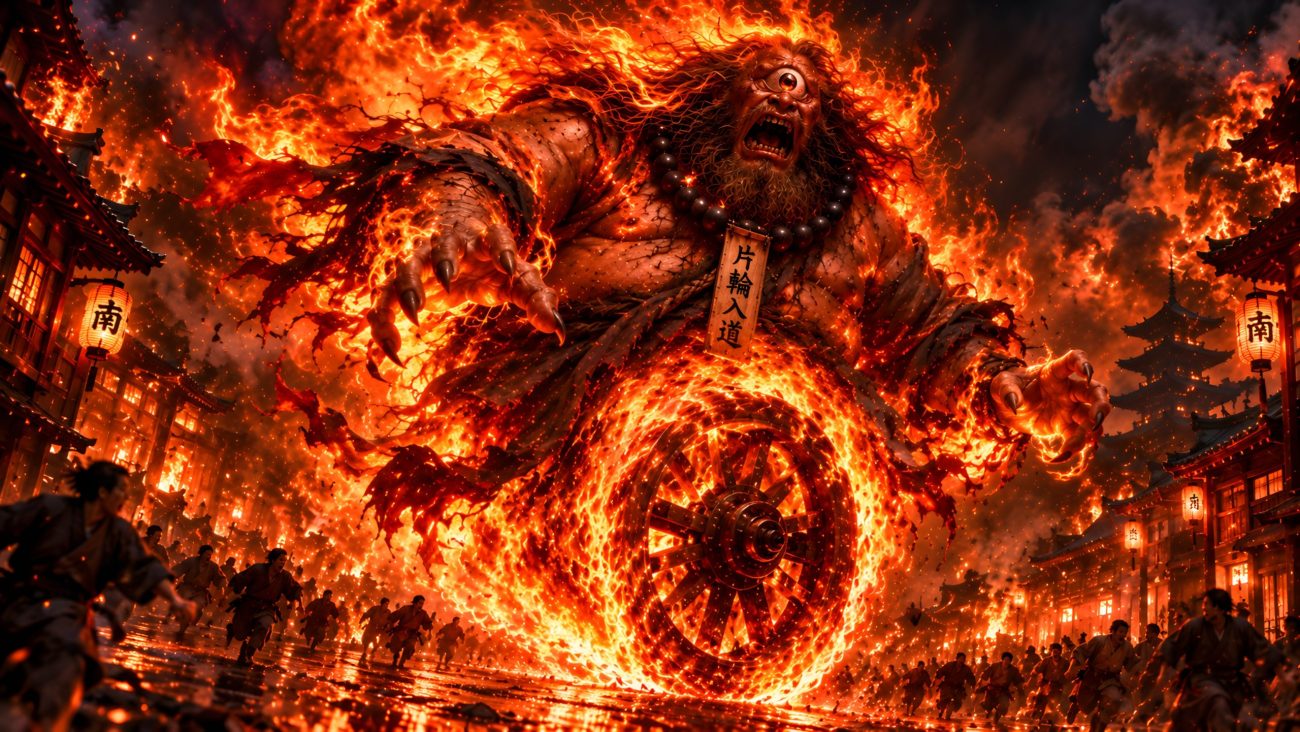
The Katawaguruma Nyūdō is a terrifying yokai that roams the streets of Kyoto at night. It appears as a gigantic hairy monk with a fierce face and enormous strength, riding upon a single wheel engulfed in flames. The burning wheel races through the darkness like a cart from hell, spreading fire and fear wherever it passes.

According to legend, the creature was once a powerful and wealthy monk who lived in the Rokuhara district of Kyoto. Cruel and arrogant, he delighted in the suffering of others and committed countless wicked deeds without fear of divine punishment. Although he enjoyed great prosperity during his life, his evil eventually caught up with him.

Divine punishment descended upon the monk, and he was consumed by supernatural flames. Transformed into a monstrous spirit, he became the Katawaguruma Nyūdō, forever condemned to wander Kyoto upon his fiery wheel.

One night, a woman living nearby put her three children to sleep and, through a knot hole in her door, secretly watched the terrible apparition pass by. The flaming monk noticed her gaze and shouted:

“Look to your children instead of looking at me!”

Terrified, the woman rushed to her children, but it was too late. The Katawaguruma Nyūdō seized all four members of the family and carried them away into the night, and they were never seen again.

Thus the One-Wheeled Monk became one of Kyoto’s most feared supernatural beings — a burning spirit born from greed and cruelty, whose fiery wheel still races through the darkness searching for those unfortunate enough to witness its passage.


Sources

TYZ. (n.d.). Katawaguruma Nyudo [片輪車入道]. In 新版TYZ 妖怪図鑑. Retrieved June 13, 2026, from https://tyz-yokai.blog.jp/archives/1079937229.html


Takatsugu and Masaki

Tradition / Region: Japanese Mythology
Alternate Names: The White Fox of Uenohara
Category: Fox


The Myth

Long ago, after many wanderings, a fox came to live in Uenohara. She had lived for centuries, yet had gained little power. Though she had survived many dangers, she had not become a spirit fox, and she carried the burden of having once taken a human life, even if it had been an enemy.

Thinking on her fate, she resolved to change. Instead of seeking power through trickery, she decided to do good for the world and for people. Taking the form of an old woman, she opened a small tea shop by the roadside.

There she welcomed travelers passing through the region, giving them warmth in winter and rest from the summer heat. The money she earned she did not keep for herself. She gave it to orphaned children, and whenever she encountered people in despair, she tried to save them.

She persuaded lovers who planned to die together to abandon their decision. She fed and clothed those driven to desperation by poverty and gave shelter to the hopeless. Year after year she continued her work, quietly helping anyone who came to her door.

In time, the number of lives she saved was said to have reached nine hundred and ninety-nine.

At last, when she reached the age of one thousand years, her body changed. Her fur turned pure white, and her tail split and multiplied until she bore nine. By the virtue she had gathered through kindness, the fox finally rose to the rank of a great spirit.

Thus she was remembered as the fox of Uenohara, who gained power not through cunning, but through compassion, and whose many good deeds transformed her into a nine-tailed white fox of legend.


Sources

Tyz-Yokai Blog. (n.d.). Takatsugu and Masaki. Retrieved March 1, 2026, from https://tyz-yokai.blog.jp/archives/1064835229.html.


Obana Kitsune

Tradition / Region: Japanese Mythology
Alternate Names: Obanagitsune
Category: Fox


The Myth

In the world of Edo-period theatre there was a fox known as Obana Kitsune, remembered from a dance performed in the play Willow Dolls and Birds Singing.

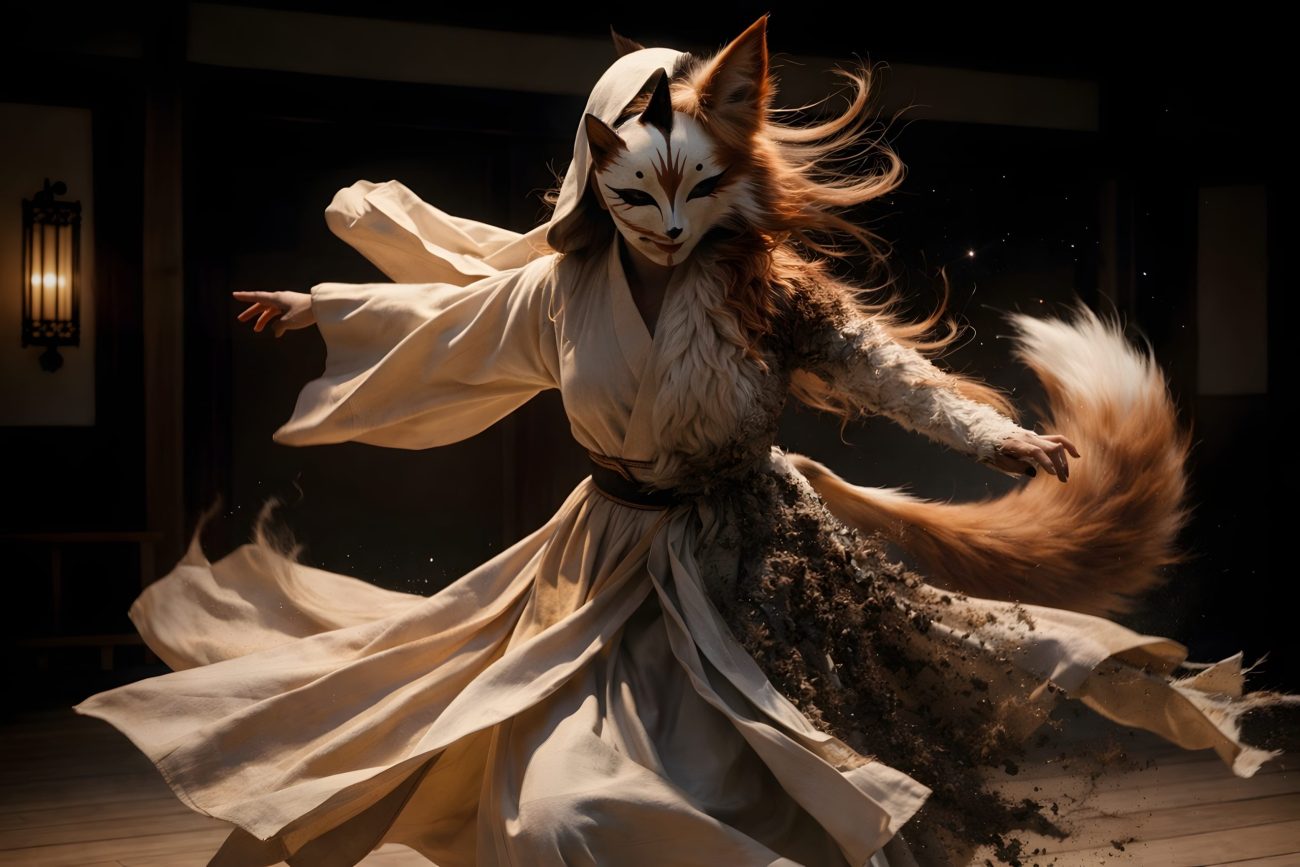
In this performance, a nun appears on stage, facing forward in calm devotion. Yet when she turns, her face changes, and with the aid of a mask she becomes a fox. Spinning in dance, she reveals her true nature before vanishing as suddenly as she appeared.

This fox was said to be Obana Kitsune, a spirit born from stories of foxes who disguise themselves as monks or nuns to move among humans. Like the foxes of older tales, she takes on holy robes and human form, only to reveal her identity in a sudden transformation.

Her story echoes older performances in which animal spirits disguised as religious figures try to persuade hunters to spare their kind, or escape danger through clever tricks. When her disguise fails, the fox does not fight. Instead she dances, spins, and slips away, leaving only the memory of movement behind.

Thus Obana Kitsune was remembered as a fox of the stage — a spirit who appeared in the form of a nun, revealed herself through dance, and vanished like a performance fading into silence.


Sources

Tyz-Yokai Blog. (n.d.). Obana Kitsune. Retrieved March 1, 2026, from https://tyz-yokai.blog.jp/archives/1058717512.html.


Takuzōsu

Tradition / Region: Japanese Mythology
Alternate Names: Takuzōsu Inari, Hakuzō Inari
Category: Fox


The Myth

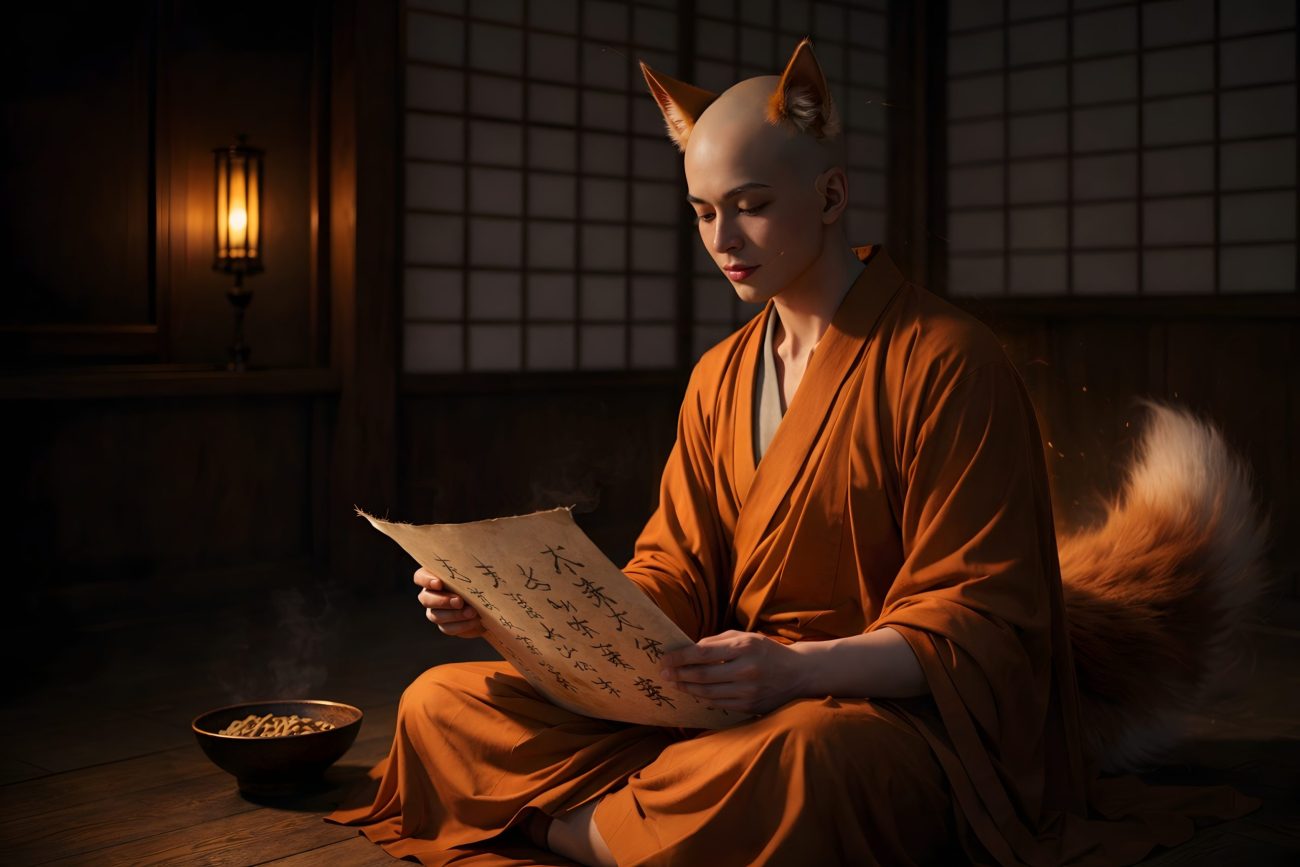
At Dentsūin Temple in Koishikawa there was once said to have lived a monk named Takuzōsu. He appeared suddenly in the temple dormitory and astonished the other monks with his knowledge, mastering the teachings of Pure Land Buddhism in only a few years. He spoke fluently on doctrine and scripture, and none doubted his devotion.

One night, however, the head priest dreamed that Takuzōsu appeared before him in radiant form. In the dream the monk revealed his true identity — he was Inari Daimyōjin, a divine being who had once been enshrined in the castle of Ōta Dōkan. He declared that he had come to taste the teachings of the Pure Land and promised to guard the temple. With that, he vanished into the dawn clouds.

Another version of the story tells that Takuzōsu was in truth a fox spirit who had taken the form of a monk. He lived among the clergy, studying and discussing Buddhism by night. One day, while sleeping deeply, his true nature was revealed. Ashamed, he fled the temple and disappeared into the mountains.

Yet even after he vanished, the monks said he continued to visit at night, speaking of Buddhist teachings as before. His writings were preserved, though later readers claimed the characters seemed strangely formed, as if written by something not entirely human.

In time the fox was honored as a protective spirit and enshrined as Takuzōsu Inari, the guardian of the temple. Stories were also told that during his years at the temple he loved soba noodles and sometimes paid for them using leaves that turned to money, or money that turned to leaves by morning.

Because of this, offerings of the first soba of the day were made to the shrine, and Takuzōsu was remembered as a fox who had walked among monks, studied the Dharma, and become a guardian spirit of the temple he once haunted.


Sources

Tyz-Yokai Blog. (n.d.). Takuzōsu. Retrieved March 1, 2026, from https://tyz-yokai.blog.jp/archives/1058309922.html.


Yao no Kitsune

Tradition / Region: Japanese Mythology
Alternate Names: Eight-Tailed Fox
Category: Fox


The Myth

During the reign of Tokugawa Iemitsu, the third shogun of the Edo shogunate, it is said that he once fell gravely ill and was confined to his bed. As his condition worsened, those around him feared the worst.

One night, while he slept, Iemitsu had a vivid dream. In it, a fox with eight tails appeared before him. The fox came from the direction of Nikkō Tōshōgū Shrine and spoke clearly, telling him, “You will soon recover.”

When Iemitsu awoke, his illness began to ease just as the fox had promised. His strength returned, and before long he was restored to health. Believing the vision to be a sign of divine protection, he ordered that the fox from his dream be painted so that its image would be preserved.

The painting was later said to have been created by the shogunate’s official artist, and the story of the dream was remembered as proof that the fox had appeared as a messenger of higher powers.

Thus the Eight-Tailed Fox was remembered not as a trickster or deceiver, but as a spirit of omen and reassurance — a fox who came in a dream from a sacred shrine to promise recovery, and whose appearance was taken as a sign of unseen guardians watching over the ruler of the land.


Sources

Tyz-Yokai Blog. (n.d.). Yao no Kitsune. Retrieved March 1, 2026, from https://tyz-yokai.blog.jp/archives/1040893326.html.