Nurikabe

Tradition / Region: Japan (Edo-period yōkai scrolls)
Alternate Names:
Category: Yōkai / Lion / Dog


The Myth

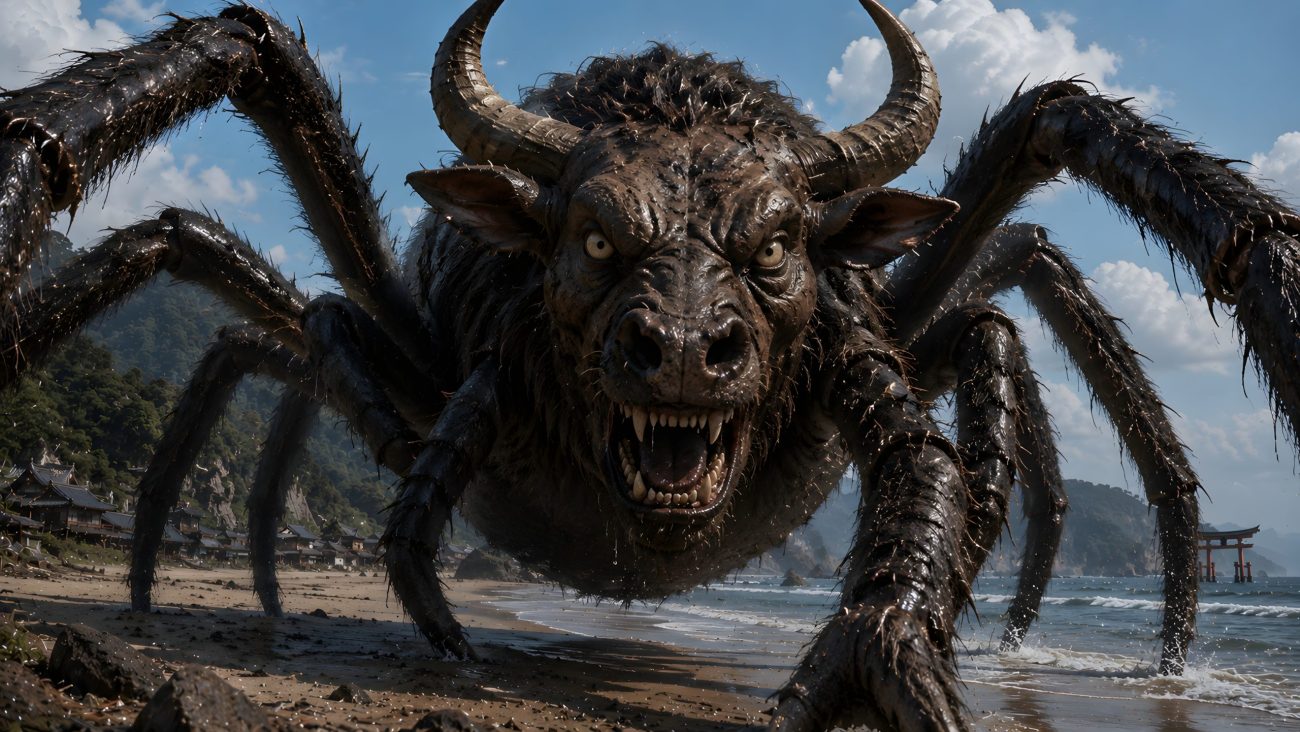
In illustrated yōkai scrolls from Japan, a creature known as the Nurikabe appears in a form unlike the better-known invisible wall of later folklore. This Nurikabe is a tangible beast with four legs and a powerful body. Its most striking feature is its enormous face, which bears three eyes that shine with an unnatural blue light. It has large, drooping ears like those of an elephant and two black tusks that curve outward. Its body is painted white, giving it a ghostly and imposing appearance. Some describe it as resembling a dog or a lion, though it does not fully match any known animal.

In the scrolls where it appears, the Nurikabe is shown near crashing waves. Behind it emerge figures such as Umi-otoko, a human seaman, and Umi-bōzu, a fearsome sea spirit. This setting places the Nurikabe at the boundary between land and sea, standing where the human world meets the supernatural. It does not act directly against the figures shown, but its presence dominates the scene, suggesting a powerful being that guards or obstructs passage.

The scroll depicting this Nurikabe is dated to the early nineteenth century. No clear written legend accompanies it, and its precise origin is unknown. It is uncertain whether this beast represents a specific local tradition or whether it was created by the artist as a yōkai form inspired by existing beliefs. Its connection to the later Nurikabe known for blocking travelers’ paths is not clearly stated in the original material.

As it appears in the scroll, the Nurikabe remains an enigmatic creature: a massive, watchful being standing firm amid waves and spirits, neither clearly hostile nor welcoming, marking a place where movement forward is uncertain and dangerous.


Interpretive Lenses

Religious Readings
Philosophical Readings
Psychological Readings
Esoteric Deep Dive
Political / Social Readings
Other

Rashamen

Tradition / Region: Japan (Edo period)
Alternate Names: Raschamen
Category: Sheep


The Myth

Rashamen was the name used for sheep brought to Japan by overseas ships. Because sheep were unfamiliar, people associated them with foreigners, and the name was said to come from rasha, the woolen clothing worn by Westerners.

In 1776, during the An’ei era, an animal called a raschamen was exhibited as a public spectacle in the districts of Ryōgoku and Asakusa in Edo. People paid to see it as a rare and strange creature from abroad. The animal on display was a sheep, with paint smeared over its body to make it look more unusual.

The spectacle became widely known. The sheep was taken around and shown to crowds, presented as something exotic rather than as an ordinary animal.

The event was later mentioned by Hiraga Gennai in his work Hoheiron Kohen, where he described the rashamen performance and noted that it was simply a painted sheep being displayed to the public.


Interpretive Lenses

Religious Readings
Philosophical Readings
Psychological Readings
Esoteric Deep Dive
Political / Social Readings
Other

Lady Rokujo

Tradition / Region: Japan (Heian-period court literature)
Alternate Names: Rokujo no Miyasudokoro, Miyasudokoro
Category: Vengeful spirit / living ghost


The Myth

Lady Rokujo was a noblewoman of great refinement, the daughter of a minister and once the wife of the Crown Prince. Widowed at a young age, she later became the lover of Hikaru Genji. Though dignified and proud of her rank, she suffered deeply from jealousy and humiliation, especially as Genji’s affections shifted toward younger women. These unspoken emotions slowly twisted within her.

During the events recorded in The Tale of Genji, her resentment grew so powerful that her spirit began to leave her body without her conscious will. At the Kamo Festival, after being humiliated in a carriage dispute involving Genji’s lawful wife, Lady Aoi, Lady Rokujo’s spirit fully manifested. Invisible yet deadly, it began to torment Lady Aoi, who was pregnant at the time.

Lady Aoi suffered greatly. After a long and painful labor, she gave birth to a son, but her condition suddenly worsened, and she died only days later. Meanwhile, Lady Rokujo realized that her spirit had wandered when she noticed the smell of ritual mustard seeds clinging to her own clothing. Genji himself witnessed her spirit while tending to Lady Aoi. Horrified by what she had become, Lady Rokujo resolved to sever her ties with him.

She left the capital, parting from Genji at Nonomiya, and traveled to Ise with her daughter, who served as a sacred princess. Yet even distance could not quiet her heart. After returning to Kyoto, Lady Rokujo fell ill and died, entrusting her daughter to Genji’s care. Death, however, did not end her suffering.

Her spirit continued to appear, driven by lingering obsession. It haunted Lady Murasaki and later the Third Princess, afflicting them with sickness and terror. Through these hauntings, her bitterness toward Genji was made known again and again.

Only after memorial rites were performed, urged by Genji and carried out for her troubled soul, was it hoped that Lady Rokujo might finally find release. Until then, she endured as one of the most feared figures of courtly legend — a woman whose restrained emotions became so powerful that even death could not contain them.


Interpretive Lenses

Religious Readings
Philosophical Readings
Psychological Readings
Esoteric Deep Dive
Political / Social Readings
Other