Enkirigumo

Tradition / Region: Japanese Mythology
Alternative names: Relationship-Severing Spider
Category: Spider


The Myth

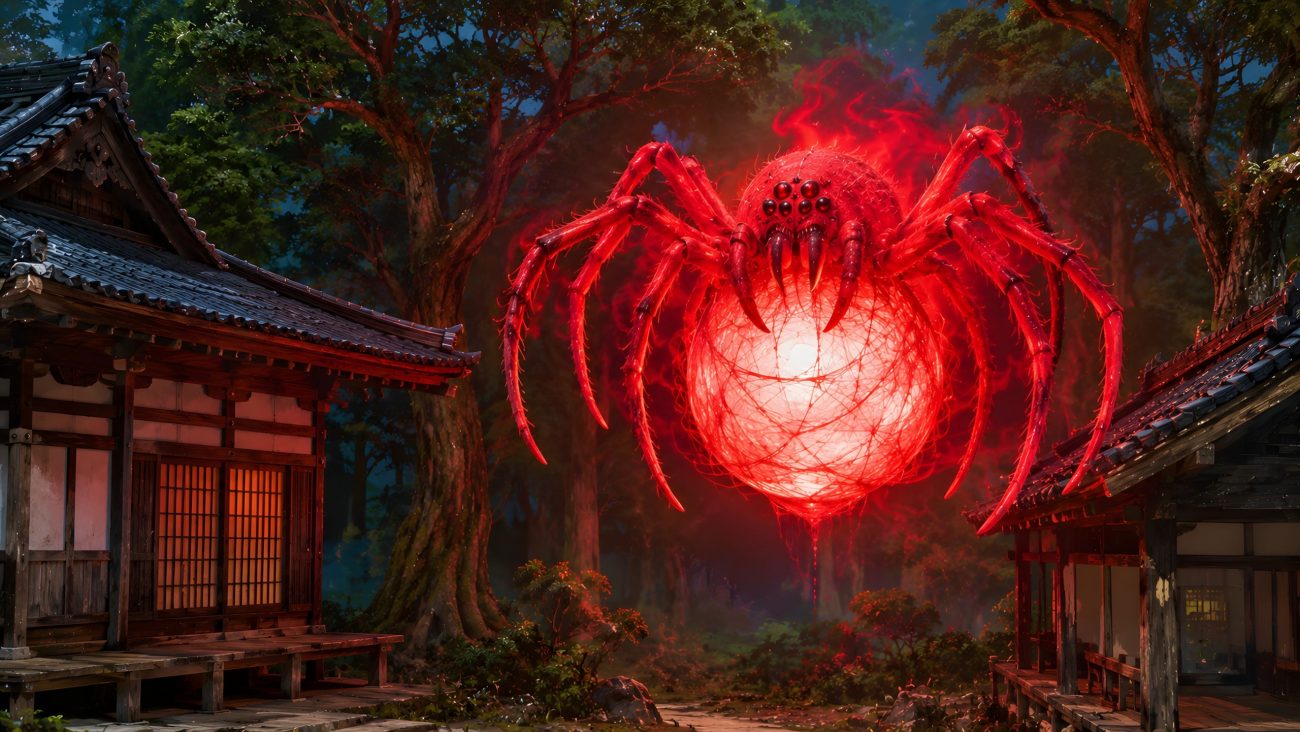
The Enkirigumo is a giant spider yōkai associated with the forests at the foot of Mount Katsuragi in Nara Prefecture. It was believed to descend from the ancient giant spider of Katsuragi and lived for generations within a woodland known as Spider Forest.

At night, the Enkirigumo did not always appear in its true form. Instead, it transformed into a glowing orb the size of a lantern, drifting silently through the trees as it searched the forest.

During the Meiji period, the forest was cut down to provide timber for the reconstruction of Honganji Temple, destroying the spider’s home. Homeless, the Enkirigumo began wandering into the nearby village every night, floating through the darkness around houses that still had large trees.

The villagers became terrified of the mysterious glowing apparition and stopped leaving their homes after sunset. Young couples could no longer meet secretly beneath the cover of night, and romances quietly came to an end.

Because its nightly appearances unintentionally separated lovers and prevented relationships from forming, the creature became known as the Enkirigumo—the Spider That Severs Relationships.


Sources

TYZ. (n.d.). Enkirigumo [縁切蜘蛛]. In 新版TYZ 妖怪図鑑. Retrieved June 28, 2026, from https://tyz-yokai.blog.jp/archives/1010654031.html
Ushioni

Tradition / Region: Japanese Mythology
Alternative names: Gyūki, Goki
Category: Spider, Cow


The Myth

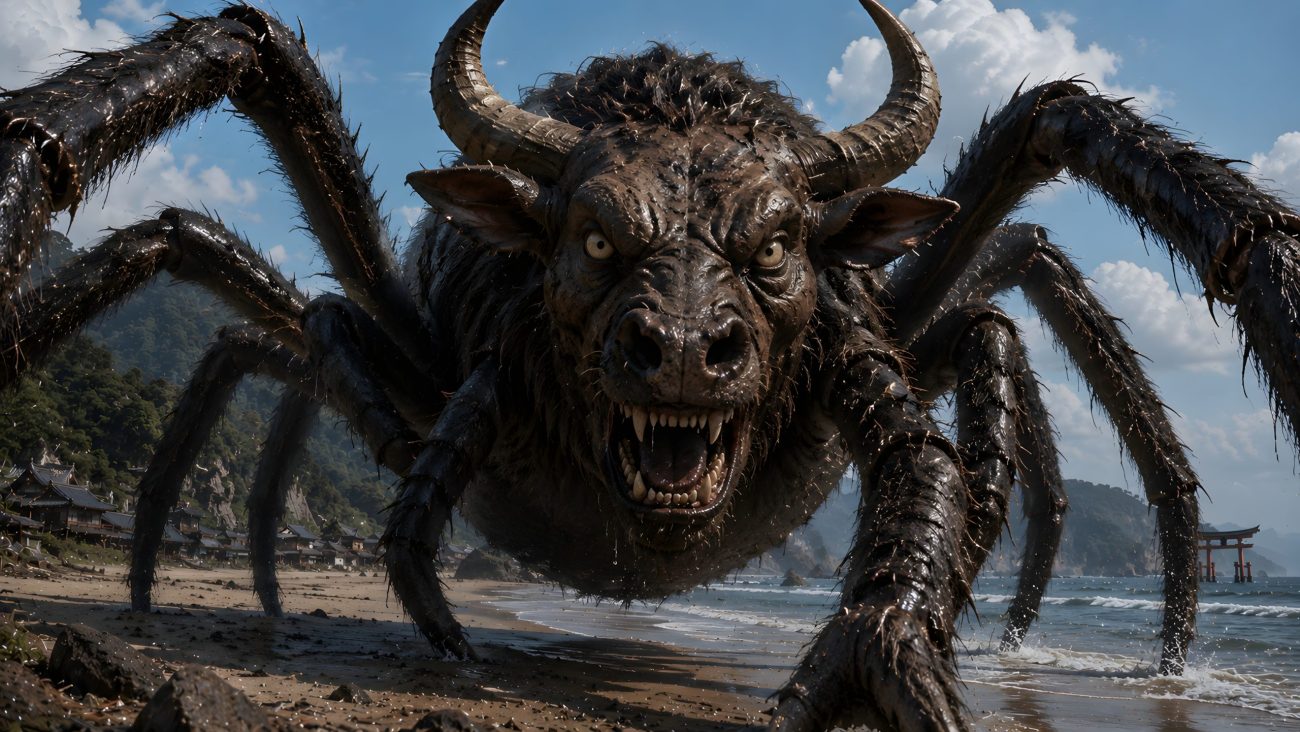
The Ushioni is a terrifying yōkai that usually appears as a monstrous ox-like creature, although its appearance varies greatly between regions. Some traditions describe it as a giant ox, while others portray it with the face of an oni and the body of a huge spider, or as a two-legged beast with wing-like membranes. It is a violent predator feared for attacking both humans and animals.

The Ushioni is most commonly associated with dangerous places near water, including deep pools, rivers, waterfalls, marshes, and the seashore. Numerous locations throughout Japan bear names such as Ushioni Pool or Ushioni Waterfall, reflecting the belief that these monsters once haunted them.

Along the coasts of western Japan, the Ushioni often works together with other sea yōkai such as the Nure-onna and Iso-onna. It may first appear as a beautiful woman carrying a baby and ask a traveler to hold the child. As soon as the victim accepts, the infant becomes impossibly heavy, making escape impossible before the Ushioni reveals itself and attacks.

In the mountains of the Kumano region, the Ushioni was believed to kill without even touching its victims. It simply stared relentlessly at anyone it encountered until they gradually weakened, collapsed, and died. This mysterious affliction was known as having one’s shadow swallowed. People believed the only protection was to recite the strange charm: “Stones flow, leaves sink, cows neigh, and horses roar.”

Another tradition from Izumo says that during long periods of rain, a mysterious white light could cling to a person’s body. This phenomenon was called meeting a Ushioni and was believed to disappear only when exposed to fire.

One famous legend tells of an Ushioni that terrorized the region around Negoro-ji Temple in Kagawa Prefecture, killing people and livestock until it was finally slain by the master archer Yamada Kurōdo Takakiyo. The temple is said to preserve the monster’s horns as proof of its existence.

Across Japan, the Ushioni is remembered as one of the country’s most feared monsters—a savage ox demon that haunts lonely waters, deceives travelers, and brings death to anyone unfortunate enough to meet its gaze.


Sources

TYZ. (n.d.). Ushi Oni [牛鬼]. In 新版TYZ 妖怪図鑑. Retrieved June 28, 2026, from https://tyz-yokai.blog.jp/archives/1010653546.html


Tsuchigumo

Tradition / Region: Japanese Mythology
Alternative names: Yamagumo, Ōgumo, Yatsukahagi
Category: Spider


The Myth

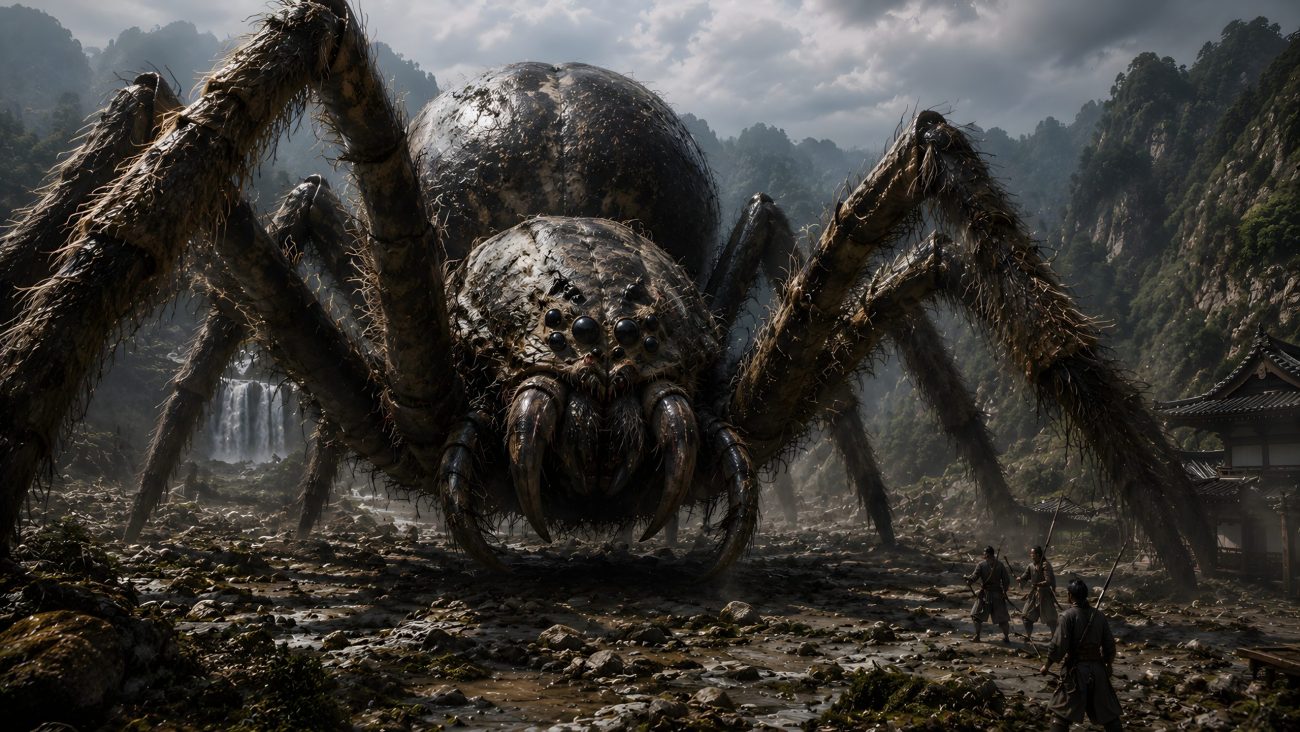
The Tsuchigumo is a colossal spider yōkai that dwells in mountains, caves, abandoned mansions, and underground lairs. It is a master of illusion, capable of taking human form, disguising itself as monks, women, or other beings to lure victims into its webs before revealing its monstrous true form.

Although later folklore depicts it as a supernatural spider, the name originally referred to rebellious clans that resisted the early Yamato court. During the medieval period these figures gradually transformed into the giant spider monsters of Japanese legend.

The most famous legend tells of the warrior Minamoto no Yorimitsu, who was suffering from a mysterious illness when a towering monk entered his room at night and attempted to bind him with ropes. Yorimitsu slashed the stranger with his sword, causing the figure to flee while leaving behind a trail of blood. Following the trail with his retainers, he discovered a gigantic spider hidden inside a cave and killed it. His sword thereafter became known as Spider-Cutter.

Another famous version tells how Yorimitsu and his companion entered a ruined mansion after following a floating human skull. There they were attacked by strange monsters before a beautiful woman appeared to deceive them. When Yorimitsu wounded her, she fled, leaving a trail of white blood that led into a mountain cave. Inside they found the Tsuchigumo in its true form—a gigantic spider said to be nearly sixty meters long. After a fierce battle they slew the monster, and when its swollen body was cut open, nearly two thousand human skulls spilled from its abdomen, along with countless smaller spiders.

The Tsuchigumo became one of Japan’s most famous spider yōkai, remembered as a monstrous cave-dwelling predator whose greatest weapon was deception, using illusions and shapeshifting before trapping its victims in its immense webs.


Sources

Wikipedia contributors. (n.d.). Tsuchigumo. In Wikipedia. Retrieved June 28, 2026, from https://en.wikipedia.org/wiki/Tsuchigumo


Spider Son

Tradition / Region: Japanese Mythology
Alternative names: Spider Son
Category: Spider


The Myth

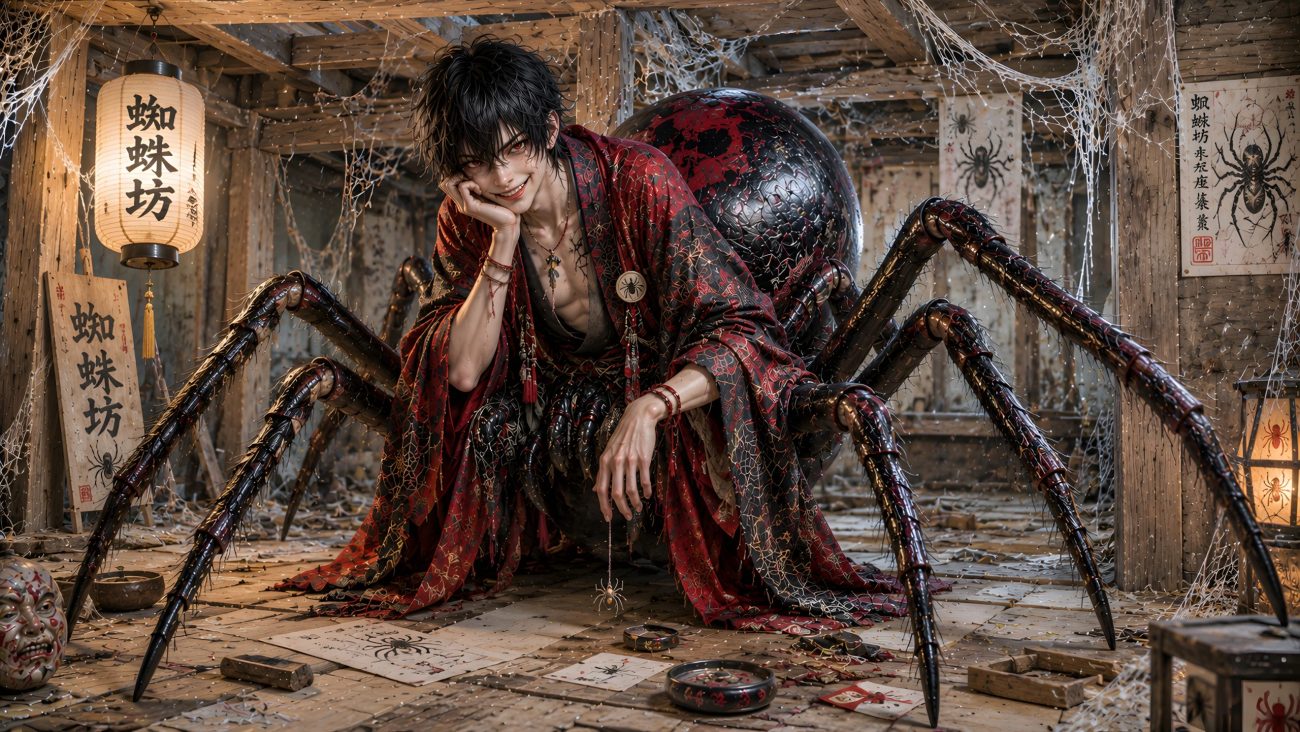
The Spider Son was a half-human, half-spider child born from the union of a mountain spider spirit and a human woman. Although monstrous in appearance, he became famous for his wisdom, craftsmanship, and supernatural knowledge.

The story tells of a poor widower and his thirteen-year-old daughter, who survived by gathering wild greens in the mountains. One spring she met a handsome young man who offered to buy everything she collected each day. After many meetings, he revealed his true identity, transforming into a gigantic spider. Before disappearing into the mountains, he told her she was carrying his child and asked her to raise it with care.

In time she gave birth to a son who was human from the waist up but possessed the body of a spider below. Rather than abandoning him, the family lovingly accepted him and raised him as their own.

Ashamed of his appearance, the Spider Son asked his grandfather to cut a hole in the floor so he could remain hidden beneath the house while only his upper body emerged. From there he spent his days carving wooden toys, statues of gods and Buddhas, and other beautiful works. The children of the village loved his creations, and grateful families rewarded the poor household with rice and money.

As he grew older, the Spider Son became known for his extraordinary wisdom. When the daughter of a wealthy man fell gravely ill, he declared that she could be cured simply by drinking water from a hidden spring at the foot of a nearby mountain. Although few believed him, the spring was found exactly where he described, and the girl recovered immediately after drinking its water.

From then on, people traveled from far away seeking the Spider Son’s advice and predictions, which rarely proved false. His fame spread throughout the region, bringing prosperity to the once-impoverished family, while the mysterious child of a mountain spider came to be remembered as a miraculous being rather than a monster.


Sources

TYZ. (n.d.). Spider Son [蜘蛛の子]. In 新版TYZ 妖怪図鑑. Retrieved June 28, 2026, from https://tyz-yokai.blog.jp/archives/1074146146.html


Ashidakagumo-Henge

Tradition / Region: Japanese Mythology
Alternative names: Ashidakagumo-Henge
Category: Spider


The Myth

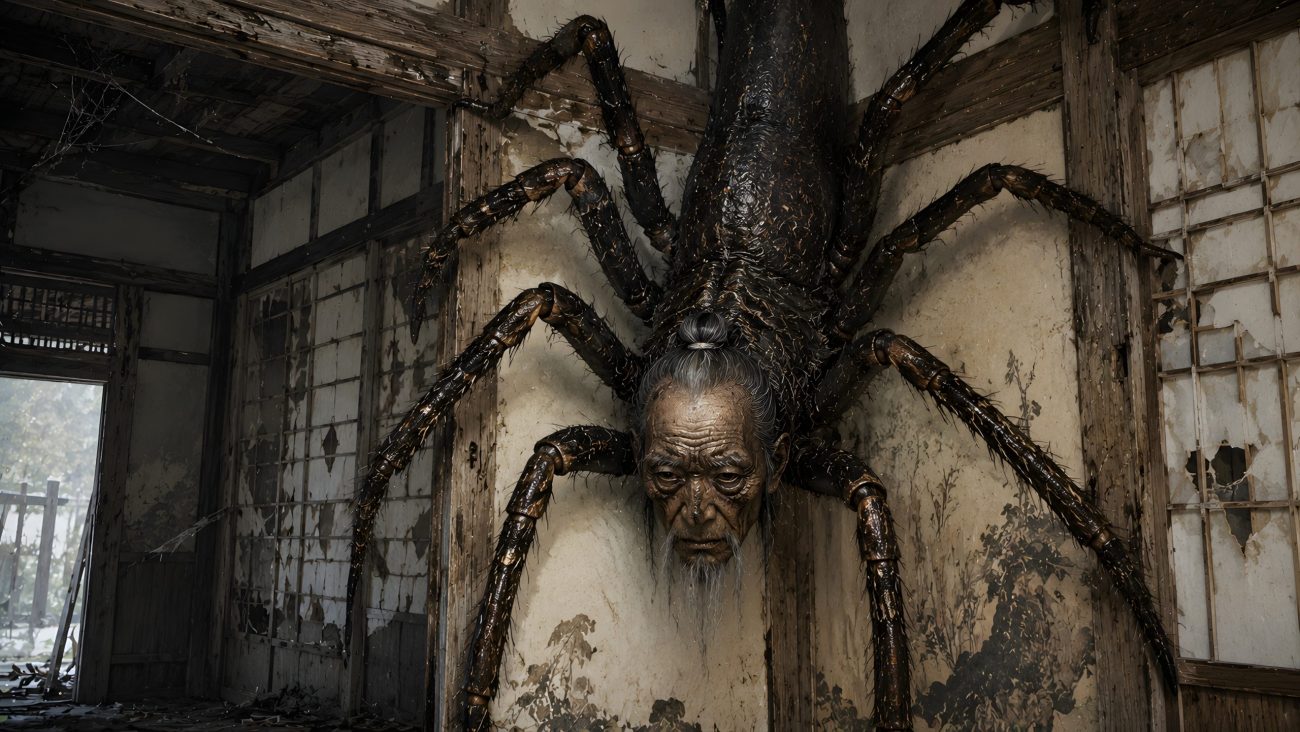
The Ashidakagumo-Henge is an aged giant spider that gains the power to transform into a human. Unlike the seductive Jorōgumo, it often appears as an eerie elderly woman whose unnatural presence brings fear and madness.

One tale tells of a man from a mountain village who went out for an evening walk beneath the moon. High in the fork of a great chestnut tree he saw an old woman with tangled hair, blackened teeth, and a disturbing smile staring directly at him. Terrified, he hurried home.

After returning, he fell into an uneasy sleep. The old woman repeatedly appeared in his dreams until, bathed in moonlight, she stood outside his house exactly as she had appeared in the tree. Grabbing his sword, the man prepared himself as the woman slowly opened the sliding door and stepped inside.

As soon as she entered, he struck her across the body with a single powerful slash. The monster staggered from the blow, but before he could strike again the man lost consciousness.

When he awoke, neighbors had gathered after hearing his scream. The mysterious old woman had vanished. Inside the house there was no trace of her except for the severed legs of an enormous spider lying on the floor.

The story concludes that even ordinary spiders, after living long enough, can acquire supernatural power and transform into terrifying human-like beings.


Sources

TYZ. (n.d.). Ashidakagumo-Henge [足高蜘蛛変化]. In 新版TYZ 妖怪図鑑. Retrieved June 28, 2026, from https://tyz-yokai.blog.jp/archives/1010654434.html


Jorōgumo

Tradition / Region: Japanese Mythology
Alternative names: Jorōgumo, Jorō Kumo
Category: Spider


The Myth

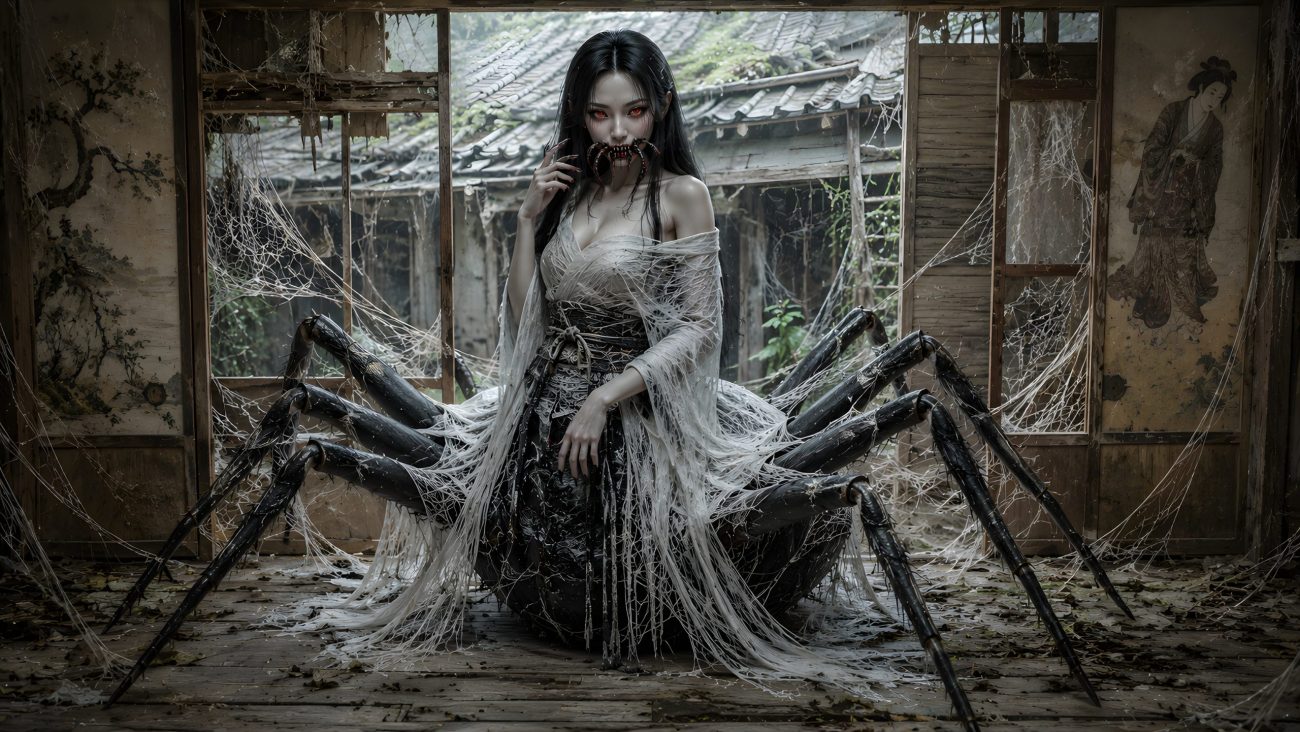
The Jorōgumo is a supernatural spider that can transform into a beautiful woman to deceive and ensnare humans. It is one of Japan’s most famous spider yōkai and is often associated with lonely houses, forests, waterfalls, and secluded places. Some traditions identify the guardian of Jōren Falls on Mount Amagi as a Jorōgumo.

In its true form, the Jorōgumo is an enormous spider capable of spinning vast webs. It can disguise itself as an elegant young woman, or sometimes an older woman, using beauty, charm, and conversation to lure unsuspecting victims into its trap.

One famous tale tells of a wealthy samurai named Sonroku, who spent his summer afternoons resting at a secluded villa. One day an elderly woman appeared and claimed that her beautiful daughter had fallen deeply in love with him after hearing one of his poems. She led him to a magnificent mansion where the daughter, a stunning young noblewoman dressed in colorful silk, begged him to stay with her forever.

Although captivated by her beauty, Sonroku refused because he was already married. As the mysterious woman desperately clung to him, the entire mansion suddenly vanished. He found himself back on the veranda where he had fallen asleep only moments earlier.

Looking around, Sonroku noticed a small female spider walking nearby while countless spiders covered the eaves with webs. He then remembered chasing away a spider with his pipe a few days before, just as the old woman in the vision had claimed her mother had been driven away with a pipe. Realizing the entire encounter had been the work of the spider spirit, he ordered every web removed, and the strange visitations never returned.

The Jorōgumo is remembered as a dangerous shapeshifter that uses beauty, illusion, and desire rather than brute force, patiently weaving both webs and deception to capture its victims.


Sources

TYZ. (n.d.). Jorōgumo [絡新婦]. In 新版TYZ 妖怪図鑑. Retrieved June 28, 2026, from https://tyz-yokai.blog.jp/archives/1010654252.html