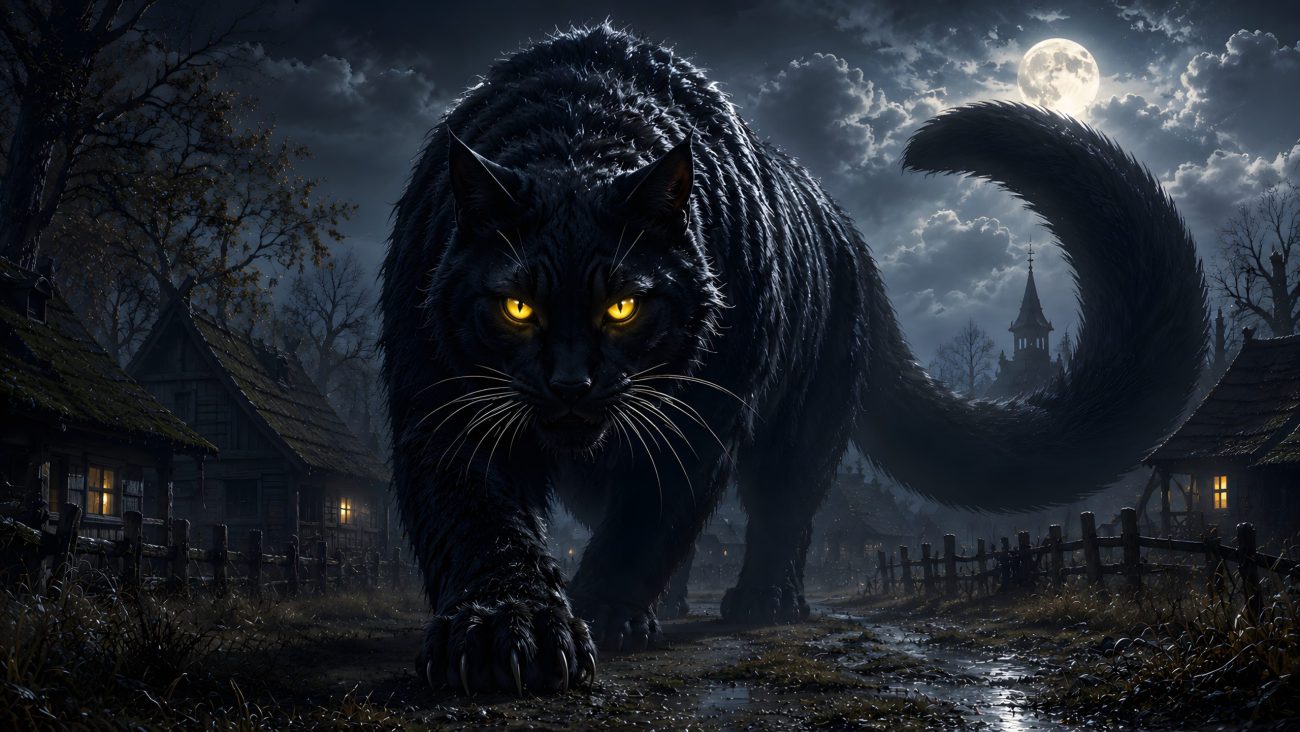
Ball-Tailed Cat

Tradition / Region: American Mythology
Alternative names: Dingmaul, Sliver Cat
Category: Cat


The Myth

The Ball-Tailed Cat is a fearsome beast said to resemble a mountain lion, distinguished by an extraordinarily long tail ending in a heavy, solid ball.

The creature hunts by swinging its powerful tail with tremendous force, striking prey unconscious before moving in to kill it. Travelers who wandered too close were said to be knocked senseless by a single blow from the tail.

Some stories describe a more dangerous variety known as the Sliver Cat. Instead of a smooth club, one side of its tail ends in sharp spikes. After stunning its victim with the smooth side, it turns the tail and drives the spiked side into its prey, holding it fast before delivering the final attack.

Another variant, the Dingmaul, is similarly known for using its massive tail as its primary weapon, making the Ball-Tailed Cat one of the most feared creatures said to roam the forests of North America.


Sources

“Ball-tailed Cat.” Wikipedia: The Free Encyclopedia. Wikimedia Foundation. Accessed July 28, 2026. https://en.wikipedia.org/wiki/Ball-tailed_cat


Arima Bake-neko

Tradition / Region: Japanese Mythology
Alternative names: Arima Monster Cat
Category: Cat


The Myth

The Arima Bake-neko is one of Japan’s most famous monster cat legends. The story takes place at the Edo residence of the Arima clan during the rule of Lord Arima Yoriyuki.

During a banquet, a wild dog burst into the palace while chasing a kitten. As the dog lunged toward the lord, a lady-in-waiting named Otaki struck it dead with an iron ladle, saving his life. When the lord offered her a reward, she asked only that the frightened kitten be spared. Impressed by her courage and kindness, the lord took her as his concubine.

Otaki’s rise provoked the jealousy of the other women in the household, especially the head lady-in-waiting, Iwanami, who relentlessly tormented her. Unable to endure the abuse any longer, Otaki took her own life.

The kitten she had rescued, now named Tama, licked Otaki’s spilled blood and transformed into a monstrous cat. Seeking revenge, it burst into the palace and killed Iwanami by tearing out her throat. Afterward, the women responsible for tormenting Otaki died one after another under mysterious circumstances.

The monster’s vengeance grew ever more savage. It murdered the pregnant concubine Otoyo, ripping open her body and killing both her unborn child and her maid. It even attacked Lord Yoriyuki himself while he walked in the garden, but the guard Yamamura Tenzen struck the creature between the eyes with his sword, forcing it to flee.

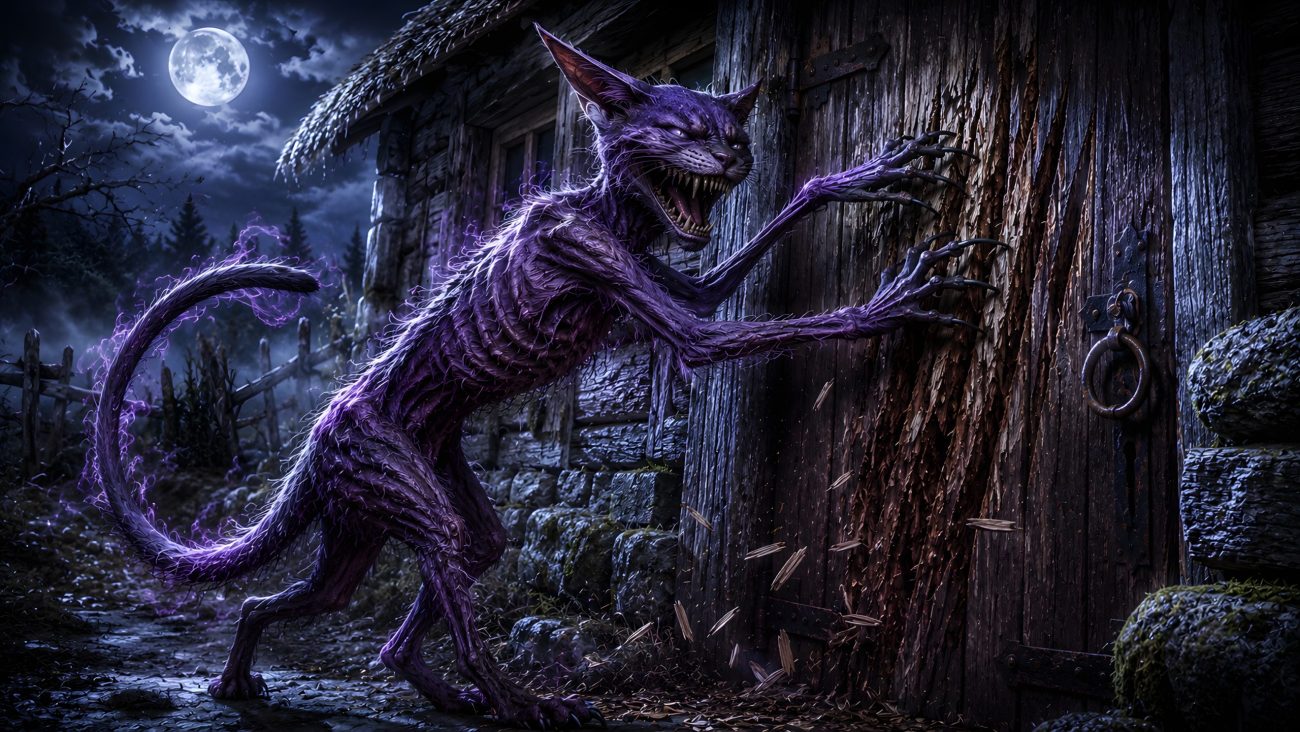
When Tenzen returned home, he discovered that his elderly mother bore the same wound. He realized the monster cat had already killed and devoured her, assuming her appearance to hide among the living.

Joining forces with the former sumo wrestler Onogawa Kisaburō, Tenzen hunted the creature to the Arima residence’s great fire watchtower, where it had made its lair. There the monster revealed its true form, but together the two men defeated and killed it, finally ending the cat’s bloody revenge.


Sources

Takahashi, Toshihiro. “有馬の化け猫 (Arima-ba-neko).” 新版TYZ 妖怪図鑑 (New TYZ Yokai Encyclopedia). February 11, 2018. Accessed July 27, 2026. https://tyz-yokai.blog.jp/archives/1069687960.html.


Arassas

Tradition / Region: French Mythology
Alternative names:
Category: Cat


The Myth

The Arassas is a strange creature with the head of a cat and the body of a lizard. Its gray skin blends with old stone, allowing it to hide among ruined houses, crumbling walls, and abandoned places where it makes its home.

Its most feared power is its gaze. Anyone who looks into its eyes dies instantly. The Arassas also possesses a venomous bite capable of killing those unfortunate enough to be struck by it.

Although deadly, the Arassas is not said to hunt people relentlessly. It remains hidden among ancient ruins, emerging only when disturbed. Children are traditionally believed to be unharmed by the creature, while adults who venture carelessly into its domain risk falling victim to its fatal stare.

The Arassas is also described as shy and occasionally playful, yet it never forgives those who intrude upon its refuge. Travelers are warned to avoid deserted buildings and ruined walls, for the creature may be waiting silently among the stones, nearly impossible to distinguish from the crumbling masonry until it is too late.


Sources

Countess Sica. “Arassas.” A Book of Creatures. November 18, 2019. Accessed July 27, 2026. https://abookofcreatures.com/2019/11/18/arassas/


Cat Witch of Heist op den Berg

Tradition / Region: Belgian Mythology
Alternate Names:
Category: Cat, Witch


The Myth

During the time of Napoleon I, a Belgian soldier was returning home from war, passing through a Prussian village.

As he walked through the town, he noticed a woman sitting outside her house. She was smoking a pipe, but something about her seemed wrong—on her backside there was a dark, unnatural stain. The soldier immediately suspected that she was a witch.

Without hesitation, he took his rifle from his shoulder, loaded it with a consecrated bullet, and fired—just grazing her.

He then continued his journey back to Belgium, where he was required to stay for several days.

There, he encountered a woman who bore strange signs: she had a black patch at the back of her skirt and a wound on her nose that refused to heal. The injury lingered unnaturally, as if it could not recover.

It became clear that this was the same being he had shot before.

The wound remained open because it had been inflicted by a consecrated bullet—something believed to harm witches in a way that could not be undone.


Sources

de Cock, A. (1921). Vlaamsche sagen uit den volksmond. In Amsterdam: Maatschappij voor goede en goedkoope lectuur, from https://www.dbnl.org/tekst/cock001vlaa01_01/colofon.php p. 37.


Prachatice Cat

Tradition / Region: Czech Mythology
Alternate Names: —
Category: Cat


The Myth

The Prachatice Cat is a sinister manifestation of cats acting under supernatural influence, capable of intelligence, coordination, and deadly intent.

One night, after a village celebration, a drunken farmer stumbled home and heard strange music coming from his barn. Curious, he opened the doors and let the moonlight reveal the scene inside.

There, a gathering of cats had assembled. They were not behaving like ordinary animals—each cat held its own tail in its mouth and played it like a musical instrument, producing eerie sounds like flutes and pipes. In the center, a dance was taking place: a cat whirled together with the farmer’s own large black tomcat.

The spectacle was unnatural and unsettling, but the farmer reacted with anger rather than fear. He cursed his cat and threatened it, dismissing what he had seen as drunken nonsense. Then he went inside and fell asleep.

During the night, the black cat entered the house silently. It approached the sleeping man and, in a calculated act of revenge, forced its tail down his throat, suffocating him.

By morning, the farmer was dead.

The story left behind a lasting warning, remembered in local tradition:
cats are not always harmless creatures, and what appears tame may conceal something dangerous.

The Prachatice Cat embodies the idea that animals—especially cats—can serve as vessels of hidden forces, capable of turning against humans when disrespected or provoked.


Sources

sagen.at contributors. (n.d.). Katzenmusik. In sagen.at, from https://www.sagen.at/texte/sagen/tschechien/watzlik/katzenmusik.html


Ghostly Cat

Tradition / Region: Austrian Mythology
Alternate Names: White Cat Spirit
Category: Cat, Ghost


The Myth

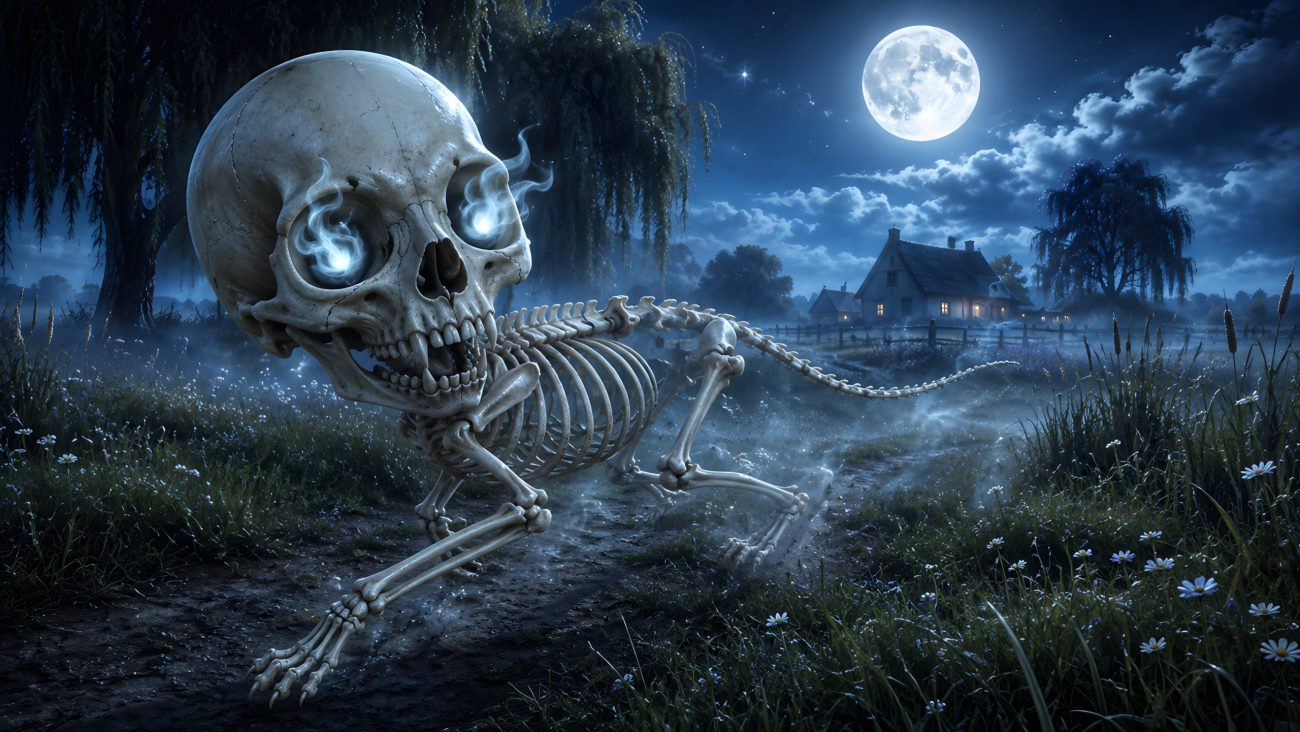
The Ghostly Cat is the spirit of a woman condemned to wander in the form of a large white cat, appearing at night on the rooftops of an old house.

The legend tells of a man who lived a corrupt and immoral life, while his wife endured everything in silence. Eventually, he fell under the influence of another wicked woman, and together they plotted to murder his wife using poisoned food.

However, through a twist of fate, the poison was consumed by the very woman who had prepared it. The effects were unnatural and disturbing. Instead of dying immediately, she began to lose her humanity and believed herself to be a cat.

She crawled on all fours, ran wildly through the house, climbed across the roof, and screamed like an animal. Her madness intensified with time, growing worse by the hour, until finally she fell from the highest point of the roof and broke her neck.

After her death, she did not find rest.

She became a restless spirit, condemned to return as a ghostly white cat, roaming the rooftops at night. Those who come too close to her path risk being attacked, as she lashes out with sharp claws at anyone who dares approach.

The Ghostly Cat represents a punishment tied to guilt, corruption, and unnatural transformation — a human reduced to an animal in life, and bound to that form even after death.


Sources

sagen.at contributors. (n.d.). Die gespenstische Katze. In sagen.at, from https://www.sagen.at/texte/sagen/oesterreich/wien/sagen_legenden_gugitz/katze.html


Kasha

Tradition / Region: Japanese Mythology
Alternate Names:
Category: Cat


The Myth

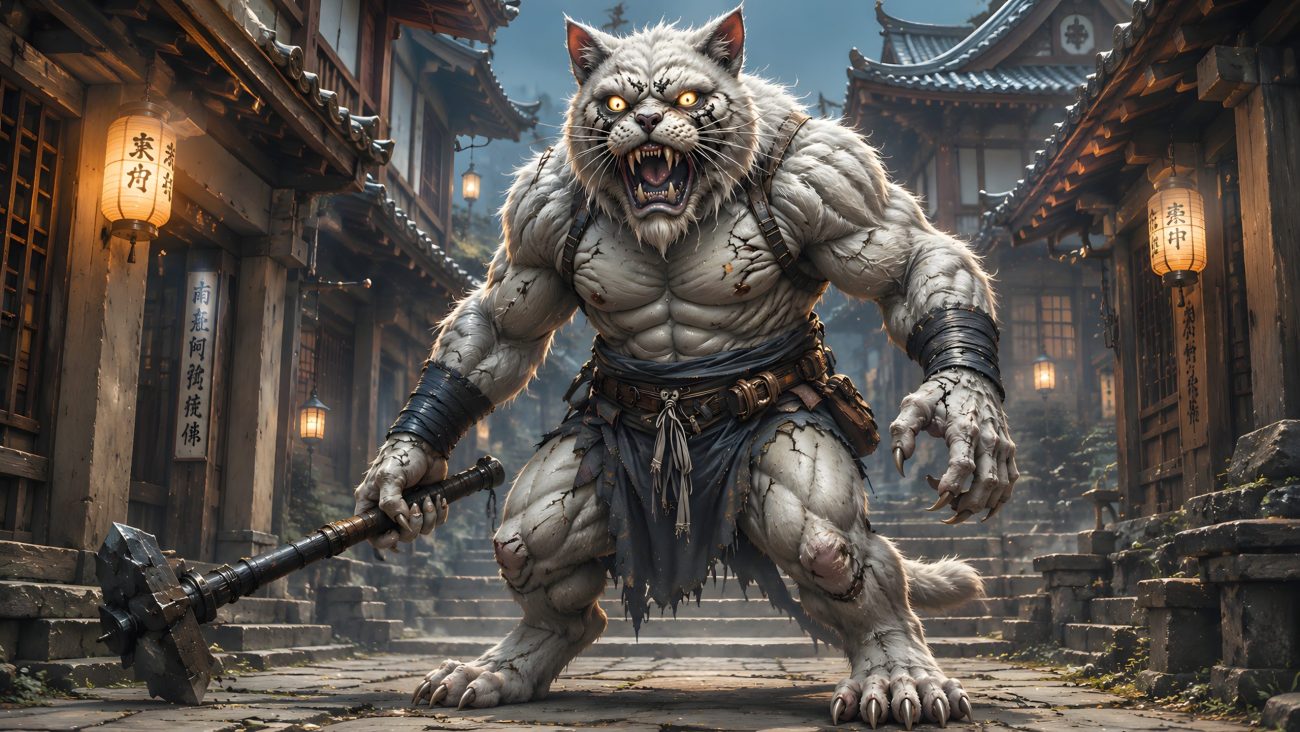
The Kasha is a cat-like yokai associated with death and the punishment of wrongdoers. It is said to carry away the corpses of those who committed crimes, and is often depicted grasping a body while connected to a flaming chariot or fire.

The Kasha appears when a person who has committed wrongdoing dies. It takes the corpse and carries it away, acting as an agent of karmic consequence rather than human judgment. It is portrayed as a cat-like being that may stand upright and seize the body, sometimes shown with a chariot of fire. Images of the Kasha appear in works such as death scrolls and mandalas, where it is shown taking the dead away. Its form varies by region, sometimes more monstrous and sometimes more cat-like, but it is consistently associated with the removal of sinful corpses and the inevitability of moral consequence.


Sources

TYZ Yokai Blog. (2014). 火車 (Kasha). From https://tyz-yokai.blog.jp/archives/1010655129.html


White Cat of the Alzette Bridge

Tradition / Region: Luxembourg Mythology
Alternate Names: New Year’s Water Spirit, Alzette Bridge Cat
Category: Cat


The Myth

Each year on New Year’s Eve, the water spirit of the Alzette River is said to appear in Ettelbrück in the form of a white cat on the bridge.

One year, a man crossing the bridge that night encountered the animal, which followed him through the deep snow. He hurried home, but the strange creature followed him into the house. No matter how often he tried to drive it out, it kept reappearing in the room.

At last he went to bed and tried to sleep, but the cat sat before him and cried out in a pitiful voice. When the clock struck one, the animal suddenly vanished. In the morning, however, the man discovered that his face had been badly scratched.

People said that the water spirit itself had visited him in the form of the white cat.


Sources

sagen.at contributors. (n.d.). Die weiße Katze auf der Teichbrücke zu Ettelbrück. In sagen.at, from https://www.sagen.at/texte/sagen/luxemburg/Katze_Ettelbrueck.html


The White Cat of Budersberg

Tradition / Region: Luxembourg Mythology
Alternate Names: Budersberg White Cat
Category: Cat, Swamp dweller


The Myth

In the meadowlands below the village of Budersberg, a snow-white cat is said to appear on certain nights.

It is sometimes seen where the stream called the Gessel flows into the Brüllchen, but most often it shows itself in the middle of the marsh known as the Fäschtemsmoore. There it moves silently through the darkness and then vanishes again, leaving no trace behind.

Thus the people spoke of the white cat that haunted the meadows and marshes below Budersberg.


Sources

sagen.at contributors. (n.d.). Die weiße Katze bei Budersberg. In sagen.at, from https://www.sagen.at/texte/sagen/luxemburg/Katze_Budersberg.html


Nuegyo

Tradition / Region: Japanese Mythology
Alternate Names: Nue
Category: Fish, Cat


The Myth

Nuegyo is a strange and unsettling fish said to appear in the seas off the coast of Japan. Those who encountered it did not recognize it as any known creature of the ocean, and even experienced fishermen were unable to name it.

The Nuegyo is said to be about the length of a man’s forearm. Its skin is rough, like that of a shark, while its head resembles that of a cat. Atop its head rests a hard, bowl-shaped mass, like stone. Its nose and mouth are also catlike, and from both sides of its jaw protrude sharp, bone-like spines several inches long. A thin spine rises from the top of its head, giving it an even more unnatural appearance.

Its body is shaped somewhat like that of a gurnard, but its fins are long and soft, extending all the way toward the tail. These fins are wide and flexible, like the wings of a bat. When spread open, they form a fan-like shape. It is said that the Nuegyo can use these fins as wings, rising above the surface of the sea and gliding through the air.

Because of its bizarre combination of features—part fish, part beast, and capable of flight—people began to call it Nuegyo, likening it to the legendary Nue, a creature made of mismatched forms. Whether it truly flies or merely skims the waves is unknown, but the Nuegyo is remembered as a sea being that does not fully belong to water or sky, and whose appearance defies ordinary understanding.


Sources

TYZ-Yokai Blog contributors. (n.d.). 座敷童子 (Zashiki-warashi). In TYZ-Yokai Blog, from https://tyz-yokai.blog.jp/archives/1010654392.html