Ghost Town Ghost

Tradition: Tlingit Mythology, American Mythology
Alternative Names: Ghost House
Category: Ghost


The Myth

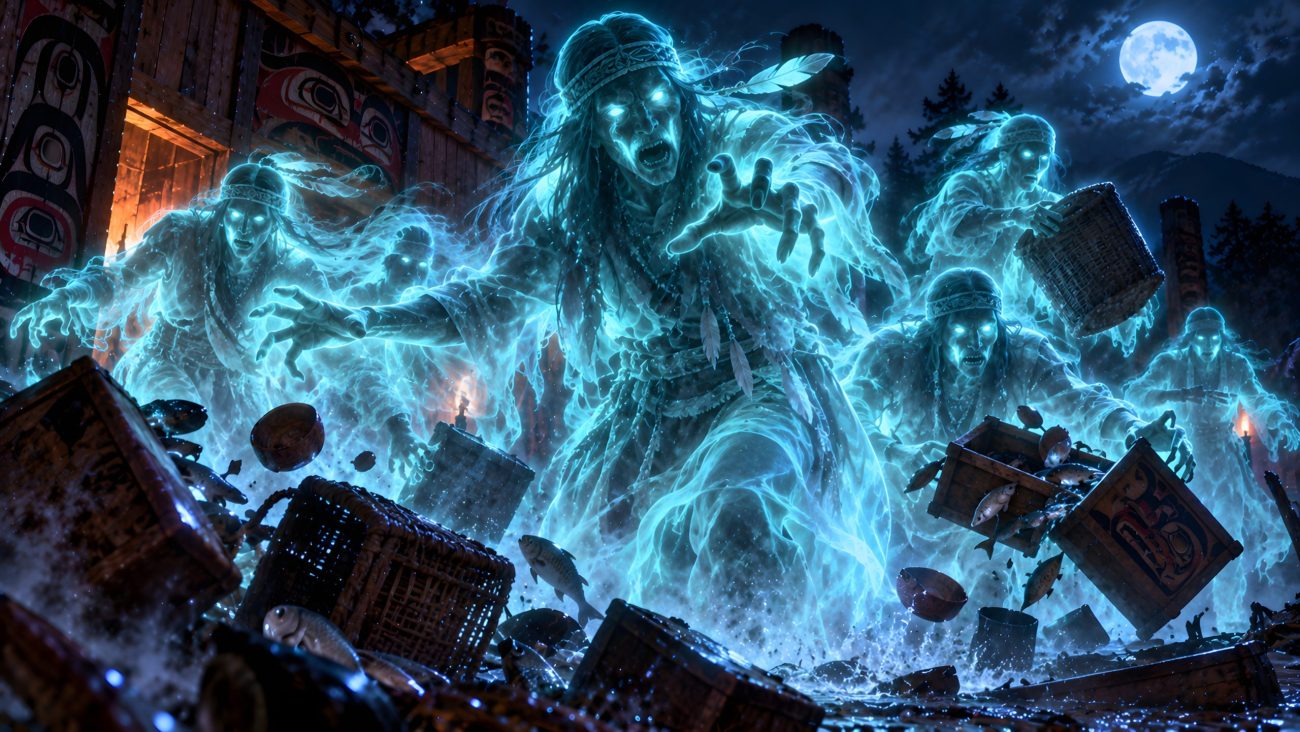
Ghost Town is a deserted settlement inhabited by invisible spirits. When Raven arrives, he finds a large town where everyone appears to have died. He enters the largest house, but an unseen presence continually pushes him away, even though he cannot see anyone inside. Realizing that the house is haunted, Raven discovers that the apparently empty town is not as deserted as it seems.

Raven decides to take provisions from the empty houses, loading them into his canoe before paddling away. However, he does not notice that a long rope connects the stern of his canoe to a tree on the shore. Once he reaches the end of the rope, the canoe is abruptly pulled back to the beach, and all the provisions are returned to the houses. Despite these mysterious actions, Raven cannot see anyone responsible.

The invisible inhabitants then retaliate by dropping a large stone onto Raven’s foot, leaving him badly lame. Although the town appears empty, its ghostly residents can move objects, prevent outsiders from taking their possessions, and inflict physical harm on those who disturb their settlement.


Sources

Judson, Katharine Berry, ed. Myths and Legends of Alaska. Illustrated. Chicago: A. C. McClurg & Co., 1911.


Uryak

Tradition: Tatar Mythology, Bashkir Mythology, Russian Mythology
Alternative Names: Örek, Örak, Эрак
Category: Ghost


The Myth

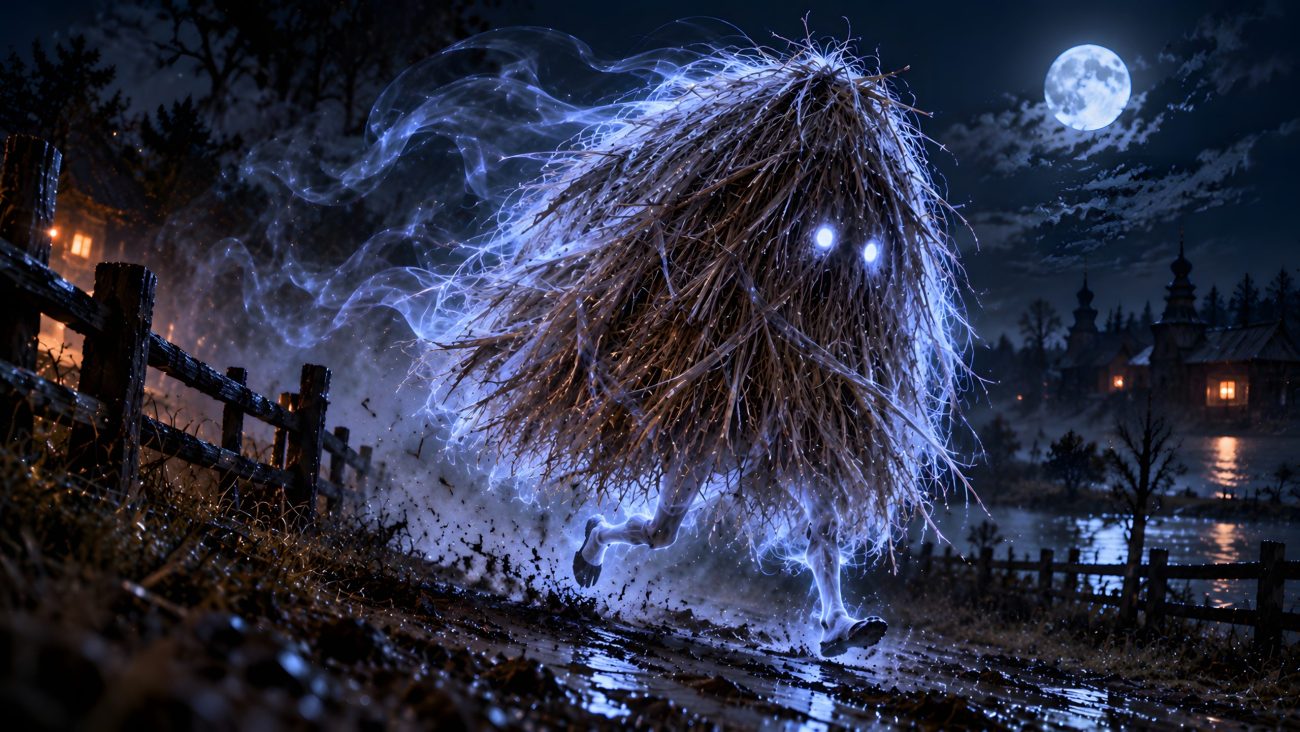
The Uryak is the ghost of a person who died a violent death, appearing in places where blood has been spilled. It may take the form of a human figure or a haystack-like shape, swaying and moving forward as it travels. Some accounts describe it as a strange, indistinct creature that can transform into a cloud. Although it is generally not considered directly harmful to people, its appearance is deeply frightening, particularly when encountered alone at night. The Uryak is associated with the graves of those who died violently and is believed to appear at the very place where a person’s life ended.

The Uryak is said to have a distinctive heart-rending cry that draws attention to its presence. People who encounter it may become terrified, confused, or even lose the use of their limbs. In Tatar tradition, a person who sees the spirit from a distance may hear its mournful cries and attempt to avoid it. If the Uryak approaches someone and refuses to leave them alone, the traditional way to drive it away is to address it with foul language. Bashkir accounts also describe the Örak as a terrifying apparition that may appear as a very tall, thin man in a white robe. It can frighten people into delirium, disability, or madness, and is sometimes said to visit murderers, knock on their doors, and torment them.

The Uryak can also appear in deceptive forms. One Tatar tale tells of a woman riding along a forest path who encounters a man dressed in white standing on a bridge. As she approaches, he transforms into a round ball of fire, rolls toward her cart, and becomes a little girl who climbs aboard. The frightened woman tries prayers and religious invocations to make the strange child leave, but the girl refuses and begins striking her with a stick while shouting obscenities. After a long struggle, the woman abandons the cart and flees, while the girl continues following her. Only when the woman remembers that a horse must be harnessed head-on to a cart does she escape the apparition. The strange girl immediately disappears, and the woman returns safely to her village. Such encounters portray the Uryak as a restless and uncanny spirit whose appearances are linked to violent death, fear, and places marked by bloodshed.


Sources

“Уряк (Uryak).” New Bestiary (Bestiary.us). https://www.bestiary.us/uryak


Bánánach

Tradition: Irish Mythology
Alternative Names: Bánánacha (plural)
Category: Ghost


The Myth

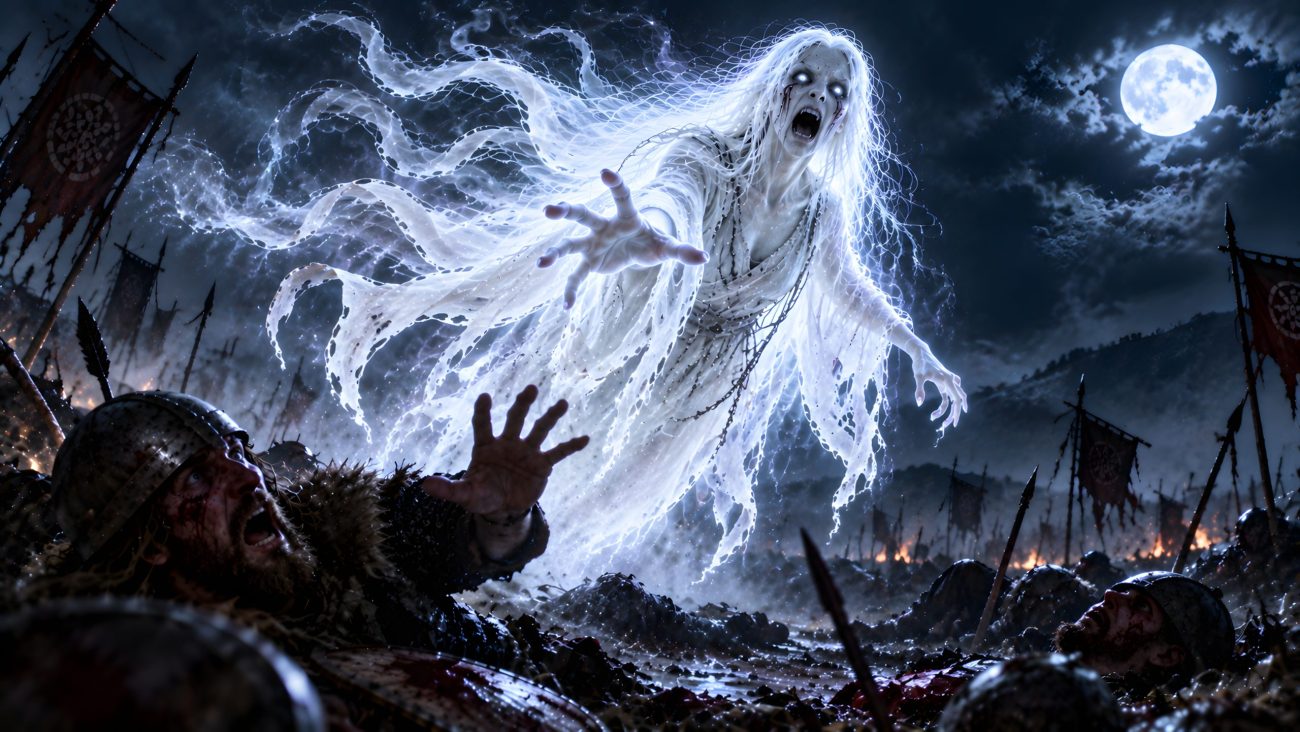
The bánánach are supernatural spectres that haunt battlefields, appearing amid the terror and confusion of war. They are associated with the clash of weapons, the cries of combatants, and the frightening sounds that fill the battlefield. Rather than being described with a fixed physical appearance, they are portrayed as mysterious presences whose arrival intensifies the fear of those caught in battle.

In Irish mythology, the bánánach appear alongside other terrifying battlefield beings, including the bócanach, a goat-like battle spectre, and the geniti glinne, a female battle spectre associated with valleys. These beings are connected with the supernatural forces of warfare and are said to have been sent by the Tuatha Dé Danann to strike fear into the enemies of the hero Cú Chulainn, answering his battle cry. Their presence made the sounds and dangers of combat seem to take on a life of their own.

The bánánach and their companion spectres were so terrifying that even the legendary bull Dond Cúalnge was associated with the power to ward them off. They embody the supernatural terror of the battlefield, where the clash of weapons and the cries of warriors become indistinguishable from the frightening presence of otherworldly beings.


Sources

“Bánánach.” Wikipedia: The Free Encyclopedia. Wikimedia Foundation. Accessed October 15, 2026. https://en.wikipedia.org/wiki/B%C3%A1n%C3%A1nach


Bean-nighe

Tradition: Scottish Mythology
Alternative Names: Washing Woman, Washer at the Ford, Nigheag, Nigheag na h-ath, Nigheag bheag a bhroin
Category: Ghost


The Myth

The bean-nighe is a female spirit who appears beside lonely streams, pools, and fords, washing the blood from the clothing and burial shrouds of people who are about to die. She is often heard singing a mournful dirge as she beats the garments against stones, seemingly absorbed in her grim task. Her appearance varies between regions. On the islands of Mull and Tiree, she has unusually long breasts that she throws over her shoulders while washing. On Skye, she resembles a small, pitiful child, while in Perthshire she is described as short, round-bodied, and dressed in green. Other accounts give her a single nostril, a large protruding front tooth, or red, webbed feet.

The bean-nighe is regarded as a messenger from the Otherworld and an omen of approaching death, particularly a sudden or violent one. Some traditions say she is the spirit of a woman who died in childbirth and must wash burial clothes until the day she would naturally have died. Those who encounter her may sometimes discover the fate awaiting them. If approached stealthily and caught, she may answer questions, reveal whose shroud she is washing, or grant three wishes. On Mull and Tiree, a person who wishes to obtain knowledge from her must approach from behind and claim to be her foster-child by taking one of her breasts into his mouth. If the garment belongs to the person himself or to a friend, he may be able to stop her washing and avert the threatened death. On Skye, however, anyone whom she sees first risks losing the use of their limbs.

One Highland tale tells of Gille-cas-fliuch, who encountered the washerwoman of the ford during the night as she washed and lamented beside stepping stones on Benbecula. He seized her and demanded three wishes in exchange for releasing her. The bean-nighe revealed that she was washing the death shroud of Great Clanranald, who would never again cross the ford at Dun-buidhe during his lifetime. Gille-cas-fliuch threw the shroud into the loch on the point of his spear and hurried to warn Clanranald. The chief immediately ordered a small boat to be made and crossed the loch to the mainland, never returning to Dun-buidhe. In another tale, a tall woman was seen washing bloodstained shirts in Loch Slin shortly before the roof of Fearn Abbey collapsed during a service, killing many people. Such stories portray the bean-nighe as a mysterious herald of death whose washing foretells tragedies that may still be avoided if her warning is understood in time.


Sources

“Bean-nighe.” Wikipedia: The Free Encyclopedia. Wikimedia Foundation. Accessed October 15, 2026. https://en.wikipedia.org/wiki/Bean-nighe


Gloeiige

Tradition: Dutch Mythology
Alternative Names: De Glène Kerel, De Gloeiige Man, Gloeiende Gerrit, Gleunigen, Glende Kerels, Sjoufert
Category: Ghost


The Myth

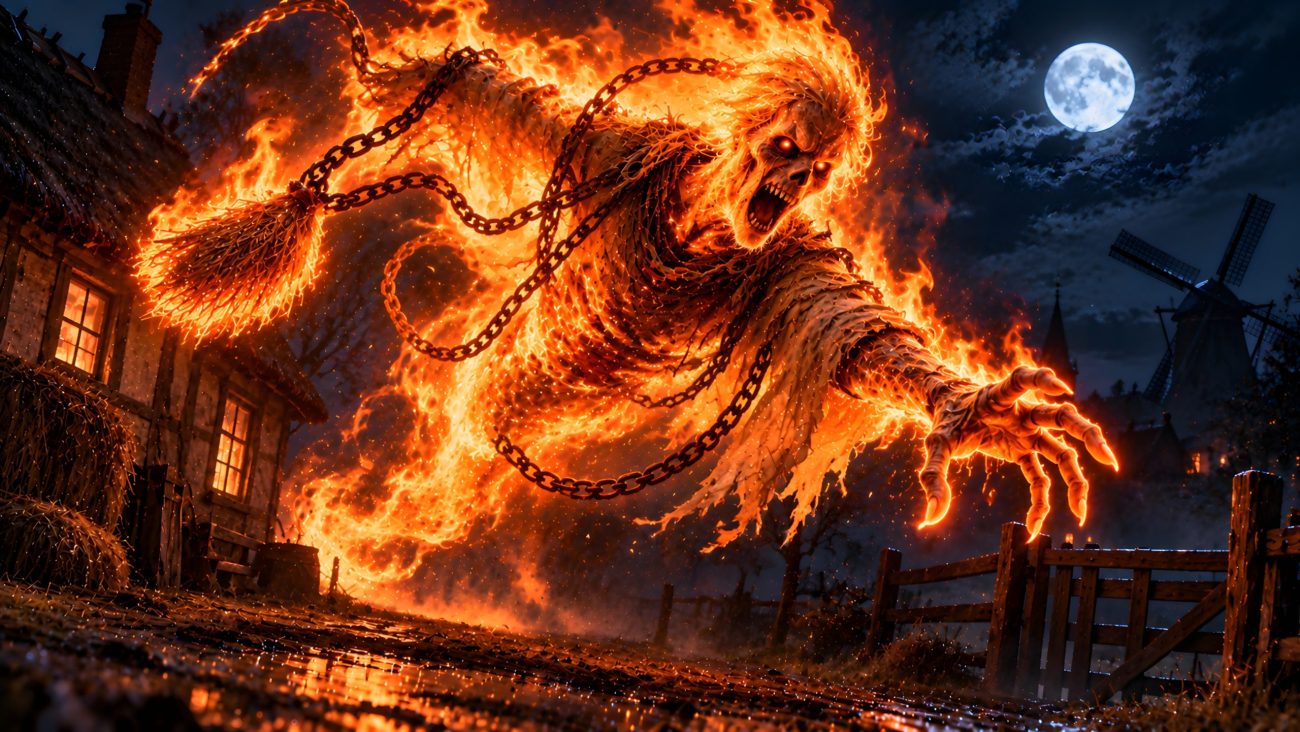
The Gloeiige is a fiery ghostly apparition that appears as a living flame, a fireball, or a blazing projectile. Sometimes it takes the shape of a burning bundle of straw or a flaming thatch of roofing. These spirits are the restless souls of people who brought a curse upon themselves during their lives, particularly unjust land surveyors and arsonists, but also thieves and murderers. Many had sworn false oaths, declaring, “May I burn forever if I lie.” After death, they were condemned to fulfil their own terrible curses, doomed to burn as fiery apparitions.

The Gloeiigen are dangerous spirits that may be summoned by calling or whistling for them. Anyone who calls one and then flees may discover a blackened handprint burned onto their door the following morning. In autumn, the fiery spirits descend from the sky and lash chimneys with their blazing chains. Sometimes they enter houses themselves, striking sinners with their chains and leaving painful brands upon their bodies.

In Venlo, the inhabitants were said to have to provide the Gloeiige with an annual offering consisting of a cartload of sand, a pair of tin shoes, and seven and a half stuivers. These strange demands reflect the spirit’s fearsome place in local tradition, where the souls of those who had sworn false oaths or committed serious wrongs continued to suffer through fire after death.


Sources

Van der Veen, Abe. “Van aardmannetje tot zwarte juffer: Een lijst van Nederlandse en Vlaamse elfen en geesten.” Abe de Verteller. https://abedeverteller.nl/van-aardmannetje-tot-zwarte-juffer-een-lijst-van-nederlandse-en-vlaamse-elfen-en-geesten/


Lange Man

Tradition: Belgian Mythology, Dutch Mythology
Alternative Names: Lange Man
Category: Ghost


The Myth

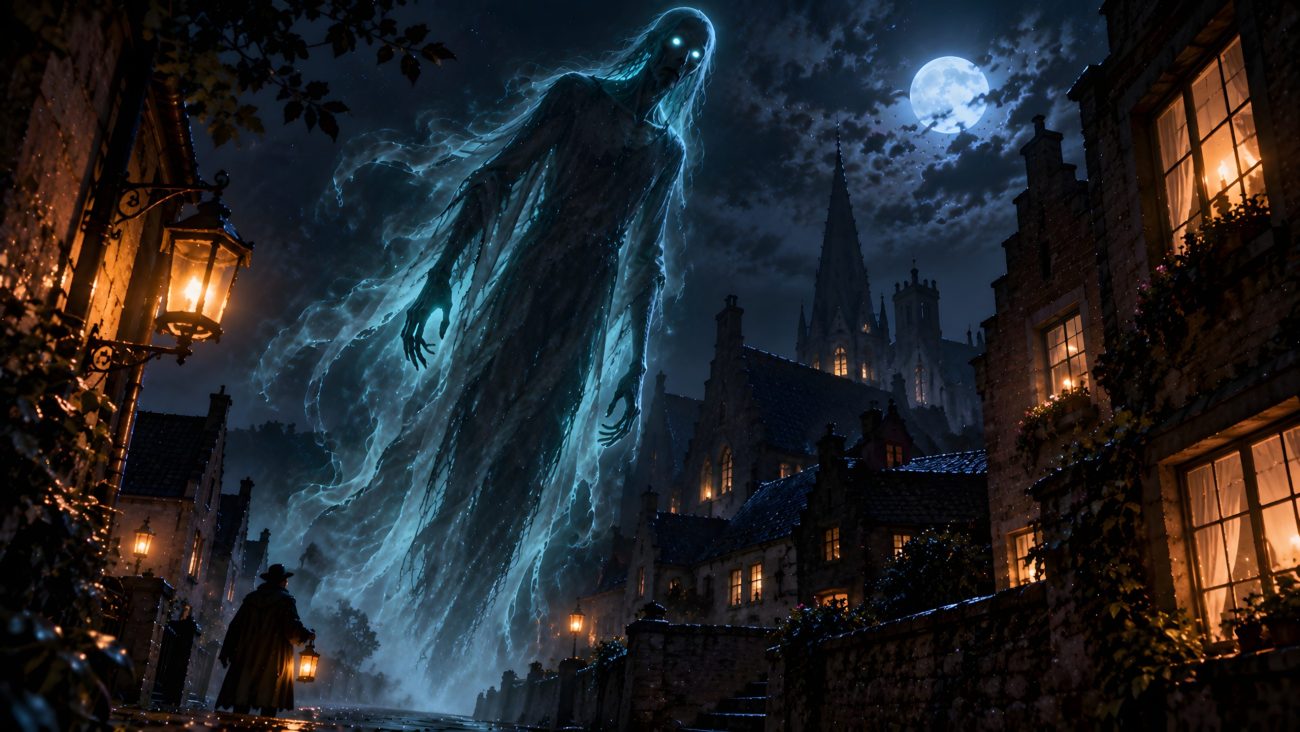
The Lange Man is a tall, black apparition shaped like a human figure. Rather than walking, he glides above the ground with his legs held tightly together, his neck stiff and his arms hanging limply at his sides. Despite his frightening appearance, he is said to protect people who travel late at night.

In Maastricht, the Lange Man is said to emerge from a cellar opening during the night before growing to a height greater than the surrounding houses. He peers through people’s windows and knocks on the highest panes of glass, towering over the buildings as he moves through the darkness. He can also transform himself into an old woman or a large, rolling ball, making his appearance unpredictable and unsettling.

Despite his occasional protective role, the Lange Man is also regarded as a harbinger of disease. His nocturnal appearances and strange transformations are signs that illness may soon come to the people who encounter him.


Sources

Van der Veen, Abe. “Van aardmannetje tot zwarte juffer: Een lijst van Nederlandse en Vlaamse elfen en geesten.” Abe de Verteller. https://abedeverteller.nl/van-aardmannetje-tot-zwarte-juffer-een-lijst-van-nederlandse-en-vlaamse-elfen-en-geesten/


Sara-kazoe

Tradition: Japanese Mythology
Alternative Names: Plate Counter, Sara-kazoe
Category: Ghost


The Myth

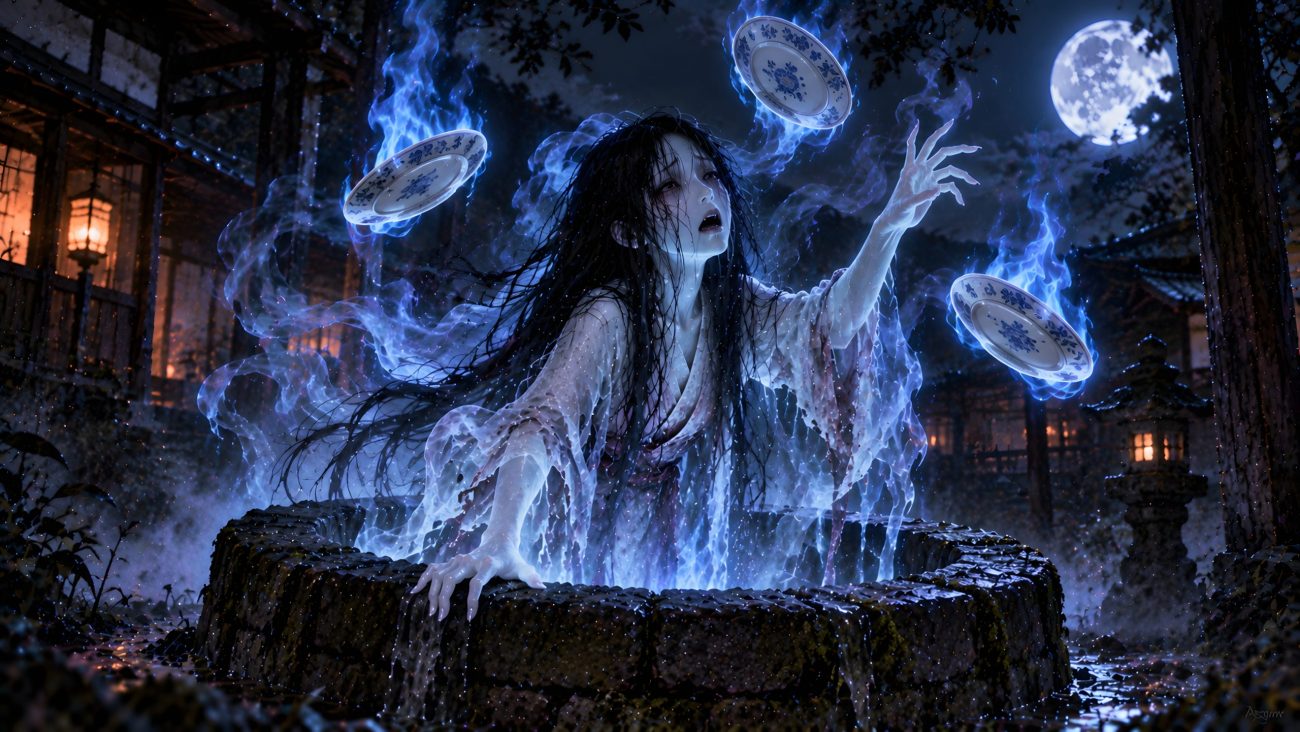
Sara-kazoe is a ghostly yokai depicted as a woman emerging halfway from an old well, with flames issuing from her body as three plates rise into the air around her. Her terrifying appearance is associated with the tragic tale of a maid who was murdered after accidentally dropping one plate from a set of ten into a well. The woman had been entrusted with the precious plates, and the loss of even one brought terrible consequences upon her.

After her death, the maid’s ghost returned to the well every night. There, she counted the plates aloud, slowly numbering them from one to nine before breaking into a sorrowful cry, unable to reach the missing tenth plate. Her nightly lament became an eerie reminder of the injustice done to her, and her spirit remained bound to the well where her life had ended.

The legend of Sara-kazoe is associated with the famous Japanese ghost story of Okiku from Banshū Sarayashiki, the tale of the Plate Mansion of Banshu. The old well in Banshu is identified as the place connected with the haunting, where the murdered maid’s spirit continues to count the plates. Through her repeated cries and fiery apparition, Sara-kazoe embodies the suffering of a wronged woman whose death left her trapped in an endless cycle of grief.


Sources

“皿数え (Counting Plates).” 新版TYZ 妖怪図鑑 (New TYZ Yokai Encyclopedia). https://tyz-yokai.blog.jp/archives/1067140521.html


Daki no O-Hyaku

Tradition: Japanese Mythology
Alternative Names: Daki no Obyaku, Hyakuno O-Hyaku
Category: Ghost


The Myth

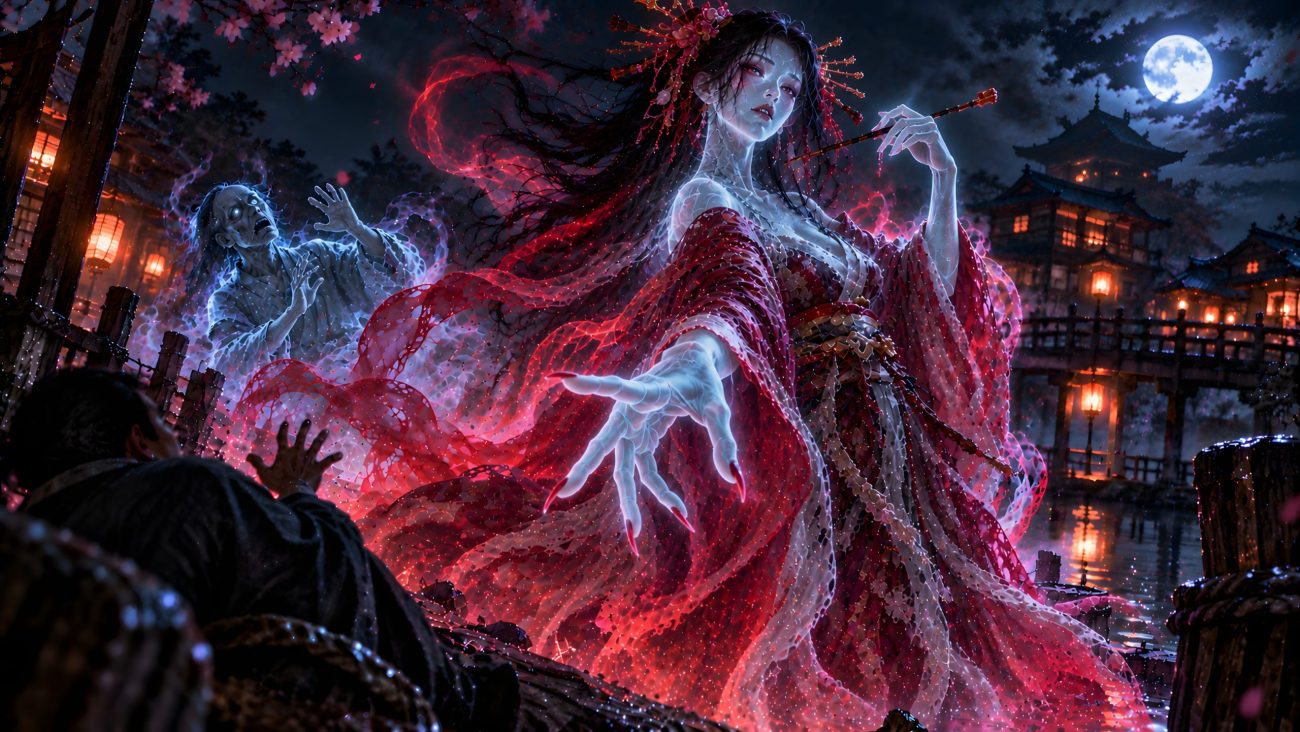
Daki no O-Hyaku was a notorious villainous woman whose name was associated with the legendary Chinese temptress Daji, the infamous consort of King Zhou of the Shang dynasty. In Japanese tales, O-Hyaku was portrayed as a beautiful and ruthless woman whose ambition, seduction, and cruelty brought ruin to the men and households around her. Her story became especially infamous through tales of murder, betrayal, robbery, and schemes to seize the wealth and power of the Satake family of Akita.

In the popular stories, O-Hyaku was born as the sister of a fisherman named Shinsuke and entered domestic service at the home of Tokubei, a wealthy shipowner in Naniwa. After becoming his mistress, she revealed her cruel nature by accusing his pregnant wife, Otaka, of infidelity and driving her from the household. O-Hyaku then indulged in a life of luxury until Tokubei’s business collapsed. The pair travelled to Edo, where O-Hyaku met Hikogorō, a notorious bandit, abandoned Tokubei, and became Hikogorō’s lover. She established a geisha house in Fukagawa and sometimes performed as a geisha under the name Kosan.

When O-Hyaku later encountered Tokubei, who had fallen into poverty and become a ragpicker, she pretended to calm his anger and lured him to a deserted reclaimed area of Fukagawa. There she stabbed him in the stomach with a large kitchen knife and pushed him into a pond. When he struggled to rise, she kicked him back into the water until he died. As she prepared to leave, Tokubei’s ghost appeared before her as a pale blue ball of fire, hovering around her in silent accusation. Rather than show fear, O-Hyaku mockingly told the spirit to illuminate her way home like a paper lantern. His ghost became one of the most chilling signs of the wickedness attributed to her.

O-Hyaku’s ambitions grew beyond personal wealth. She joined forces with Nakagawa Chūdai, an official serving the Satake family in Edo, and plotted to corrupt the family lord, Satake Sakyō-no-daibu, by encouraging him to indulge in alcohol and pleasure until he became incapable of ruling. Their ultimate goal was to seize the wealth and power of the Akita domain. Other tales accuse O-Hyaku of deceiving a blind travelling entertainer named Omine, selling her daughter, and arranging for Hikogorō’s men to murder her. She was also said to have escaped exile on Sado Island, extorted money from wealthy farmers near Niigata, and eventually become a pirate commanding numerous followers. Her schemes ultimately failed, and she was cornered by her pursuers.

Behind O-Hyaku’s transformation into a monster of cruelty lay the vengeance of a supernatural sea creature. Long before, Tokubei’s father, Tokuzō, had been sailing aboard the Satake family’s ship, the Sen-nichimaru, when a violent storm arose and a giant sea monk, or umibōzu, appeared offshore. Tokuzō courageously borrowed the lord’s sword and cut the monster down with a single stroke. The slain creature’s vengeful spirit flew inland and possessed O-Hyaku, transforming her from a naturally gentle woman into a figure consumed by lust and wickedness. At the end of the turmoil, when O-Hyaku was surrounded and could no longer escape, an enormous monk-like figure rose behind her, towering to an impossible height. Declaring that the vengeance had run its course and that the events should serve as a warning to future generations, the giant vanished. Freed from the sea spirit, O-Hyaku returned to her former gentle nature and was captured without resistance. In one version, she repented of her crimes and accepted death at the hands of Tokubei’s son, believing this was the only fitting end for her. She died at the age of twenty-five.


Sources

“妲己のお百 (Dakki no O-Hyaku).” 新版TYZ 妖怪図鑑 (New TYZ Yokai Encyclopedia). https://tyz-yokai.blog.jp/archives/1060567084.html
Shikishima

Tradition: Japanese Mythology
Alternative Names: Kuruwa Bunko Shikishima Monogatari
Category: Ghost


The Myth

Shikishima is a beautiful courtesan who was kidnapped as a young child and sold to the pleasure quarters of Yoshiwara. Despite her frail health, she rises to become a high-ranking courtesan at the Miuraya brothel. With only three months remaining on her contract, she dreams of freedom but is troubled by her love for Fujishiroya Jūzaburō, a man who is already married. Her life takes a terrible turn when she is falsely accused of stealing valuables from sleeping customers. The real culprit, the greedy madam Otsume, conspires with the servant Genshiro to frame Shikishima and conceal their own misdeeds. When Shikishima refuses to confess, she is brutally tortured. Her young daughter Wakano is brought in and tortured alongside her, forcing Shikishima to accept the blame in an attempt to spare the girl further suffering.

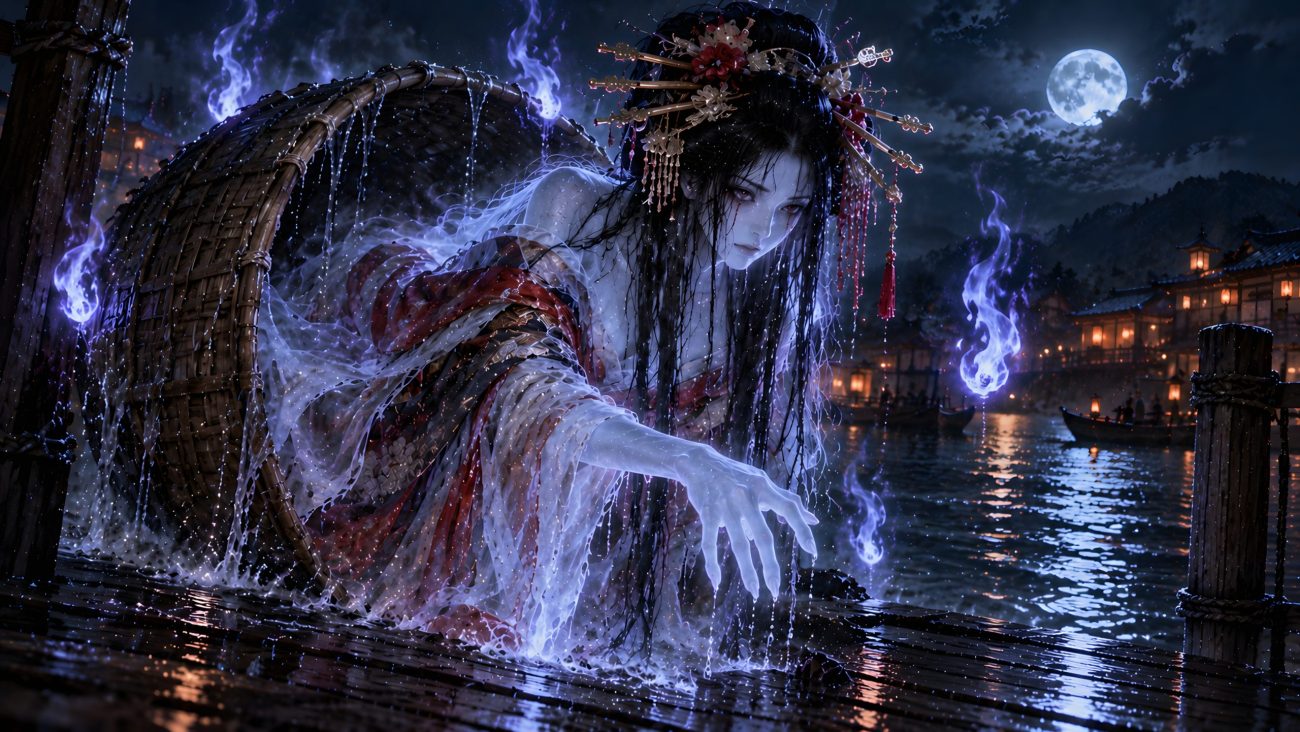
Afterward, Shikishima discovers that the accusation was part of a larger plot to silence her because she knew of the secret affair between Genshiro and Otama, the wife of the Miuraya’s owner. Genshiro intends to kill her to protect their secret. As Shikishima lies dying, she curses her tormentors and vows to make them understand the consequences of their actions. Genshiro mocks her challenge to return as a ghost before cutting her throat with a dagger. He makes it appear that she has eloped and fled the brothel, stuffs her body into an old wicker basket, and throws it into the sea. A mysterious flame rises from the water, and Shikishima’s vengeful spirit begins to haunt Genshiro. Her ghost glares at him with burning resentment, appearing alongside eerie, shadowy flames and pursuing him wherever he goes.

Shikishima’s spirit eventually appears in a wicker basket that rises from the water, revealing her seemingly fresh corpse with its eyes suddenly opening to glare at her murderers. She accuses Genshiro of falsely framing her and condemning her to a horrible death. Even when he challenges her to kill him, her ghost refuses to leave, declaring that she cannot abandon a land filled with hatred without taking revenge. She also visits Jūzaburō in a dream, asking him to care for their daughter and promising that they will be reunited as husband and wife in the afterlife. Before disappearing, she entrusts her daughter’s future to him. Guided by the revelations of her spirit, Jūzaburō and Shikishima’s allies begin uncovering the truth and bringing those responsible for her death to justice. The shadowy flame that accompanies the revenge finally goes out when Otama is beheaded, marking the end of Shikishima’s haunting.


Sources

“敷島 (Shikishima).” 新版TYZ 妖怪図鑑 (New TYZ Yokai Encyclopedia). https://tyz-yokai.blog.jp/archives/1077741624.html


Otsuta

Tradition: Japanese Mythology
Alternative Names: Otsuya
Category: Ghost


The Myth

Otsuta, also known as Otsuya, is the daughter of a fishmonger who becomes a concubine in the household of the samurai Isobe Kazuenosuke. Favored for her beauty, she becomes entangled in a conspiracy led by the wicked retainer Iwagami Godayu and his son Tenzo, who seek to control the Isobe family. When Otsuta overhears their secret plans to poison their rivals, Tenzo decides to silence her. He first attempts to force himself upon her, but she refuses him. When Monzaburo intervenes and helps her escape, Tenzo accuses them both of adultery to conceal his own crimes.

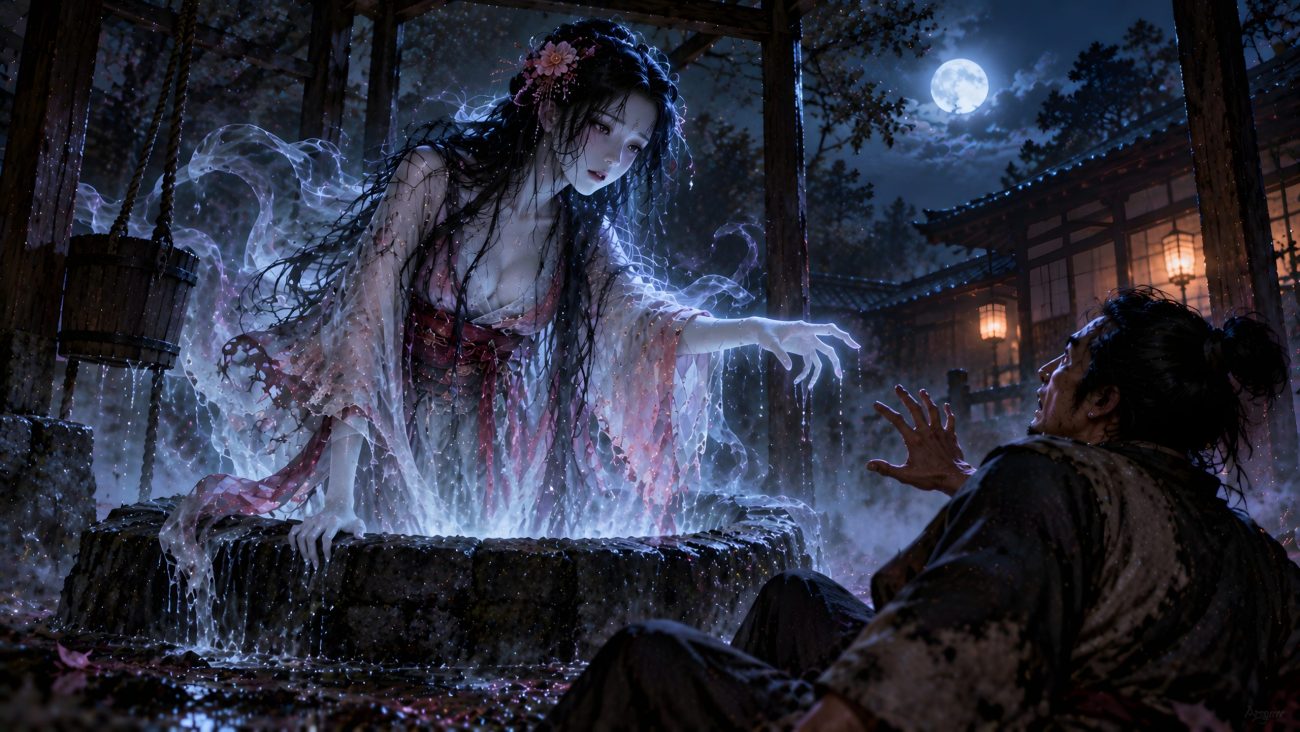
Otsuta attempts to defend her innocence before Kazuenosuke, but Tenzo’s lies and accusations turn her master against her. She is tortured, falsely accused of breaking a precious family teacup, and forced to drink poisoned water. As she writhes in agony, Otsuta swears that she will soon return to take revenge. Tenzo mockingly challenges her to come back as a ghost, claiming that he has never encountered one outside a play. Kazuenosuke then strikes her repeatedly with his sword, and her body is thrown into a well where a former master had also murdered a concubine. Soon afterward, rain and wind extinguish the lights, and Otsuta’s ghost appears amid smoke and a sudden burst of flame before vanishing.

Otsuta’s spirit later appears to Monzaburo as he prepares to commit seppuku after being falsely accused of adultery. She stops him and reveals the conspiracy of the Iwagami father and son, explaining the truth she had been prevented from telling while alive. Although she has returned from the dead, Otsuta declares that she does not hate Kazuenosuke. Grateful because the money she earned in his service once helped save her family from debt, she intends to remain in the world of the living to protect his household. Monzaburo promises to safeguard her family, and Otsuta’s ghost disappears with a joyful expression. Her revelations help expose the conspiracy, leading to the downfall of the villains and the restoration of justice.


Sources

“おつた (Otsuta).” 新版TYZ 妖怪図鑑 (New TYZ Yokai Encyclopedia). https://tyz-yokai.blog.jp/archives/1077741622.html