Selkie

Tradition / Region: Scottish Mythology
Alternate Names: Selkie folk, Seal folk, Haaf-fish (large seals in folklore)
Category: Mermaid, Shapeshifter


The Myth

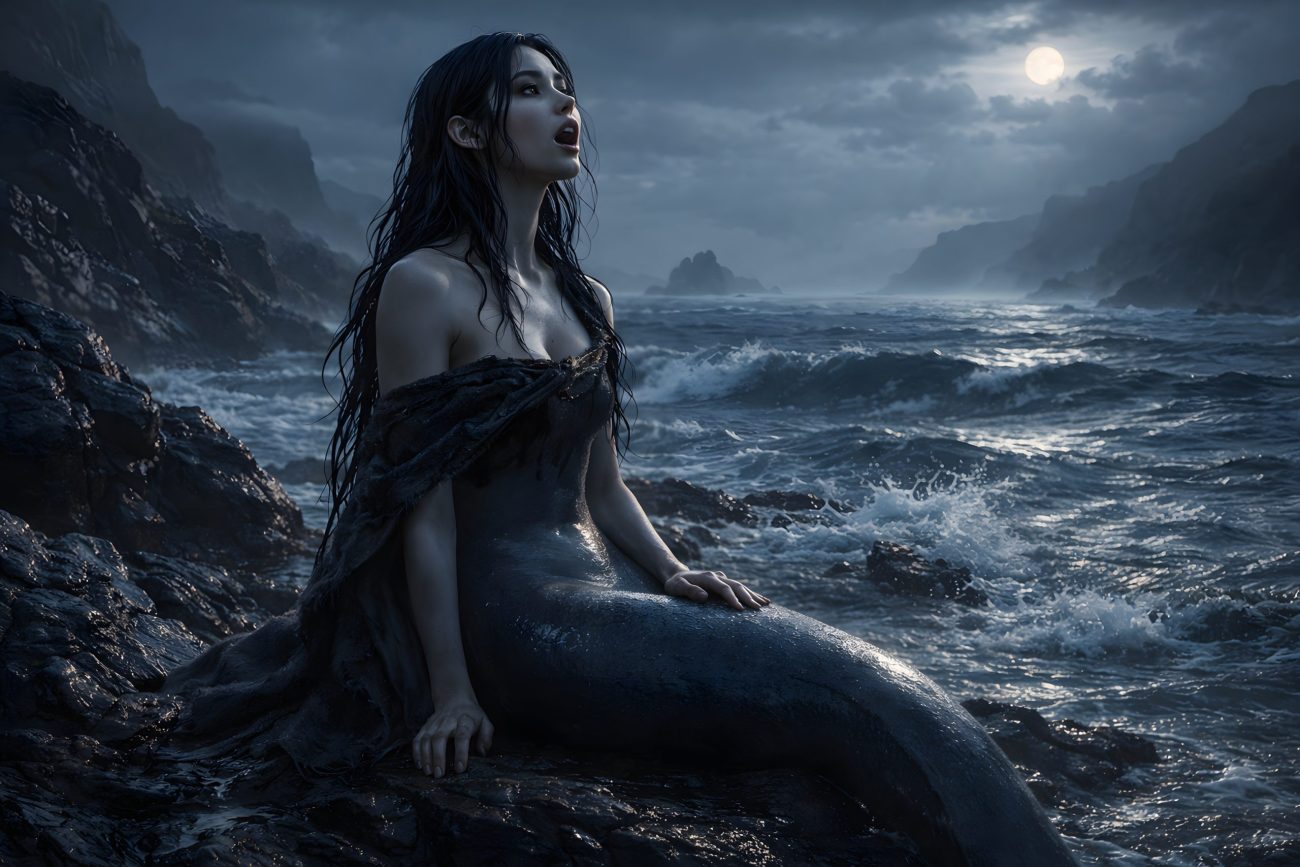
Along the coasts of the Northern Isles it is said that certain seals are not animals at all, but selkie folk—beings who live as seals in the sea and as humans when they shed their skins upon the shore. On quiet nights they come out of the water, remove their seal hides, and dance in human form under the moon.

Many tales tell of men who find one of these skins and hide it. When the selkie woman returns and cannot find her seal coat, she is trapped on land. The man forces her to become his wife, and though she lives with him and may bear his children, her heart is always with the sea. She spends her days gazing toward the waves, longing for the place she came from.

Years may pass this way, until one day she discovers the hidden skin—sometimes by chance, sometimes with the help of a child who unknowingly reveals its hiding place. The moment she touches it, she runs to the shore, puts it on, and slips back into the water. However much she loved her children, she does not return. Some say the children later see a great seal watching them from the sea, crying out softly as if in farewell.

There are also stories of male selkies. In human form they are said to be strikingly handsome and dangerously charming. They come ashore to seek out lonely women, especially those whose husbands are long at sea. A woman wishing to summon one might weep into the ocean, and the selkie would rise to her. From such unions children might be born, sometimes marked by webbing between their fingers or toes.

Other tales speak of seals that are killed by fishermen, only for their bodies to change into human form. Without their skins, these seal-people cannot return to their underwater homes. In one story, a stranded fisherman is carried safely back to shore by a grieving selkie in exchange for the return of a stolen skin, for without it the creature could never go back to the sea.

Thus the selkie folk are remembered as beings of two worlds—living in the deep, walking the shore in borrowed human shape, and forever drawn back to the water that is their true home.


Gallery


Sources

Wikipedia contributors. (n.d.). Selkie. In Wikipedia, The Free Encyclopedia. Retrieved February 14, 2026, from https://en.wikipedia.org/wiki/Selkie


Interpretive Lenses

Religious Readings
  • Christian Ascetic Deep Dive
Philosophical Readings
  • Nietzschean Deep Dive
Psychological Readings
  • Jungian Deep Dive
Esoteric Deep Dive
  • Hermetic Deep Dive
Political / Social Readings
  • Marxist Deep Dive
Other
  • How to Invite The Selkie

Keask

Tradition / Region: Scottish Highland folklore
Alternate Names: Maiden of the Waves
Category: Mermaid, Salmon


The Myth

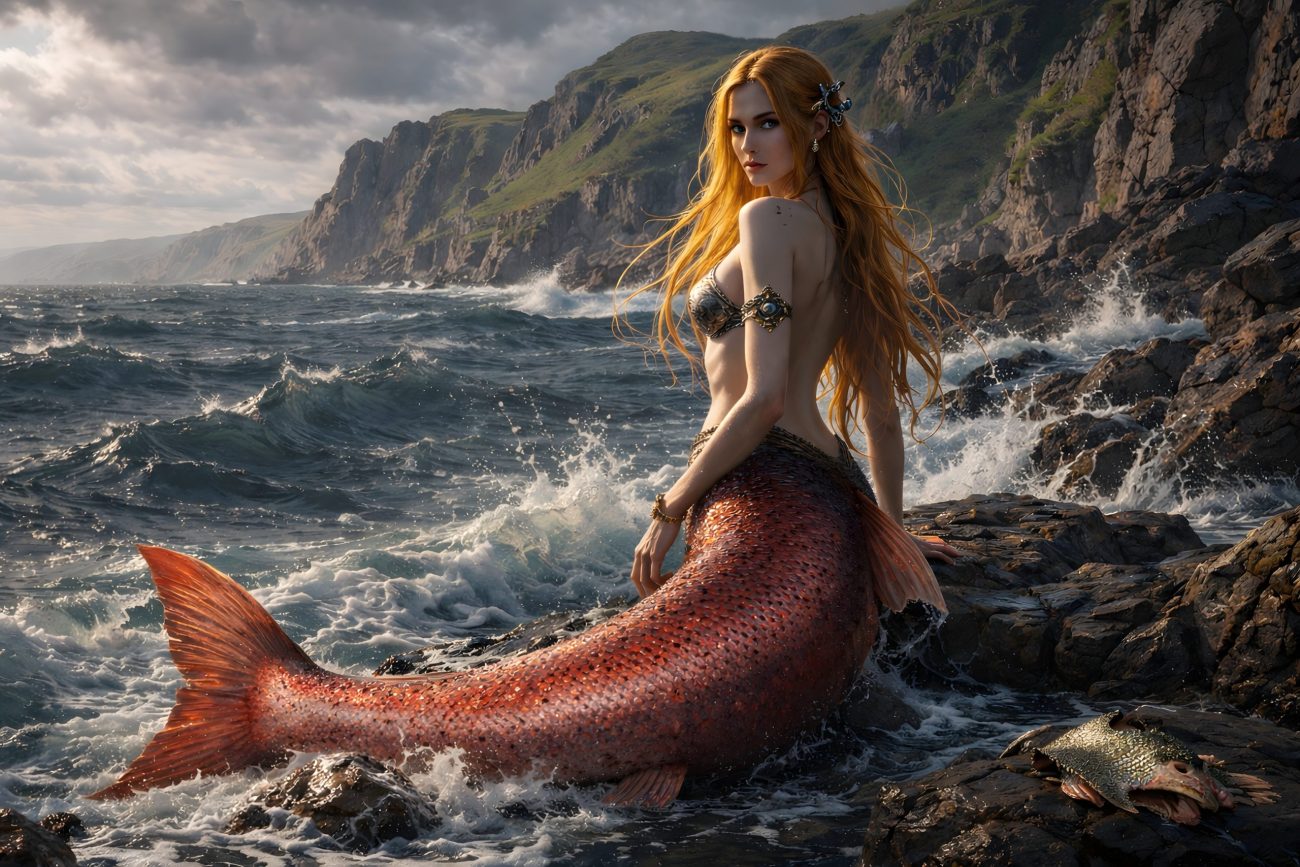
In the waters off the Highlands lives the Keask, a sea maiden with the body of a beautiful woman and the tail of a great salmon. When she is beneath the sea her hair is dark green, but when she rises into the air it turns bright gold. She wears ornaments said to come from hidden chambers beneath the earth.

The Keask can sometimes be caught by mortals. If seized, she will grant three wishes in exchange for her freedom. Like other sea maidens, she can cast off her outer fish skin and take human form. In this shape she may wed a mortal man and live among his people. Yet if she ever recovers the skin that was taken from her, she returns to the sea. Even so, she does not forget her children, and is said to guide them in storms or lead them to good fishing.

One tale tells of a Keask who swallowed a man whole. His beloved lured the creature ashore by playing the harp, and the man escaped. The Keask then seized the harpist instead. To defeat her and free the captive, the hero had to destroy her hidden life. This life was not in her body but in a separable soul concealed far away: an egg inside a fish, the fish inside a duck, the duck inside a ram, buried beneath a house in a forest on an island in the middle of a lake. When the egg was destroyed, the Keask lost her power and the prisoner was freed.

Thus the Keask is remembered as both a bride from the sea and a dangerous being whose life and power lie hidden beyond her body.


Gallery


Sources

Bestiary.us contributors. (n.d.). Keask. In Bestiary.us, from https://www.bestiary.us/keask/


Interpretive Lenses

Religious Readings
  • Christian Ascetic Deep Dive
Philosophical Readings
  • Nietzschean Deep Dive
Psychological Readings
  • Jungian Deep Dive
Esoteric Deep Dive
  • Hermetic Deep Dive
Political / Social Readings
  • Marxist Deep Dive
Other
  • How to Invite The Keask

Am fear liath mòr

Tradition / Region: Scottish Mythology
Alternate Names: Big Grey Man of Ben Macdui; The Greyman
Category: Mountain dweller


The Myth

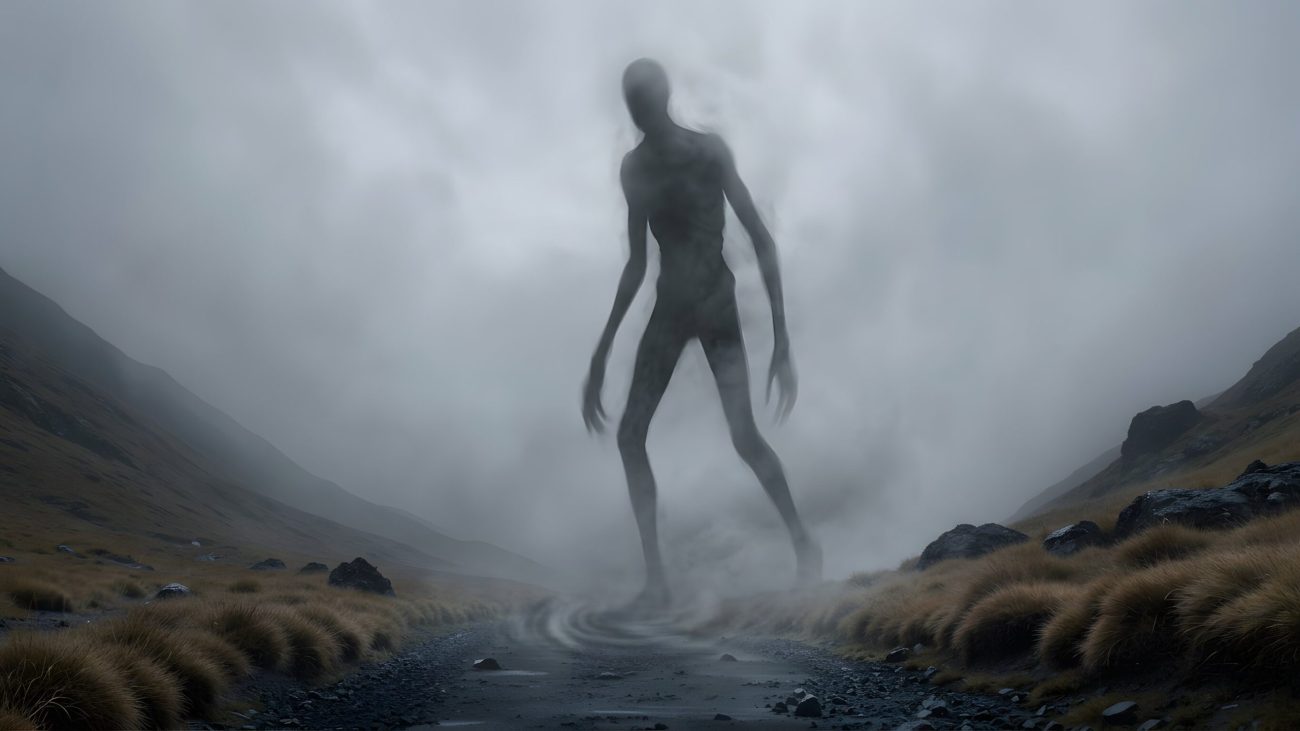
High among the mist-choked summits of Ben Macdui, in the Cairngorm Mountains, there is said to dwell a presence known as Am Fear Liath Mòr—the Big Grey Man.

He is rarely seen clearly. Those who encounter him most often speak not of sight, but of sound.

Climbers ascending the mountain alone in drifting fog begin to hear it: a crunch of gravel behind them. One heavy step. Then another. The stride is too long—three or four times the length of their own. When they stop, the steps stop. When they walk, it follows.

They turn, but the mist shows nothing.

The Greyman is said to be tall—far taller than any man—thin and looming, with long arms and broad shoulders. Some claim he stands over ten feet high. His skin and hair are dark, and he moves silently within the mountain’s fog. But most who feel his presence never see him clearly at all. Instead, they are overcome by an overwhelming dread, a certainty that something vast and watchful is near.

In 1891, a solitary climber descending from the summit cairn heard those immense footsteps trailing him in the mist. He tried to reason with himself, telling his mind it was nonsense. But the crunch, crunch continued. Terror seized him, and he fled blindly down the mountain, stumbling among boulders for miles before reaching the forest below. He swore never to return to the summit again.

Others have spoken of similar experiences. Brothers camping near the peak heard slurring footsteps circling their tent through the night, as if something paced them patiently in the dark. A rescue worker during the war felt the mist close in unnaturally tight around him and sensed pressure at his throat, as though unseen hands hovered near. Another man awoke to find a towering dark silhouette standing against the moonlight outside his tent.

One mountaineer claimed he saw a shape surge through the fog toward him. He fired his revolver at it, but the figure did not falter. He ran for his life, racing down the mountain in record time.

No photograph has ever captured the Greyman. Strange footprints once found in the snow proved to be the work of wind and meltwater. Yet the stories persist.

Some say the figure is nothing more than shadow and illusion—the Brocken spectre, a climber’s own enlarged form cast upon the mist by the rising sun. Others insist that something older and less easily explained roams the high passes.

Whatever he may be, the Big Grey Man remains in the fog of Ben Macdui, pacing silently behind those who dare to walk the summit alone.


Sources

Wikipedia contributors. (n.d.). Am Fear Liath Mòr. In Wikipedia, The Free Encyclopedia. Retrieved February 14, 2026, from https://en.wikipedia.org/wiki/Am_Fear_Liath_M%C3%B2r


Marool

Tradition / Region: Shetland Mythology, Scottish Mythology
Alternate Names: Mareel
Category: Fish


The Myth

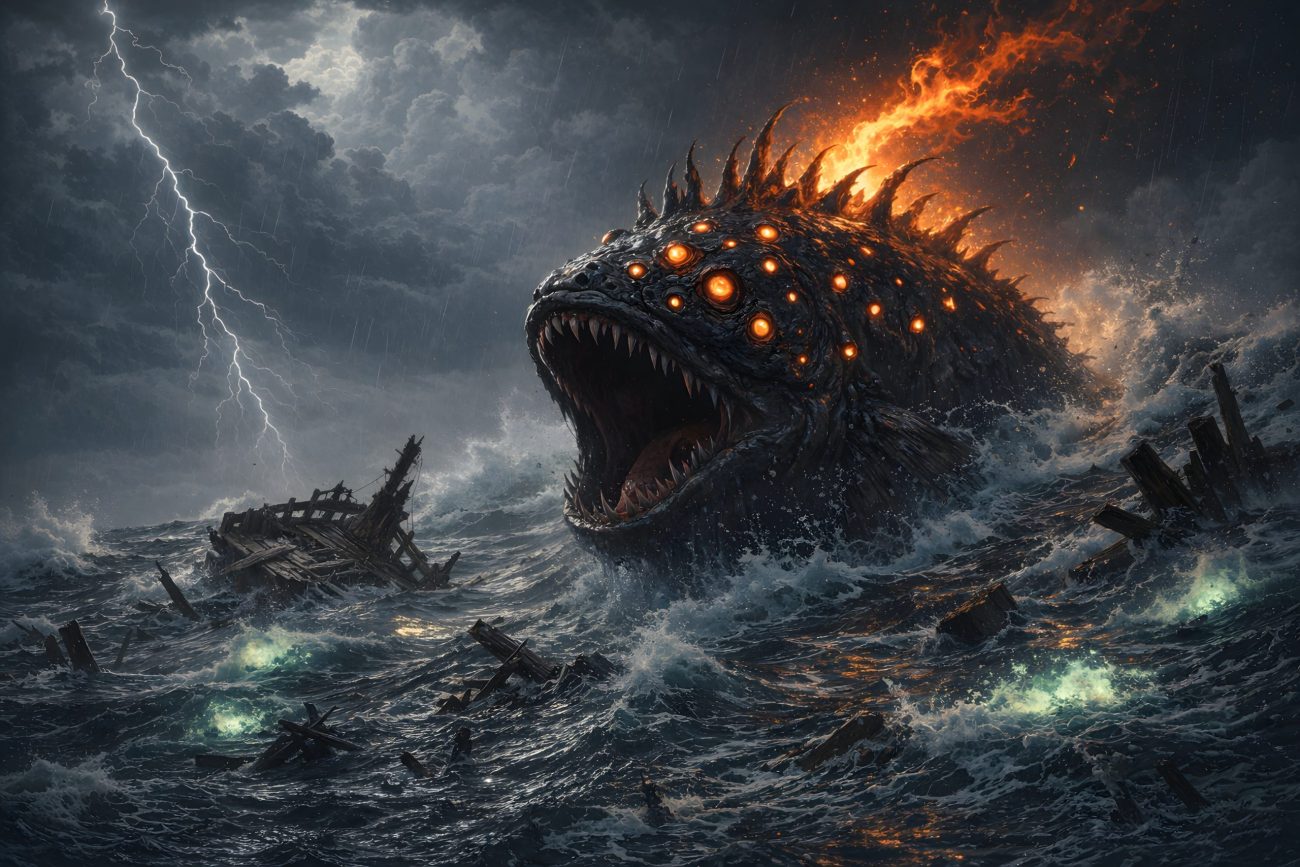
In the storm-dark seas around Shetland there dwells a malevolent being known as the Marool, a devil of the deep that wears the shape of a fish. Its head is covered in eyes, watching in every direction, and upon its crown burns a crest of living flame.

The Marool is most often seen amid mareel—ghostly, glowing sea-foam that shines with cold light at night. When storms rise and the waves grow wild, sailors fear its presence, for the Marool delights in disaster. As ships are overturned and dragged under by the sea, it is said that the creature sings, its voice carried on the wind, wild with joy at the destruction.

In later times, the name Marool came to be used for strange deep-sea fishes such as the anglerfish or monkfish. Yet in the old tales of Shetland, the Marool is remembered not as a mere animal, but as a watching, singing spirit of shipwreck and storm.


Gallery


Sources

A Book of Creatures contributors. (n.d.). Marool. In A Book of Creatures, from https://abookofcreatures.com/2016/03/04/marool/


Interpretive Lenses

Religious Readings
  • Christian Ascetic Deep Dive
Philosophical Readings
  • Nietzschean Deep Dive
Psychological Readings
  • Jungian Deep Dive
Esoteric Deep Dive
  • Hermetic Deep Dive
Political / Social Readings
  • Marxist Deep Dive
Other
  • How to Invite The Marool

Buarach-bhaoi

Tradition / Region: Scottish Mythology
Alternate Names: Buarach na Baoi; Buarach-bhaoi nan sùilean claon
Category: Fish, Eel


The Myth

The Buarach-bhaoi, whose name means “the wild shackle” or “the shackle of the furious one,” is a dangerous water creature believed to dwell in dark rivers, lochs, and fords. It is described as a leech- or eel-like being, lurking unseen beneath the surface.

When horses attempted to cross certain waters, the Buarach-bhaoi would suddenly coil itself around their legs like an iron shackle. Unable to free themselves, the animals would stumble, fall, and be dragged beneath the water, where they drowned. Afterward, the creature would suck their blood.

The Buarach-bhaoi is said to have nine eyes or holes along its head and back. Through these openings, the blood it consumed would seep out again. Because of this strange and unsettling feature, it was also called “the furious shackle of the squinting eyes.”

Stories place the Buarach-bhaoi in several regions. It was believed to haunt dangerous crossings, especially the dark waters of Loch Tummel, as well as rivers and lochs in Badenoch, Perthshire, and along the west coast of Argyllshire. Wherever the waters ran deep, fast, and shadowed, people feared it might be waiting.

The Buarach-bhaoi was not thought to hunt humans directly, but its presence made certain crossings deadly. Travelers learned to avoid suspicious fords, knowing that what looked like still water might conceal a living shackle beneath.


Gallery


Sources

Campbell, J. G. (2020). Superstitions of the Highlands & Islands of Scotland. Originally published 1900.


Interpretive Lenses

Religious Readings
  • Christian Ascetic Deep Dive
Philosophical Readings
  • Nietzschean Deep Dive
Psychological Readings
  • Jungian Deep Dive
Esoteric Deep Dive
  • Hermetic Deep Dive
Political / Social Readings
  • Marxist Deep Dive
Other
  • How to Invite The Buarach-bhaoi