Sluagh

Tradition: Irish Mythology, Scottish Mythology
Alternative Names: Sluagh na Marbh, Sluagh, Host of the Dead, Fairy Host
Category: Fairy


The Myth

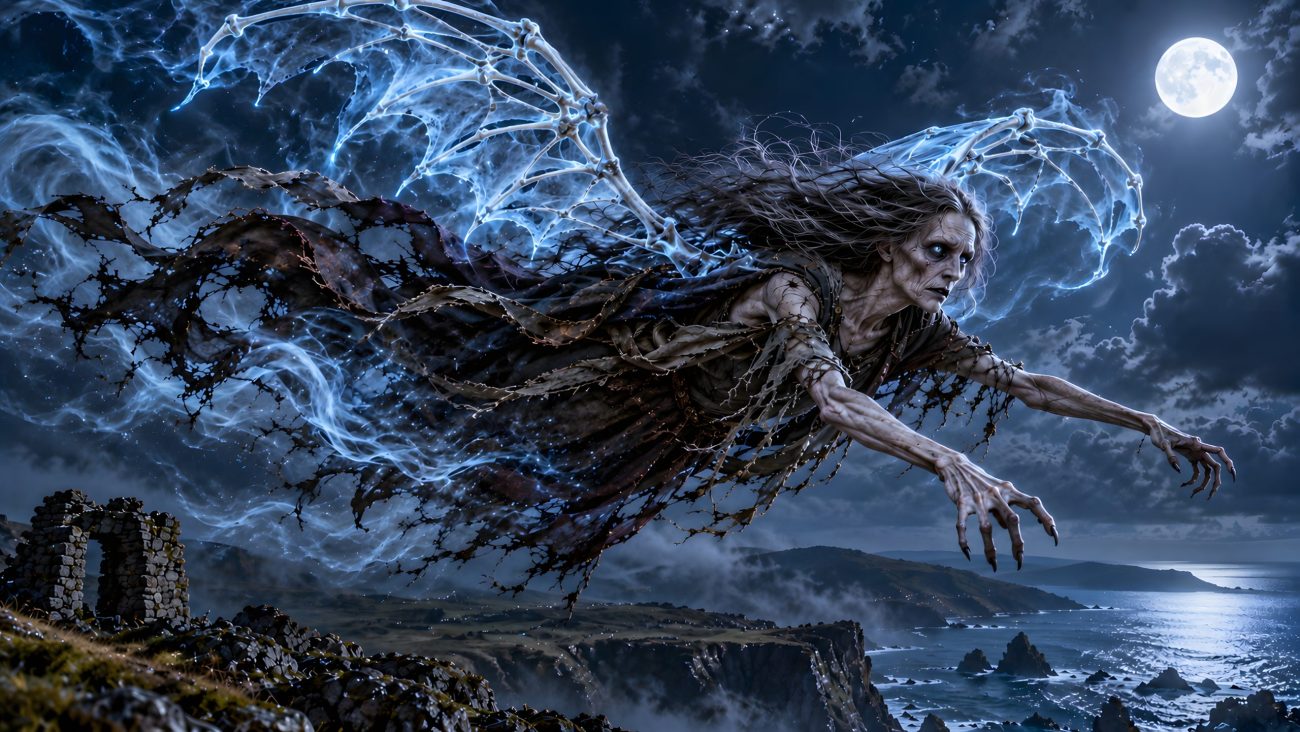
The Sluagh, or Sluagh na Marbh, were a supernatural host of the unforgiven dead who traveled through the skies in Irish and Scottish folklore. They were imagined as the souls of the dead flying together through the air, often forming a crescent-shaped mass resembling a great flock of birds. Their appearance was especially associated with the Western Isles of Scotland, where the gathering of the dead around Halloween was also understood as a gathering of the fairy host.

The Sluagh were capable of descending upon a person from any direction and carrying them away through the air. They could transport their victims enormous distances, flying from one island to another, and were generally feared as dangerous beings to mortals. Yet their nature was not entirely hostile: some traditions remembered the Sluagh rescuing people who had become trapped in dangerous clefts among the rocks. Their ability to appear suddenly from the sky and carry humans away made them an especially terrifying presence in the remote landscapes of the Scottish islands.

The Sluagh were therefore imagined as an airborne supernatural army, neither entirely belonging to the world of the living nor completely separated from the fairy realm. Their name means a “host,” “army,” or “crowd,” fitting their appearance as a great collective of spirits rather than a single creature. As the Sluagh na Marbh, the “host of the dead,” they represented the restless or unforgiven dead moving together through the night sky, particularly during the supernatural season surrounding Halloween.


Sources

“Sluagh.” Wikipedia: The Free Encyclopedia. Wikimedia Foundation. Accessed October 5, 2026.
https://en.wikipedia.org/wiki/Sluagh
Ly Erg

Tradition: Scottish Mythology
Alternative Names: Ly-erg
Category: Fairy


The Myth

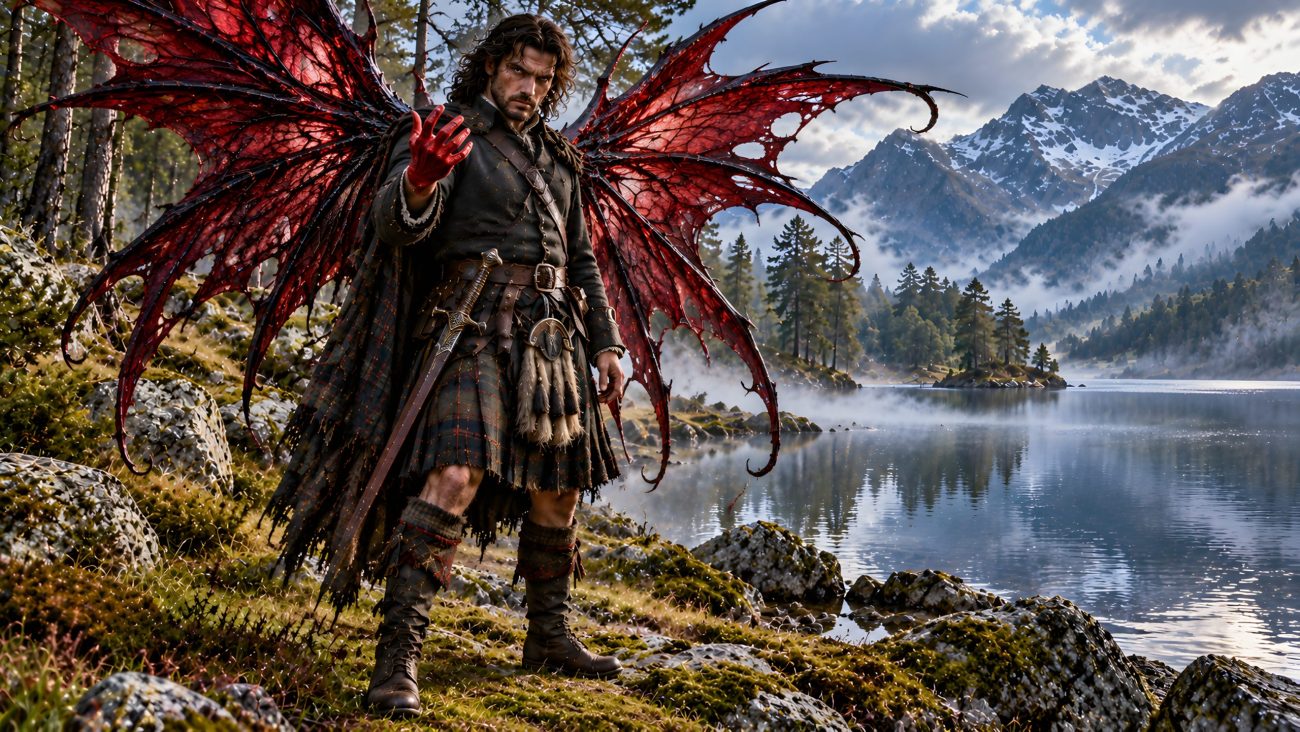
The Ly Erg is a dangerous fairy of Scottish folklore, particularly associated with the Glenmore Forest. It appears dressed as a soldier and can scarcely be distinguished from an ordinary human warrior, except for its right hand, which is permanently red as though stained with the blood of its victims. While wandering through the countryside, the Ly Erg approaches bodies of water and waits for travelers to pass.

When someone comes near, the creature raises its red right hand and challenges them to single combat. The challenge is impossible to survive: anyone who accepts and fights the Ly Erg will die within a fortnight, regardless of whether they defeat the fairy or are defeated themselves. The red hand is therefore a warning of the fate awaiting anyone who accepts its challenge.

One tale tells of three brothers who encountered the Ly Erg and chose to fight it. All three engaged the supernatural warrior in combat, and each died immediately after the encounter. The Ly Erg consequently became a terrifying figure of the Scottish wilderness, appearing like an ordinary soldier until its blood-red hand reveals the supernatural danger behind its challenge.


Sources

“Ly Erg.” Wikipedia: The Free Encyclopedia. Wikimedia Foundation. Accessed October 5, 2026.
https://en.wikipedia.org/wiki/Ly_Erg


Spaewife

Tradition: Scottish Mythology
Alternative Names: Spaewife, Spae-wife, Spey-wife
Category: Fairy


The Myth

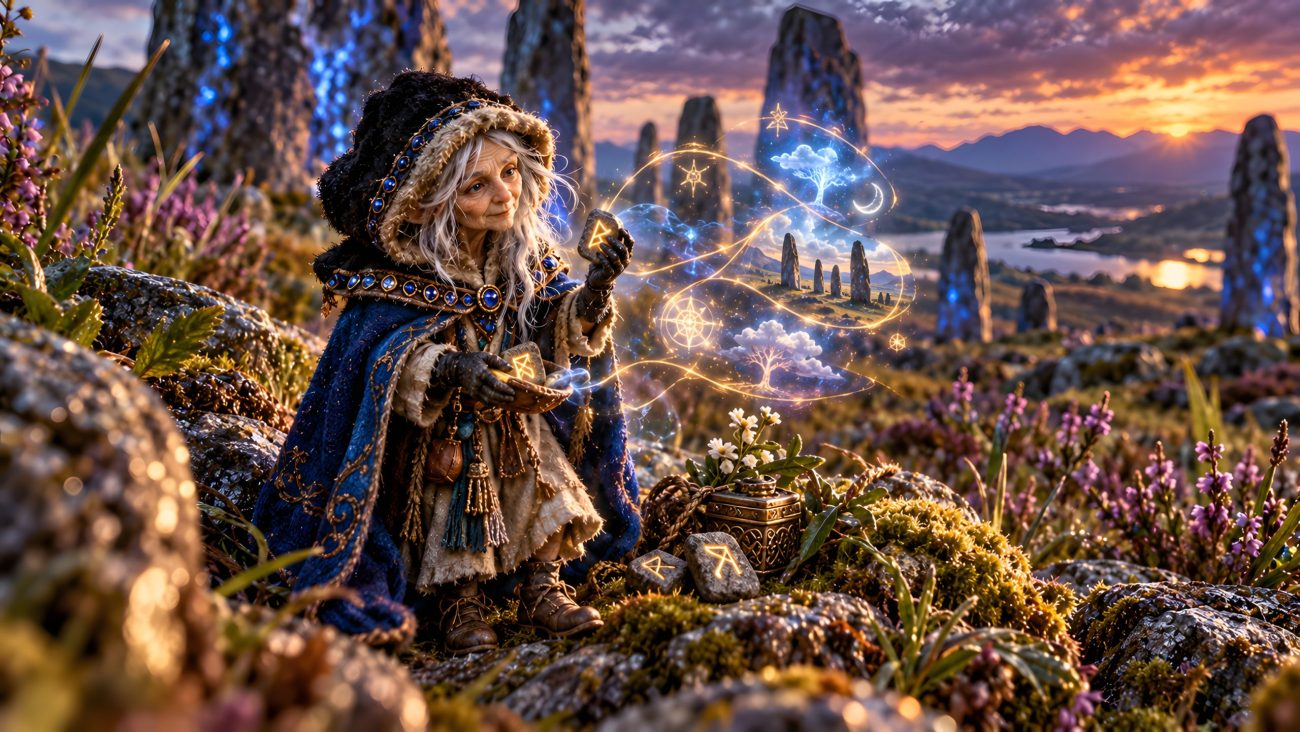
The fairy Spaewives were tiny supernatural women, no taller than a human finger, who were said to possess the gift of prophecy. They usually dressed like ordinary peasant women, but when properly summoned their appearance became magnificent. Their humble clothing was transformed into a blue cloak with a gem-lined collar, a black lambskin hood lined with catskin, calfskin boots, and catskin gloves. They were also skilled healers and could perceive the future through runes, tea leaves, and signs revealed by natural phenomena.

The Spaewives were believed to descend from the supernatural beings who erected the ancient standing stones. Their prophetic abilities therefore belonged to an old and mysterious tradition connected with the landscape and its ancient monuments. Like human fortune-tellers who bore the same name, they could reveal what was yet to come, but their supernatural nature made their knowledge and healing abilities part of the hidden fairy world.

The name Spaewife was also used for human female fortune-tellers in Scots, but the fairy Spaewife was a distinct little supernatural being. She combined the roles of seer and healer with the mysterious powers of an elf, appearing as an insignificant peasant woman until called upon to reveal her true magical nature.


Sources

“Spey-wife.” Wikipedia: The Free Encyclopedia. Wikimedia Foundation. Accessed October 5, 2026. https://en.wikipedia.org/wiki/Spey-wife


Ghillie Dhu

Tradition: Scottish Mythology
Alternative Names: Gille Dubh
Category: Fairy


The Myth

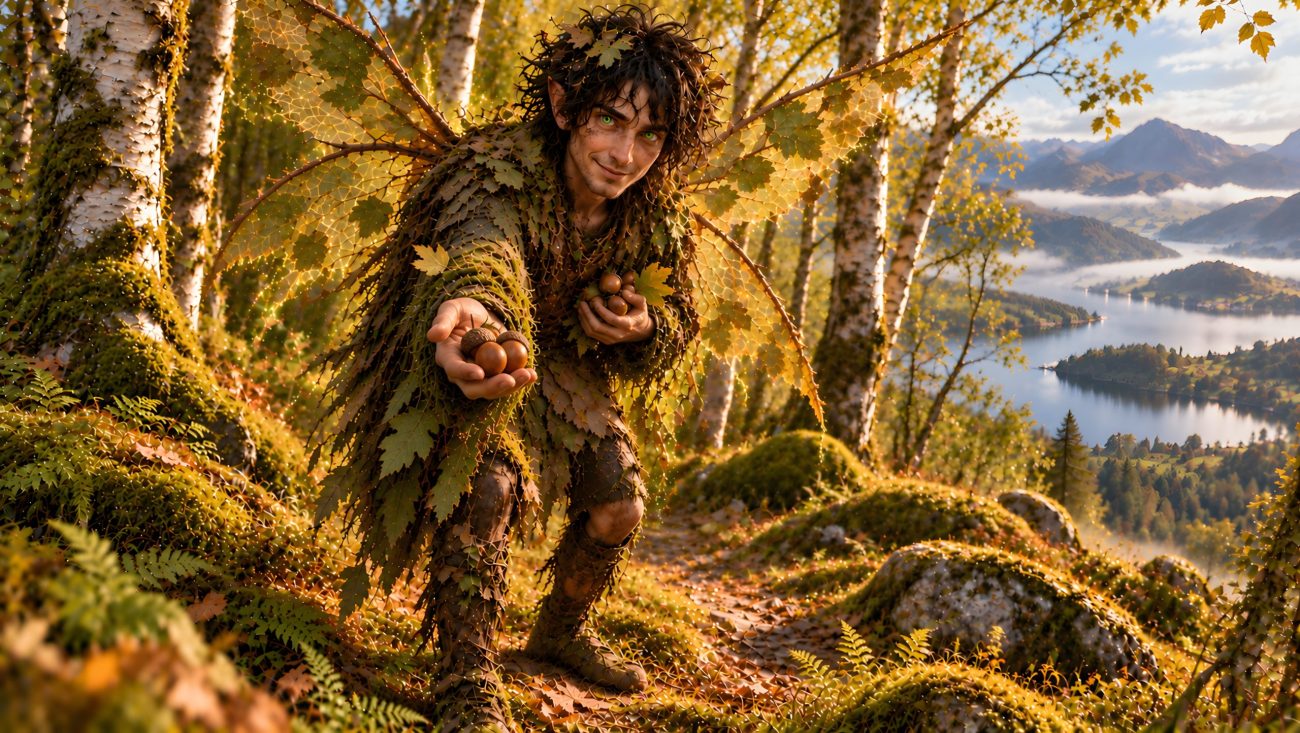
The Ghillie Dhu was a solitary male fairy who lived in a birch wood near Loch an Draing in the north-west Highlands around Gairloch. He was a small, dark-haired and disheveled figure, with black hair and a wild appearance. Rather than wearing ordinary clothing, he covered himself in leaves and green moss taken from the surrounding trees, making him almost indistinguishable from the forest. Although timid and sometimes wild, he was generally regarded as a gentle and kind-hearted nature spirit who fiercely protected his woodland home from outsiders. He was particularly fond of children and was known to treat them with remarkable kindness.

The best-known encounter involved a girl named Jessie Macrae, who wandered into the birch woods and became lost as the sun went down. Her frightened sobs attracted the Ghillie Dhu, who came to comfort her. He either guided her safely home before darkness fell or remained with her through the night and brought her back the following morning. Over the following decades, many people reportedly saw the strange fairy in the woods, but Jessie was the only person known to have spoken with him.

Eventually, Sir Hector Mackenzie of Gairloch decided that the Ghillie Dhu was a threat and organized a hunt to capture him. Five Mackenzie dignitaries searched the woods throughout the night, but despite their efforts they could not find him. After that unsuccessful hunt, the Ghillie Dhu was reportedly never seen again. His story remained that of a solitary forest fairy who lived among the birches, feared outsiders but showed gentleness toward those who were vulnerable, especially children.


Sources

“Ghillie Dhu.” Wikipedia: The Free Encyclopedia. Wikimedia Foundation. Accessed October 5, 2026.
https://en.wikipedia.org/wiki/Ghillie_Dhu


Seelie

Tradition: Scottish Mythology
Alternative Names: Seely, Seelie Wights, Seilie Wichts, Seelie Court
Category: Fairy


The Myth

The Seelie were a host of fairy beings in Scottish folklore, associated with good fortune, blessing, and happiness. They could appear as supernatural nature spirits or as groups of fairies gathering together in courts and troupes. Despite their favourable name, the Seelie were not entirely benevolent. They could help humans who treated them well, warn people who accidentally offended them, and repay kindness with supernatural favours, but they could also become mischievous or seek revenge when insulted. Their name itself could therefore serve as a protective expression, describing them as “blessed” or “good” in the hope of avoiding their anger.

The Seelie Court was regarded as the gathering of the more friendly and less malicious fairies. Its members might approach humans for assistance, reward those who helped them, or intervene on behalf of people they favoured. Their goodwill, however, was conditional. A person who offended a Seelie being could expect punishment or retaliation, even though the creature belonged to the supposedly benevolent court. The Seelie therefore occupied an uncertain position between kindness and danger: they were capable of generosity and friendship, but demanded that humans respect them and their customs.

The Seelie stood in contrast to the darker fairy beings associated with the Unseelie Court, whose members were described as more hostile and capable of attacking humans without provocation. Scottish ballads preserve both sides of the Seelie tradition. In “Allison Gross,” the Seelie Court appears as a benevolent supernatural power, while a fragmentary version of “Tam Lin” presents them in a more threatening light. Thus, the Seelie were not simply “good fairies,” but a supernatural community whose favour could bring help and fortune while whose displeasure could bring mischief and punishment.


Sources

“Yallery Brown.” Wikipedia: The Free Encyclopedia. Wikimedia Foundation. Accessed October 4, 2026. https://en.wikipedia.org/wiki/Yallery_Brown


Bruni

Tradition: Scottish Mythology
Alternative Names: Broonie, Broonie
Category: Fairy


The Myth

Bruni is a type of brownie from the Lowlands of Scotland. The creature belongs to the tradition of small supernatural household beings known for their association with human homes and domestic life.

The name Bruni is given as a variant spelling of Broonie, the original form of the name for this Lowland Scottish brownie. A traditional rhyme associated with the creature warns of its arrival: “Ha! Ha! Ha! Bruni will take you!” Beyond this brief reference, the surviving source provides no further details about Bruni’s appearance, behavior, or particular legends.


Sources

“Bruni.” New Bestiary (Bestiary.us). Accessed October 4, 2026. https://www.bestiary.us/bruni