Key Maiden

Tradition: Swiss Mythology
Alternative Names: The White Virgin of Tegerfelden, The Enchanted Maiden of Tegerfelden Castle
Category: Ghost


The Myth

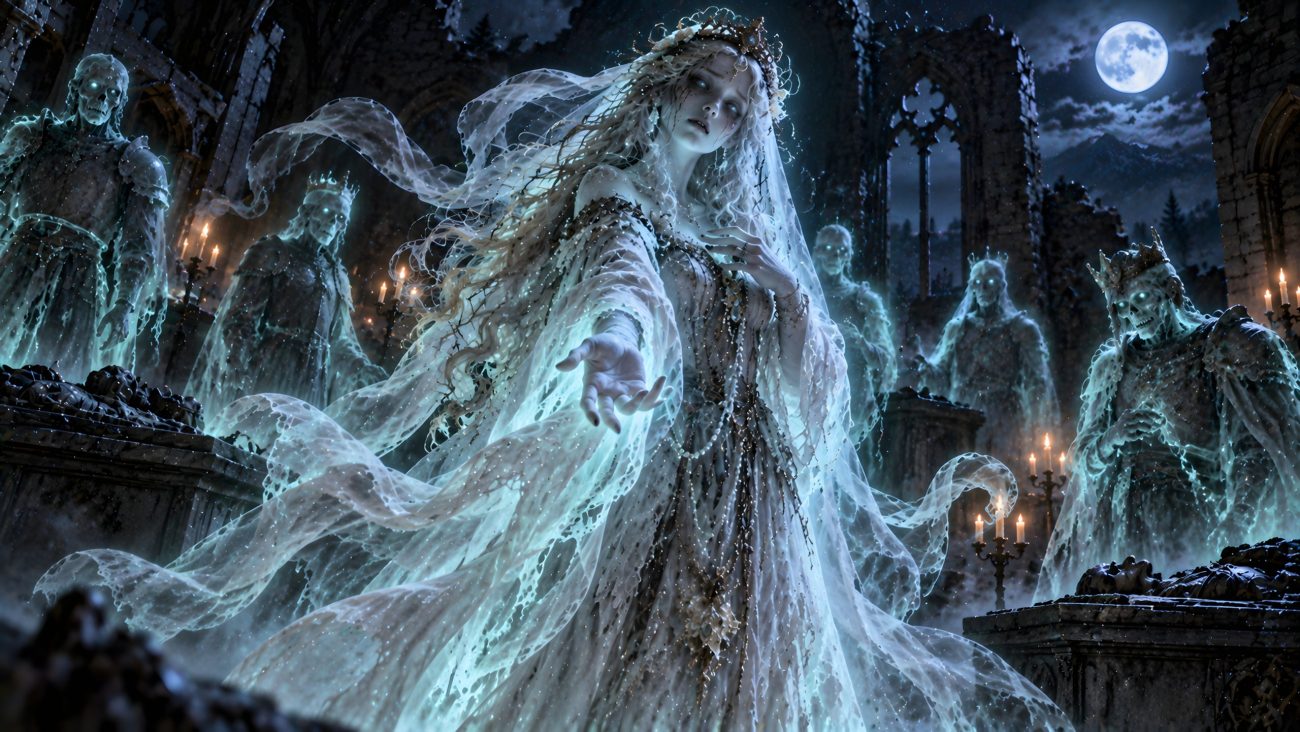
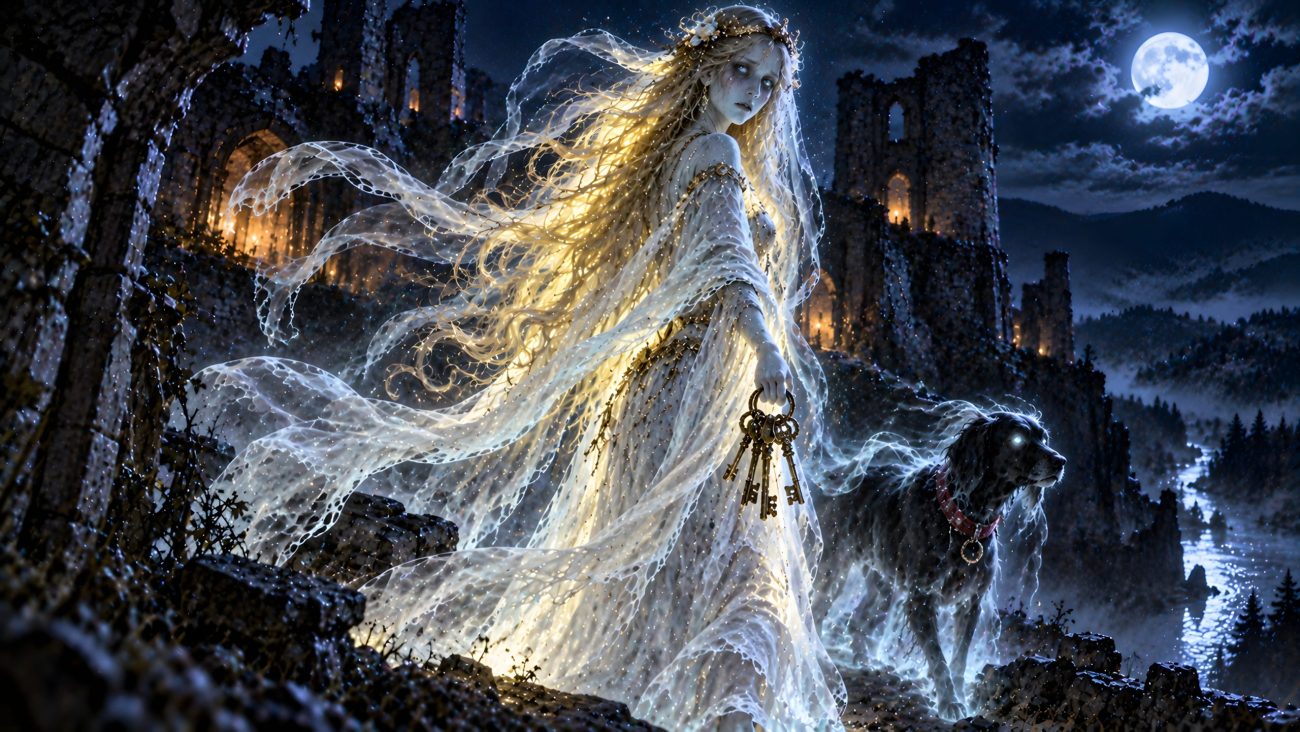
The Key Maiden is the ghost of a beautiful noblewoman who haunts the ruins of Tegerfelden Castle in the canton of Aargau, Switzerland. She appears as a pale maiden dressed in flowing white garments, with long, radiant golden hair and a jingling bunch of keys at her belt. She is often accompanied by a small black dog wearing a red collar and can be seen wandering around the ruined castle walls, collecting water from the Surb River, or performing strange rituals beneath the moonlight. Although she sometimes appears in broad daylight, her presence is surrounded by melancholy and enchantment. She remains trapped by a curse connected to her pride, the deaths of her rejected suitors, and the fate of the children who sleep in the underground halls beneath the castle.

One evening, a shepherd boy sees a small light approaching from the castle. It gradually transforms into the white-clad maiden, whose golden hair shines like a lock of sunlight. She fills a small jug with water from the Surb and sings a sorrowful song. When she pauses beside the bush where the shepherd is hiding, she seems to expect him to speak to her, but he is too frightened to respond. She sadly disappears into the castle moat. The shepherd later sees her repeatedly circling the ruins, followed by her black dog, and hears the keys in her hand ringing like silver bells. On another occasion, a poor farmer fishing beside the Surb finds a luminous golden lock floating toward him. After he foolishly throws it back into the water, the maiden appears and begs him to retrieve it. He obeys, and she ties one of its hairs to his fishing line, promising him good fortune in exchange for saying the Lord’s Prayer for her every week. His catch becomes extraordinarily abundant, and he grows wealthy. However, he eventually abandons his religious obligation and wastes his fortune. The black dog then emerges from the water and bites through the golden hair on his fishing line, ending his good luck. The farmer loses his wealth, descends into madness, and is eventually found dead in the river.

The maiden’s curse can supposedly be broken only by a Sunday-born child, who must be raised in a cradle made from a tree cut down on Good Friday and dried for a year. A woodturner who attempts to cut such a tree is given three trials by the maiden. She leads him through underground halls where ancient warriors sleep, followed by young men and women, and finally children guarded by a gigantic snake and an enormous, poisonous-looking toad. He succeeds in kissing the black dog and the maiden herself, but recoils in horror from the toad. This failure causes the maiden’s white dress to turn black, and the woodturner is cast out of the castle, his hair and beard turned white. He subsequently goes mad, calling for the maiden every day, but never sees her again.

Another attempt at redemption comes from a poor miller’s apprentice born on a Sunday. After being mocked at a New Year’s dance, he visits the castle and asks the maiden to dance with him. She accompanies him to the village, where they perform three dances before an admiring crowd. He then follows her into the underground halls, where she explains the origins of her curse. In life, her pride and vanity led her to reject many suitors by demanding that they ride three times around the castle’s dangerous cliffs. All who attempted the feat fell to their deaths, until one low-ranking knight succeeded. However, the maiden’s mother secretly poisoned the potion intended to seal their engagement, causing the knight to fall asleep before she had him thrown from the cliffs. Overcome by despair when she learned of his death, the maiden leapt to her own death as well. She was condemned to guard the victims of her arrogance. The apprentice must kiss the dog, kiss the maiden, and collect hairs from the sleeping youths and old warriors before midnight so that the enchantment can be lifted. He courageously performs the tasks but fails to escape before the gates close at twelve. The gates remain shut forever, and he is eventually found dead in a mill.

The maiden appears one final time to a traveler near the Surb River. He witnesses her riding a snow-white stag around the castle nineteen times before returning to the riverbank to comb her golden hair with a golden comb. She sings that another hundred years must pass before her hair reaches the ground, at which point she will finally find peace and ascend to heaven. The traveler watches in silent wonder, too enchanted to speak or help her. Only after she disappears does he realize that he may have missed his chance to redeem her and claim her magical treasures, including her golden comb, glittering headband, and silver fife. The Key Maiden therefore remains bound to the castle, awaiting the fulfillment of the conditions that will finally release her from her centuries of sorrow.


Sources

“Die Schlüsseljungfrau.” SAGEN.at – Schweizer Sagen. Reproduced by SAGEN.at. https://www.sagen.at/texte/sagen/schweiz/allgemein/schluesseljungfrau.html
Night Dance at Schallberg

Tradition: Swiss Mythology
Alternative Names: The Ghost Dance of Schallberg
Category: Ghost


The Myth

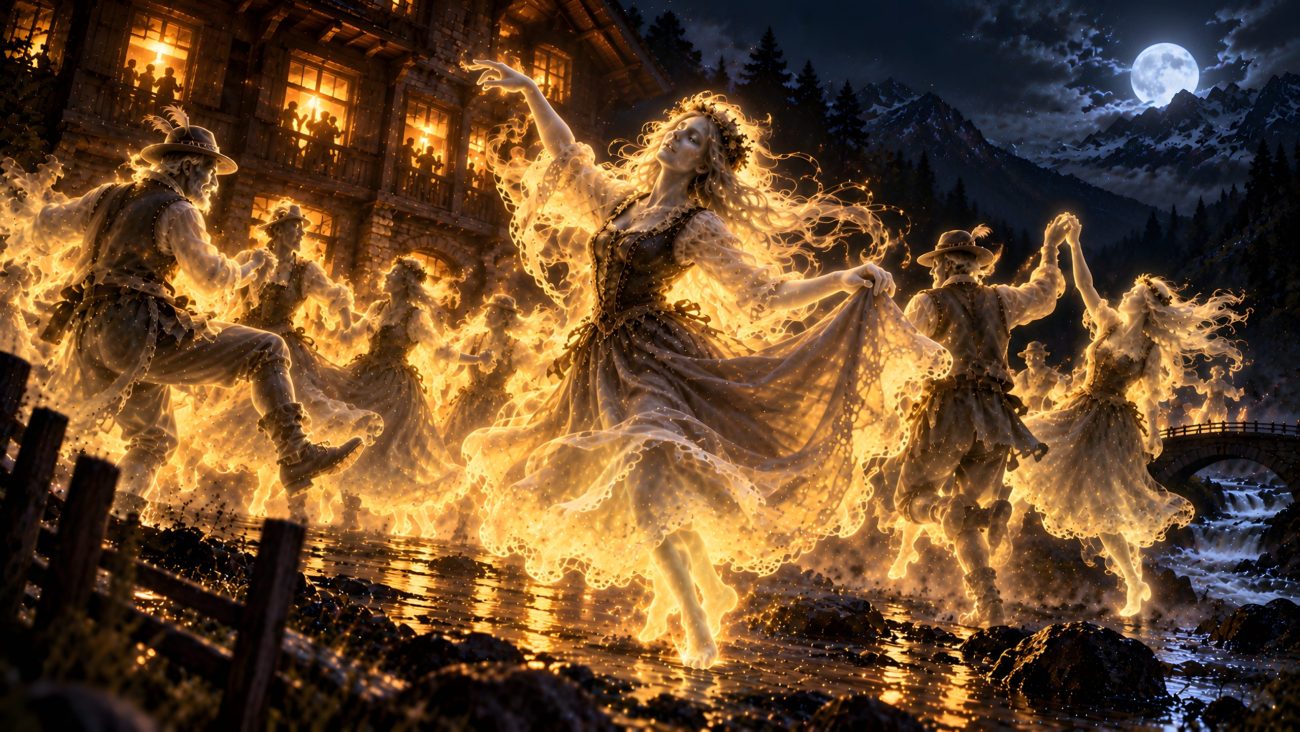
The Night Dance at Schallberg is a supernatural legend from the Valais region of Switzerland, set near the lower Schallberg in the Ganter Valley. At night, an isolated house appears brightly illuminated, filled with deafening dance music, the pounding of mountain boots, and the joyous cries of numerous dancers. Yet the gathering behaves in a disturbing and unnatural manner: whenever an observer climbs a nearby tree to watch, the lights and music abruptly disappear, leaving only the rushing waters of the Saltina River. As soon as the observer climbs down, the mysterious dance begins again. The dancers are eventually revealed to be an enchanted company condemned to atone for secret dances held in defiance of the rules.

One night, a shepherd returning from the Alpine pastures follows an old mule track through the Ganter Valley. After passing through an eerie fir forest, he notices the illuminated windows of a secluded house at Schallberg. Hearing the lively music and heavy stamping inside, he suspects that young people have gathered for a forbidden dance. Curious but unwilling to enter, he climbs into a nearby elder tree to watch. The moment he settles among the branches, the music stops and the lights go out. When he climbs down, however, the house immediately becomes illuminated again, and the dancing resumes. He repeats the experiment, only to witness the same strange disappearance. Eventually, fear overwhelms him, and he flees into the night.

Despite his terror, the shepherd later grows curious about the dancers’ identities. He waits near the Chin Bridge until the morning bell approaches, when he hears music and excited cries coming from the direction of the Aspe. A procession of dancers advances toward him, their sounds growing louder as they approach. In the moonlight, their pale, aged faces seem strangely familiar, as though they belong to young people he once knew, yet he cannot recognize anyone. Just as he prepares to join the seemingly cheerful company, the entire procession suddenly plunges into the Chin River and disappears into the raging Saltina, like a fiery sack of leaves. Horrified, the shepherd escapes the region, convinced that he has witnessed an enchanted group of dancers condemned to make amends for their forbidden revelry.


Sources

“Der Nachttanz am Schallberg.” SAGEN.at – Schweizer Sagen. Reproduced by SAGEN.at. https://www.sagen.at/texte/sagen/schweiz/allgemein/nachttanz_schallberg.html


Saanenland Ghosts

Tradition: Swiss Mythology
Alternative Names: Friesenweg, The Path of the Dead Frisians
Category: Ghost


The Myth

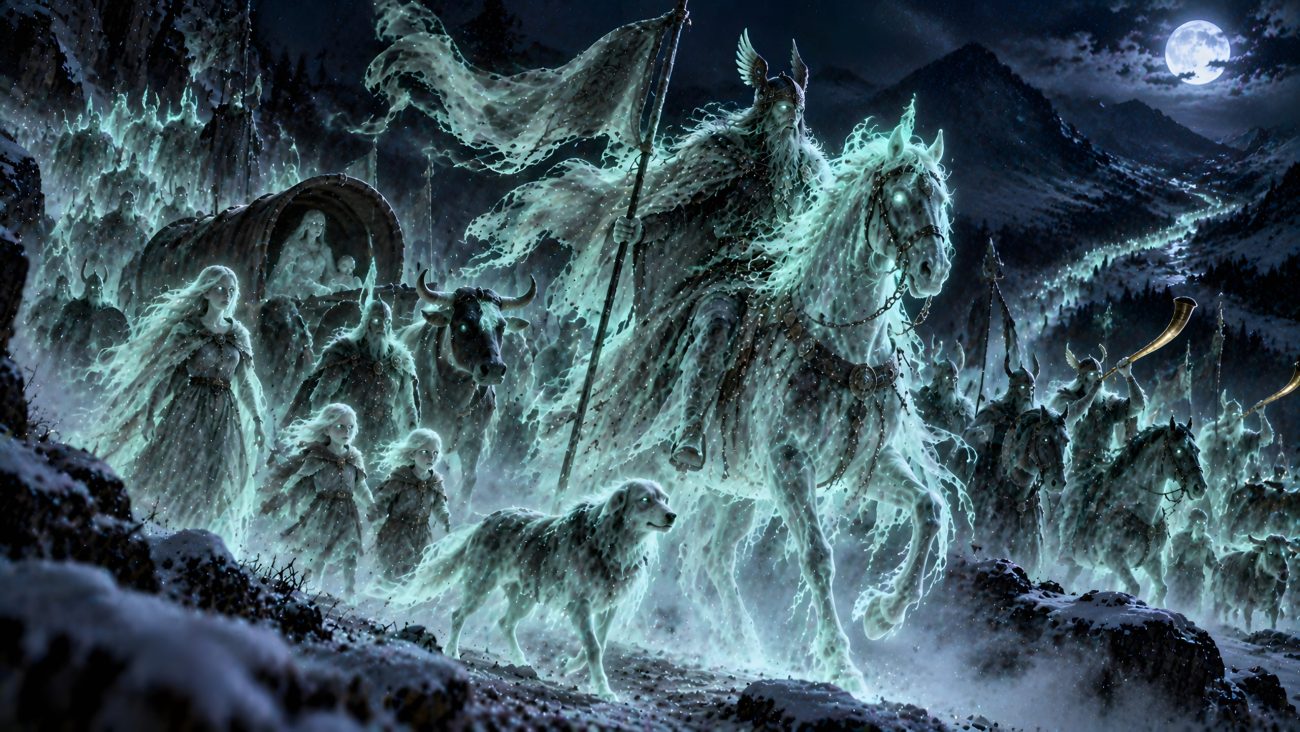
The Frisian Way is a haunted trail in the Saanenland of the Bernese Oberland in Switzerland, where the spirits of an ancient Frisian people travel through the night on their way back to their former homeland beside the North Sea. Their passage is accompanied by thunderous roaring, crashing, howling, ringing bells, and the blaring of horns. The dead are said to rise from their graves on certain nights, particularly around the winter solstice, gathering into an immense procession of warriors, horsemen, women, children, and animals. Although the spirits follow their traditional route without deviating, anyone who obstructs their way risks provoking their terrible wrath.

According to legend, the Frisians originally came to the Saanenland after famine and floods drove them from their homeland by the sea. They settled in the green Alpine valleys, cultivated the pastures, and drove wild animals into the surrounding forests. Nevertheless, they never forgot the distant shores from which they had come. On certain nights, they rise from their burial mounds and retrace their ancient route toward the North Sea. When they hear the roaring and crashing of the sea, they return to their graves in the Swiss mountains. Anyone or anything standing in their path may be swept aside as violently as if an avalanche were descending upon it.

The danger of obstructing the procession became clear when a cattle barn was built directly across the Frisian Way on an Alpine pasture. Fortunately, its two doors stood exactly where the path entered and exited the building, allowing the dead to pass through unhindered. The herdsman always left both doors open at night and suffered no harm. Before leaving to visit his family in the valley, he warned his head farmhand never to close the doors. The farmhands, however, mocked this precaution and deliberately barred the passage.

That night, a distant murmur awakened them, growing into a tremendous roar accompanied by the sounds of horns, neighing horses, barking dogs, cracking whips, and clashing weapons. A thunderous impact shook the barn, and a voice demanded that the doors be opened because the Frisian people wished to pass through. When the farmhands refused to move, the entire roof was lifted into the air, exposing the terrified men to the starry sky before crashing back into place. Realizing the danger, the head farmhand finally called upon God and opened both doors.

An extraordinary procession immediately swept through the barn. Towering men greeted the farmhand courteously before an immense army of warriors rushed past, clad in fluttering bullskins and carrying spears, battle-axes, swords, and enormous shields. Their horns projected menacingly above their fair hair. Horsemen in winged helmets followed on snorting steeds, accompanied by foot soldiers, enormous carts carrying golden-haired women and children, nimble boys, and shaggy dogs. More warriors and horses continued to pass in an apparently endless stream. The procession lasted until dawn illuminated the snow-covered mountain peaks. The farmhand returned to the hayloft, trembling with fear, and recounted everything he had witnessed. After telling his story, he never spoke again and died by evening.


Sources

“Der Friesenweg.” SAGEN.at – Schweizer Sagen. Reproduced by SAGEN.at. https://www.sagen.at/texte/sagen/schweiz/allgemein/friesenweg.html


Ruchenberg Castle Knight

Tradition: Swiss Mythology
Alternative Names: The Golden Skittles of Ruchenberg
Category: Ghost


The Myth

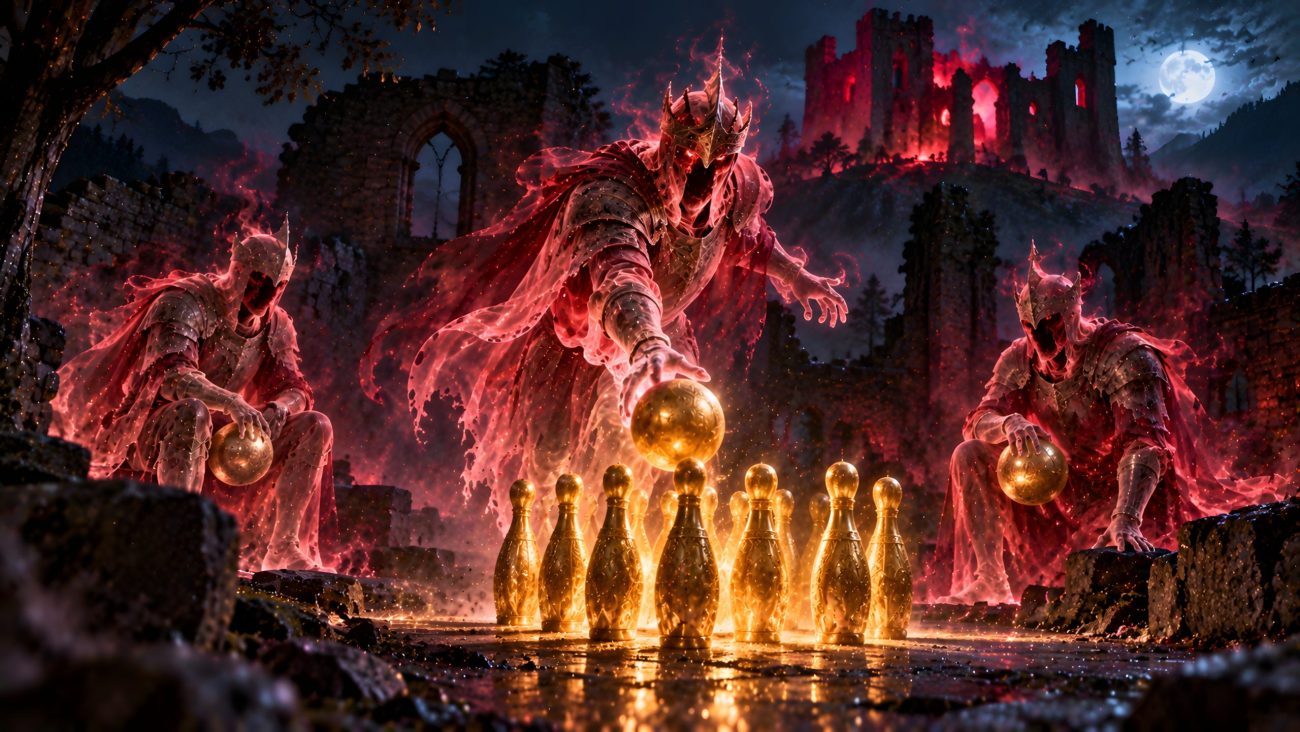
The Golden Bowling Game is a supernatural legend associated with the ruined Castle Ruchenberg in the canton of Graubünden, Switzerland. The castle is said to have been haunted since ancient times. On certain nights, its ruins glow with a brilliant red light, while strange flashes illuminate the surrounding trees and bushes. Ghostly figures move among the crumbling walls, accompanied by the clanging and crashing of iron. At the center of this eerie spectacle, three knights in clanking iron armor play a mysterious game of skittles with a set of nine golden pins and golden bowling balls.

One night, a farmer passing the ruins hears the strange noises and notices the red glow. Curiosity overcomes his unease, and he approaches the castle to investigate. From the shelter of a large tree, he watches the three knights repeatedly attempt to knock down all nine golden pins. Although they throw their golden balls with great force, they never manage to topple every pin. The farmer, who prides himself on his own bowling skill, becomes increasingly frustrated by their inability to complete the game. When the knights eventually grow tired and lie down as though asleep, he decides to demonstrate that he can do better. He also hopes to steal one of their precious golden balls.

The farmer quietly takes a ball, carefully aims, and launches it down the bowling lane. With a tremendous crash, all nine golden pins tumble over. Delighted, he cries out, “All nine!” A ghostly echo repeats his words from the castle. Immediately, the knights shout, and a tremendous commotion erupts around the ruins. Thunder crashes, and the knights, golden balls, and skittles sink into the earth. The brilliant light disappears, leaving the farmer alone in the dark woods. Once his fear subsides, he hurries away, but for the rest of his life he regrets having spoken aloud. He believes that, had he kept silent, he might have freed the knights from their supernatural imprisonment and claimed the magnificent golden bowling set.


Sources

“Das goldene Kegelspiel.” SAGEN.at – Schweizer Sagen. Reproduced by SAGEN.at. https://www.sagen.at/texte/sagen/schweiz/allgemein/goldene_kegelspiel.html


Dead Bride

Tradition: Swiss Mythology
Alternative Names: The Bride of Windegg Castle, Berta von Windegg
Category: Ghost


The Myth

Berta von Windegg is the ghostly bride of Windegg Castle in the Glarus region of Switzerland. She appears as a beautiful, pale maiden with curly hair and an enigmatic silence. Although she wears the appearance of a living noblewoman, her hands are ice-cold, and her true nature becomes apparent when she leads a prospective bridegroom into the castle chapel, where the tombs of her dead ancestors awaken. Berta is the last of her noble line and remains trapped in the ruined castle, waiting for someone who can finally redeem her.

One night, a poor knight named Kunz von Stein arrives at Windegg Castle seeking shelter. Despite its ruined exterior, he discovers an illuminated ballroom filled with splendid decorations, fine food, and wine. There he meets Berta, who silently welcomes him to the table. She answers his questions only by nodding, but Kunz learns that she is unmarried and appears to possess the entire estate. Hoping to gain both a wealthy wife and a noble inheritance, he declares his love and asks her to marry him. Berta agrees, places a golden ring on his finger, and accepts the ring he gives her in return. Although her icy hands make him shudder, Kunz suppresses his unease and follows her through dark corridors into the castle chapel.

Inside, the knight witnesses a terrifying spectacle. Berta approaches the tombs of her ancestors and touches the stone effigies lying upon them. One after another, the figures rise from their sarcophagi, their armor rattling and their garments rustling as they gather around the altar. An aged priest appears and asks Kunz whether he will take Berta von Windegg, the last of her line, as his wife. Paralyzed by terror, Kunz cannot answer. As the priest prepares to bless the couple, a rooster crows nearby. Berta cries out that she has not yet been redeemed, and the assembled knights and noblewomen immediately return to their tombs, becoming stone once more.

A sudden gust of wind carries Kunz out of the castle, where he collapses beside his horse. When he awakens, Windegg has become nothing more than an empty, crumbling ruin in the morning light. Unable to forget Berta or the bride he had failed to save, Kunz renounces worldly life and enters a monastery, placing his golden betrothal ring on the altar. He eventually dies at a very old age, but Berta remains at Windegg Castle, still waiting for the savior who will release her from her ghostly existence.


Sources

“Die tote Braut.” SAGEN.at – Schweizer Sagen. Reproduced by SAGEN.at. https://www.sagen.at/texte/sagen/schweiz/allgemein/tote_braut.html


Bloody Mary

Tradition: American Mythology
Alternative Names: Hell Mary, Mary Worth
Category: Ghost


The Myth

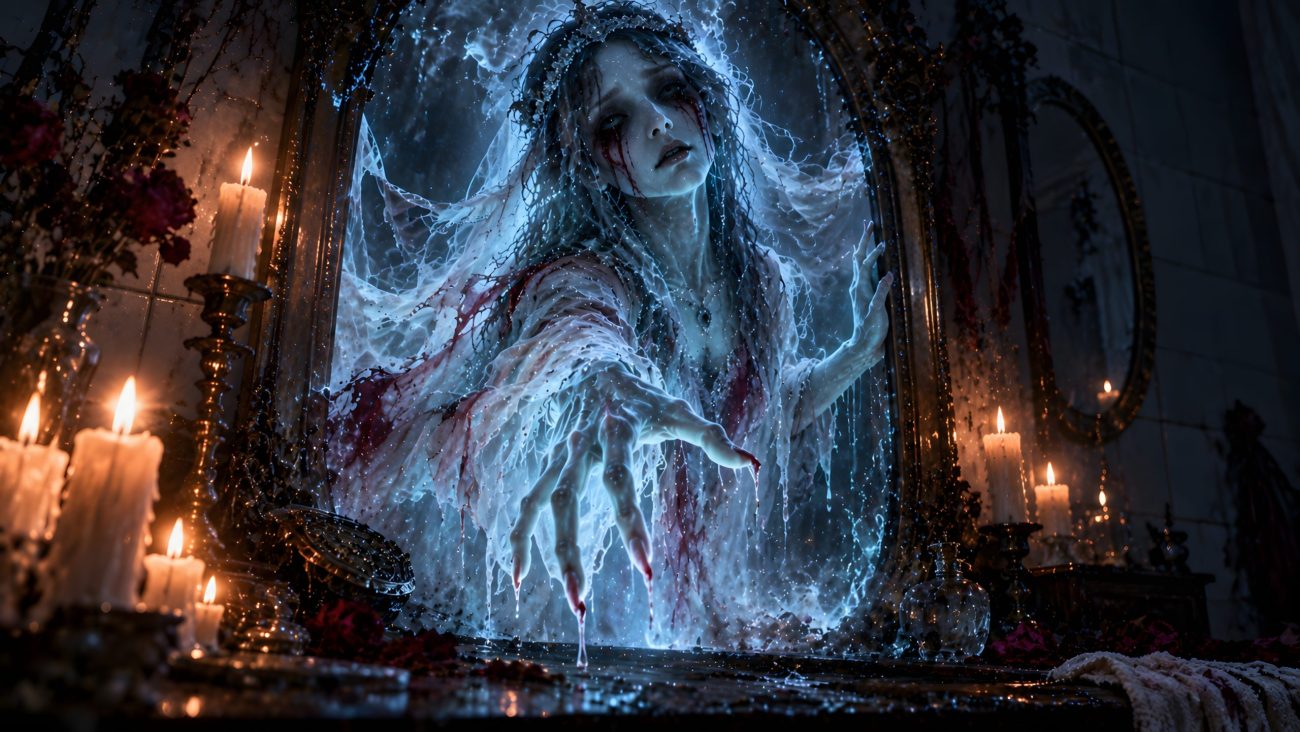
Bloody Mary is a ghostly apparition, witch, or supernatural spirit said to appear in a mirror when her name is repeatedly chanted in a ritual. She is best known through a frightening game played by groups of young people, who summon her in a dimly lit room, often using a bathroom mirror and candles. Depending on the version of the legend, Bloody Mary may be a malevolent spirit, a terrifying witch, or a more benevolent apparition capable of revealing glimpses of the future. Her appearance varies between stories, but she is sometimes described as a corpse-like figure or a ghost covered in blood, from which her name derives.

The legend has connections to older mirror-divination customs practiced by young women seeking knowledge of their future husbands. In one traditional ritual, a woman walked backward up a flight of stairs in a darkened house while holding a candle and a hand mirror. Looking into the mirror, she might see the face of the man she would eventually marry. However, if she saw a skull or the face of the Grim Reaper instead, it was taken as a sign that she would die before marriage. These practices associated mirrors with the mysterious boundary between the present and the future, allowing supernatural visions to reveal a person’s fate.

The modern Bloody Mary ritual became established as a group-participation game during the late twentieth century. Participants stand before a mirror in a darkened or candle-lit room and repeatedly chant her name, commonly three times, although some versions prescribe different numbers, including forty-seven repetitions. When she appears, Bloody Mary may scream, curse, or attack those who summoned her. More terrifying versions claim that she can strangle participants, drink their blood, steal their souls, or scratch out their eyes. Other accounts portray her as a demonic spirit or a corpse emerging from the mirror. The precise ritual and the apparition’s behavior differ between tellings, but the central fear remains the same: by speaking her name before a mirror, ordinary people risk inviting a dangerous supernatural presence into their world.


Sources

“Bloody Mary (folklore).” Wikipedia: The Free Encyclopedia. Wikimedia Foundation. Accessed October 16, 2026. https://en.wikipedia.org/wiki/Bloody_Mary_(folklore)


Song Gaksi

Tradition: Korean Mythology
Alternative Names: Song Gaksi, Cheonyeo Gwis​in, Cheonyeogwis​in, Cheonyeo gwisin (처녀귀신), Malmyeong, Cheonyeo, Song Gaksi (송각시), Song Gaksi Ghost
Category: Ghost


The Myth

Song Gaksi, also known as Cheonyeo Gwis​in, is one of the most famous ghosts in Korean folklore. She is the spirit of a young woman who died before marriage, often after being abandoned by her lover or suffering the grief of an unfulfilled romance. In some accounts, she takes her own life after being rejected. The name Cheonyeo Gwis​in literally means “virgin ghost,” reflecting the belief that a woman who dies unmarried may become a restless spirit burdened by the life and marriage she never experienced. Song Gaksi is a type of wongwi, a Korean vengeful spirit associated with resentment and an untimely or unjust death.

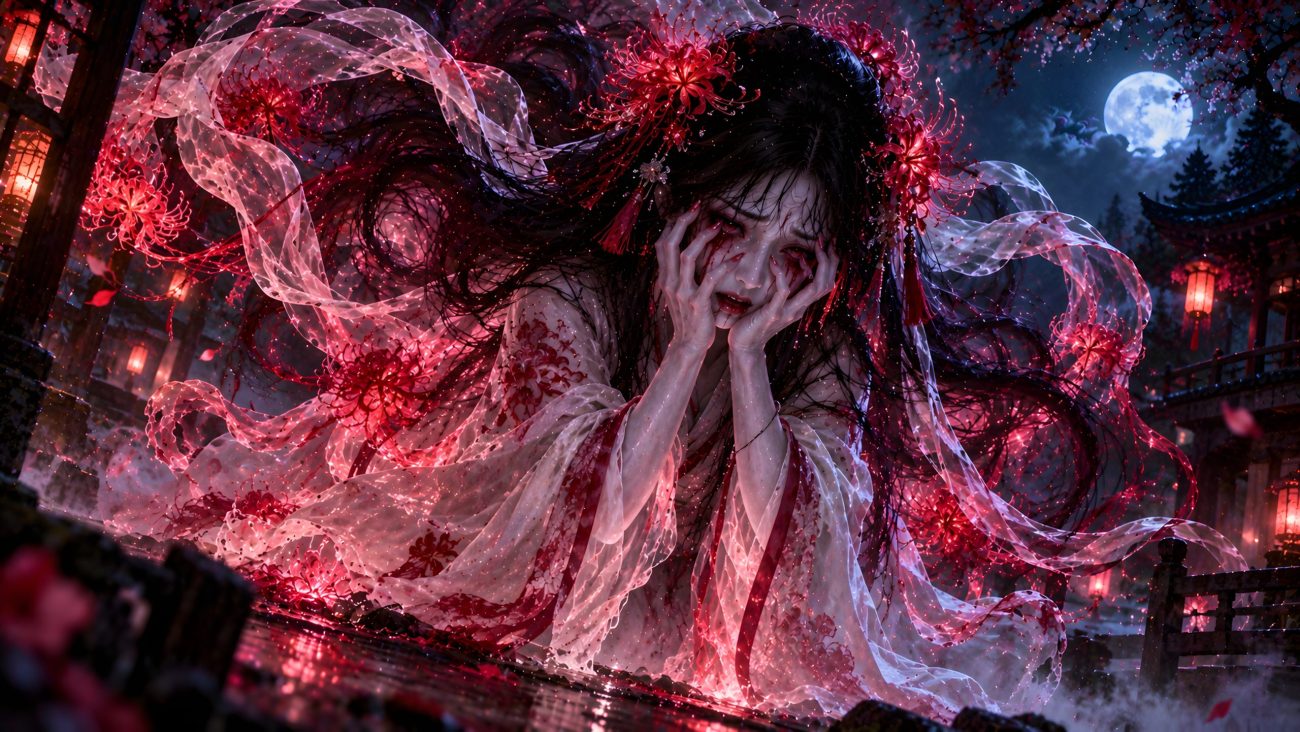
Song Gaksi is commonly depicted as a young woman with long, disheveled black hair, dressed in a white traditional Korean funeral garment. Her face is pale, with dark circles beneath her eyes and bloody streaks running from the corners of her mouth. Some depictions show traces of blood or present her as an almost indistinguishable human figure. She is often associated with abandoned buildings, hospitals, schools, bathhouses, cemeteries, and dark roads or forests. According to tradition, she may appear during the darkest hours of the night, from midnight until dawn, and is believed to bring illness or misfortune. Her presence may be accompanied by a sudden change in temperature or wind direction, and she can appear in dreams as well as in waking life.

Stories of Song Gaksi appear in Korean folklore, including tales associated with the historical figures Sin Rip and Aran. In one account, Sin Rip saves a young woman from ghosts near the Munyeong-jae mountain pass. She asks to accompany him, but he refuses, and she takes her own life shortly before his eyes. Later, when Sin Rip faces danger during a military campaign, her ghost appears to him in a dream and advises him to go to Thangmyondae. He follows her advice but is ultimately killed. Another tale tells of a newly appointed mayor of Miryang who dies at the hands of a ghost on his first night in office. When the ghost appears to a brave new official, it explains its grievance, allowing the official to identify and punish the criminal responsible. In this story, revealing the truth behind the ghost’s suffering brings peace to her soul.


Sources

“Son Gaksi.” New Bestiary (Bestiary.us). https://www.bestiary.us/son-gaksi


Dungarvon Whooper

Tradition: Canadian Mythology
Alternative Names: The Whooper, Ghost of the Dungarvon River, Ryan Garvon
Category: Ghost, Cat


The Myth

The Dungarvon Whooper is a terrifying ghost associated with the Dungarvon River in central New Brunswick, Canada. It is said to be the spirit of a young cook who was murdered in a lumber camp during the nineteenth century. In many versions of the legend, the victim was an Irishman named Ryan or Ryan Garvon, who had emigrated to Canada during the period of Irish migration following the Great Famine. Some tellings add that he had a sick mother whom he hoped to support. Although the ghost is usually invisible, certain accounts describe it as a wildcat- or puma-like creature capable of knocking down small trees with its powerful movements.

According to the best-known version of the story, the young cook was left alone at a lumber camp with the camp’s boss while the other lumberjacks were away. The boss allegedly murdered him and stole the money kept in his money belt. When the crew returned, they discovered the cook’s lifeless body, and the missing money aroused suspicions of foul play. The boss claimed that the young man had suddenly fallen ill and died before anything could be done. Because heavy snowfall made it impossible to transport the body to a distant graveyard, the lumberjacks buried him in the forest. That night, the camp was filled with terrifying whoops and screams. Believing the place to be haunted, the frightened men resolved to abandon it before dawn.

The ghost’s cries continued to haunt the woods around the young man’s grave, terrifying even the bravest lumberjacks. The supernatural sounds were interpreted as the murdered cook’s spirit protesting the injustice of his death and seeking peace. In some versions, a Roman Catholic priest named Edward Murdoch arrived from Renous and performed an exorcism at the supposed gravesite near Whooper Spring. In Michael Whelan’s celebrated 1912 song, a priest’s prayers finally quiet the haunting, allowing the region to return to peace. The story became a lasting part of New Brunswick’s lumbering folklore, passed down among woodsmen throughout the twentieth century. Although the legend’s precise origins remain uncertain, its central themes are the murder of an innocent worker, the guilt of the perpetrator, and the restless dead demanding justice before they can find peace.


Sources

“Dungarvon Whooper.” Wikipedia: The Free Encyclopedia. Wikimedia Foundation. Accessed October 16, 2026. https://en.wikipedia.org/wiki/Dungarvon_Whooper


Queen Esther’s Ghost

Tradition: Haudenosaunee, American Mythology
Alternative Names: Queen Esther, Esther Montour, The Weeping Maiden of Queen Esther’s Pond
Category: Ghost


The Myth

Queen Esther’s Ghost is a haunting figure associated with the legend of Esther Montour, a Haudenosaunee leader who lived in colonial Pennsylvania during the eighteenth century. According to local tradition, Esther’s village stood near the present-day communities of Sayre, Athens, and Waverly, and was home to hundreds of people. Her story became connected to the violence of the American Revolutionary War and the destruction of her community. Although historical accounts of the events differ, local legend remembers Queen Esther as a tragic figure whose death and the killing of her people left a lasting supernatural curse upon the land.

According to the legend, Queen Esther sought revenge after her son was killed during a violent confrontation with a drunken settler. A raid followed in September 1778, during which Arthur van Rossum and his wife Janna were reportedly killed and scalped. In response, a military expedition led by Colonel Thomas Hartley advanced up the Susquehanna River toward Tioga Point. After fierce fighting, the Haudenosaunee warriors were defeated, and Queen Esther attempted to escape into the surrounding forests with the women and children of her village. The widely repeated version of the story claims that Hartley’s men captured the fleeing villagers and brought them to a nearby pond, where the women and children were executed. Their bodies were thrown into the water, denying them the proper burial rites practiced by their people. Queen Esther was allegedly lynched from an oak tree, dismembered, and thrown into the pond alongside the other victims.

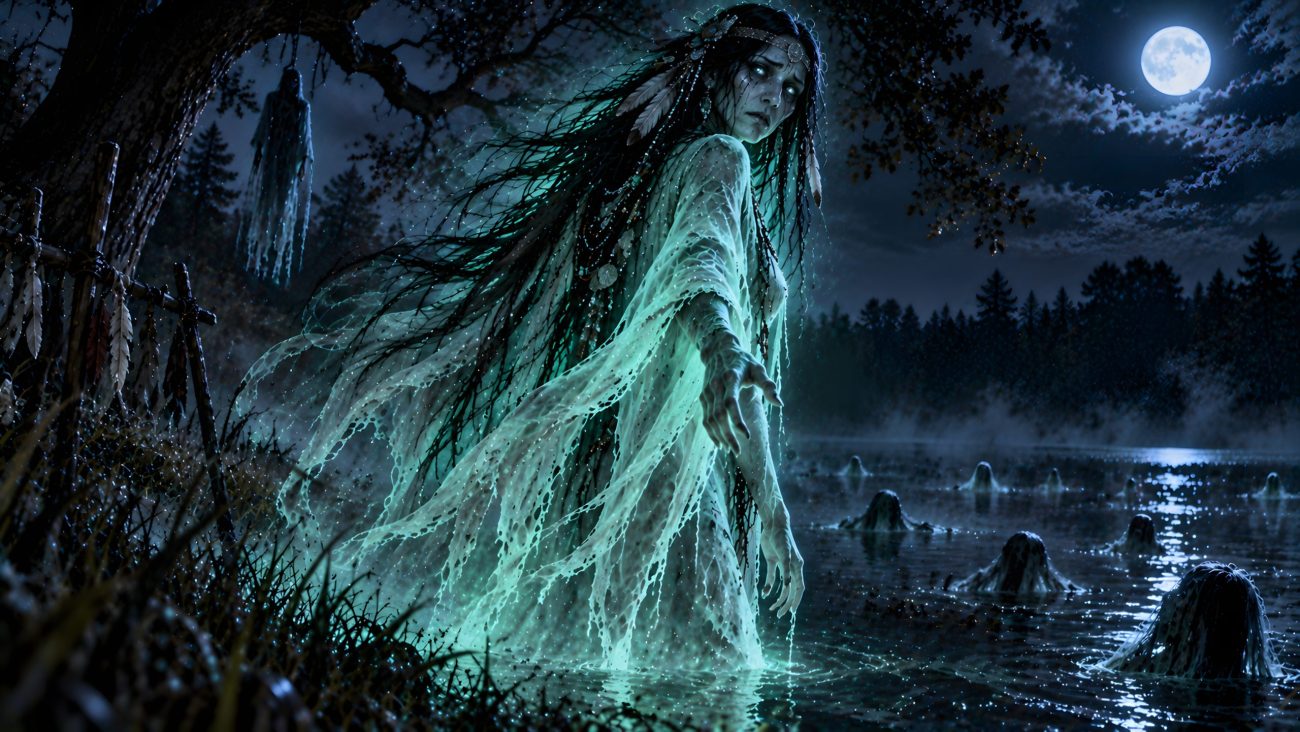
The legend of Queen Esther’s curse claims that, before her death, she pronounced a curse upon white settlers who would later occupy the land. During the early nineteenth century, residents of the surrounding community reportedly began hearing unexplained screams from the nearby forests, believed to be the cries of the massacred villagers. Hunters have also told stories of encountering a young girl weeping as she hangs from the branches of an oak tree. When they approach her, the apparition suddenly vanishes, leaving no trace behind. Some hunters believe that their weapons subsequently fail to fire unless carefully checked, interpreting these malfunctions as the spirit’s attempt to prevent further deaths. The haunting remains part of local legend, linking the landscape to memories of violence, dispossession, and the restless spirits of those who died there.


Sources

“Ghost of Queen Esther.” Wikipedia: The Free Encyclopedia. Wikimedia Foundation. Accessed October 16, 2026. https://en.wikipedia.org/wiki/Ghost_of_Queen_Esther


Fear Gorta

Tradition: Irish Mythology
Alternative Names: Fear Gortach, Man of Hunger, Man of Famine
Category: Ghost


The Myth

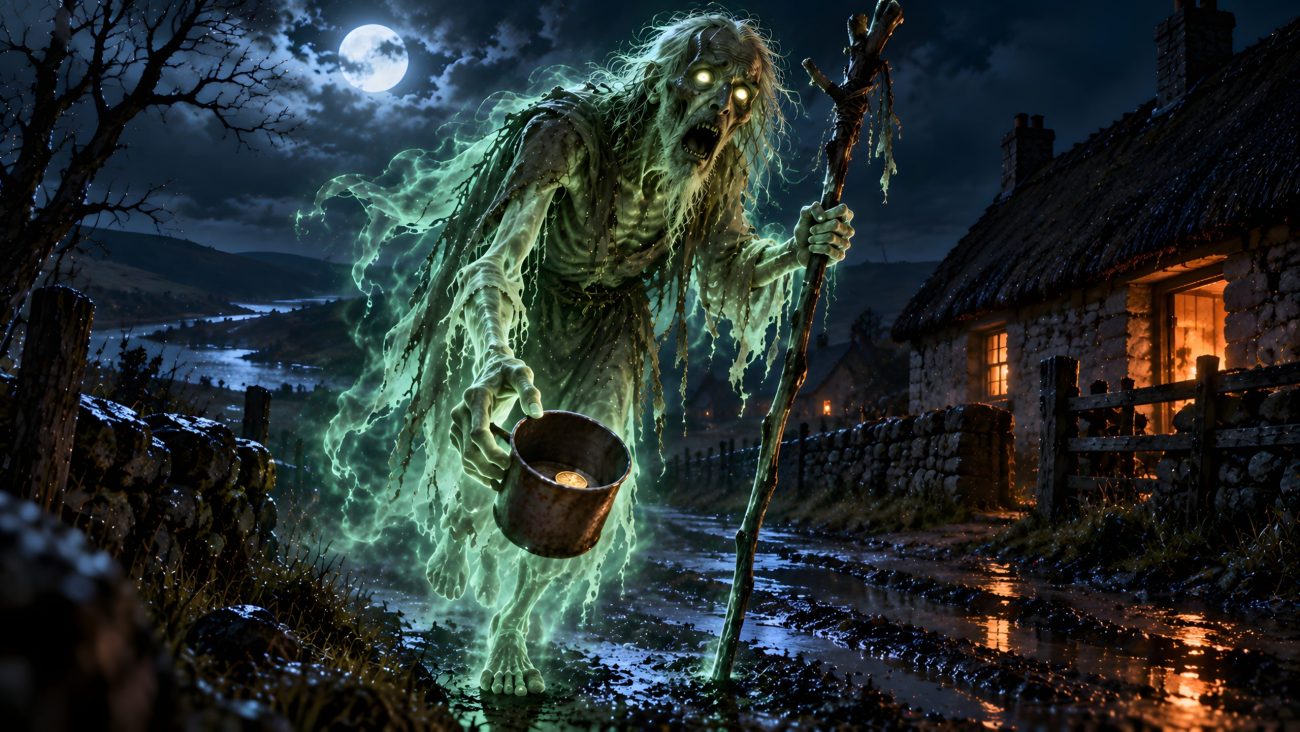
The Fear Gorta, whose name means “Man of Hunger” or “Man of Famine” in Irish, is a phantom that resembles an emaciated human being. He wanders the roads during times of famine, seeking food from those he encounters. His appearance is gaunt and starving, and he carries a long staff and a tin cup containing a single coin. He rattles the coin inside the cup to announce his presence as he approaches travelers and houses, asking for food from anyone who crosses his path.

Those who encounter the Fear Gorta are expected to offer him something to eat. If he approaches a house, its inhabitants should leave a scrap of food on the doorstep. Travelers who meet him on the road must likewise provide an offering. Those who refuse risk misfortune or even death, while those who show generosity receive blessings and good fortune. The phantom thus embodies both the terror of starvation and the moral importance of helping the hungry, making compassion a matter of survival as well as virtue.

One account describes the Fear Gorta as a harbinger of famine who emerges from a patch of hungry grass, known in Irish as Féar Gortach. In the region of Kiltubbrid, the term is also associated with a sudden, overwhelming hunger that can strike people traveling through the mountains. If this hunger is not quickly satisfied, it can prove fatal. The precise origins of the Fear Gorta are uncertain, although the familiar version of the figure is believed to have developed during or shortly after the Great Irish Famine of 1845–1852. The offerings made to him also resemble offerings associated with the Tuatha Dé Danann, suggesting that the figure may preserve elements of older supernatural traditions.


Sources

“Fear Gorta.” Wikipedia: The Free Encyclopedia. Wikimedia Foundation. Accessed October 16, 2026. https://en.wikipedia.org/wiki/Fear_gorta