Bannhölzler

Tradition: Swiss Mythology
Alternative Names: Bannhölzler of Walchwil, The Ghost of Bannhölzlerfluh, The Skittle Warden
Category: Ghost


The Myth

The Bannhölzler is a malevolent ghost associated with the common land of Walchwil, near Lake Zug, Switzerland. His legend begins with a dispute over grazing rights. A wealthy woman from Lucerne had bequeathed four thousand guilders to her godchild in Walchwil, allowing the village to acquire its common land. As the community was still small, residents of Zug were permitted to graze their cattle there. Over time, they turned this temporary permission into a claimed right, leading to repeated legal disputes. After the people of Zug lost twice, a cunning citizen devised a deceitful plan to win a third lawsuit. Before entering the court, he placed soil from Zug inside his boots and hid a comb and ladle beneath his hat. When the judge called him to swear an oath, he declared that he stood on Zug soil, misleading the court into ruling against Walchwil. On his journey home, the false witness suffered an accident. People said that the devil had wrung his neck, and from that moment he was condemned to haunt the common land and wreak havoc at Bannhölzlerfluh.

The Bannhölzler was said to haunt a split sandstone rock near the lower Roßberg, where foul-smelling water seeped from the stone. A man from Entlebuch supposedly banished the spirit there. Three springs had once flowed from the cliff: the middle one ran red and became the Bannhölzler’s prison, while his dog was confined to the left spring, which carried blue water. The spirit was bound to the common land and could not leave his domain unless summoned. Mischievous boys sometimes called him to the boundary before fleeing, but the ghost could move with extraordinary speed. When a goatherd challenged him to catch him, the Bannhölzler pursued the boy beneath a hedge and snatched a wooden shoe from his foot. He was also said to lure hikers with beautiful flowers before throwing them over the cliff to their deaths.

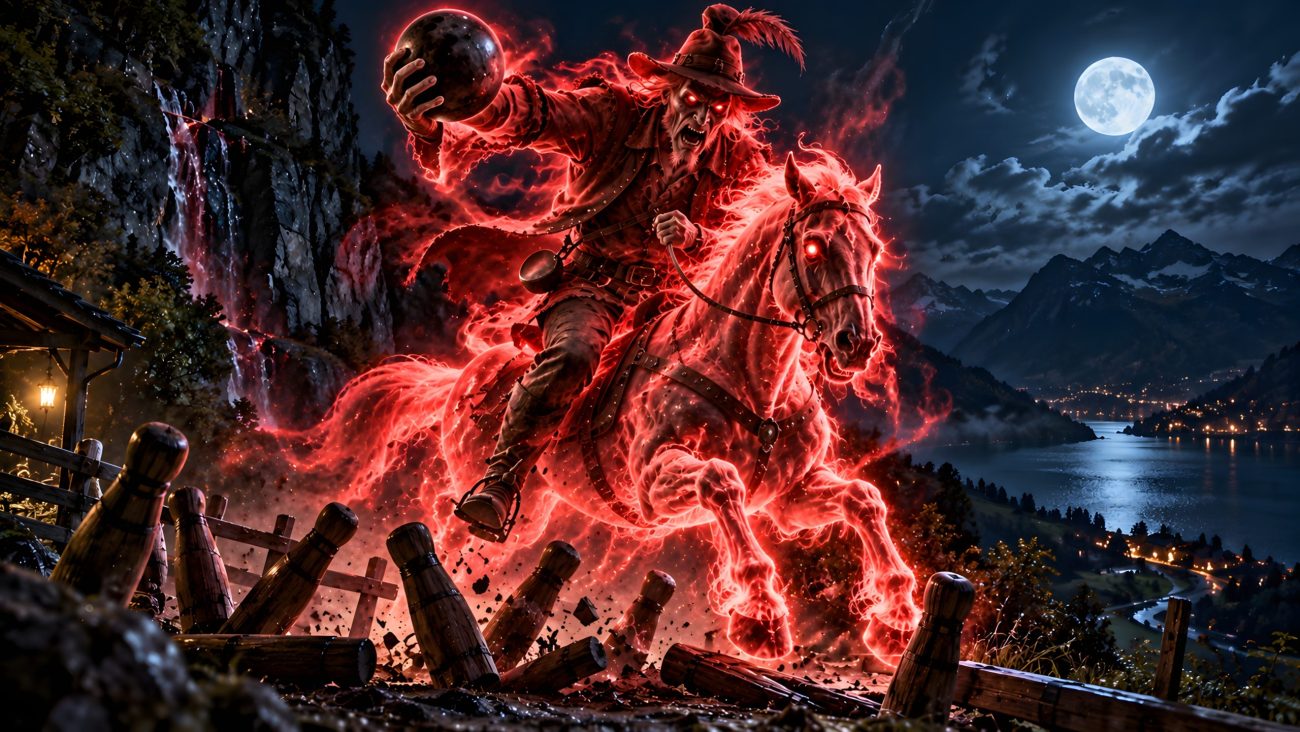
The ghost’s appearances could be violent and destructive. Once, while children played skittles beside a farmhouse on Walchwilerberg, a bowler deliberately threw the ball beyond the target and called for the Bannhölzler to retrieve it. The spirit appeared instantly, terrifying the children. As one girl tried to escape beneath a boundary fence, he tore the two ribboned braids from her head. He then seized the bowling ball and hurled it at the house with such force that it passed straight through the building. In another tale, a frustrated player called upon the skittle warden for help after suffering repeated bad luck. The Bannhölzler arrived roaring on a white horse, leapt down, seized the ball, and knocked down the entire bowling alley with a single powerful throw. The ball flew all the way to the Kaiserstock, where it struck the rock with a tremendous crash.

The Bannhölzler’s presence was also associated with guilt and false judgment. An old traveller named Gutsch-Chasper once witnessed a court session on the common land while walking from Ägeri to Walchwil. When he saw the bailiff committing perjury again, his hat would not remain on his head and his hair stood on end with terror. Eventually, after repeated destructive appearances, the Bannhölzler was banished to Mount Pilatus. He was forbidden to return unless the people of Walchwil summoned him during a major legal dispute. His legend thus connects the supernatural punishment of a dishonest witness with the protection of territorial boundaries and the dangers of invoking a powerful spirit for amusement or personal advantage.


Sources

“Die Bannhölzler.” SAGEN.at – Zuger Sagen. Reproduced by SAGEN.at. https://www.sagen.at/texte/sagen/schweiz/zug/bannhoelzer.html
Spirit of Ägeri

Tradition: Swiss Mythology
Alternative Names: The Ghostly Runner of Ägeri, The Dark Rider of the Ägeri Commons
Category: Ghost


The Myth

The Commons Spirit of Ägeri is the ghost of a runner who fraudulently secured valuable grazing land for the municipality of Ägeri, Switzerland. The dispute arose when the inhabitants of Wollerau, in the canton of Schwyz, claimed that a vast common extending into their district had been dishonestly acquired by Ägeri. According to the legend, the Black Death had killed many of the elderly inhabitants who might otherwise have remembered the ancient boundaries. Unable to settle the matter through witnesses, the communities arranged a race to establish the border. The runner who reached the designated point first would help determine which community gained the disputed land.

On the appointed day, the runner from Wollerau was astonished to find that his rival from Ägeri had covered three times the distance in the same amount of time. The Ägeri runner offered to swear that he stood on his own community’s land, and his solemn oath persuaded the authorities to award the common to Ägeri. A boundary stone was placed in the ground, but the people of Wollerau continued to suspect that fraud had taken place. Their suspicions proved justified after the runner’s death, when his ghost began to haunt the disputed territory.

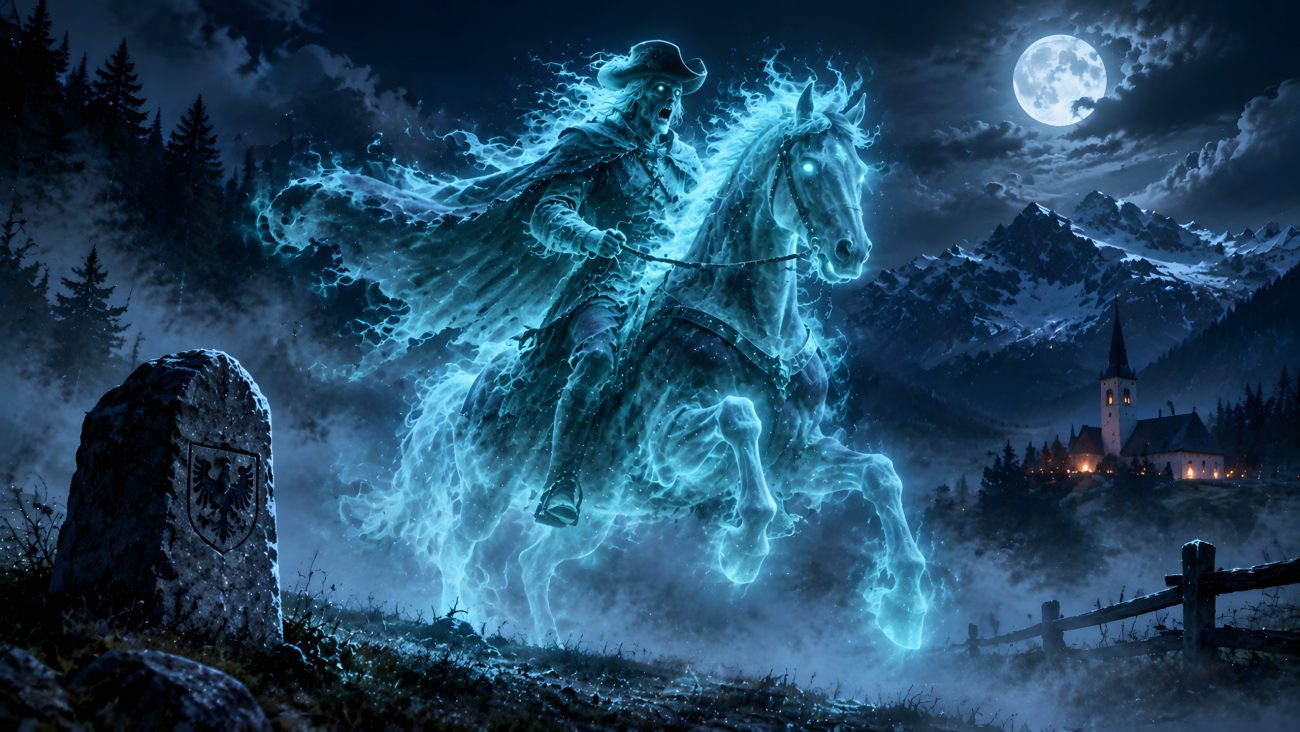
The spirit usually appeared riding a swift white horse. Whenever he approached the boundary, he screamed and howled terribly. Travellers who encountered him at night heard him begging to be released from his torment, although he refused to explain how this could be accomplished. He relentlessly harassed the inhabitants of Ägeri until they sought the help of a spirit exorcist, promising him a substantial reward if he could end the haunting. The exorcist confronted the dark rider and forced him to reveal the truth behind his supernatural punishment.

The runner confessed that he had cheated during the boundary race. He had begun on foot but then mounted a white horse, hiding the animal near the border before dismounting and presenting himself as the winner. He had also deceived the court during his oath: he carried soil from the village street in his shoes and concealed a ladle and a raking comb beneath his hat. These tricks allowed him to swear that he stood on Ägeri’s land while concealing the deception that had secured the territory. His perjury condemned him to wander the commons as a restless spirit.

The spirit exorcist ordered the runner to withdraw to a deserted place. The ghost agreed, but insisted that his fellow countrymen would have to make amends for his wrongdoing. The inhabitants of Ägeri refused to surrender the land, arguing that they had not ordered the runner to cheat. Consequently, the spirit never disappeared completely. He continued to ride across the common from time to time, especially during Lent, lamenting his fate and reminding the living of the injustice that had secured the disputed territory. According to the legend, only people born on a Sunday can see him and hear his mournful cries.


Sources

“Der Allmendgeist.” SAGEN.at – Zuger Sagen. Reproduced by SAGEN.at. https://www.sagen.at/texte/sagen/schweiz/zug/allmendgeist.html


Ghost of Wildenburg

Tradition: Swiss Mythology
Alternative Names: The Bloody Shadow of the Last Wildenburger, The Devil’s Gold of Wildenburg
Category: Ghost


The Myth

Wildenburg Castle was once home to the Wildenburgers, whose plundering brought great treasures to their fortress. When the people of Zug finally destroyed the castle in anger, its riches were buried beneath the collapsing walls and beams. The gold remained hidden among the ruins, attracting treasure hunters who hoped to recover the lost wealth.

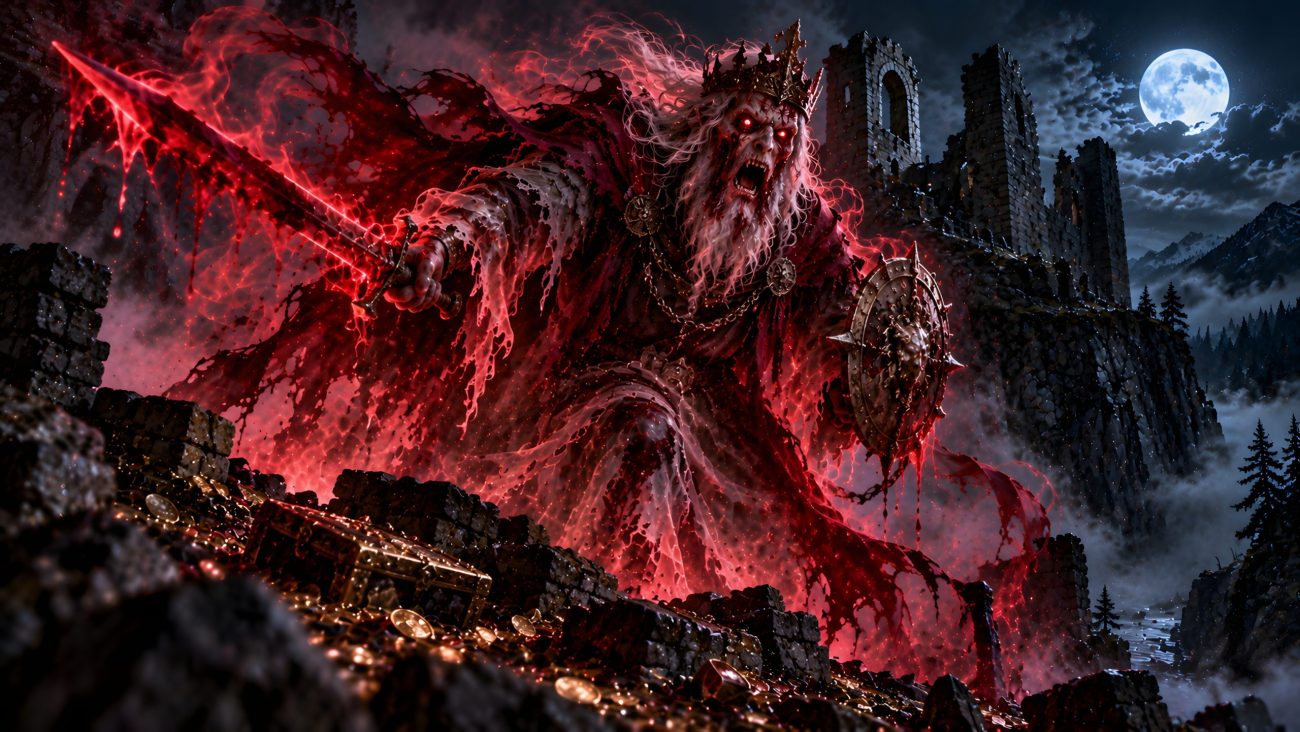
However, those who searched for the treasure faced a terrifying guardian. The bloody shadow of the last Wildenburger was said to haunt the rocky ruins, charging about while howling and throwing greedy treasure seekers down into the dark Lorzentobel ravine. The ghost’s violent attacks ensured that the riches taken by the Wildenburgers remained beyond the reach of those who sought them out of greed.

The devil was also believed to guard the buried gold. According to the legend, every Good Friday, while the Passion was being sung in the church at Baar, the devil spread his gold across the castle rock to bask in the sunlight. Anyone who arrived at the right moment could supposedly take as much gold as they wished. Yet the legend offered no guarantee that those who sought supernatural treasure would escape the dangers surrounding Wildenburg.


Sources

“Der Geist von Wildenburg.” SAGEN.at – Zuger Sagen. Reproduced by SAGEN.at. https://www.sagen.at/texte/sagen/schweiz/zug/geist_wildenburg.html


Giswil Tyrants

Tradition: Swiss Mythology
Alternative Names: The Three Knights of Rudenz, The Ghostly Money Counters of Kleinteil
Category: Ghost


The Myth

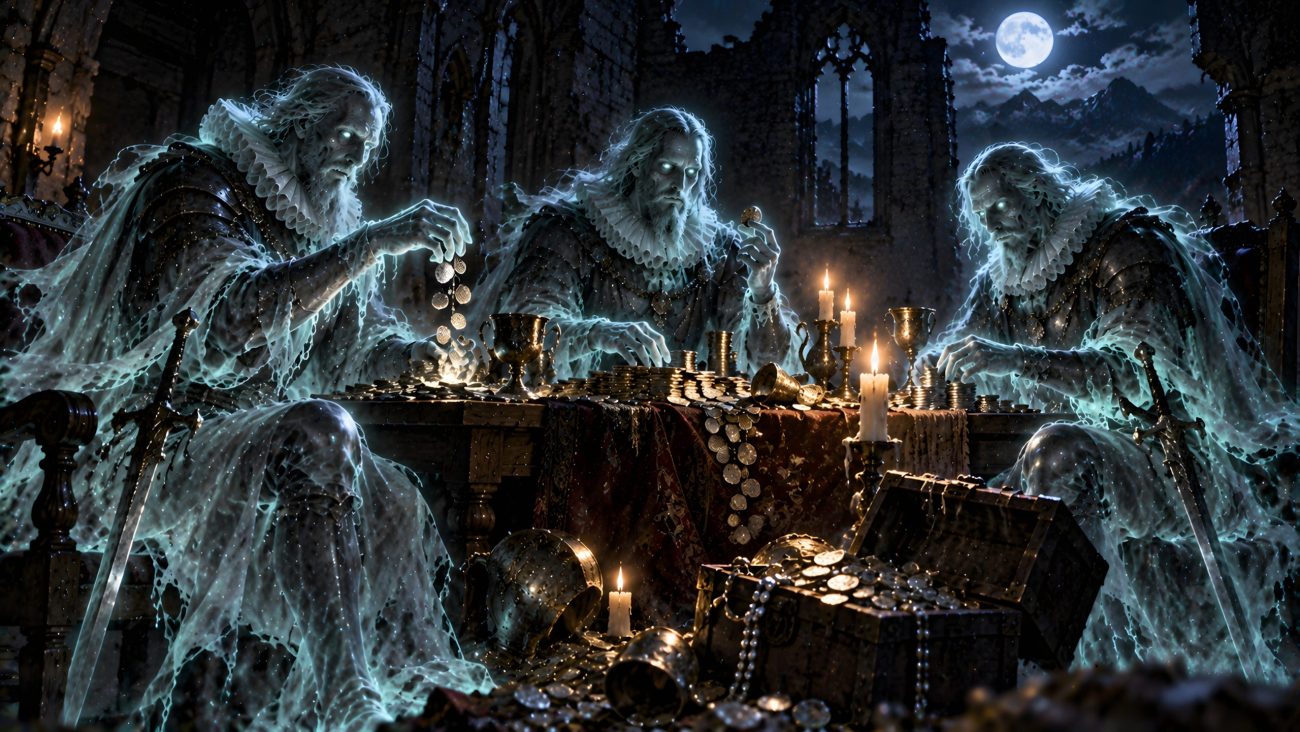
The Three Tyrants of Giswil are mysterious apparitions associated with old houses and castle ruins near Rudenz and Rosenberg in Obwalden, Switzerland. In an old house near Rudenz, close to the castle ruins, strange disturbances were once frequently reported. Loud arguments and the sound of people counting or calculating could be heard coming from a back porch. Anyone brave enough to open the door would see three tyrants seated at a table. They wore large white collars and carried long swords. However, as soon as they noticed an intruder, the three figures would scatter and vanish.

The ruins of Rudenz Castle were also associated with unexplained sounds. According to elderly locals, people gathering hay near the ruins during the summer sometimes heard a loud clanging around midday. The noise resembled a basket full of silver spoons being emptied onto a table, suggesting the presence of unseen beings handling or counting precious objects within the ruined castle.

A similar haunting was reported at an ancient house in Kleinteil, near Rosenberg. At certain times, three old knights were said to appear and count money throughout the night. They had reportedly been seen on several occasions, linking the mysterious figures of Giswil to the recurring legend of spectral warriors guarding or counting hidden wealth. Although the accounts provide no explanation for their identities or fate, the repeated appearances of three armed men, together with the sounds of money and silver, suggest a lingering supernatural presence connected to the region’s old castles and houses.


Sources

“Giswil.” SAGEN.at – Obwaldner Sagen. Reproduced by SAGEN.at. https://www.sagen.at/texte/sagen/schweiz/obwalden/giswil.html


Wild Farmers’ Ride

Tradition: Swiss Mythology
Alternative Names: ‘s wild’ Bauerng’fahr, The Wild Peasant Procession
Category: Ghost


The Myth

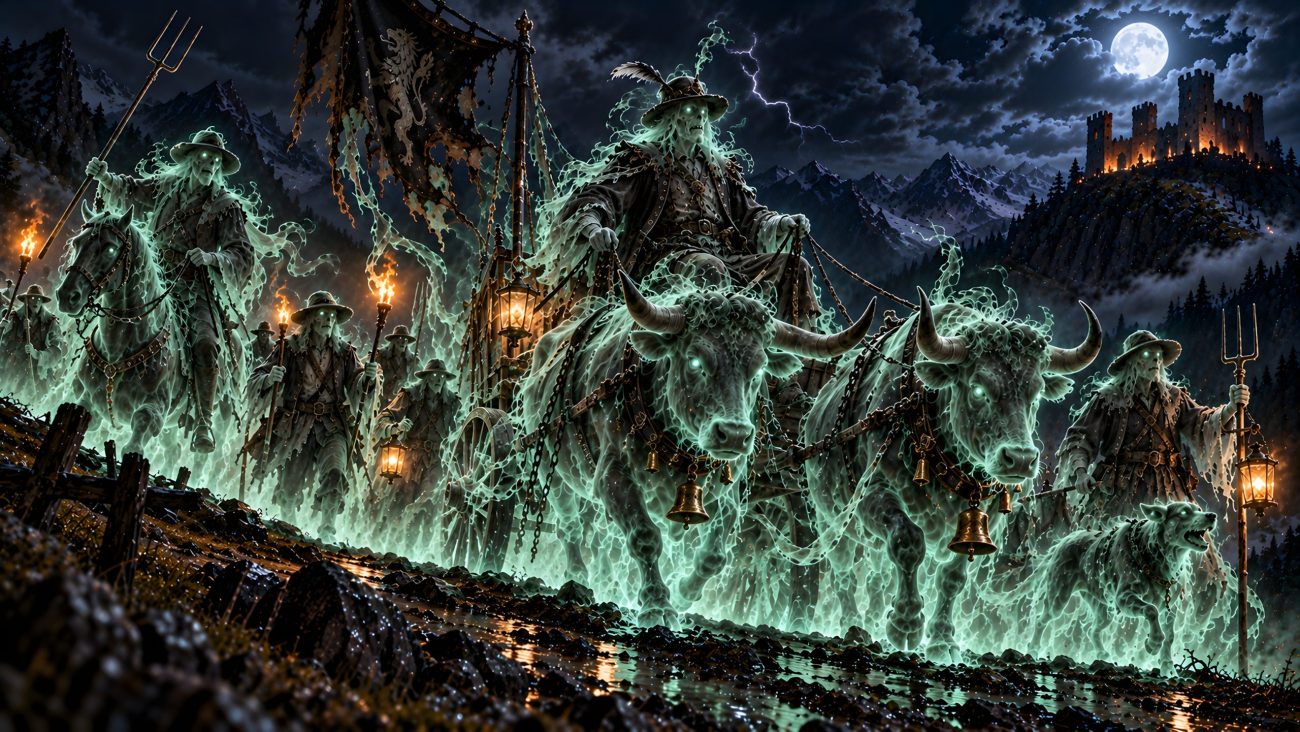
The Wild Farmers’ Ride is a supernatural procession said to haunt the road between Nauders and the ruins of Ramis Castle in the Engadine region of Switzerland. Its origins lie in the oppression of local farmers by a fierce and miserly lord who ruled from castles at Nauders and Ramis. He held farmers from Nauders and other parts of Tyrol in subjugation, treating them worse than cattle. The peasants longed to escape his tyranny and secretly plotted to regain their freedom. The legend explains the ghostly procession as the restless return of the cruel lord, his oxen, and the evil spirits of his servants.

The uprising began with a dispute over a pair of oxen. A farmer had borrowed the animals from the lord in exchange for a sack of grain, intending to keep them until his fieldwork was finished. The lord, however, demanded their return before the work was complete. When one of his squires came to reclaim the oxen, the farmer persuaded him to leave the animals for a few more days by promising another sack of grain. Two days later, the lord himself arrived to collect both the oxen and the promised grain. The farmer led him into the barn and showed him the rye. As the lord bent down to inspect it, the farmer struck him over the head, killing him. His blood flowed over the pile of grain.

Immediately afterward, the farmer raised a flag, rallying his neighbours to revolt. The peasants stormed the lord’s castle, broke through its defenses, defeated the garrison, and won their freedom. Yet the memory of the violent struggle survives in a disturbing supernatural manifestation. During storms, a ghostly procession sometimes travels between Nauders and Ramis, accompanied most prominently by the bellowing of oxen. The apparition is believed to consist of the dead tyrant, his oxen, and the evil spirits of his servants, condemned to ride through the region as a dark reminder of the lord’s cruelty and the bloody rebellion that ended his rule.


Sources

“Die Bauerngfahr.” SAGEN.at – Tiroler Sagen. Reproduced by SAGEN.at. https://www.sagen.at/texte/sagen/oesterreich/tirol/alpenburg/bauerngfahr.html


Fiery Men

Tradition: Swiss Mythology
Alternative Names: The Fiery Spirits, The Burning Men
Category: Ghost


The Myth

The Fiery Men are terrifying supernatural beings encountered by ferrymen along the Rhine and Aare rivers in Switzerland. They appear as invisible passengers, mysterious voices, or blazing figures who demand to be ferried across the water. Those who help them may become entangled in ancient curses and supernatural obligations. Their fiery nature is revealed through burning heat that can sear fingerprints into wood or turn a metal tool white-hot. Two legends recount encounters with these beings, whose journeys across the rivers are connected to centuries of waiting, mysterious redemption, and ominous destinations in the wilderness.

In the first tale, an elderly ferryman from Hauenstein falls asleep in his fishing boat beside the Rhine. He is awakened by a voice calling for passage from the Swiss bank. Each time he rows across, however, he finds no passenger waiting. After three such fruitless journeys, he angrily declares that if the call comes from a being sent by God, it must reveal itself. Immediately, a sturdy stick rolls into his boat. The ferryman rows back to the German bank, where the stick rises by itself and speaks. The mysterious passenger explains that he has watched the land become overgrown three times. Had the ferryman not crossed the Rhine for him on all three occasions, he would have been forced to wait beside an oak until an acorn grew into a tree, whose wood could eventually be used to make a cradle for a child who might one day save him. The being then asks the ferryman to offer his hand, promising that he too will soon become a blessed child. Instead of touching the invisible passenger directly, the frightened old man extends the end of his rudder. Five fingers immediately burn themselves into the wood, and the encounter ends in silence. The ferryman dies soon afterward.

The second tale takes place on Christmas Eve near Klingnau, where two boatmen are sitting in their hut beside the Aare River. At around eight o’clock, someone knocks loudly at the door. Expecting an ordinary traveler, the men open it and find a fiery figure demanding to be carried across the river. Terrified, they cross themselves, but the apparition grows increasingly impatient, forcing them to take him aboard. The boat races across the water almost without rowing, reaching the opposite bank in an instant. Before disappearing into the Hardwald forest, the fiery man warns the boatmen that all three of them will be lost unless they return to the same place at exactly eight o’clock to carry him back.

The boatmen obey the warning and wait at the appointed place. The fiery man promptly reappears and orders them to sail. After the return crossing, he thanks them and offers his hand in farewell. One boatman refuses to touch it, but the other extends the double-handled shaft of his fireman’s scythe instead. The apparition grasps the metal, which becomes white-hot to its core. The startled ferryman plunges the burning tool into the river to cool it. Meanwhile, the fiery man steps ashore and flickers away toward the desolate Giritz marsh. Both encounters reveal the dangerous nature of these mysterious beings, whose supernatural journeys can expose ordinary people to forces far beyond their understanding.


Sources

“Die feurigen Männer.” SAGEN.at – Schweizer Sagen. Reproduced by SAGEN.at. https://www.sagen.at/texte/sagen/schweiz/allgemein/feurige_maenner.html


Blümelisalp

Tradition: Swiss Mythology
Alternative Names: The Flowering Alpine Pasture, The Cursed Alpine Meadow
Category: Ghost


The Myth

Blümelisalp is a legendary alpine pasture in Switzerland that was once extraordinarily fertile and covered in flowers, but was transformed into a desolate landscape of ice and rock debris. The legend explains its destruction as divine punishment for the arrogance and impiety of a wealthy herdsman who abused the abundance of the mountain and mocked the traditional customs of the land. Similar stories are told in several Swiss regions, including the Bernese Oberland and the Klariden mountain range. In the days before the catastrophe, the pasture was so rich that cattle thrived beyond measure. Each cow was milked three times a day and produced two large buckets of milk at every milking.

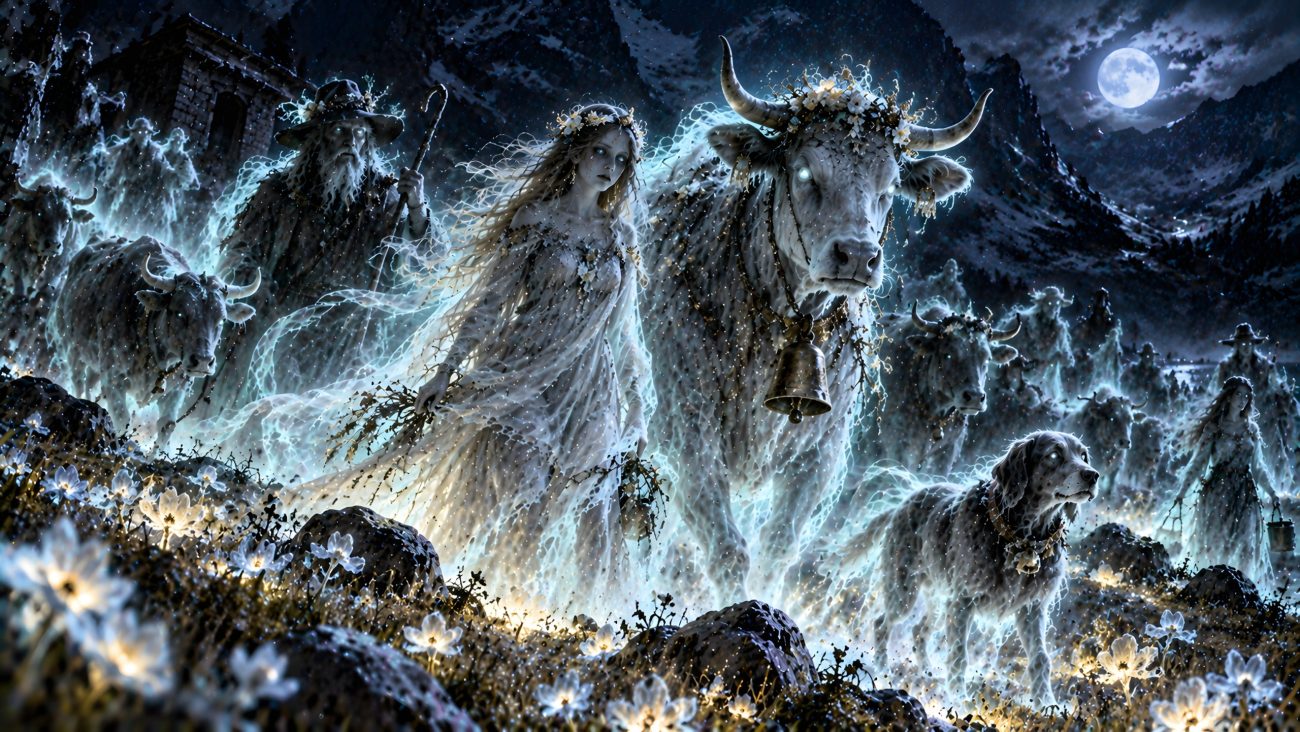
The prosperous herdsman grew proud of his wealth and began to scorn the simple customs of earlier generations. He furnished his mountain dwelling lavishly and pursued a beautiful maiden named Kathrine. His arrogance culminated in an act of sacrilege: he built a staircase into his house using his own cheeses, spread butter over them, and washed the steps with milk. His sweetheart Kathrine, his cow Brändel, and his dog Rhyn all used this extravagant staircase. His pious mother, unaware of her son’s behavior, visited the alpine pasture one summer Sunday. Exhausted by the journey, she asked for a drink. The herdsman filled a pail with sour milk, sprinkled sand over it, and offered it to her. Shocked by this deliberate insult, his mother descended the mountain and, once she reached the bottom, turned back and called upon God to punish her impious son.

A violent storm suddenly swept across the mountain, devastating the once-blessed pasture. The herdsman’s dwelling and household were buried, and both people and animals perished beneath the destruction. The herdsman’s ghost and his household were condemned to wander the mountains until they could be redeemed. His lament declares that his dog Rhyn, his cow Brändli, and his beloved Kathry must remain on Mount Klaride forever. Redemption depends on a herdsman successfully milking Brändli in silence on Good Friday, despite the thorns surrounding her udder that make the cow restless and difficult to milk. One man once managed to fill half a bucket before another person suddenly tapped him on the shoulder and asked whether the milk was foaming nicely. The milker instinctively answered, breaking the required silence. At once, the attempt failed, and Brändlein vanished from his sight. The legend leaves the alpine household trapped under its curse, awaiting someone who can complete the difficult task without speaking.


Sources

“Der Hirte auf der Blümelisalp.” SAGEN.at – Schweizer Sagen. Reproduced by SAGEN.at. https://www.sagen.at/texte/sagen/grimm/bluemelisalp.html


Gauliweibchen

Tradition: Swiss Mythology
Alternative Names: The Gauliweibchen, Gauliwibli, The Curse of Blümlisalp
Category: Ghost


The Myth

The Downfall of a Midshead, His Kathrin and His Little Dog is a Swiss alpine legend explaining the destruction of once-fertile mountain pastures beneath the glaciers of the Bernese Oberland and Valais. The stories tell of wealthy herdsmen and dairymaids whose prosperity and abundance were destroyed by divine punishment for their wickedness. Their pastures, once covered in flowers and rich grass, were swallowed by advancing ice, burying dwellings, cattle, and people beneath glaciers and rock debris. The legends also describe restless spirits that continue to haunt these desolate mountain landscapes, accompanied by the sounds of invisible cattle bells and mournful voices.

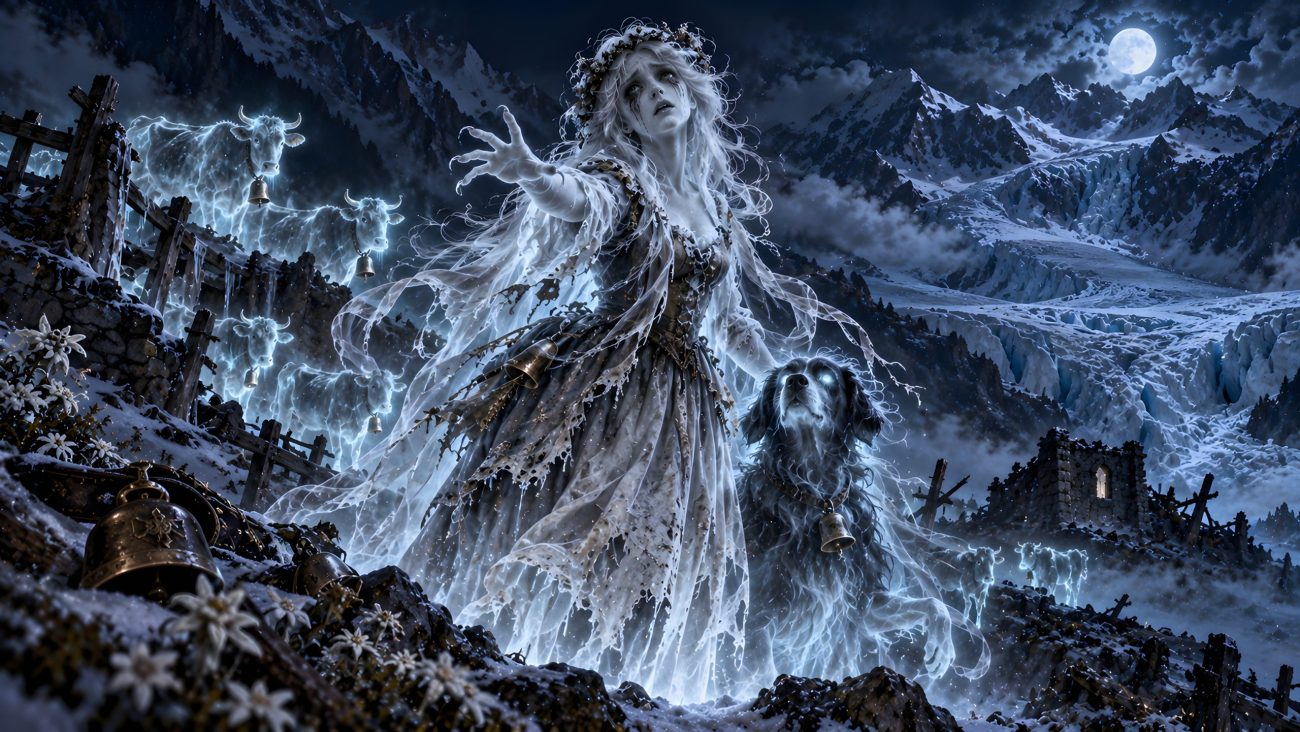
One version concerns the beautiful Blümlisalp, which once occupied the valley now covered by the Gauligletscher. The pasture belonged to a wealthy dairymaid whose wicked deeds brought heavenly punishment upon her household. The alpine meadow was cursed and buried beneath the glacier, killing the dairymaid, her little dog, a stranger, and her entire herd. The dairymaid’s ghost became known as the Gauliweibchen or Gauliwibli. She and her dog are said to appear occasionally to shepherds in the Gauli region. During one encounter, a man heard her lament that she, Kathrin, her cow Brün, and her dog Rhin must remain forever on Blümlisalp. Shepherds also sometimes hear the bells of cattle that cannot be seen. In the nearby Aaralp, another haunting is attributed to a headless woman from Valais, who has reportedly approached shepherds while they were milking goats.

A related version comes from the Turtmann Glacier in Valais. Before the glacier covered the valley, a magnificent alpine pasture called Blümlisalp flourished there. Its herdsman lived a dissolute life with a young woman named Kathrin and kept a black dog, while treating his elderly, blind father cruelly. One night, during a terrible thunderstorm, the son ordered his father to bring in cattle grazing at a distance. Afraid to disobey, the blind man ventured into the storm. Strangely compelled to continue onward, he wandered farther from the pasture, followed by the entire herd. At that moment, the glacier broke loose from the heights and swept over the pasture, burying the dwelling and its inhabitants beneath an immense mass of ice and rubble. The herdsman, Kathrin, and the little dog perished, and their former home could never again be seen. Before devastating floods, valley dwellers are sometimes said to glimpse the little black dog and hear a voice lamenting that Kathrin and the speaker must remain forever beneath the ice.

Another similar tale concerns the Oberplegi Alp on Mount Glärnisch. A herdsman who lived there had sinned with a young woman named Kathrin, built a staircase out of cheese, and served dung to his elderly mother. One day, he and Kathrin plunged into a crevasse. The herdsman is occasionally said to appear engulfed in flames, crying that he, Kathrin, and his dog Pari must remain forever beneath the ice. A comparable legend is also associated with the Clariden mountains. Across these stories, the destruction of fertile alpine pastures becomes a punishment for cruelty, arrogance, sexual misconduct, and the violation of obligations toward one’s parents. The surviving apparitions preserve the memory of the lost households, condemned to remain in the mountains that buried them.


Sources

“Der Untergang.” SAGEN.at – Sagen aus Vernaleken. Reproduced by SAGEN.at. https://www.sagen.at/texte/sagen/vernaleken/untergang.html


Homburg Castle Music

Tradition: Swiss Mythology
Alternative Names: Ghost Music of Homburg Castle
Category: Ghost


The Myth

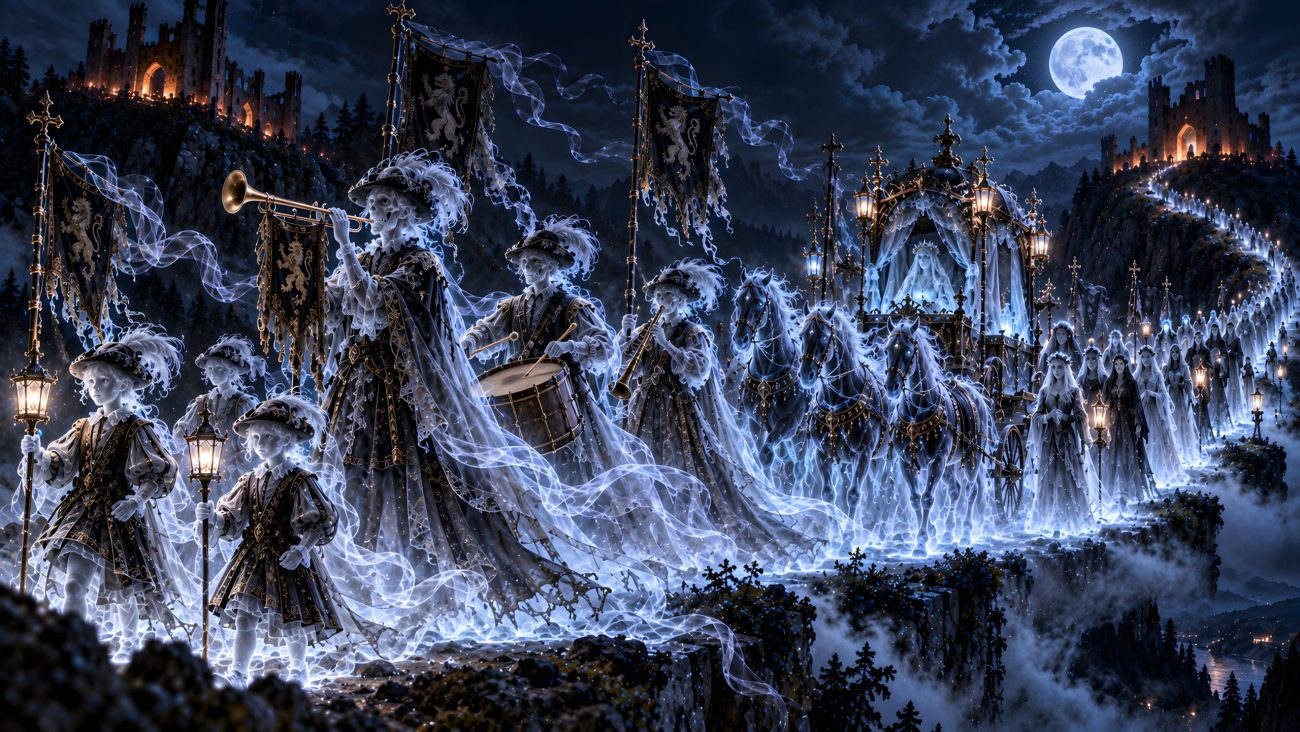
The Homburg Castle Music is a mysterious supernatural procession associated with the ruins of Homburg and Rechberg castles, which stand on opposite wooded summits of the Homberg ridge between Basel-Landschaft and the Fricktal region of Aargau, Switzerland. On moonlit nights, strange music can accompany an extraordinary procession traveling along a road suspended in the air between the two castles. The music is played by an otherworldly band of horn players, trombonists, and trumpeters, and the procession moves with uncanny grace and silence. The phenomenon is also regarded as a portent of severe summer thunderstorms, whose approaching fury can be heralded by the distant sound of the mysterious music.

One night, a traveler named Joseph Hochreuter from Wittnau was crossing the Homberg after returning from Basel-Land. As he descended the mountain, he discovered that the plain before him was blocked by a double hedge of living greenery, with a broad, perfectly straight highway running between the hedges. While he stood wondering at the sight, the night wind carried the sound of distant music toward him. Soon a magnificent procession appeared. At its head marched pairs of boys dressed like pages in identical black-and-white coats, arranged from the smallest to the largest. Behind them came men dressed entirely in black, followed by a band whose musicians played loudly as they advanced. A fine gentleman’s carriage drawn by six jet-black horses followed at a distance, with several ladies and gentlemen visible inside. Behind the carriage walked pairs of maidens in snow-white dresses, ranging from tiny children to fully grown women, while women in black cloaks brought up the rear.

The procession passed in remarkable order and elegance, raising no dust and making no sound beyond its music. Hochreuter soon realized that the highway did not follow the mountain’s slopes but ran straight through the air from Homburg Castle to Rechberg Castle. Eager to discover where the procession was going, he hurried toward the ridge to obtain a better view. Suddenly, the moon disappeared, plunging everything into darkness. The green hedges, the elevated highway, and the entire procession vanished, and the music gave way to thunder roaring in every direction. A violent storm broke over the mountain, and Hochreuter struggled to find his way down to the valley. According to the legend, the music of Homburg Castle can still be heard for hours across the surrounding countryside when a severe summer thunderstorm approaches.


Sources

“Die Homburger Schlossmusik.” SAGEN.at – Schweizer Sagen. Reproduced by SAGEN.at. https://www.sagen.at/texte/sagen/schweiz/allgemein/homburger_schlossmusik.html


Vanished Duke

Tradition: Swiss Mythology
Alternative Names: The Ghost of Charles the Bold, Charles of Burgundy
Category: Ghost


The Myth

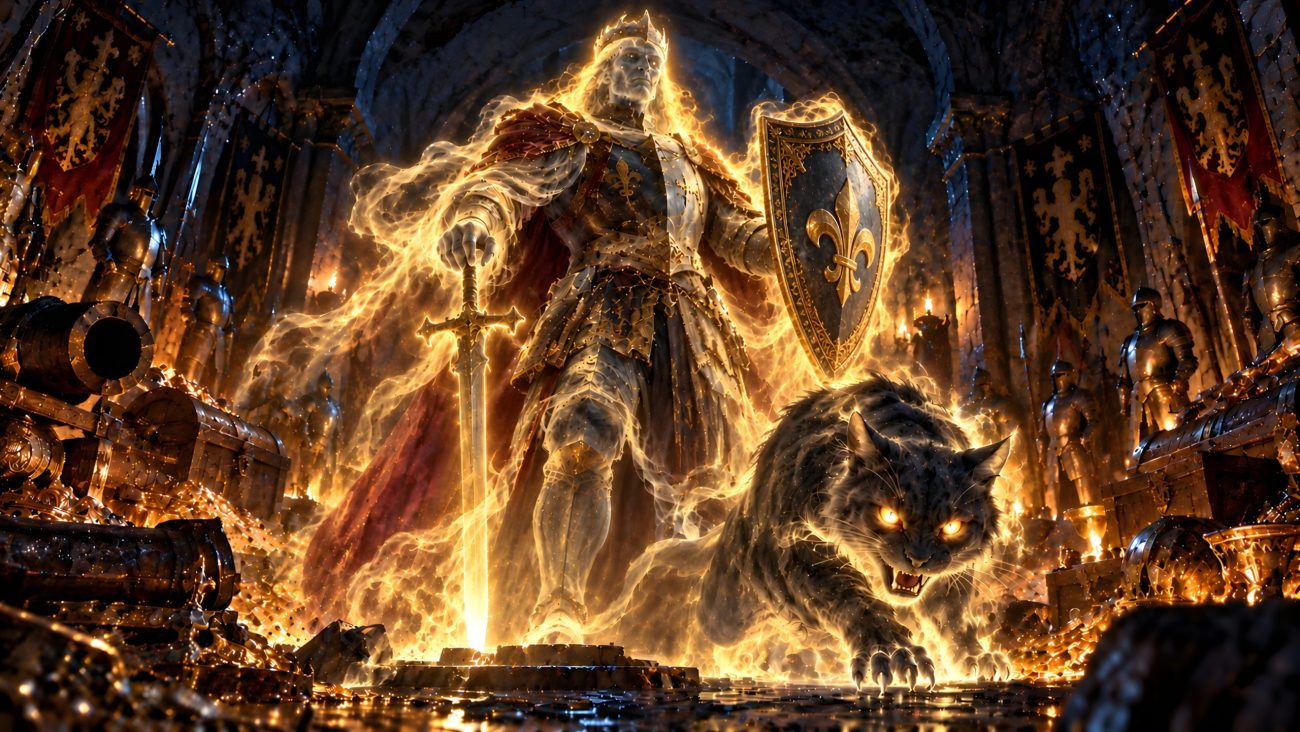
The Vanished Duke is the ghost of Charles of Burgundy, who haunts a hill between Grandson and Montagny in the Swiss canton of Vaud. According to legend, an ancient oak stands on the hill where the Swiss Confederation defeated the Duke of Burgundy. Beneath the earth lies a magnificent hidden hall filled with weapons, coats of arms, cannons, golden vessels, precious stones, jewelry, and countless treasures. The duke remains imprisoned there for centuries, awaiting a courageous person who can help redeem him by completing a dangerous task before midnight without uttering a single word.

One winter evening, a poor farmer named Johannes from Montagny passes the hill while mourning the rejection of his marriage proposal. The parents of his beloved Margrit have refused to let their daughter marry him because he lacks wealth. As Christmas approaches, an armored knight suddenly appears and addresses Johannes by name. Knowing of his troubles, the knight promises him great riches if he returns alone to the hill on Christmas Eve after eleven o’clock. Johannes must carry something to Lake Neuchâtel and then remove the knight’s sword belt before midnight. If he succeeds without speaking, the treasures hidden beneath the hill will be his. The knight then vanishes, leaving Johannes to wonder whether he can fulfill the strange promise.

On Christmas Eve, Johannes returns to the hill despite the bitter cold and his growing fear. The knight appears again, strikes the ancient oak with his sword, and causes both of them to sink into the earth. Inside a magnificent, brightly lit hall, Johannes sees the treasures but is soon confronted by a large, coal-black cat with fiery eyes. The knight orders him to carry the creature to the Tophet, a rock on Lake Neuchâtel, and throw it into the water. Johannes obeys, enduring the cat’s fierce scratches without crying out. When he throws it into the lake, the water begins to ripple and boil, and he hurries back to the underground hall.

There, the knight reveals his identity as Duke Charles of Burgundy. He explains that his misfortune began after he broke his word and had several Swiss men hanged from the trees on the hill. Since then, he has been forced to wait for centuries until someone courageous enough to redeem him arrives. Johannes must now remove the duke’s sword belt without speaking. As he works, the duke mysteriously grows taller, forcing Johannes to stretch up on tiptoe. When the heavy sword slips from its scabbard and cuts him, Johannes nearly cries out but manages to remain silent. At that moment, the clocks of Grandson and Yverdon strike midnight, completing the task.

The redeemed duke thanks Johannes and allows him to take some of the treasure. Johannes gathers gold coins in his handkerchief and suddenly finds himself back beside the oak tree, with the coins still in his possession. The following day, he returns to Margrit’s parents, who change their minds when they see his newfound wealth and agree to the marriage. Johannes later donates money to the people of Montagny so that they can build a beautiful church. Through his courage, silence, and faithfulness to his promise, he wins both the treasure and the woman he loves while freeing the vanished duke from his centuries-long imprisonment.


Sources

“Der verschwundene Herzog.” SAGEN.at – Schweizer Sagen. Reproduced by SAGEN.at. https://www.sagen.at/texte/sagen/schweiz/allgemein/verschwundene_herzog.html