Tradition: Swiss Mythology
Alternative Names: Bannhölzler of Walchwil, The Ghost of Bannhölzlerfluh, The Skittle Warden
Category: Ghost
The Myth
The Bannhölzler is a malevolent ghost associated with the common land of Walchwil, near Lake Zug, Switzerland. His legend begins with a dispute over grazing rights. A wealthy woman from Lucerne had bequeathed four thousand guilders to her godchild in Walchwil, allowing the village to acquire its common land. As the community was still small, residents of Zug were permitted to graze their cattle there. Over time, they turned this temporary permission into a claimed right, leading to repeated legal disputes. After the people of Zug lost twice, a cunning citizen devised a deceitful plan to win a third lawsuit. Before entering the court, he placed soil from Zug inside his boots and hid a comb and ladle beneath his hat. When the judge called him to swear an oath, he declared that he stood on Zug soil, misleading the court into ruling against Walchwil. On his journey home, the false witness suffered an accident. People said that the devil had wrung his neck, and from that moment he was condemned to haunt the common land and wreak havoc at Bannhölzlerfluh.
The Bannhölzler was said to haunt a split sandstone rock near the lower Roßberg, where foul-smelling water seeped from the stone. A man from Entlebuch supposedly banished the spirit there. Three springs had once flowed from the cliff: the middle one ran red and became the Bannhölzler’s prison, while his dog was confined to the left spring, which carried blue water. The spirit was bound to the common land and could not leave his domain unless summoned. Mischievous boys sometimes called him to the boundary before fleeing, but the ghost could move with extraordinary speed. When a goatherd challenged him to catch him, the Bannhölzler pursued the boy beneath a hedge and snatched a wooden shoe from his foot. He was also said to lure hikers with beautiful flowers before throwing them over the cliff to their deaths.
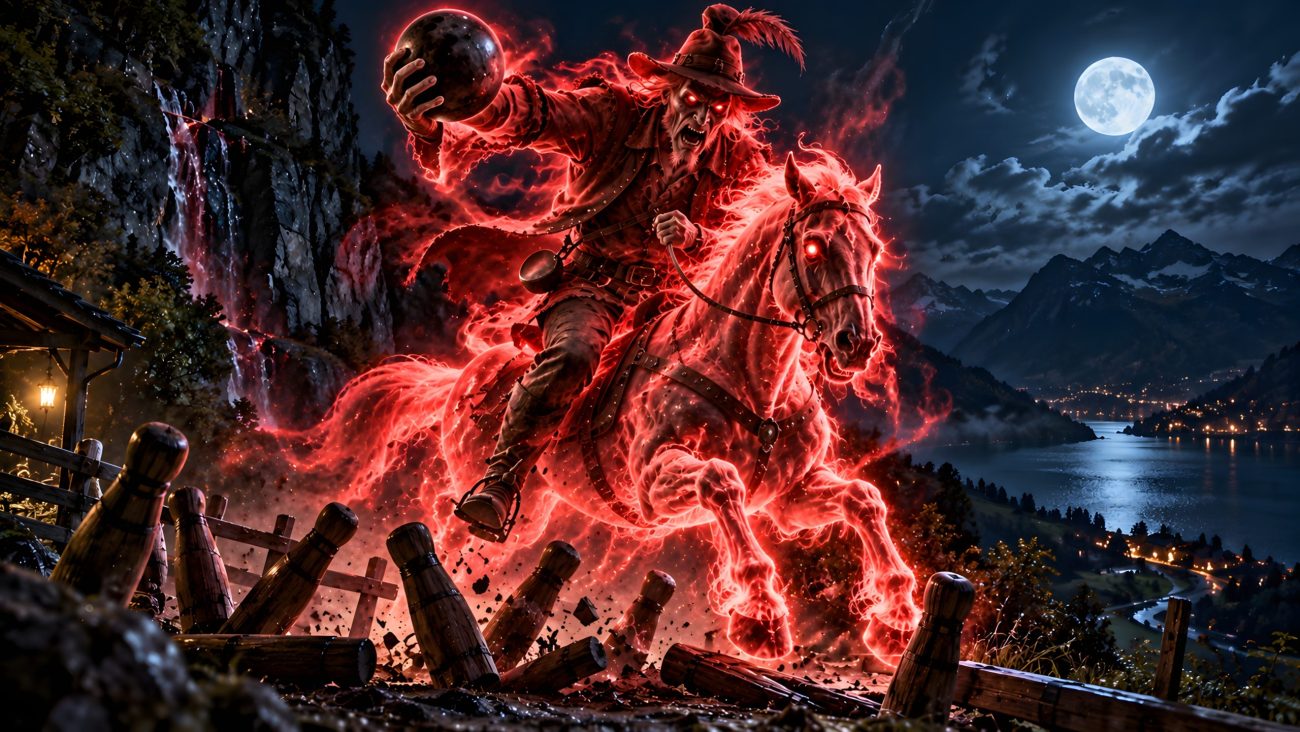
The ghost’s appearances could be violent and destructive. Once, while children played skittles beside a farmhouse on Walchwilerberg, a bowler deliberately threw the ball beyond the target and called for the Bannhölzler to retrieve it. The spirit appeared instantly, terrifying the children. As one girl tried to escape beneath a boundary fence, he tore the two ribboned braids from her head. He then seized the bowling ball and hurled it at the house with such force that it passed straight through the building. In another tale, a frustrated player called upon the skittle warden for help after suffering repeated bad luck. The Bannhölzler arrived roaring on a white horse, leapt down, seized the ball, and knocked down the entire bowling alley with a single powerful throw. The ball flew all the way to the Kaiserstock, where it struck the rock with a tremendous crash.
The Bannhölzler’s presence was also associated with guilt and false judgment. An old traveller named Gutsch-Chasper once witnessed a court session on the common land while walking from Ägeri to Walchwil. When he saw the bailiff committing perjury again, his hat would not remain on his head and his hair stood on end with terror. Eventually, after repeated destructive appearances, the Bannhölzler was banished to Mount Pilatus. He was forbidden to return unless the people of Walchwil summoned him during a major legal dispute. His legend thus connects the supernatural punishment of a dishonest witness with the protection of territorial boundaries and the dangers of invoking a powerful spirit for amusement or personal advantage.
Sources
“Die Bannhölzler.” SAGEN.at – Zuger Sagen. Reproduced by SAGEN.at. https://www.sagen.at/texte/sagen/schweiz/zug/bannhoelzer.html