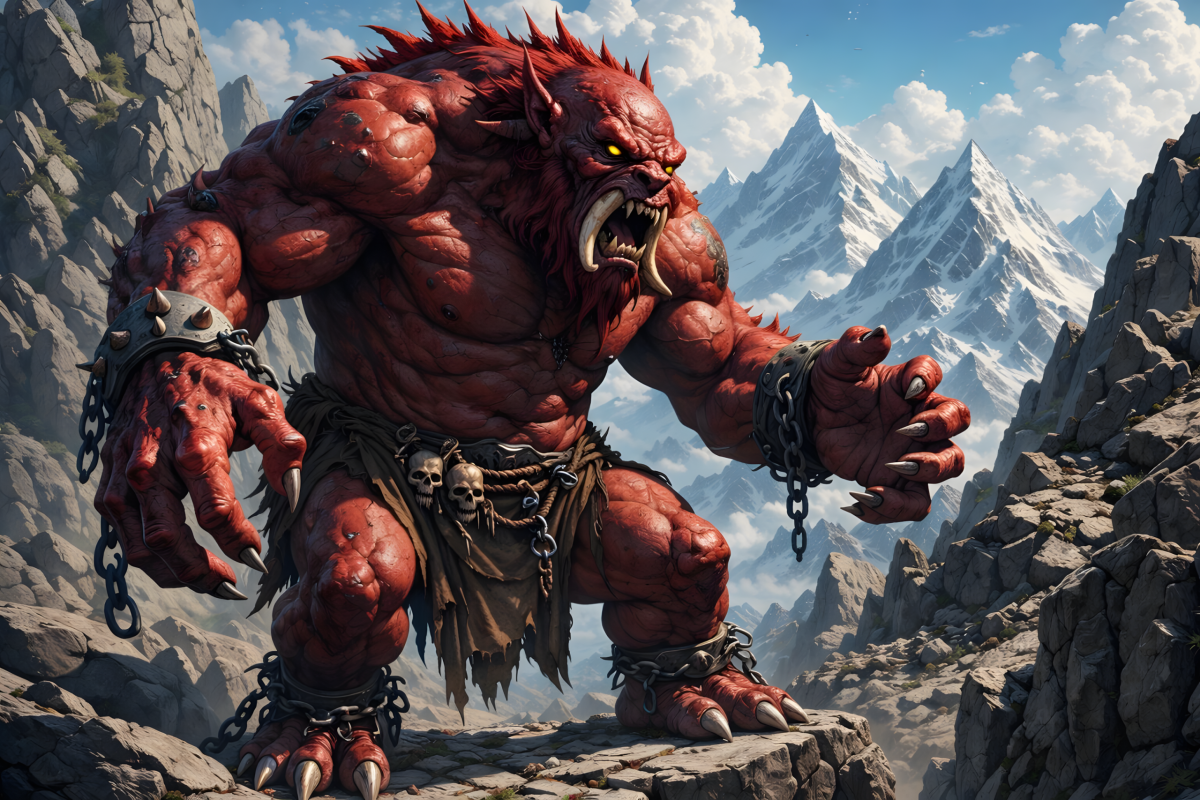
Yama-Otoroshi is a yokai said to inhabit Mount Tsurugi in the Tateyama mountain range. It is described as resembling an ogre with a red face and body and lacking iron bars. It was believed to wait on rocky outcrops and attack climbers.
It was said that before 1907, climbers failed to reach the summit of Mount Tsurugi because the Yama-Otoroshi waited on the rocks, seized them by the collar, and threw them to their deaths. After the Meiji period, the being was said to descend from the mountain and take up residence at temple gates such as Zenkoji Temple. There it grabbed non-believers by the collar and stopped them from passing through. In this form, it was also called simply Otoroshi. An illustration shows the red-faced, two-horned ogre throwing away a climber.
Tradition / Region: Hungarian Mythology Alternate Names: The Greencoat; Green Coat Man; Mountain Dwarf of Günser Category: Mountain dweller
The Myth
In the Günser Mountains, people speak of a small, strange being known as the Grünröckel, the Greencoat. It is said to appear on bright moonlit nights along mountain paths and hollow roads. Though not truly evil, its appearance is feared, for those who meet it often suffer misfortune afterward.
One summer night, three men from the mountains were hauling wood down into town with their oxen, using the cool moonlight to avoid the heat and the swarms of flies. Their teams moved one behind another through a hollow between vineyards while the drivers rested on their wagons.
Suddenly the first pair of oxen stopped and would not go forward.
The driver climbed down and went ahead to see what blocked the way. There, in the middle of the hollow, shining clearly in the full moon, stood a short figure. It wore a pointed hat, a white ruff at the neck, and over its shoulders a bell-shaped green coat that hung down to its thighs. Beneath it were short breeches and tight trousers. The little man stood still, smiling with an eerie grin.
Terrified, the driver leapt back and seized his long-handled axe. He rushed forward and struck with all his strength. But just as the blade came down, the small man sprang lightly up the embankment and vanished at once. Though the slope was thick with vines, the figure passed through without a sound or any sign of resistance, as if it had never been solid at all.
The men continued on their way, shaken. Soon afterward, one of the companions died unexpectedly, and people said the meeting with the Greencoat had brought the ill fortune.
In the mountains it is also said that the Grünröckel is a spirit who delights in startling travelers and teasing wanderers, though he is not wholly hostile. Some claim he is the restless ghost of an executed man who once fled through these hills, while others believe he is an ancient mountain spirit who has always belonged to the land.
But all agree that when the small man in the green coat appears in the moonlight, it is a sign that something strange is about to follow.
Tradition / Region: Romanian Mythology Alternate Names: Fiery Man; Fire Spirit of the Mountains Category: Spirit, Mountain dweller
The Myth
In the mountains near Pretai, people said that the Fiery Men wandered even at dusk, appearing suddenly and vanishing just as quickly.
One evening, several women gathered at the spinning room. As they opened the door, one of them mockingly called out into the dark, “Fiery man, come and kiss me!”
Hardly had they shut the door when a violent blow struck it from outside. The impact was so fierce that the wood itself was scorched, and the print of a burning hand was left branded into it.
From then on, the women believed that one of the Fiery Men had truly answered the call.
When Untombinde, the king’s daughter, set out for the sacred pools of the Ilulange River, her parents warned her not to go. She ignored them and traveled there with two hundred maidens as her escort.
At the river they bathed and played in the water. But when they came out, their clothes, jewels, and bracelets were gone. They had been taken by Isiququmadevu.
The monster was a vast, bloated being with an enormous mouth, said to be large enough to swallow whole villages. Terrified, the maidens begged for their possessions back. One by one, as they pleaded, the monster returned their things. At last only Untombinde remained.
The others urged her to beg the creature for mercy, but she refused proudly, saying she would not humble herself before it. At once Isiququmadevu seized her and dragged her into the pool.
When King Usikulumi heard what had happened, he sent his army to kill the monster. But Isiququmadevu rose up and swallowed the entire force in one gulp. She then went to the village and devoured everyone there—men, women, children, and cattle—leaving only one man alive. Among the swallowed were his twin children.
The man armed himself with a spear and went in search of the creature. Along the way he asked the animals he met where she had gone, and each told him, “Forward, forward.”
At last he found Isiququmadevu, swollen from all she had eaten and resting in the forest. When he declared that he had come for his children, the monster again tried to mislead him, saying only, “Forward, forward.” But he attacked her with his spear and killed her.
He cut open her body, and from inside came the army, the villagers, and the cattle, all alive. Untombinde came out last.
Other tales tell how a young woman named Usitungusobenthle once cut open the sleeping monster and freed a village she had swallowed, and how a princess named Uluthlazase escaped her by refusing to release her clothes and fleeing while the creature went to seek help.
Thus Isiququmadevu is remembered as a devouring monster who swallows whole communities, yet can be overcome by courage and determination.
In the mountains near Karimata, at the foot of Mount Hotaka, there is said to be a strange being called Waawu, named for the cry it makes in the night.
Long ago, a hunter from a nearby village went into the mountains and stayed overnight in a small hut. In the middle of the night he heard a terrifying voice echo through the darkness.
“Wauawu! Wauawu!”
Something rushed toward the hut and began to shake it violently. The walls rattled and the beams creaked, but the hunter could not see what attacked him. Frozen with fear, he waited for morning and fled back to the village, telling everyone a Waawu had appeared.
Some days later, several villagers went into the mountains to gather lumber and stayed in the same hut. As night fell, they heard the same cry approaching through the forest.
“Waawu… Wauawu…”
The sound grew louder and louder until their bodies seemed to go numb. Too frightened to leave, they remained inside the hut for several days.
One night the creature returned again, screaming “Waa-woo! Waa-woo!” and shaking the hut so violently it seemed it would collapse. The men huddled together and chanted, “Far-off Kuwabara, far-off Kuwabara,” praying for safety until dawn.
When morning finally came, they fled back to the village and told what had happened.
From then on, the place where the cries were heard was called Waa-woo Sawa—Wau Valley—named after the unseen monster whose voice once shook the mountain huts in the night.
High above the village of Flumserberg, in the dark forests and shadowed slopes of the mountain, there dwelt the Night Folk.
They were seen only at certain times.
When someone in the village lay upon their deathbed, watchers would sometimes glimpse a strange procession descending from the mountain heights. A multitude of black figures moved silently in a long line. Among them strode a towering white man, conspicuous and pale, wearing a wide, floppy hat. He walked at their center, taller than all the rest.
The procession did not enter the village openly. Instead, it halted at an old, crumbling house near the former town hall. There the figures would gather, as if conferring among themselves. From that place came a low, far-reaching murmur—an eerie sound that drifted through the air but could not be understood.
They lingered for a time.
Then, just as silently, the Night Folk turned and made their way back up the mountainside. One by one they disappeared into the darkness of the forest, until no trace of them remained.
Soon after, word would spread that the dying villager had passed.
Because of this, when a body from Flumserberg was carried to burial, the funeral procession would always stop at the old town hall. There the priest would come out to meet it, as though acknowledging the unseen procession that had already come down from the mountain and returned to its hidden realm.
Tradition / Region: Argentine Mythology Alternate Names: Mother of the Hill Category: Mountain dweller
The Myth
High in the mountains, where gold and silver sleep in dark veins beneath the rock, there dwelt a radiant woman known as Orco Mamman—the Mother of the Hill.
She was beautiful beyond compare. Her hair fell long and shining down her back, and she would sit upon the heights, slowly brushing it with a golden comb. The metals beneath the earth were under her care—gold, silver, iron, and all the hidden treasures buried deep within the mountain’s bones.
The miners who climbed the slopes knew of her. As long as they took only what they needed and honored the mountain, she allowed them to pass unharmed. The tunnels rang with hammers, and caravans of mules carried ore down winding paths.
But when greed took hold—when men gouged too deeply into the mountains, tearing them open and weakening their heart—Orco Mamman grew wrathful.
She would rise from the heights and move unseen among the ridges. As the caravans descended, heavy with stolen metal, she would push them from behind. Carts, mules, and men alike would tumble into dark ravines, swallowed by the abyss below.
Those who survived spoke in hushed voices of a glimpse—a flash of golden hair in the wind, the glint of a comb, a woman standing silently at the edge of a precipice.
From that time on, the wise miners remembered: the mountain is alive, and its Mother watches.
Long ago, in the valleys and mountains of the Basotho, there arose a monstrous being called Khanyapa.
It had no fixed shape. It was vast, bloated, and ever-growing. Its hunger knew no limit. As it roamed from village to village, it swallowed everything in its path—men, women, children, cattle, wild beasts. The more it devoured, the larger it became. From its body lashed multiple sharp tongues, which it wielded like weapons. Its voice was so terrible that it made the rocks tremble.
Soon there were no towns left standing. The valleys were silent. Humanity had vanished.
Only one woman survived. She had hidden herself in ashes, masking her scent and appearance, and so the monster did not detect her. When Khanyapa had eaten all it could find, its swollen body dragged itself into a mountain pass and became wedged there, too distended to move further.
Alone in the emptied world, the woman wept and prayed that humankind should not end. The gods heard her plea. She conceived and bore a son in an abandoned stable.
When she looked upon the child, she saw around his neck a necklace of divining charms. She named him Ditaolane—the Diviner.
But Ditaolane was no ordinary child. In the time it took his mother to prepare straw for his bed, he had already grown into a full man, wise in speech. Seeing the desolation around him, he asked why the earth lay empty. His mother told him of the monster whose hunger had devoured the world. She pointed to the mountain pass where the great body of Khanyapa lay.
Though she warned him, Ditaolane took up a knife and went alone to confront the devourer.
Khanyapa swallowed him as it had swallowed all others.
But Ditaolane did not die.
Inside the monster’s vast belly, among the swallowed multitudes, he drew his knife and began to cut. He tore at the entrails of Khanyapa. The monster roared, shaking the earth, but at last it collapsed and died.
Still trapped inside, Ditaolane cut his way outward. As the blade pierced flesh, thousands of voices cried out—those who had been swallowed alive. He opened a great wound, and through it poured the nations of the earth, restored to life.
The people rejoiced at first, but soon suspicion took root in their hearts. Who was this man who had survived the beast? What power did he possess? Fearing him, they plotted his death.
But Ditaolane would not be taken. He escaped them by turning himself into stone.
And so the world was freed from the devouring monster, yet the savior who restored humanity withdrew from it, leaving behind the memory of the time when all living things were swallowed and reborn from the belly of Khanyapa.
Gallery
Sources
Wikipedia contributors. (n.d.). Kamappa. In Wikipedia, The Free Encyclopedia. Retrieved February 14, 2026, from https://en.wikipedia.org/wiki/Kamappa
On the Isle of Man there once roamed a terrible being known as the Buggane—a great, hulking creature of malice and brute strength.
The Buggane was a shapeshifter. At times it appeared as a monstrous black calf, at others as a towering man with horse’s ears or hooves. In its truest and most dreadful shape it was covered in coarse black hair, with blazing eyes like torches and sharp tusks gleaming in its mouth. Some said it bore bull’s horns. It was so immense that it could tear the roof from a church as easily as a man might lift a hat.
Though powerful, the Buggane had its limits. It could not cross running water, nor could it stand upon ground made holy.
One tale tells of a Buggane that found itself accidentally carried away on a ship bound for Ireland. Furious at being taken from its island home, it whipped up a savage storm, driving the vessel toward the jagged rocks of Contrary Head. The terrified captain prayed to St. Trinian, promising to build him a chapel if they were spared. The saint guided the ship safely into Peel Harbour. Enraged, the Buggane roared, “St. Trinian shall never have a whole church in Ellan Vannin!”
True to its word, when a chapel was built in the saint’s honor, the Buggane tore its roof off—once, twice, three times—so that St. Trinian’s Church was never left complete.
Bugganes were not only destroyers of churches. They plagued farms and villages. One from Glen Maye nearly hurled a lazy housewife into a waterfall for neglecting her baking. She escaped only by slipping free of her apron strings. Another, at Gob-na-Scuit, ripped thatch from haystacks, blew smoke back down chimneys, and shoved sheep from steep grassy cliffs.
Some Bugganes lived by the sea in dark caves. The Buggan ny Hushtey was known for despising idleness, punishing those who shirked their work.
Most famous of all is the battle between the Buggane of Barrule and the Irish giant Fionn mac Cumhaill.
When Fionn came to the Isle of Man, the Buggane sought him out for combat. Fionn wished to avoid the fight, so his clever wife disguised him as a baby and laid him in a cradle. When the Buggane saw the size of the “child,” he thought, “If this is the baby, what size must the father be?” and withdrew—for a time.
But they did meet at last, near Kirk Christ Rushen. From sunrise to sunset they fought. Fionn planted one foot in the Big Sound and the other in the Little Sound, shaping the channels between the Calf of Man, Kitterland, and the main island as he struggled. The Buggane stood firm at Port Erin. In the end, the Buggane wounded Fionn so grievously that he fled toward Ireland.
The Buggane could not follow across the sea. Instead, it tore out one of its own teeth and hurled it after him. The tooth struck Fionn and fell into the water, becoming the jagged rock known today as Chicken Rock. Fionn turned and laid a mighty curse upon it, condemning it to remain there as a hazard for sailors as long as water runs and grass grows.
And so the Bugganes remain in Manx memory—wild, shape-shifting giants of fury and strength, feared for their violence and remembered in the land itself.
Gallery
Sources
Wikipedia contributors. (n.d.). Buggane. In Wikipedia, The Free Encyclopedia. Retrieved February 14, 2026, from https://en.wikipedia.org/wiki/Buggane
Tradition / Region: Scottish Mythology Alternate Names: Big Grey Man of Ben Macdui; The Greyman Category: Mountain dweller
The Myth
High among the mist-choked summits of Ben Macdui, in the Cairngorm Mountains, there is said to dwell a presence known as Am Fear Liath Mòr—the Big Grey Man.
He is rarely seen clearly. Those who encounter him most often speak not of sight, but of sound.
Climbers ascending the mountain alone in drifting fog begin to hear it: a crunch of gravel behind them. One heavy step. Then another. The stride is too long—three or four times the length of their own. When they stop, the steps stop. When they walk, it follows.
They turn, but the mist shows nothing.
The Greyman is said to be tall—far taller than any man—thin and looming, with long arms and broad shoulders. Some claim he stands over ten feet high. His skin and hair are dark, and he moves silently within the mountain’s fog. But most who feel his presence never see him clearly at all. Instead, they are overcome by an overwhelming dread, a certainty that something vast and watchful is near.
In 1891, a solitary climber descending from the summit cairn heard those immense footsteps trailing him in the mist. He tried to reason with himself, telling his mind it was nonsense. But the crunch, crunch continued. Terror seized him, and he fled blindly down the mountain, stumbling among boulders for miles before reaching the forest below. He swore never to return to the summit again.
Others have spoken of similar experiences. Brothers camping near the peak heard slurring footsteps circling their tent through the night, as if something paced them patiently in the dark. A rescue worker during the war felt the mist close in unnaturally tight around him and sensed pressure at his throat, as though unseen hands hovered near. Another man awoke to find a towering dark silhouette standing against the moonlight outside his tent.
One mountaineer claimed he saw a shape surge through the fog toward him. He fired his revolver at it, but the figure did not falter. He ran for his life, racing down the mountain in record time.
No photograph has ever captured the Greyman. Strange footprints once found in the snow proved to be the work of wind and meltwater. Yet the stories persist.
Some say the figure is nothing more than shadow and illusion—the Brocken spectre, a climber’s own enlarged form cast upon the mist by the rising sun. Others insist that something older and less easily explained roams the high passes.
Whatever he may be, the Big Grey Man remains in the fog of Ben Macdui, pacing silently behind those who dare to walk the summit alone.