Dooinney-Oie

Tradition / Region: Manx Folklore
Alternative names: The Night-Man
Category: Cave dweller


The Myth

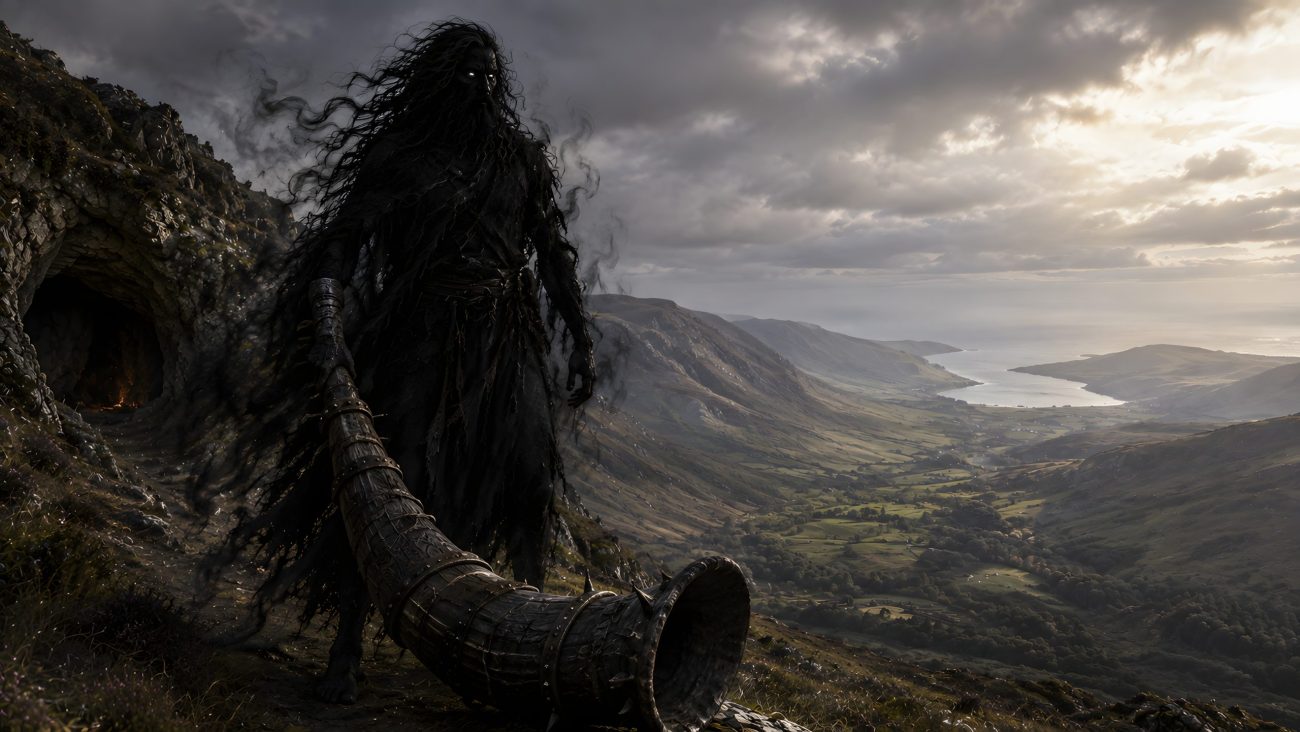
The Dooinney-Oie, or Night-Man, is a supernatural being who lives in a lonely cave on the side of Cronk-y-Thonna overlooking Glen Roy. He is associated with the mountains and valleys around Laxey and is known for carrying a horn whose sound can be heard across the surrounding countryside. He is also said to help the local people and to perform work for them while they sleep.

No one willingly approached the Night-Man’s cave. Boys who ventured too close sometimes suffered sudden pains or sprained their wrists and ankles, while children gathering blackberries or hazelnuts were warned to keep away from the place.

Despite this, the Dooinney-Oie was considered useful to the people of Laxey. He warned fishermen when storms were approaching, helping them protect their lines, nets, and fishing pots and sometimes saving their lives. Farmers and crofters also benefited from his warnings, as they could bring their flocks down from the hills before dangerous weather arrived. Like the Fynoderee, he would sometimes perform work for people while they were asleep.

The Night-Man eventually devised a way to reach the breast of Lhergy Grawe so that his warnings could be heard across a larger area. After a month of planning, he built a strange chariot with two small wheels on one side and two large wheels on the other. The seat was suspended from the frame by strips of hide so that he would not be thrown about on the rough mountain paths. By moving the horses from one end of the chariot to the other, he could travel safely along the steep slopes.

From his position on Lhergy Grawe, the Dooinney-Oie would blow his horn to warn the people of Glen Roy, Granane, Glen Drink, and Laxey of approaching storms.

One September night, a young man named Joe Steveson was returning home beneath the bright moon when he heard the Night-Man’s horn. He saw something shining in the ling on the mountain and climbed up Lhergy Grawe to investigate. There he discovered the Dooinney-Oie’s horn lying on the ground. Although he was too frightened to take it away, he hid the horn before leaving.

When the Dooinney-Oie returned and discovered that his horn was missing, he became furious. His cries echoed through the valleys like thunder, and the people said that he was so enraged that fire flew from his mouth. Joe Steveson was terrified and never recovered from the fright.

On another night, a man from Baldhoon who had often mocked the Night-Man was returning home after drinking. When he heard the horn, he shouted insults across the valley. The Dooinney-Oie ignored him at first, but after hearing another insult, he leapt from his seat and rushed down Lhergy Grawe, shouting and stamping so violently that the ground seemed to shake.

The man ran for his life. When the Dooinney-Oie reached the river, however, the stepping-stones were covered by the water. He retreated slightly, took a run, gave a great shout, and leapt across.

The frightened man managed to reach the house of a religious man just as the Dooinney-Oie arrived. One enormous shout at the door shook the turfs on the rafters and rattled the thatch, but the Night-Man could do no more. The man remained inside for the night and never again shouted after the Dooinney-Oie.

Years later, when the sound of the Night-Man’s horn had become rare, a man from Grawe decided that the trees growing around his old position were preventing him from returning. He made a new road through the trees from the Chibbyry-Pherick road, but the Dooinney-Oie did not return.

The man then supposed that the Night-Man had died. Believing that such a faithful friend of the people deserved a monument, he hired quarrymen and masons to build a large round tower at the place where the Dooinney-Oie had once stood.

Before the tower was finished, the Night-Man came to see it. He did not like what he saw. He seized the tower, gave one enormous shout, and tore the entire structure down.

From that day onward, the Dooinney-Oie was never seen again. Yet on quiet evenings, when the sun sinks red behind the clouds over the grey sea, farmers still say that they can hear his horn sounding far away on Lhergy Grawe.


Sources

“Alux.” Wikipedia: The Free Encyclopedia. Wikimedia Foundation. Accessed July 28, 2026. https://en.wikipedia.org/wiki/Alux
Beisht Kione Dhoo

Tradition / Region: Manx Mythology
Alternative names: Beast of Black Head
Category: Horse, Sea dweller


The Myth

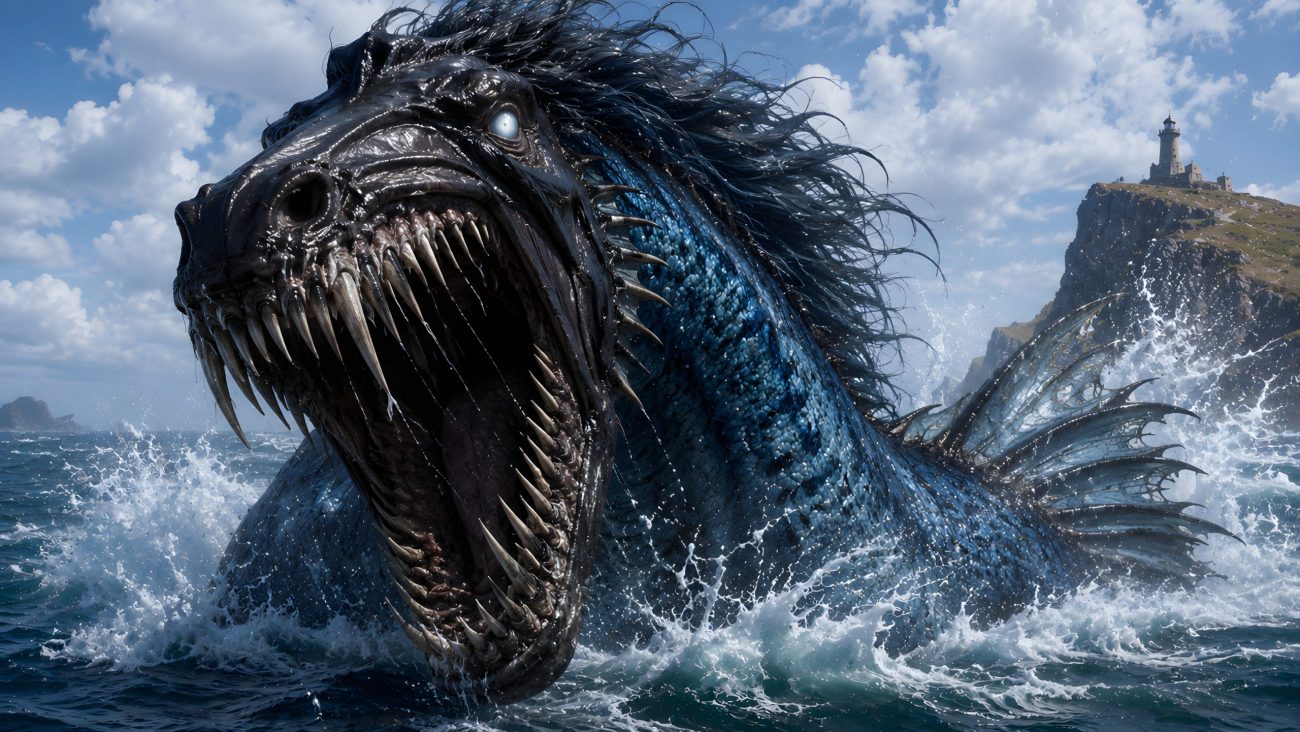
The Beisht Kione Dhoo, or the Beast of Black Head, is one of the most feared sea creatures in Manx folklore. It is said to dwell within the sea caves of Black Head, near Spanish Head at the southern tip of the Isle of Man.

Those who claim to have encountered the creature describe it as having the head of a large horse. Fishermen sailing near Spanish Head have reported hearing its terrifying roars echoing across the sea, and the beast is regarded as a dangerous presence capable of bringing disaster upon fishing vessels.

According to one tradition, the Beisht Kione Dhoo is the restless soul of a man murdered by pirates to guard a hidden treasure concealed within the caves of Black Head. Because of the fear surrounding the creature, no one is said to have attempted to recover the treasure.

To appease the beast and secure good fortune, offerings of rum were left in the caves at Spanish Head. Fishermen also threw a glass of rum into the sea before beginning their voyage, hoping the Beisht Kione Dhoo would spare them from harm and reward them with a plentiful catch.


Sources

A Book of Creatures. (2017, July 10). Beisht Kione Dhoo. Retrieved June 29, 2026, from https://abookofcreatures.com/2017/07/10/beisht-kione-dhoo/


Moddey Dhoo

Tradition / Region: Manx Mythology
Alternate Names: Mauthe Doog
Category: Dog, Ghost


The Myth

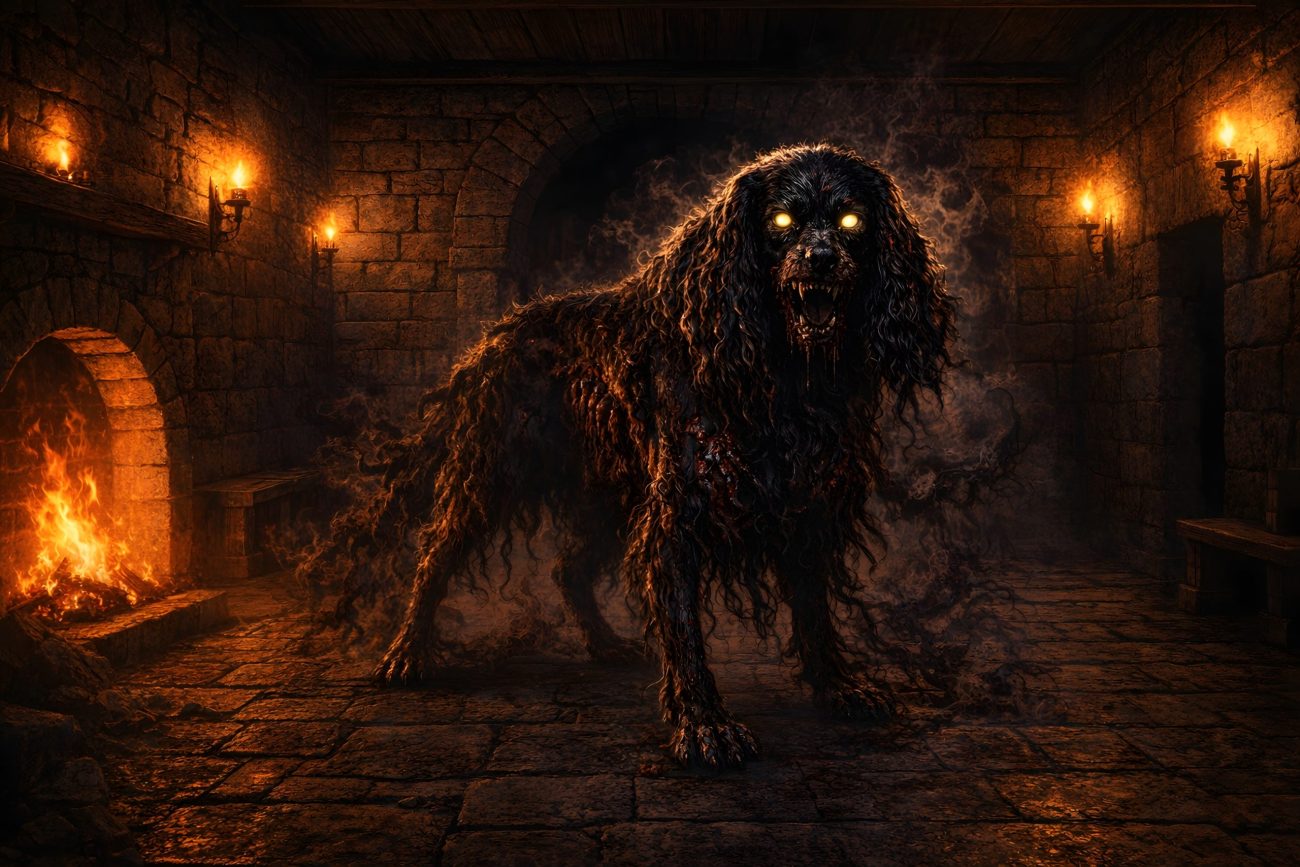
In the Isle of Man there was once said to haunt Peel Castle a great black spectral dog known as the Moddey Dhoo.

It appeared as a large shaggy hound, often described as resembling a black spaniel. The creature was seen moving through the rooms of the castle, but most often it lay in the guardroom beside the fire, visible to the soldiers stationed there. Over time, they grew accustomed to its presence, though it never ceased to disturb them.

The dog was said to enter and leave through a certain passage in the castle each evening and return to it again at dawn.

One night, a guard, emboldened by drink, ignored the custom that the castle gates should be locked by two men together. He took the keys alone and went down the haunted passage to deliver them. Soon afterward, he returned pale and shaken, unable or unwilling to say what he had seen.

Within a few days he died.

After this, the passage was sealed and never used again. From that time onward, the black dog was no longer seen.

Thus the Moddey Dhoo was remembered as the silent hound of Peel Castle — a spirit that walked the halls, appeared before soldiers, and vanished after leaving one final warning behind.


Sources

Wikipedia contributors. (n.d.). Moddey Dhoo. In Wikipedia, from https://en.wikipedia.org/wiki/Moddey_Dhoo


Buggane

Tradition / Region: Manx Mythology
Alternate Names: Boagane; Buggan ny Hushtey
Category: Mountain dweller, Ogre


The Myth

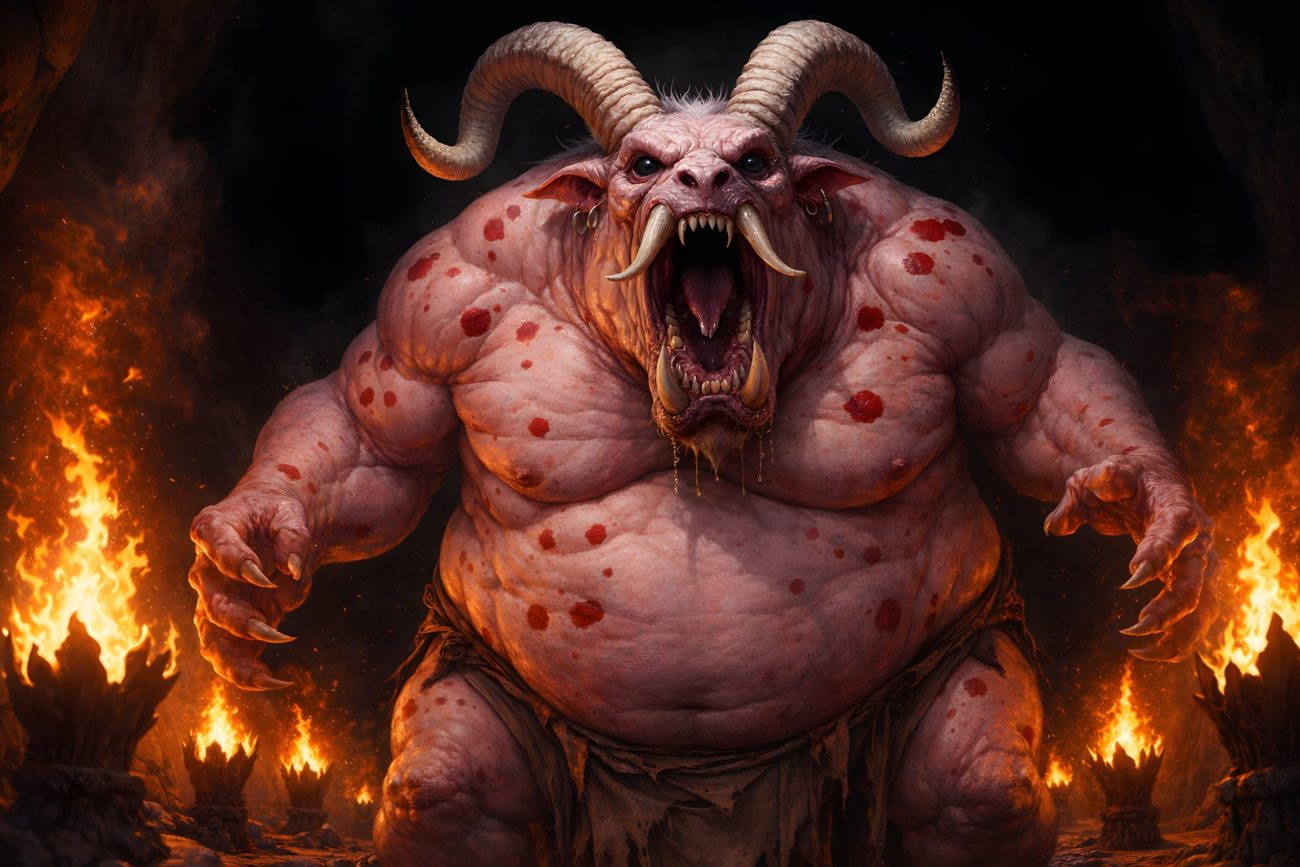
On the Isle of Man there once roamed a terrible being known as the Buggane—a great, hulking creature of malice and brute strength.

The Buggane was a shapeshifter. At times it appeared as a monstrous black calf, at others as a towering man with horse’s ears or hooves. In its truest and most dreadful shape it was covered in coarse black hair, with blazing eyes like torches and sharp tusks gleaming in its mouth. Some said it bore bull’s horns. It was so immense that it could tear the roof from a church as easily as a man might lift a hat.

Though powerful, the Buggane had its limits. It could not cross running water, nor could it stand upon ground made holy.

One tale tells of a Buggane that found itself accidentally carried away on a ship bound for Ireland. Furious at being taken from its island home, it whipped up a savage storm, driving the vessel toward the jagged rocks of Contrary Head. The terrified captain prayed to St. Trinian, promising to build him a chapel if they were spared. The saint guided the ship safely into Peel Harbour. Enraged, the Buggane roared, “St. Trinian shall never have a whole church in Ellan Vannin!”

True to its word, when a chapel was built in the saint’s honor, the Buggane tore its roof off—once, twice, three times—so that St. Trinian’s Church was never left complete.

Bugganes were not only destroyers of churches. They plagued farms and villages. One from Glen Maye nearly hurled a lazy housewife into a waterfall for neglecting her baking. She escaped only by slipping free of her apron strings. Another, at Gob-na-Scuit, ripped thatch from haystacks, blew smoke back down chimneys, and shoved sheep from steep grassy cliffs.

Some Bugganes lived by the sea in dark caves. The Buggan ny Hushtey was known for despising idleness, punishing those who shirked their work.

Most famous of all is the battle between the Buggane of Barrule and the Irish giant Fionn mac Cumhaill.

When Fionn came to the Isle of Man, the Buggane sought him out for combat. Fionn wished to avoid the fight, so his clever wife disguised him as a baby and laid him in a cradle. When the Buggane saw the size of the “child,” he thought, “If this is the baby, what size must the father be?” and withdrew—for a time.

But they did meet at last, near Kirk Christ Rushen. From sunrise to sunset they fought. Fionn planted one foot in the Big Sound and the other in the Little Sound, shaping the channels between the Calf of Man, Kitterland, and the main island as he struggled. The Buggane stood firm at Port Erin. In the end, the Buggane wounded Fionn so grievously that he fled toward Ireland.

The Buggane could not follow across the sea. Instead, it tore out one of its own teeth and hurled it after him. The tooth struck Fionn and fell into the water, becoming the jagged rock known today as Chicken Rock. Fionn turned and laid a mighty curse upon it, condemning it to remain there as a hazard for sailors as long as water runs and grass grows.

And so the Bugganes remain in Manx memory—wild, shape-shifting giants of fury and strength, feared for their violence and remembered in the land itself.


Sources

Wikipedia contributors. (n.d.). Buggane. In Wikipedia, The Free Encyclopedia. Retrieved February 14, 2026, from https://en.wikipedia.org/wiki/Buggane


Little Fellows

Tradition / Region: Manx mythology
Alternate Names: Themselves, Little People, Little Ones, Lil’ Boys
Category: Gnome


The Myth

On the Isle of Man, the Little Fellows still walk the land—though never, ever should they be called fairies. To name them so is careless, even dangerous. They are spoken of politely, as Themselves or the Little People, for they may be listening.

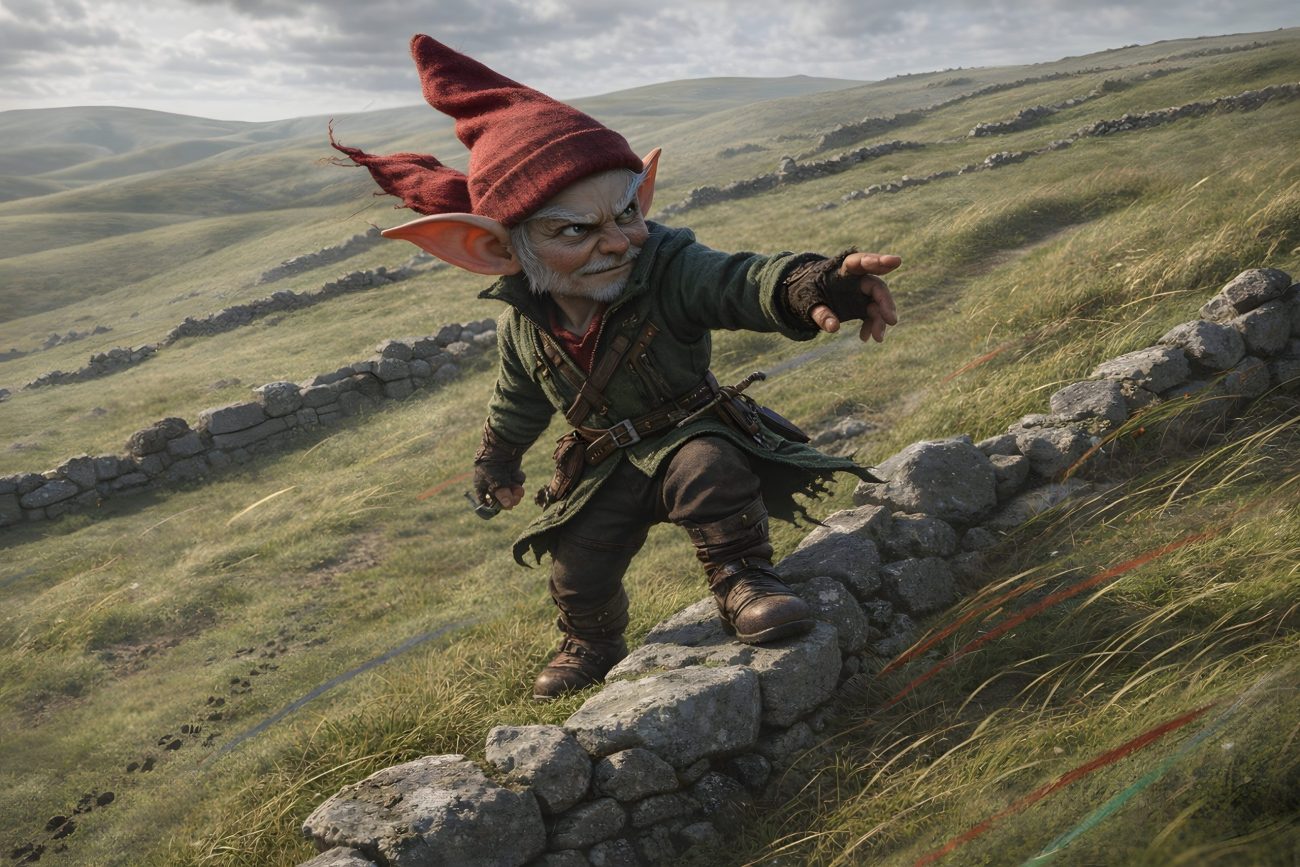
The Little Fellows are not tiny, winged creatures, but small folk, two to three feet tall, shaped much like humans. They dress in red caps and green jackets, and they love the hunt above all things. Many have seen them riding out on horseback, followed by packs of little hounds shimmering in every color of the rainbow. Their hunting parties pass swiftly through fields and hills, vanishing as suddenly as they appear.

They are clever, willful, and easily offended. Mischief comes naturally to them, and spite is never far away. A careless word, a disrespectful glance, or a failure to show courtesy may earn their anger. That is why the people of the island speak of them kindly and indirectly, giving them flattering names so as not to draw ill luck.

Though troublesome, the Little Fellows are not wholly evil. They live alongside the human world, slipping in and out of sight, riding the hills, running their hounds, and watching how people behave. Those who respect them may pass unharmed. Those who forget themselves may learn—too late—that the Little People have long memories, sharp tempers, and ways of reminding humans that Ellan Vannin is not theirs alone.


Sources

ManxLiterature.com contributors. (n.d.). Manx fairy tales. In ManxLiterature.com, from https://manxliterature.com/sort-by-genre/other/manx-fairy-tales/