Jibakurei

Tradition: Japanese Mythology
Alternative Names: 地縛霊, Earth-Bound Spirit, Land-Bound Ghost
Category: Ghost


The Myth

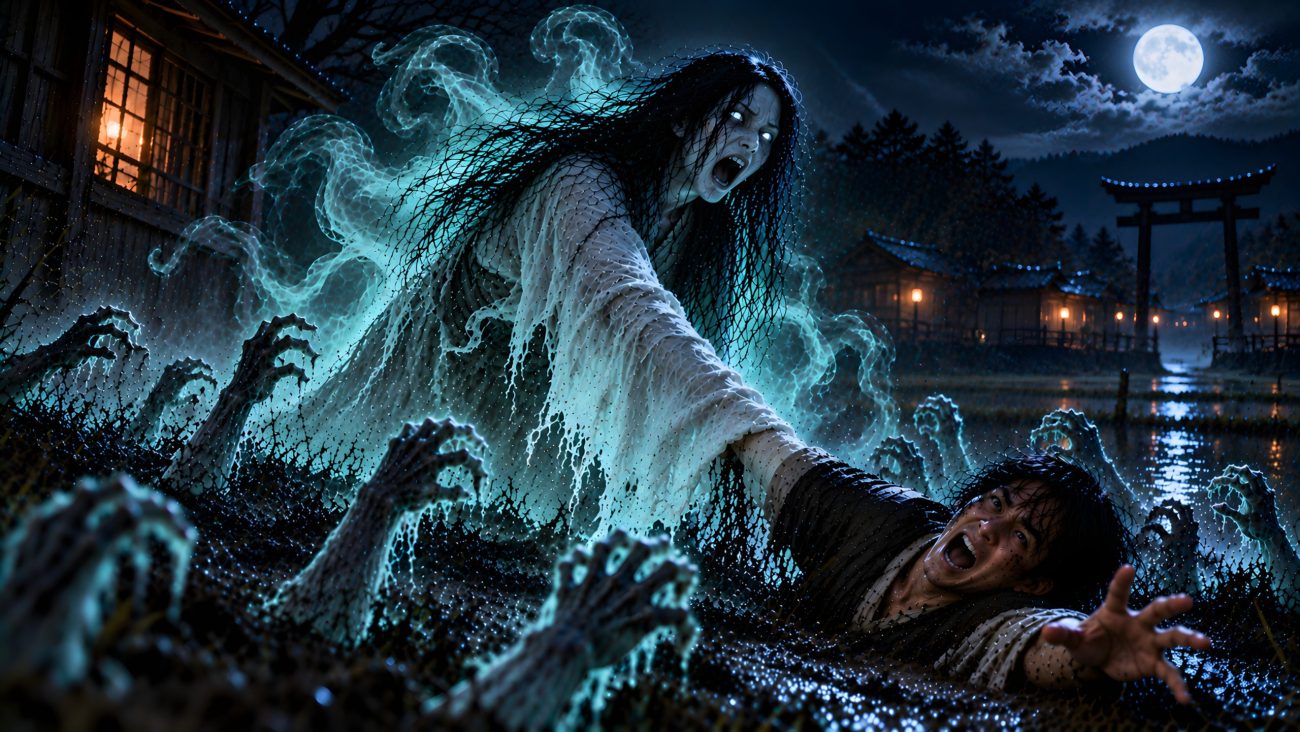
Jibakurei are spirits of the dead believed to remain bound to a particular place, such as a piece of land or a building. They may be unable to accept their own death or may not realise that they have died. Other spirits remain in a location because of a special attachment or unresolved reason connected to that place.

According to descriptions of these spirits, a sudden death caused by war, an accident, or a disaster may leave the deceased unable to accept what has happened. Strong emotions, such as hatred, can also keep a spirit tied to the place where it died. Some accounts describe spirits of people who died by suicide as unaware of their death, repeatedly reenacting the act. Until they become conscious of their death, these spirits are believed to remain bound to the location as Jibakurei.


Sources

“地縛靈 (Dìbǎlíng).” Chinese Wikipedia. Wikimedia Foundation. Accessed October 16, 2026. https://zh.wikipedia.org/wiki/%E5%9C%B0%E7%B8%9B%E9%9D%88
Huangfu Gui

Tradition: Chinese Mythology
Alternative Names: 黃父鬼, Huang Father Ghost, Yellow Father Demon
Category: Ghost


The Myth

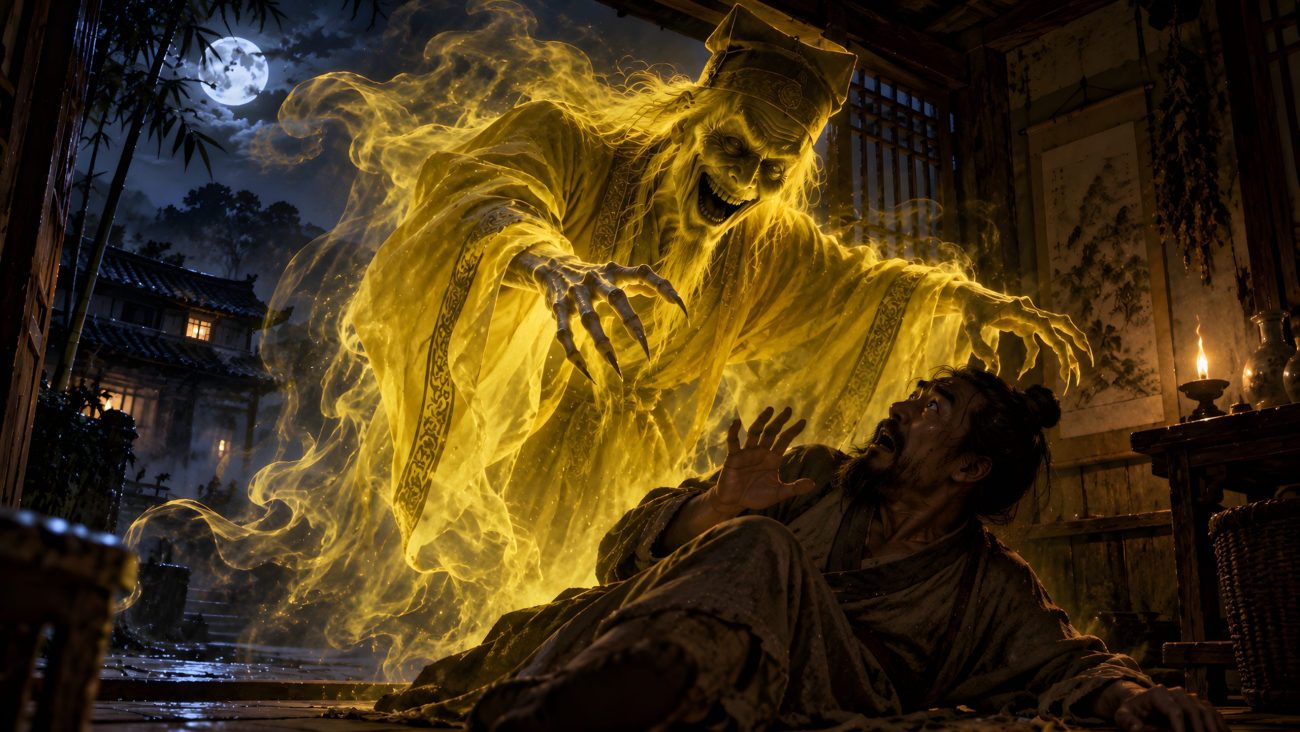
Huangfu Gui is a malevolent supernatural being recorded in Chinese literature as appearing around the fifth and sixth centuries, particularly in Hubei Province. It is described as wearing yellow clothing, and some accounts portray its entire body, from head to toe, as yellow. The spirit is associated with the spread of disease and was greatly feared by local inhabitants.

Huangfu Gui is said to enter people’s homes, often remaining invisible or taking on different forms. It can transform into a woman, birds, other animals, or even smoke, making its true appearance difficult to determine. Despite its threatening nature, the creature is described as constantly smiling or laughing. According to the legend, if it stands before a household’s entrance and laughs aloud, the people living inside will fall ill with an epidemic disease.

The spirit was also worshipped as a supernatural deity by inhabitants of Yuzhang Commandery, and some accounts say that it claimed to be a mountain god. Its ability to change shape, enter homes, and bring sickness made it both a feared and mysterious presence. Stories of Huangfu Gui appear in classical Chinese collections, including the Taiping Guangji and the Shuyi Ji.


Sources

“黄父鬼 (Huángfùguǐ).” Chinese Wikipedia. Wikimedia Foundation. Accessed October 16, 2026. https://zh.wikipedia.org/wiki/%E9%BB%84%E7%88%B6%E9%AC%BC


Blauwe Gerrit

Tradition: Dutch Mythology
Alternative Names: Blauw Garrit, Blue Gerrit
Category: Ghost


The Myth

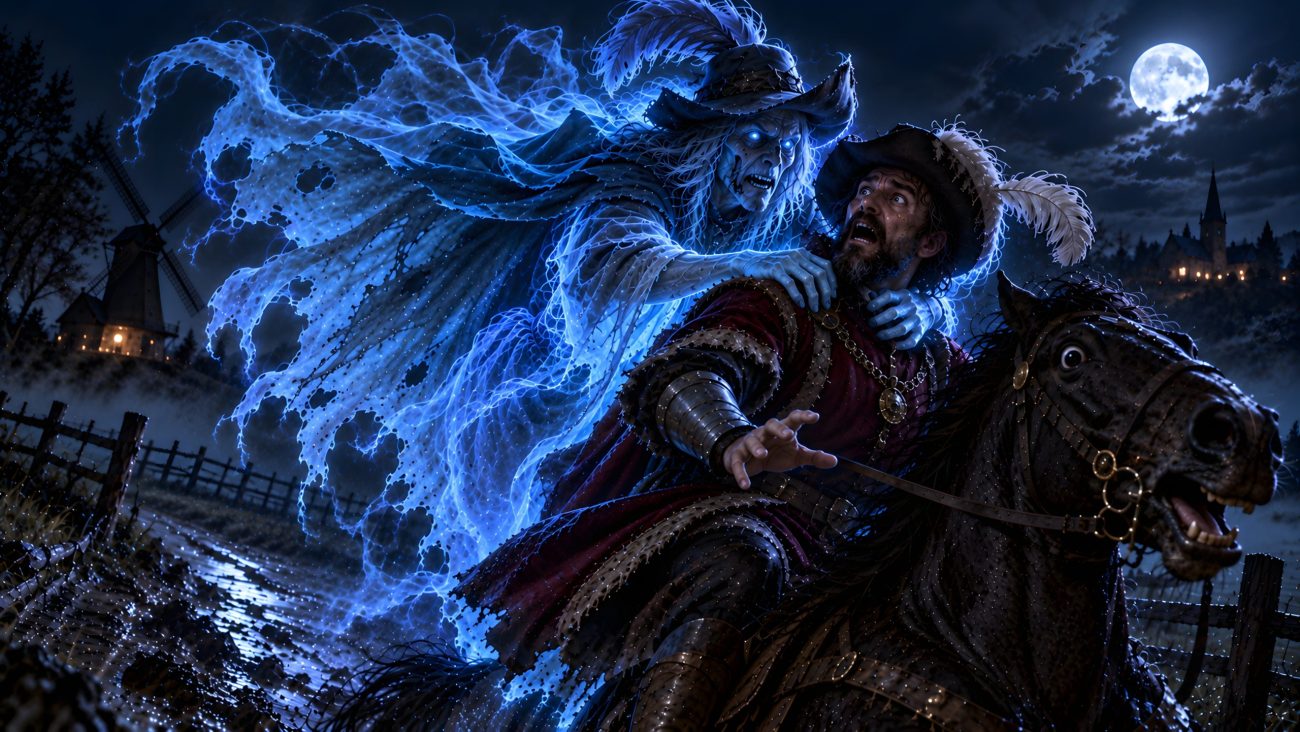
Blauwe Gerrit, whose name means Blue Gerrit, is a mysterious spirit from Gelderland in the Netherlands. He is known for invisibly climbing onto carts and horses, preventing them from moving forward. When he reveals himself, he is described as having glowing eyes and wearing a fluttering, luminous blue cloak that makes him a striking and unsettling apparition.

Despite his frightening appearance, Blauwe Gerrit can act as a protector of the vulnerable. In one tale, a young girl was threatened with abduction by a predatory knight. Blauwe Gerrit secretly climbed onto the knight’s horse, causing the animal to refuse to move no matter how much the rider tried to make it go forward. Eventually, the knight dismounted to investigate. At that moment, Blauwe Gerrit leapt onto the knight’s neck, rendering him completely unable to move.

The spirit forced the knight to remain outside in the freezing cold for the entire night, giving the girl an opportunity to escape. The story portrays Blauwe Gerrit as a supernatural figure who uses his strange power over horses and people to obstruct wrongdoing and protect those in danger.


Sources

Van der Veen, Abe. “Van aardmannetje tot zwarte juffer: Een lijst van Nederlandse en Vlaamse elfen en geesten.” Abe de Verteller. https://abedeverteller.nl/van-aardmannetje-tot-zwarte-juffer-een-lijst-van-nederlandse-en-vlaamse-elfen-en-geesten/


Pastor of Nennig

Tradition: Luxembourg Mythology
Alternative Names: Der Pastor von Nennig
Category: Ghost


The Myth

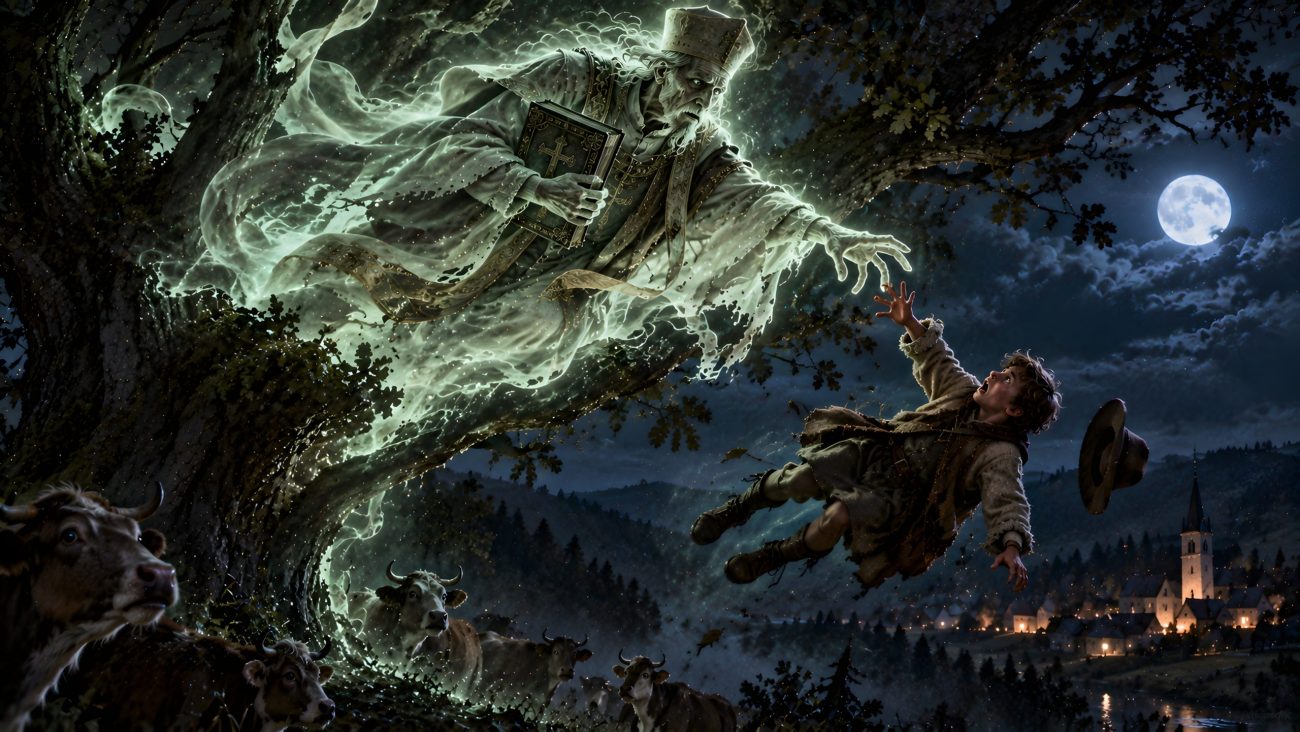
The Pastor of Nennig is the ghost of an elderly priest who appears to a young boy tending cattle near the village of Nennig. The apparition sits in a tree where the first branches begin to spread from the trunk. Dressed in priestly vestments and holding a missal, the old man appears to murmur a prayer while gazing pleadingly at the boy. For six weeks, the boy sees the same apparition without telling anyone, until fear finally drives him to confess the matter to his spiritual father.

Following his confessor’s advice, the boy approaches the priestly apparition and asks what he wants. The ghost reveals that he was the penultimate pastor of Nennig and that he still owes the Virgin Mary a Mass. The boy, who was the priest’s last baptismal candidate, is the only person who can release him. The priest instructs him to pray the Ave Maria, make a pilgrimage to Luxembourg, and offer a consecrated candle at the high altar in honour of the Queen of Heaven.

The devout boy undertakes the pilgrimage accompanied by many other worshippers. At the Church of Our Lady in Luxembourg, he walks three times around the high altar in silent prayer and places the consecrated candle on its steps. He then declares that the priest has been released. The elderly ghost, who has accompanied the pilgrims throughout their journey, rises towards heaven. However, the boy is so deeply affected by these events that his health deteriorates, and he soon dies. According to the legend, the priest had been praying after him, calling him to follow into death. The tale reflects a local belief that the dead can summon the people they loved most in life to join them in the afterlife.


Sources

La Fontaine, Edmond de. Luxemburger Sagen und Legenden. Gesammelt und herausgegeben von Ed. de la Fontaine. Luxemburg: Jos. Beffort, 1882.


Spear-Bearer

Tradition: Luxembourg Mythology
Alternative Names: Der Lanzenträger, The Lancer
Category: Ghost


The Myth

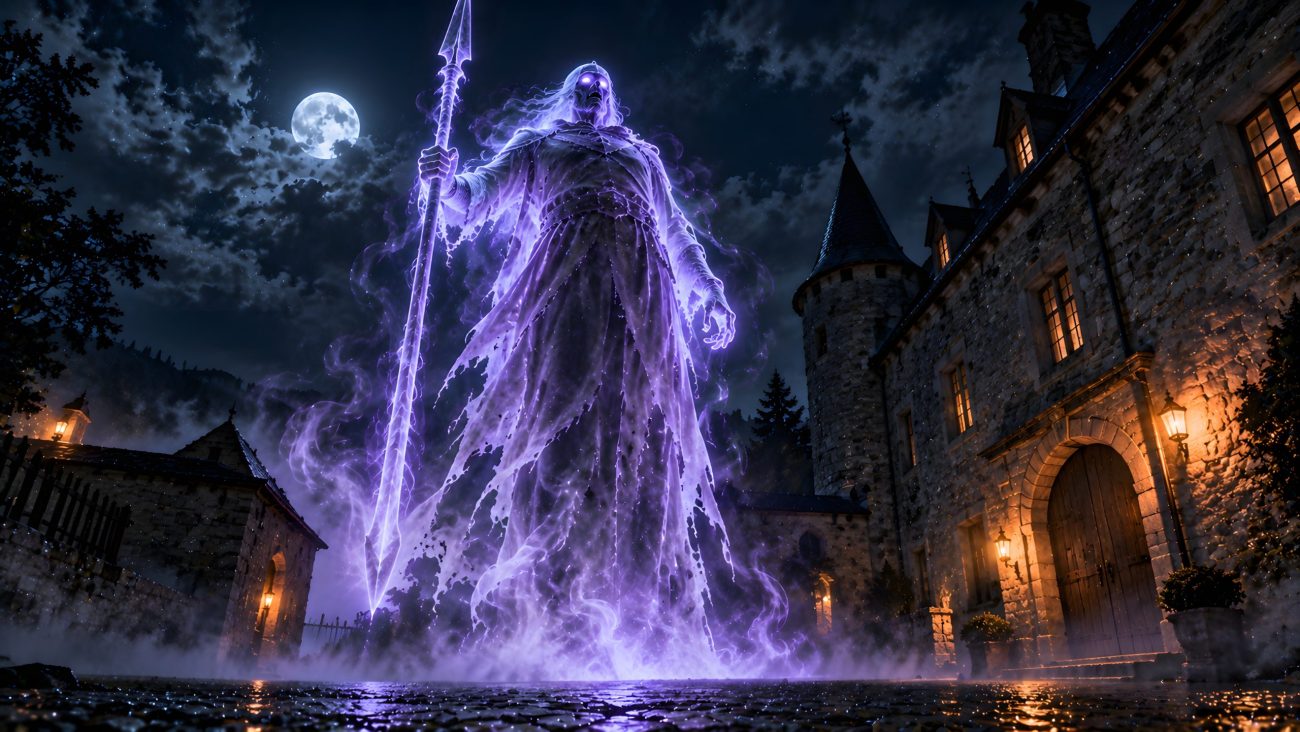
The Spear-Bearer is a mysterious apparition said to appear at midnight before the main entrance of the tenant farmer’s house in the courtyard of Born Castle in Luxembourg. The figure takes the form of a man holding a spear in his hand and remains completely silent.

As he stands before the entrance, the Spear-Bearer gradually grows taller and taller until his head reaches the height of the castle roof. Once he has attained this enormous size, he suddenly disappears. His silent appearance, unnatural growth, and unexplained disappearance make him a haunting presence associated with the grounds of Born Castle.


Sources

La Fontaine, Edmond de. Luxemburger Sagen und Legenden. Gesammelt und herausgegeben von Ed. de la Fontaine. Luxemburg: Jos. Beffort, 1882.


Velna Bedre

Tradition: Latvian Mythology
Alternative Names: Devil’s Pit
Category: Ghost


The Myth

Velna Bedre, meaning the Devil’s Pit, is a sinister place in Latvian legend associated with dangerous supernatural forces. According to Andrejs Pumpurs’s epic poem Lāčplēsis, the pit lies in a landscape shaped by the actions of the devil and the thunder god Pērkons. In the tale, the devil digs a bottomless hole in the course of the Daugava River, causing the river to plunge into its depths. Pērkons responds with lightning and redirects the waters, raising a steep-sided hill around the pit.

The place retains its frightening reputation long after these events. Travellers passing through the area at night are warned that ghosts appear and attempt to deceive them, luring them into the pit and bringing them harm. The legend presents Velna Bedre as a dangerous place where the ordinary world borders a realm of malevolent supernatural beings.

Velna Bedre is also connected to the witch Spīdala and her companions. After travelling through the night on enchanted wooden blocks, they descend into the Devil’s Pit, where witches gather in a strange underground dwelling filled with bones, skulls, magical objects, and monstrous creatures. The pit thus serves not merely as a haunted landmark but as an entrance to a hidden world of witches, devils, and dark magic.


Sources

Pumpurs, Andrejs. “II daļa.” In Lāčplēsis. Archived version, Internet Archive Wayback Machine, January 31, 2006. https://web.archive.org/web/20060131100630/http://www.ailab.lv/Teksti/Senie/Pumpurs/2.dala.html


Old Helgenhüsli Ghost

Tradition: Swiss Mythology
Alternative Names: The Haunted Helgenhüsli, The Spirit of Nasenegg
Category: Ghost


The Myth

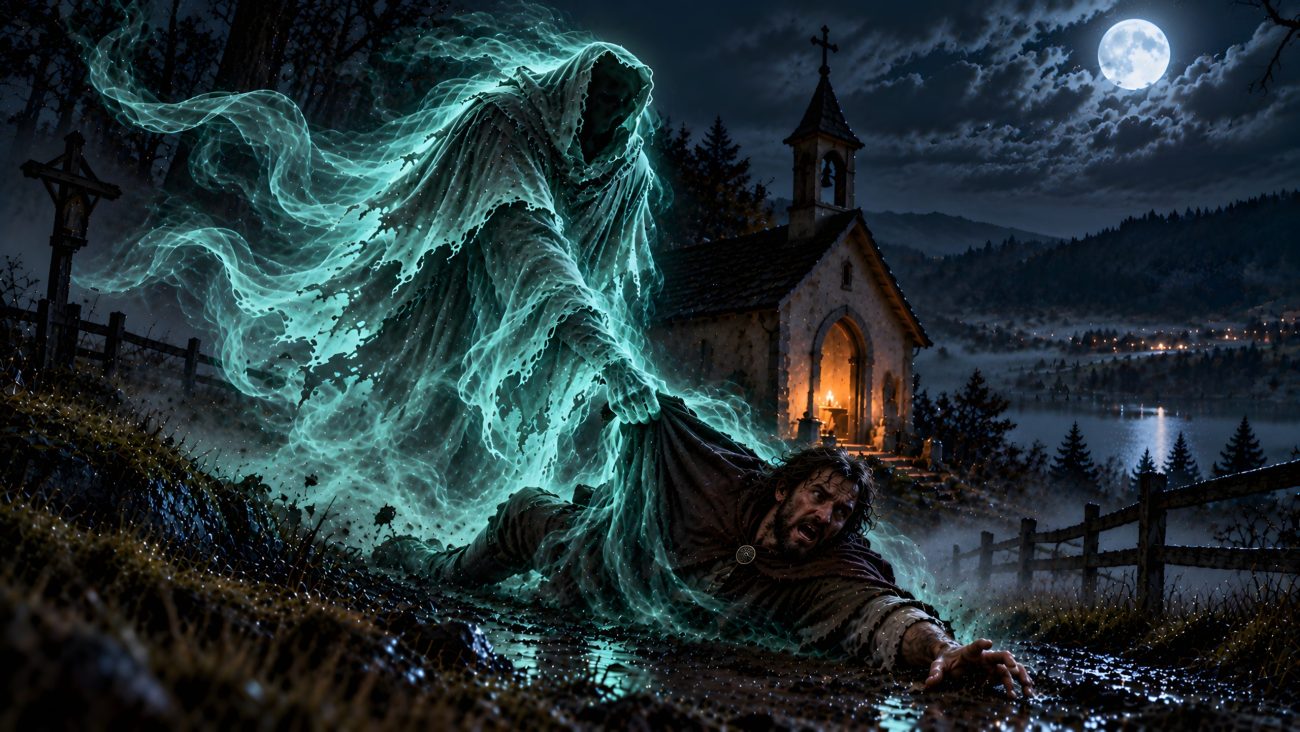
The old Helgenhüsli, a small wayside chapel that once stood along the path from Erlenmoos to Schwandegg, near Bärfalle, was reputed to be haunted. Although the building was demolished about a century ago, stories of its supernatural disturbances survived. One night, Ammann Uhr was returning from Einsiedeln and attempted to pass the little chapel, but a mysterious spirit led him astray. He wandered through the surrounding moorland for three hours, unable to recognize the landscape or find his way. Only as dawn approached did the misleading presence finally depart, allowing him to escape the bewildering ordeal.

The chapel was also said to repel those who tried to enter it. A man from Holzhäusern once went there at night to wait for a friend. As he attempted to enter the building, an invisible hand gave him a powerful shove, preventing him from going inside. The same strange occurrence had reportedly happened to the friend he was expecting, suggesting that an unseen spirit guarded the little chapel and refused entry to visitors.

Another eerie place lay along the road from Zug to Walchwil, below Lothenbach, at a spot known as Nasenegg. This location was associated with an apparition witnessed by a sober local man, who claimed to have seen a ghost there years earlier. The figure was particularly strange because it possessed neither a head nor any other limbs. These accounts established several locations around Zug as places where invisible forces, disorienting spirits, and bizarre apparitions disturbed those who encountered them.


Sources

“Die Gespensterorte.” SAGEN.at – Traditionelle Sagen aus der Schweiz (Zug). Reproduced by SAGEN.at. https://www.sagen.at/texte/sagen/schweiz/zug/gespensterorte.html


Ghost Cart

Tradition: Swiss Mythology
Alternative Names: The Phantom Cart of the Sihl Ravine
Category: Ghost


The Myth

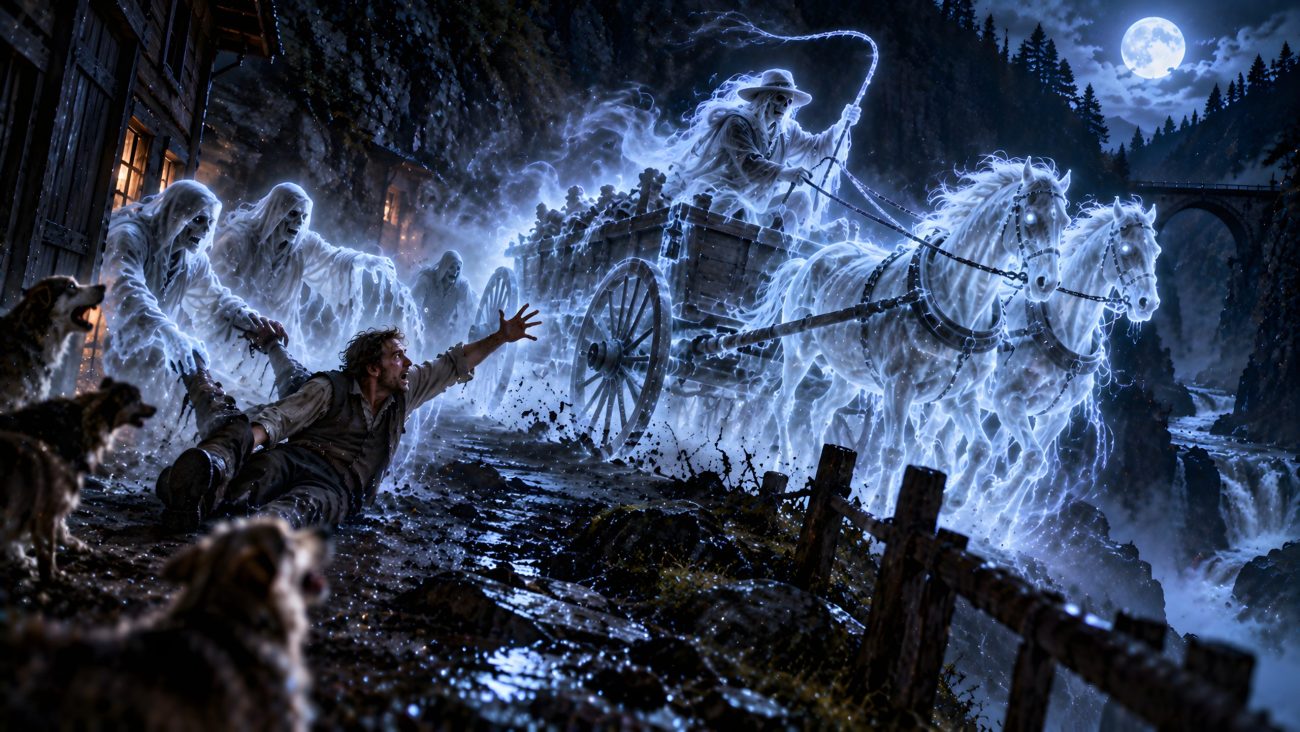
In the old house of Friedli Menzinger, a man who was later beheaded, there once lived a poor widow with a large family of hungry children. Not far from the house lay an enchanted ravine carved by the Sihl River, whose waters often raged fiercely. On certain nights, the quiet of the surrounding countryside was disturbed by a strange and unsettling sound coming from the narrow path through the ravine.

The noise resembled a heavily laden cart struggling to make its way uphill, its wheels and load apparently laboring along the steep, confined track. The sound was so frightening that the widow never dared to look through her window or peer through the narrow cracks in her shutters. Whenever the ghostly cart approached, an even more terrible commotion erupted around the house: dogs and cats howled wildly and seemed to rage around the property.

The mysterious vehicle became known as the ghost car from the Sihl ravine. Its exact nature and origin remained unexplained, but its nocturnal passage brought terror to the widow and her children. The legend preserves the image of a phantom cart whose unseen journey could be heard in the darkness, accompanied by the furious howling of animals around the old house.


Sources

“Der Geisterwagen.” SAGEN.at – Traditionelle Sagen aus der Schweiz (Zug). Reproduced by SAGEN.at. https://www.sagen.at/texte/sagen/schweiz/zug/geisterwagen.html


Berg Ghost

Tradition: Swiss Mythology
Alternative Names: The Chain-Rattling Ghost of Berg
Category: Ghost


The Myth

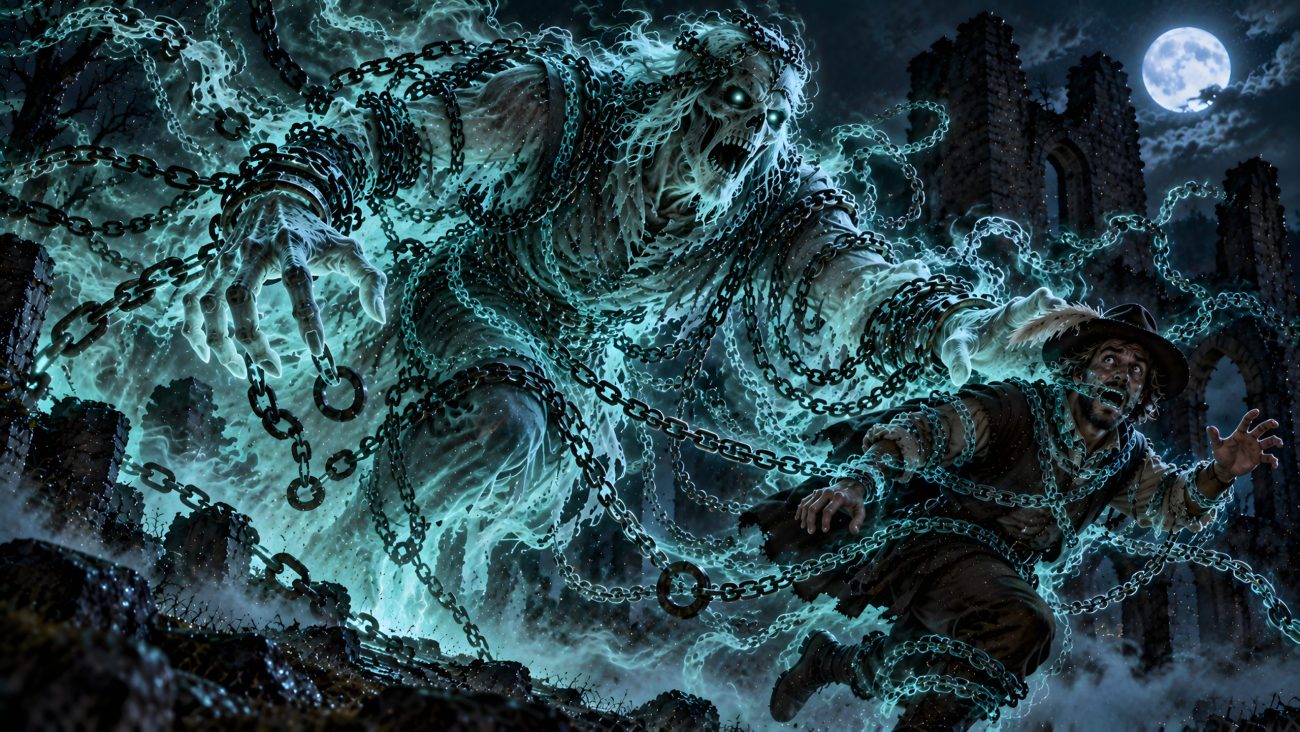
Near Berg in the Swiss canton of St. Gallen, an old and dilapidated town once stood abandoned. A man had taken his own life there, and afterward the place became associated with a disturbing supernatural presence. At night, people reportedly heard the sounds of unseen movements and the horrible rattling of chains, as though a restless spirit were wandering among the ruins. The eerie noises gave the deserted settlement a frightening reputation.

Only one man claimed to be unafraid of the apparition, boasting that even the wicked could not frighten him. Determined to demonstrate his courage, he approached the haunted place, but two miller’s apprentices had prepared a trick. They hid nearby and rattled chains to imitate the terrifying sounds attributed to the ghost. When the supposed haunting began, the self-proclaimed hero fled in fear.

The tale turns the legend of a restless spirit into a humorous story about false bravery. The ghostly noises that supposedly haunted the ruined town were revealed to be the work of mischievous pranksters, while the man who claimed to fear nothing proved unable to withstand even an imitation of the supernatural.


Sources

“Gefährlich.” SAGEN.at – Traditionelle Sagen aus der Schweiz (St. Gallen). Reproduced by SAGEN.at. https://www.sagen.at/texte/sagen/schweiz/st_gallen/gefaehrlich.html


Walchwil Ghost

Tradition: Swiss Mythology
Alternative Names: The Ghost of the Walchwil Vineyards
Category: Ghost


The Myth

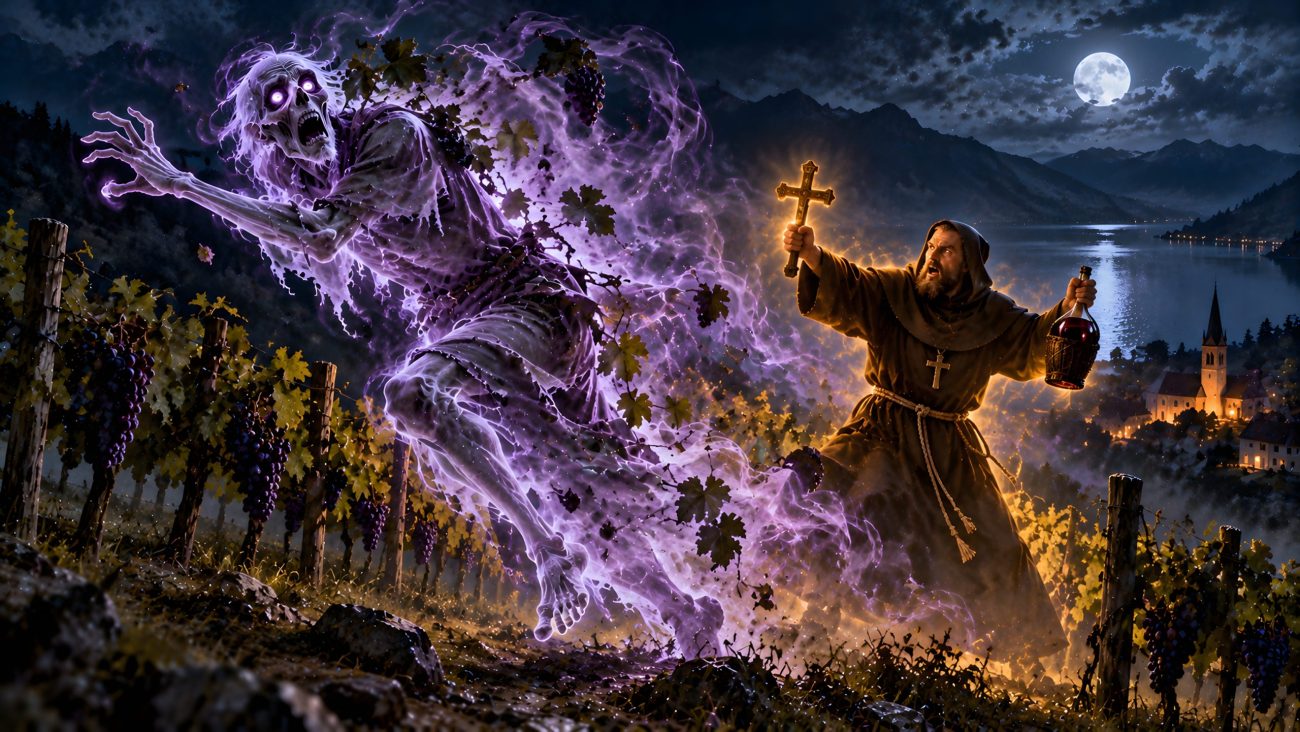
Many years ago, the picturesque hills of Walchwil in Switzerland were famous for producing an exceptionally fine wine said to possess mysterious powers. The wine was celebrated far beyond the village, and wondrous tales circulated about its strength. Yet the vineyards were also haunted by an evil ghost that tormented and terrified people of all ages, appearing both in daylight and under the cover of darkness. The pious winegrowers and fishermen of Walchwil struggled for a long time to find a way to rid themselves of the troublesome spirit.

Their hopes rose when a small monastery of Capuchin friars was established in nearby Arth. Desperate for help, the inhabitants sent a messenger to the neighboring village, asking the monks to drive away the ghost. A Capuchin friar answered their plea and came to Walchwil. Before attempting the exorcism, however, he demanded half a liter of the village’s fiery wine.

The ghost was terrified by the friar’s plan and immediately fled, declaring that if the priest drank even half a liter of Walchwil wine, it would be completely defeated. From that moment onward, the evil spirit was never seen in the vineyards again. The legend celebrates the extraordinary strength of Walchwil wine, whose reputation proved powerful enough to overcome even a terrifying supernatural enemy.


Sources

“Der Wein.” SAGEN.at – Traditionelle Sagen aus der Schweiz (Zug). Reproduced by SAGEN.at. https://www.sagen.at/texte/sagen/schweiz/zug/wein.html