Okita

Tradition: Japanese Mythology
Alternative Names: Okita, おきた
Category: Ghost


The Myth

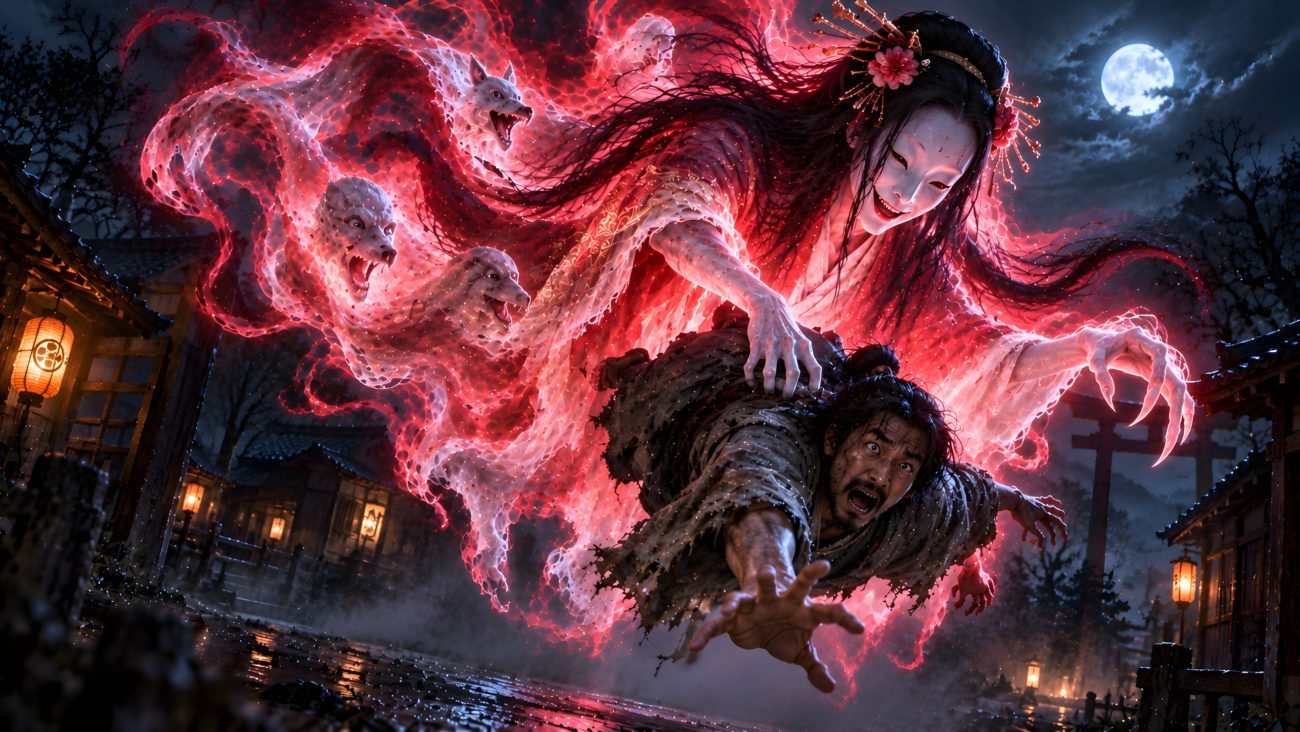
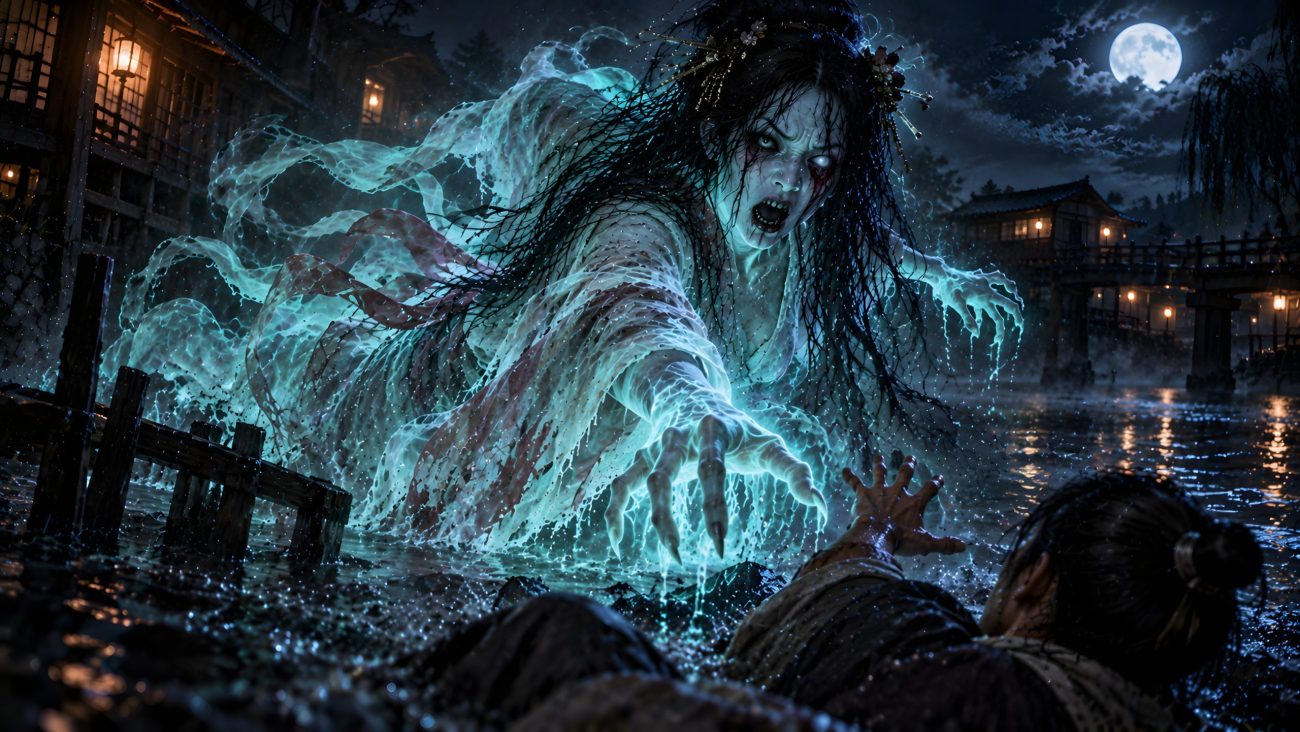
Okita is a tragic woman whose story appears in Tsuruya Nanboku’s illustrated supernatural novel Kaidan Iwakura Mannojō. She is the daughter of Chōshichi, who runs an establishment in Osaka associated with performers who specialize in female impersonation in Kabuki theatre. Okita falls deeply in love with Iwakura Mannojō, a female impersonator who becomes her husband. Despite her devotion, Mannojō is a reckless man who wastes money on drinking and gambling, repeatedly demands money from her, and eventually abandons her while travelling to perform in the provinces. Okita remains faithful and works hard to support herself, but her husband’s debts leave her homeless and destitute. Her only comfort comes from Matasuke, a former servant who helps her financially, and her beloved cat, which mysteriously brings her small silver coins.

Mannojō eventually travels to Echigo, where he begins an affair with Otaka, the daughter of a retainer named Yanagawa Geki. Geki learns Mannojō’s identity and schemes to elevate his own position by falsely presenting him as the missing second son of the Asai family. To clear the way for Mannojō’s new marriage, he sends Okita a letter claiming that her husband has died. Devastated by the news, Okita becomes ill, loses sight in one eye, and spends her days praying. When she finally learns the truth, her grief turns into overwhelming hatred. As she combs her hair, great clumps fall out before her, and she becomes consumed by a desire for revenge. She wanders about in a deranged state, asking for the way to Echigo, before disappearing. On the forty-ninth day after her disappearance, Matasuke discovers a woman’s skull in the Yodo River, with a large, one-eyed eel occupying its eye socket. The eel speaks in Okita’s voice, revealing that she drowned and remains trapped between life and death. She begs Matasuke to have her remains buried and Buddhist prayers performed, but declares that she cannot rest until her vengeance against Mannojō is complete.

Okita’s curse soon reaches Mannojō and Otaka. Her cat appears at their drinking party carrying a false Buddhist memorial tablet and scratches Mannojō’s face. When the tablet is placed against Otaka’s face, it sticks fast, and both suffer grotesque swelling and a mysterious illness. They become increasingly isolated as their servants flee, while Mannojō suffers visions of Okita and attacks those around him in fits of madness. Otaka eventually gives birth to a monstrous, one-eyed eel, which Geki secretly throws into a stream. The family’s misfortunes culminate in violence and betrayal, and Geki kills Mannojō and Otaka while attempting to conceal his own wrongdoing. At Mannojō’s funeral, a terrifying creature known as a Kasha descends amid a storm and seizes the corpse. Although the story does not explicitly identify the creature as Okita’s cat, the narrative suggests that her beloved animal may have transformed into the corpse-stealing monster. Geki is eventually captured after Matasuke exposes the truth, and the corrupt schemes surrounding Mannojō’s false identity are brought to an end. With the return of the Asai family’s stolen heirloom dagger, Okita’s brutal revenge finally concludes.


Sources

“Okita.” 新版TYZ 妖怪図鑑 (New TYZ Yokai Encyclopedia). https://tyz-yokai.blog.jp/archives/1060178316.html
Osawa

Tradition: Japanese Mythology
Alternative Names: Oosawa, おおさわ
Category: Ghost


The Myth

Osawa is a tragic woman whose vengeful spirit appears in the Japanese supernatural novel Kinsei Kaidan Shimoyo Hoshi, written by Ryūtei Tanehiko and illustrated by Katsushika Hokusai in 1808. The story takes place during Japan’s Bunmei era (1469–1487) and features a character based on Oiwa, the famous vengeful spirit of Japanese ghost lore. Osawa is the daughter and heiress of the Murota family. Although she possesses a pure heart, she is considered exceptionally ugly, with short, curly hair, rough skin, a crooked nose, prominent cheekbones, mottled teeth, and a voice compared to a wolf howling at the moon. She marries Takanishi Ihei, a rōnin from Bōshū, but he resents the marriage and eventually becomes devoted to Hanako, a beautiful woman with whom he had once shared a close relationship.

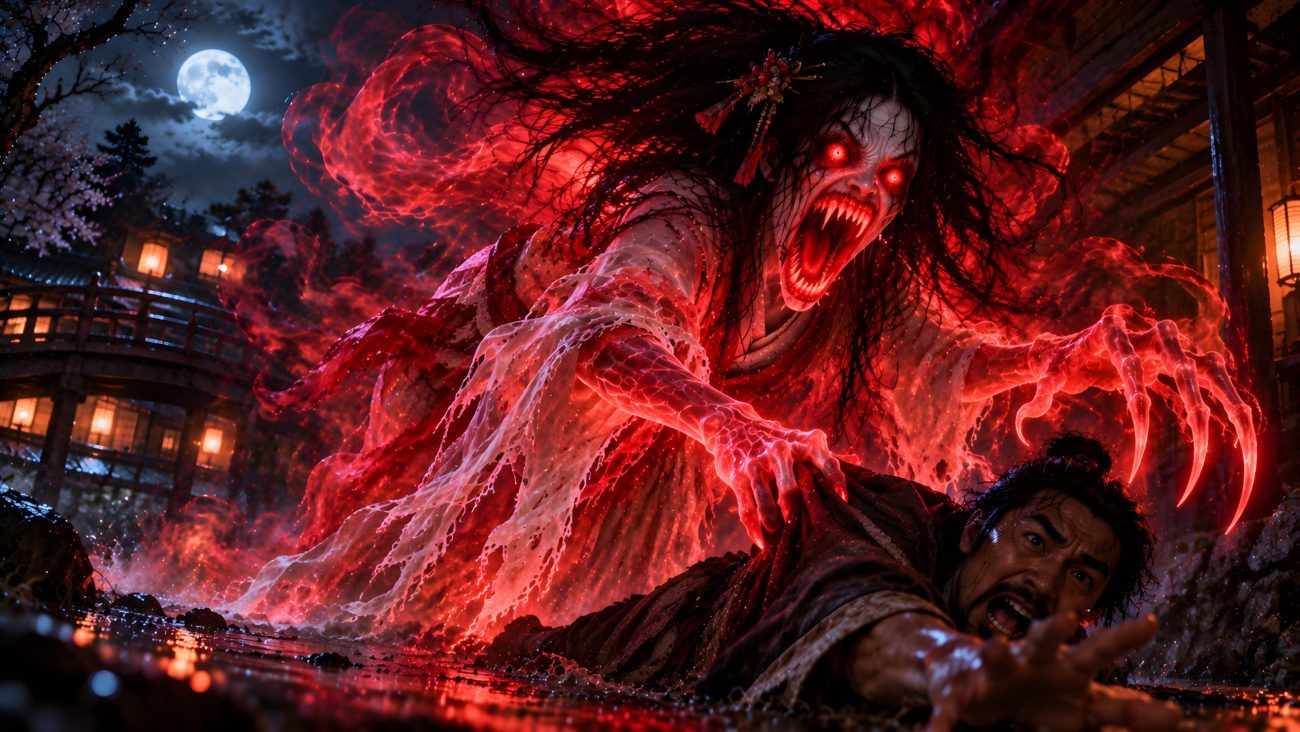
Ihei conspires with an accomplice to rid himself of Osawa. He pretends to be impoverished, sells her possessions, neglects their home, and falsely accuses her of infidelity before casting her out. Despairing at her treatment, Osawa throws herself into a stream. Ihei subsequently marries Hanako, but on their wedding night strange events begin to occur. Insects repeatedly extinguish their lamp, and a small snake falls from the ceiling. Ihei suspects that Osawa’s vengeful spirit has taken the form of the snake. It repeatedly returns, eventually carrying Hanako’s hairpin in its mouth, before vanishing into a shadowy flame. The couple later have children, but Osawa’s spirit continues to haunt those connected with her suffering, possessing people, causing madness, and bringing death and misfortune upon the families involved.

Osawa’s revenge grows increasingly terrifying. She appears as a pale woman with disheveled hair, manifests as ghostly fire, and confronts Ihei with a cold hand that seizes his collar. Her spirit can vanish and reappear elsewhere, while attempts to attack her prove futile, as though striking through mist. Snakes, hairpins, rats, and other uncanny manifestations become instruments of her curse. Ihei eventually develops a festering wound and confesses that his mistreatment of Osawa has brought these calamities upon him. His daughter Omura is also tormented by the spirit, and Ihei ultimately dies when a sash transforms into a snake and strangles him. Osawa’s haunting continues in the surrounding region, where ghostly fires and the sounds of an unseen carriage inspire fear. The apparitions finally cease after the Buddhist abbot Shōkai builds a mound for Osawa and chants sutras. In the story’s conclusion, Osawa’s accumulated grudges are finally released, and her spirit begins to find a path toward salvation through Buddhist prayer and mourning.


Sources

“Osawa” 新版TYZ 妖怪図鑑 (New TYZ Yokai Encyclopedia). https://tyz-yokai.blog.jp/archives/1038485591.html


Ushirogami

Tradition: Japanese Mythology
Alternative Names: 後神, うしろがみ, Behind Spirit
Category: Ghost


The Myth

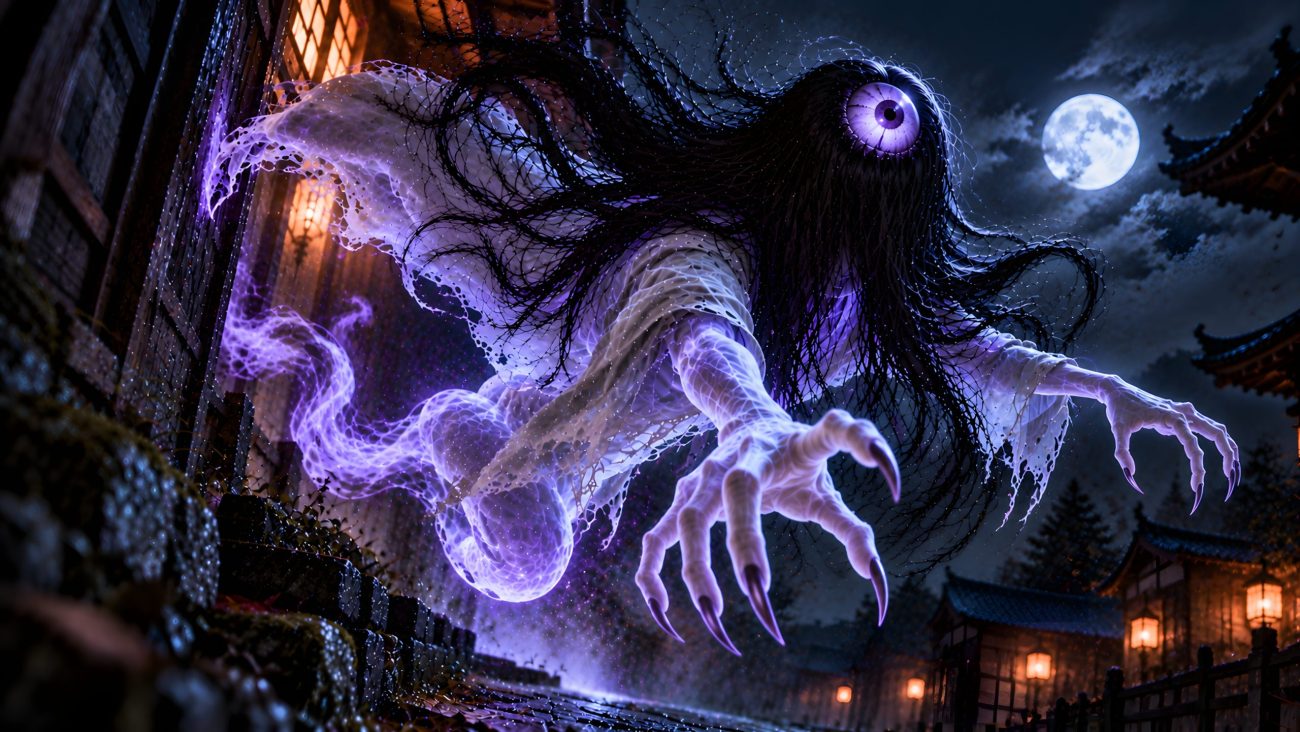
Ushirogami, whose name translates as “Behind Spirit,” is a Japanese supernatural being associated with cowardice and fear. It resembles a ghost with long black hair and a single large eyeball on the top of its head. Rather than having feet, it possesses a long, twisting body that allows it to leap high into the air. Ushirogami is considered a kind of okubyōgami, a spirit that causes cowardice or specifically preys upon those who are already timid.

The Ushirogami’s favorite trick is to sneak up behind unsuspecting people and frighten them. It tugs at the hair on the backs of their necks, then vanishes as soon as they turn around to discover who touched them. Sometimes it presses icy hands against their necks or breathes hot air onto them. The spirit particularly enjoys targeting cowardly young women walking alone at night. It may suddenly untie their hair, let it fall loose, or run its hands through it until it becomes tangled. It can also summon powerful gusts of wind to blow umbrellas away, leaving its victims startled and unsettled.

The Ushirogami’s name contains a wordplay that connects its supernatural behavior with human reluctance. The Japanese word ushiro means “behind,” while kami means “spirit” in this context. However, ushirogami also refers to the hair at the back of the neck. The expression ushirogami wo hikikaeru, meaning to have the hair at the back of the neck pulled, describes the painful reluctance of someone who must do something they desperately wish to avoid. As they search for an excuse to escape, they may look back as though something were pulling them away. By tugging at this hair, the Ushirogami gives physical form to the feeling of cowardice and hesitation. It can therefore be understood both as an external spirit that instills fear and as a personification of a person’s own reluctance to face something they dread.


Sources

“Ushirogami.” Yokai.com. https://yokai.com/ushirogami/


Miao Gui

Tradition: Chinese Mythology
Alternative Names: 庙鬼, Temple Ghost
Category: Ghost


The Myth

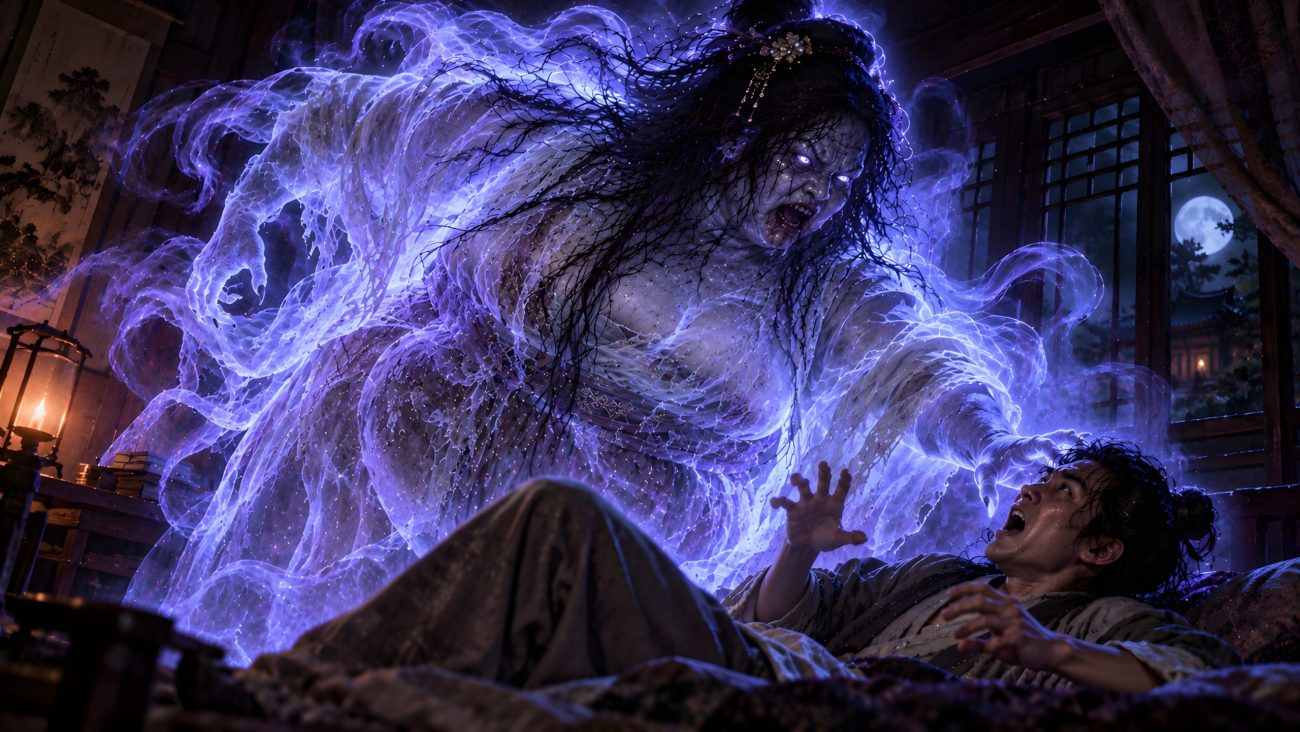
Miao Gui, or the Temple Ghost, is a malevolent spirit featured in Strange Tales from a Chinese Studio (Liaozhai Zhiyi) by Pu Songling. It takes the form of a woman to approach and torment men. In the story, the ghost appears as a heavyset, dark-complexioned woman whose appearance is described as unattractive. Despite the man’s rejection of her advances, she refuses to leave him alone.

The tale follows Wang Qihou, a student from Xincheng, who encounters the woman entering his room. She approaches his bed with an intimate and improper intention, but Wang rejects her. The spirit continues to appear whenever he sits or lies down, and when he remains firm in resisting her, she becomes angry and slaps him across the face. She then hangs a belt from a beam and forces him into an apparent attempt at hanging himself. Wang finds himself imitating the posture, standing rigidly with his feet off the ground, unable to die. Afterwards, he becomes mentally ill and repeatedly attempts to run towards a river, claiming that the ghost intends to throw him into it.

One day, a warrior carrying chains enters the room and angrily rebukes the spirit for tormenting an honest man. He binds the woman’s neck and drags her out through the window. As she passes outside, she loses her human appearance: her eyes flash like lightning, and her mouth becomes as red as a basin of blood. Wang recalls seeing a clay demon resembling her among the four clay figures at the entrance of the City God Temple. Once the spirit is removed, his illness disappears. The story presents iron chains as a means of restraining and driving away the ghost.


Sources

“廟鬼 (Miàoguǐ).” Chinese Wikipedia. Wikimedia Foundation. Accessed October 16, 2026. https://zh.wikipedia.org/wiki/%E5%BB%9F%E9%AC%BC


Duotou Gui

Tradition: Chinese Mythology
Alternative Names: 多頭鬼, Many-Headed Ghost, Double-Headed Ghost, Nine-Headed Ghost, Congtou Gui
Category: Ghost


The Myth

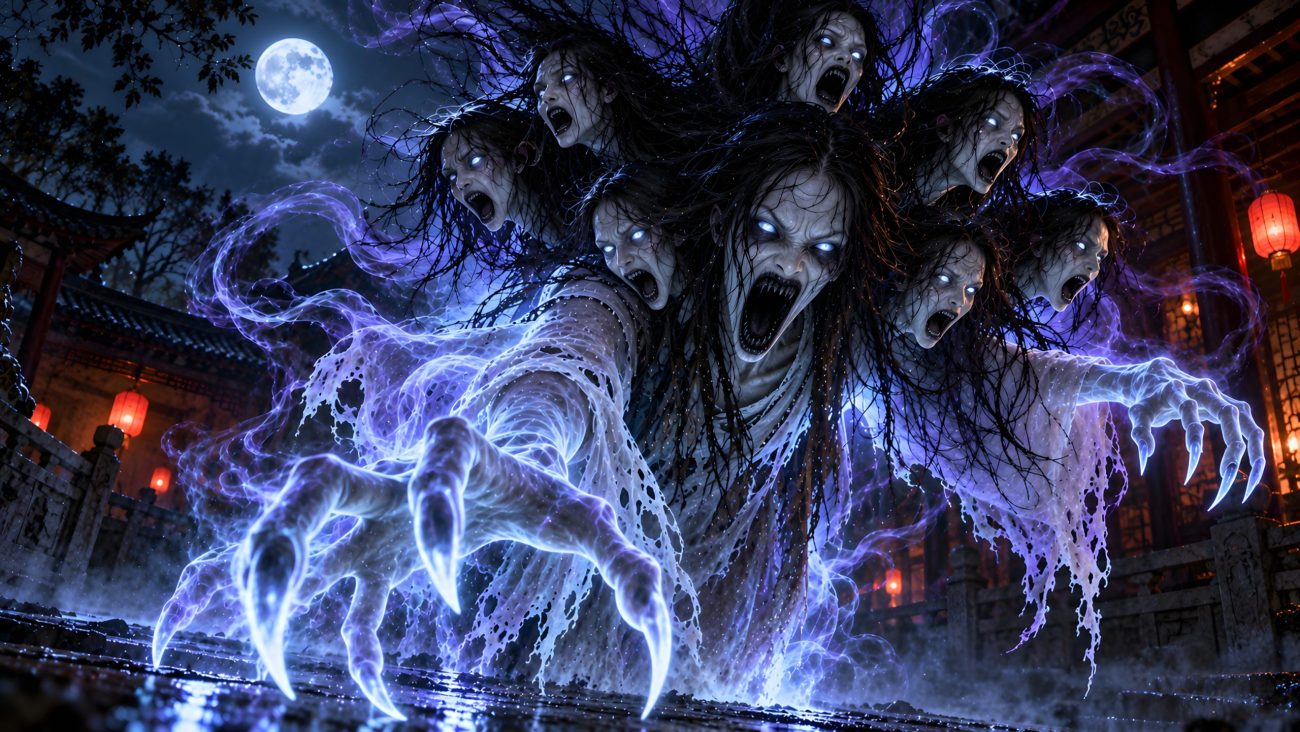
Duotou Gui, meaning the Many-Headed Ghost, is a type of supernatural monster in Chinese tradition characterised by its unusual abundance of heads. The category includes several different forms, such as the Double-Headed Ghost, the Nine-Headed Ghost, the Congtou Gui, whose body is covered in numerous small heads, and the Faceless Ghost, which has no eyes, nose, ears, or mouth. Stories of these strange beings appear in the Qing dynasty collection Ershi Lu by Yue Jun.

One tale describes a scholar who went into his courtyard early one morning for a walk. On reaching the corridor, he saw someone sleeping on the steps and snoring loudly. When he approached to investigate, he discovered that the sleeper was a monster with a single body but two necks and two heads. Each head possessed human-like eyes, ears, a nose, and a mouth, but one had the face of an old man while the other resembled a young man.

The Double-Headed Ghost later returned with a Nine-Headed Ghost. A third creature then appeared: the Congtou Gui, which had a human body covered with numerous small heads piled together like peach stones. The three monsters were eventually chased away by the arrival of the Faceless Ghost, a strange being without eyes, a nose, ears, or a mouth.

Many-headed ghosts also appear among the supernatural figures represented in traditional practices of the Yi people of Liangshan. In these customs, people make ghost effigies from wild grasses and create ritual boards marked with animal blood and incantations to drive away harmful spirits. The figures represented include male and female ghosts, many-headed and headless ghosts, one-legged ghosts, and spirits with severed hands.


Sources

“多头鬼 (Duōtóuguǐ).” Chinese Wikipedia. Wikimedia Foundation. Accessed October 16, 2026. https://zh.wikipedia.org/wiki/%E5%A4%9A%E5%A4%B4%E9%AC%BC


Jixing Gui

Tradition: Chinese Mythology
Alternative Names: 疾行鬼, Abhichata, Swift-Running Ghost
Category: Ghost


The Myth

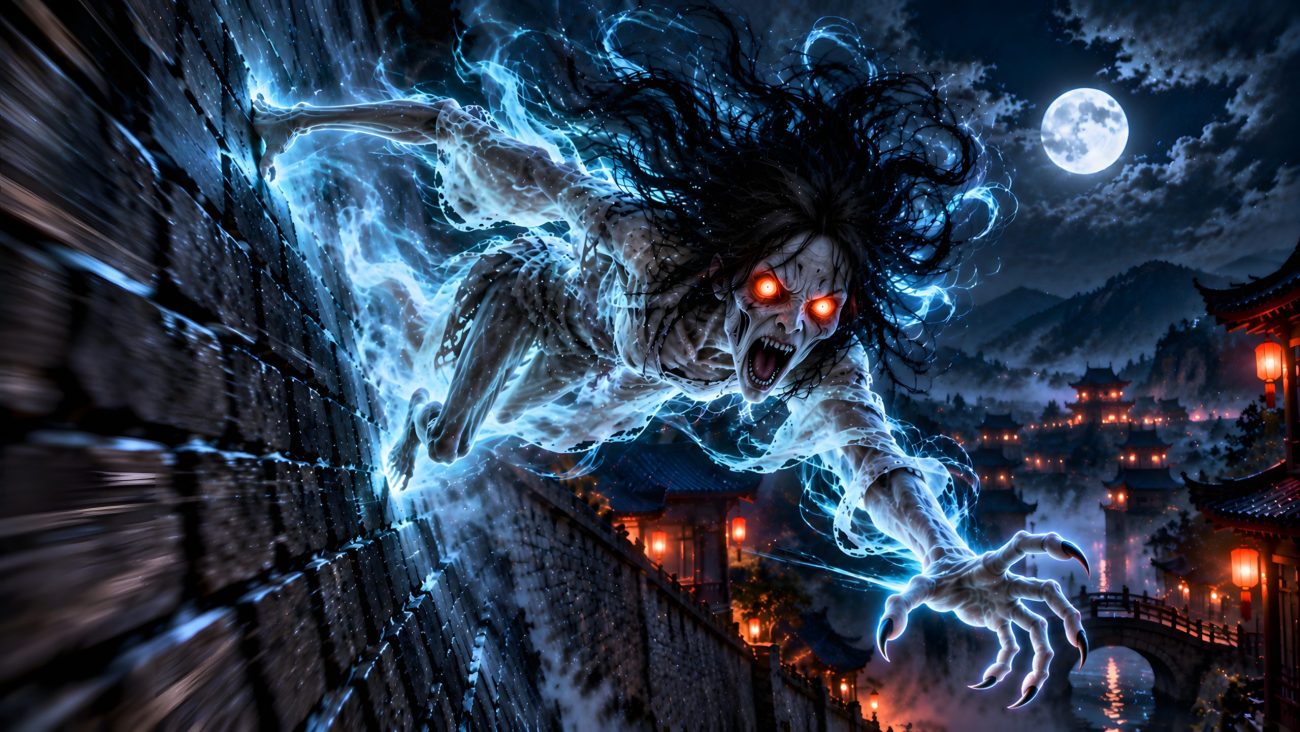
Jixing Gui, meaning the Swift-Running Ghost, is a supernatural being in Chinese tradition known for its extraordinary speed. It can run as swiftly as the wind, travel a thousand li in moments, and appear or disappear without a trace. According to traditional descriptions, it moves at night by pressing its body against walls and travelling sideways without its feet touching the ground.

Jixing Gui is counted among the thirty-six kinds of hungry ghosts described in the Buddhist scripture Sutra of the Remembrance of the True Dharma (Zhengfa Nianchu Jing). It is also known as Abhichata and is described as a type of yaksha. According to the tradition, these spirits are the rebirth of monks who broke their religious vows during their previous lives.

Despite its remarkable speed, Jixing Gui suffers from a terrible curse concerning food. It can eat only filthy things, and whenever it consumes them, its entire body bursts into flames, causing it intense agony. Some accounts also describe the swift-running spirit as pursuing and dealing with fugitives, using its supernatural speed to catch those attempting to escape.


Sources

“疾行鬼 (Jíxíngguǐ).” Chinese Wikipedia. Wikimedia Foundation. Accessed October 16, 2026. https://zh.wikipedia.org/wiki/%E7%96%BE%E8%A1%8C%E9%AC%BC


Yimu Wu Xiansheng

Tradition: Chinese Mythology
Alternative Names: 一目五先生, Wuqigui (五奇鬼), Five Extraordinary Ghosts
Category: Ghost


The Myth

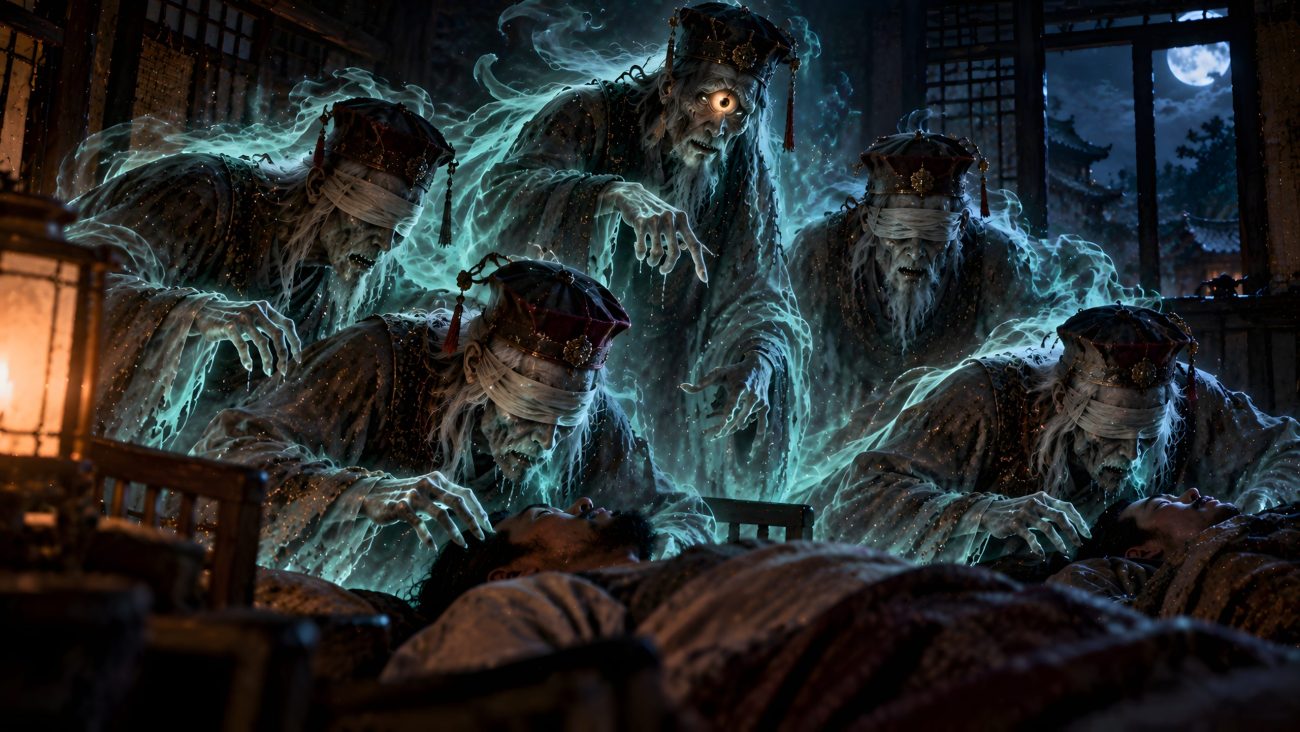
Yimu Wu Xiansheng, meaning the One-Eyed Five Gentlemen, is a group of five supernatural beings from Zhejiang, China, recorded in Yuan Mei’s Qing dynasty collection Zibuyu. The five ghosts share a single functioning eye: four of them are blind, while the fifth possesses the only eye and uses it to guide the entire group. The other four cannot act independently and must obey the commands of their one-eyed leader, who determines whom they may approach.

The five ghosts are said to appear during years of widespread epidemic. They travel together and approach people while they are deeply asleep, sniffing them with their noses. If one ghost sniffs a person, that person falls ill; if all five sniff the same person, the victim dies. The four blind ghosts stumble and move uncertainly, relying entirely on the one-eyed ghost’s judgment to direct their actions.

In one account, a man named Qian stays overnight at an inn where the other guests are asleep. He remains awake and witnesses the five ghosts arriving after the lamp suddenly dims. The ghosts prepare to sniff a sleeping guest, but their leader forbids them because the person is exceptionally virtuous. It then rejects another guest who is greatly blessed, as well as a third who is profoundly wicked. When the four ghosts ask whom they may feed upon, their leader points to two people who are neither good nor evil and possess neither fortune nor blessings. The four ghosts surround these unfortunate sleepers and sniff them together. Their breathing gradually fades as the ghosts’ bellies swell. The story portrays the five beings as supernatural agents of disease who select their victims according to a person’s moral character and fortune.


Sources

“一目五先生 (Yīmùwǔ Xiānsheng).” Chinese Wikipedia. Wikimedia Foundation. Accessed October 16, 2026. https://zh.wikipedia.org/wiki/%E4%B8%80%E7%9B%AE%E4%BA%94%E5%85%88%E7%94%9F


Obake

Tradition: Japanese Mythology
Alternative Names: Bakemono (化け物), お化け
Category: Ghost


The Myth

Obake and bakemono are terms used in Japanese folklore for supernatural beings associated with transformation and shapeshifting. Their names refer to things that change form. Although they are sometimes translated as ghosts, they primarily describe living creatures or supernatural entities that temporarily transform into different shapes. In a secondary sense, obake can also refer to the spirit of a deceased human, making it a synonym for yūrei.

The true form of an obake or bakemono may be an animal, a plant spirit, or even an inanimate object. Foxes known as kitsune, raccoon dogs called bake-danuki, badgers known as mujina, and supernatural cats called bakeneko are all associated with transformation. Plant spirits such as kodama may also fall within this broad category, while objects believed to develop souls are known as tsukumogami.

A bakemono may disguise itself as a human or appear in a strange and frightening shape. Examples include the one-eyed childlike hitotsume-kozō, the towering ōnyūdō, and the faceless noppera-bō. In common usage, obake and bakemono can refer to a wide range of bizarre apparitions and supernatural beings, making them broadly similar to the term yōkai.

The concept of obake also spread into Hawaiian local culture through the influence of Japanese communities. Japanese supernatural stories became part of local folklore, including tales of the water-dwelling kappa and faceless apparitions known as noppera-bō. In Hawaii, these faceless ghosts are also called mujina, a name confusion associated with a story by Lafcadio Hearn in which a badger transforms into a faceless being. Hawaiian folklorist Glen Grant further documented reports of supernatural incidents, including many involving Japanese-style obake.


Sources

“Obake.” Wikipedia: The Free Encyclopedia. Wikimedia Foundation. Accessed October 16, 2026. https://en.wikipedia.org/wiki/Obake


Dakhuul

Tradition: Mongolian Mythology, Russian Mythology
Alternative Names: Dahul, Dakhul
Category: Ghost


The Myth

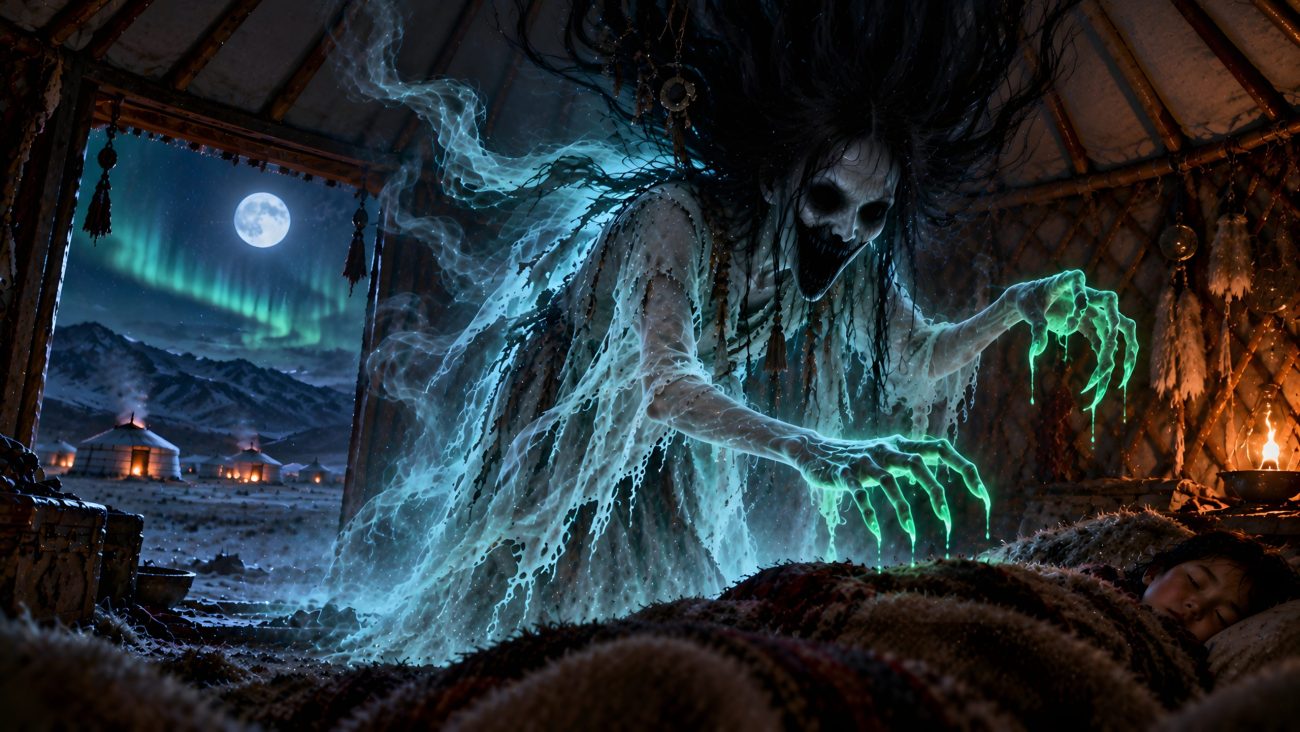
Dakhuul are malevolent spirits in the lower mythology of the Mongols and Buryats, believed to harm children and inflict illnesses upon their victims. These supernatural beings are described as invisible, ghost-like entities that bring sickness and suffering to the living.

According to the tradition, Dakhuul may originate from people who died under particular circumstances, including poor people, virgins, or young women. After death, they are believed to become dangerous undead spirits capable of afflicting the living with illness, with children being especially vulnerable to their harmful influence. The name Dahul is a Latinized variant of Dakhuul.


Sources

“Дакхуул (Dakhuul).” New Bestiary (Bestiary.us). https://www.bestiary.us/dakhuul


Painted Skin

Tradition: Chinese Mythology
Alternative Names: Huapi (畫皮), The Painted Skin Demon
Category: Ghost


The Myth

Painted Skin is a supernatural tale recorded by Pu Songling during the Qing dynasty in his collection Strange Tales from a Chinese Studio. The story tells of Wang Sheng, a man from Taiyuan who encounters a beautiful young woman claiming to have fled from home. Captivated by her appearance, he takes her into his household despite his wife Chen’s warnings. However, the woman is not human but a monstrous demon capable of disguising itself by wearing a painted human skin.

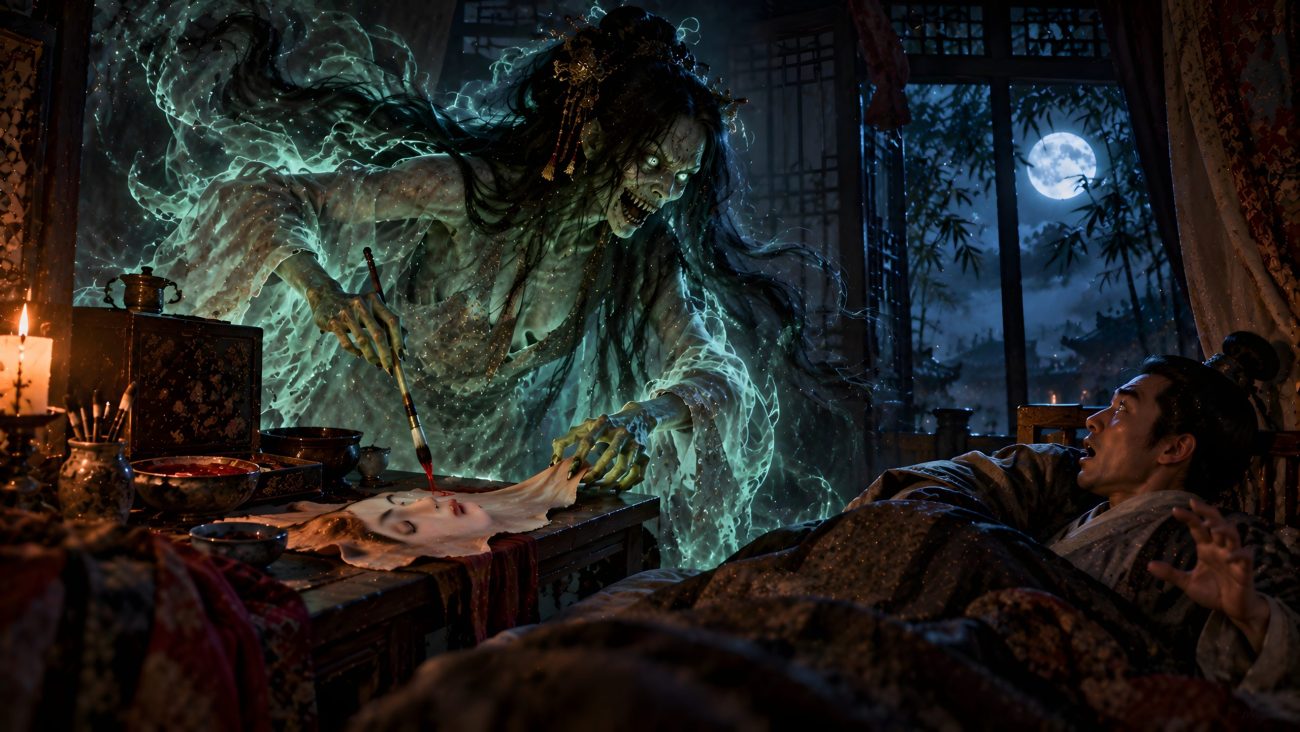
After encountering a Taoist priest who warns him that he is being haunted by an evil spirit, Wang Sheng grows suspicious. Peering through a window at home, he witnesses the horrifying truth: a green-faced monster with saw-like teeth is using a coloured brush to paint a human skin. Once its work is complete, the creature puts on the skin and transforms into the beautiful woman. The terrified Wang Sheng returns to the priest, who gives him a fly whisk to hang at his bedroom entrance. The demon initially hesitates to enter, but eventually destroys the charm, breaks into the room, tears open Wang Sheng’s chest, and steals his heart, killing him.

The Taoist priest later tracks down the demon while it is disguised as an old woman. He strips away its human skin with a wooden sword, revealing its monstrous form, and beheads it. The creature’s body dissolves into thick smoke, which the priest captures in a gourd. Yet Wang Sheng remains dead, and the priest claims he lacks the power to revive him. He directs Chen to seek help from a filthy, mad beggar in the marketplace. The beggar humiliates and strikes her, then forces her to swallow a mouthful of his phlegm before departing. When Chen returns home and mourns her husband, she feels an unbearable lump in her chest and vomits up what proves to be a human heart. She places it inside Wang Sheng’s chest and binds his wound. His body gradually warms, his breathing returns, and by dawn he is alive again.

The tale warns against being deceived by outward beauty and mistaking evil for something desirable. The demon’s painted skin conceals a hideous reality, while Chen’s willingness to endure humiliation for her husband becomes the means of his restoration. The story combines horror, shapeshifting, Taoist supernatural practices, and a moral lesson about desire, deception, and the consequences of foolish infatuation.


Sources

“画皮 (Huàpí).” Chinese Wikipedia. Wikimedia Foundation. Accessed October 16, 2026. https://zh.wikipedia.org/wiki/%E7%95%AB%E7%9A%AE