Tradition: Chinese Mythology
Alternative Names: 多頭鬼, Many-Headed Ghost, Double-Headed Ghost, Nine-Headed Ghost, Congtou Gui
Category: Ghost
The Myth
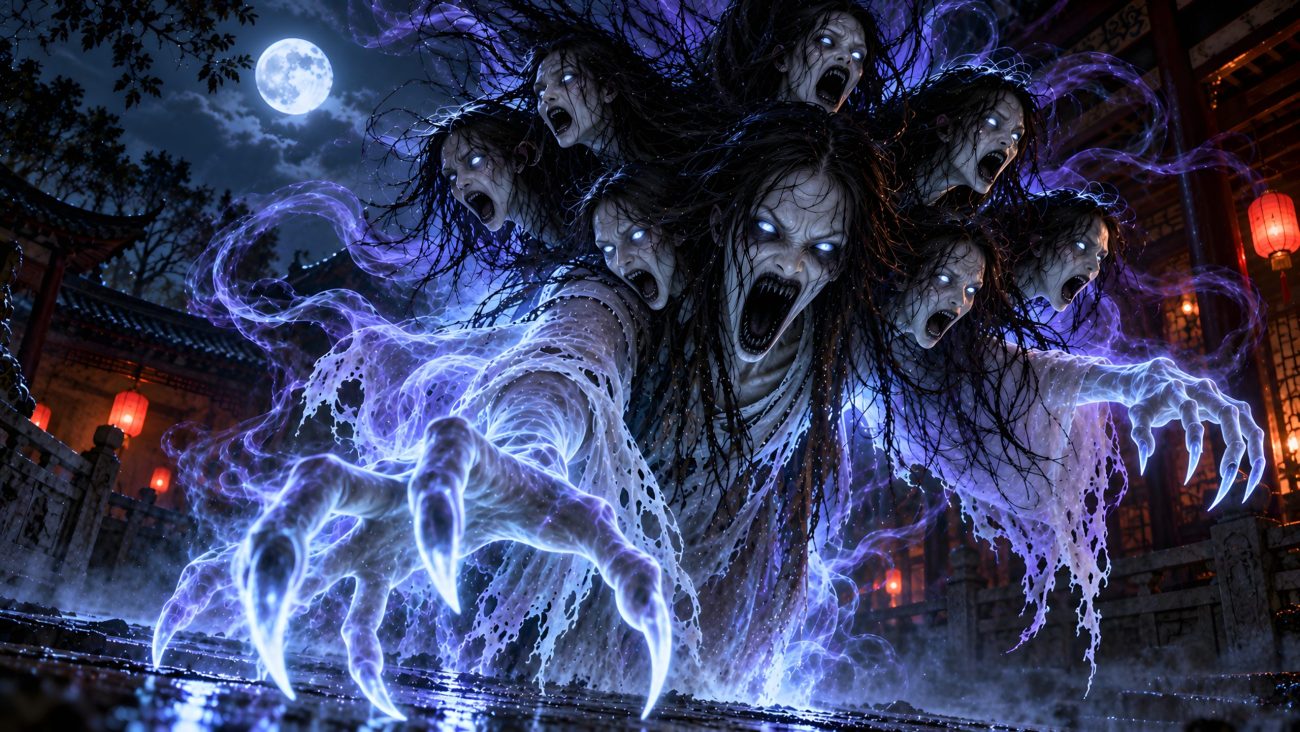
Duotou Gui, meaning the Many-Headed Ghost, is a type of supernatural monster in Chinese tradition characterised by its unusual abundance of heads. The category includes several different forms, such as the Double-Headed Ghost, the Nine-Headed Ghost, the Congtou Gui, whose body is covered in numerous small heads, and the Faceless Ghost, which has no eyes, nose, ears, or mouth. Stories of these strange beings appear in the Qing dynasty collection Ershi Lu by Yue Jun.
One tale describes a scholar who went into his courtyard early one morning for a walk. On reaching the corridor, he saw someone sleeping on the steps and snoring loudly. When he approached to investigate, he discovered that the sleeper was a monster with a single body but two necks and two heads. Each head possessed human-like eyes, ears, a nose, and a mouth, but one had the face of an old man while the other resembled a young man.
The Double-Headed Ghost later returned with a Nine-Headed Ghost. A third creature then appeared: the Congtou Gui, which had a human body covered with numerous small heads piled together like peach stones. The three monsters were eventually chased away by the arrival of the Faceless Ghost, a strange being without eyes, a nose, ears, or a mouth.
Many-headed ghosts also appear among the supernatural figures represented in traditional practices of the Yi people of Liangshan. In these customs, people make ghost effigies from wild grasses and create ritual boards marked with animal blood and incantations to drive away harmful spirits. The figures represented include male and female ghosts, many-headed and headless ghosts, one-legged ghosts, and spirits with severed hands.
Sources
“多头鬼 (Duōtóuguǐ).” Chinese Wikipedia. Wikimedia Foundation. Accessed October 16, 2026. https://zh.wikipedia.org/wiki/%E5%A4%9A%E5%A4%B4%E9%AC%BC