Tradition: Chinese Mythology
Alternative Names: Huapi (畫皮), The Painted Skin Demon
Category: Ghost
The Myth
Painted Skin is a supernatural tale recorded by Pu Songling during the Qing dynasty in his collection Strange Tales from a Chinese Studio. The story tells of Wang Sheng, a man from Taiyuan who encounters a beautiful young woman claiming to have fled from home. Captivated by her appearance, he takes her into his household despite his wife Chen’s warnings. However, the woman is not human but a monstrous demon capable of disguising itself by wearing a painted human skin.
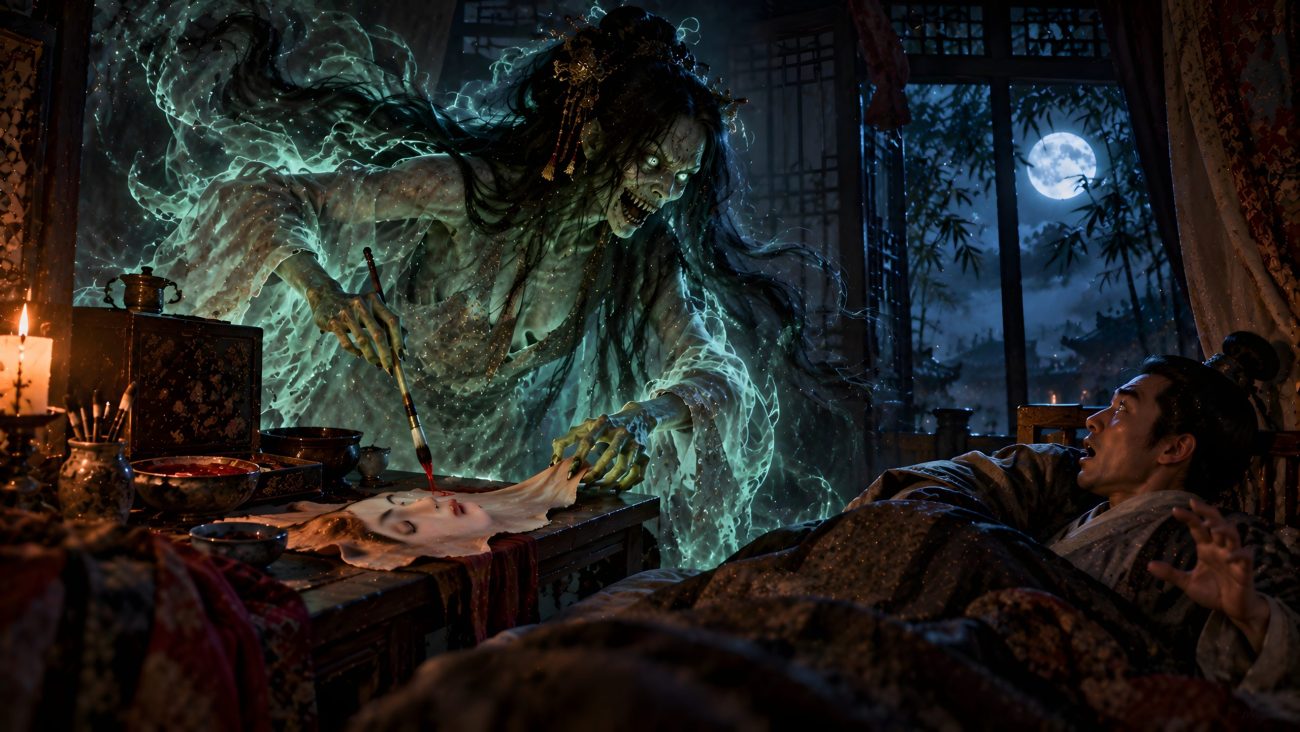
After encountering a Taoist priest who warns him that he is being haunted by an evil spirit, Wang Sheng grows suspicious. Peering through a window at home, he witnesses the horrifying truth: a green-faced monster with saw-like teeth is using a coloured brush to paint a human skin. Once its work is complete, the creature puts on the skin and transforms into the beautiful woman. The terrified Wang Sheng returns to the priest, who gives him a fly whisk to hang at his bedroom entrance. The demon initially hesitates to enter, but eventually destroys the charm, breaks into the room, tears open Wang Sheng’s chest, and steals his heart, killing him.
The Taoist priest later tracks down the demon while it is disguised as an old woman. He strips away its human skin with a wooden sword, revealing its monstrous form, and beheads it. The creature’s body dissolves into thick smoke, which the priest captures in a gourd. Yet Wang Sheng remains dead, and the priest claims he lacks the power to revive him. He directs Chen to seek help from a filthy, mad beggar in the marketplace. The beggar humiliates and strikes her, then forces her to swallow a mouthful of his phlegm before departing. When Chen returns home and mourns her husband, she feels an unbearable lump in her chest and vomits up what proves to be a human heart. She places it inside Wang Sheng’s chest and binds his wound. His body gradually warms, his breathing returns, and by dawn he is alive again.
The tale warns against being deceived by outward beauty and mistaking evil for something desirable. The demon’s painted skin conceals a hideous reality, while Chen’s willingness to endure humiliation for her husband becomes the means of his restoration. The story combines horror, shapeshifting, Taoist supernatural practices, and a moral lesson about desire, deception, and the consequences of foolish infatuation.
Sources
“画皮 (Huàpí).” Chinese Wikipedia. Wikimedia Foundation. Accessed October 16, 2026. https://zh.wikipedia.org/wiki/%E7%95%AB%E7%9A%AE