Stockhüper

Tradition: Swiss Mythology
Alternative Names: Stock Jumper, Hopen
Category: Ghost


The Myth

Along the road from Sattel to Ägeri, in the Swiss canton of Zug, lies the Schornen, an area known for its Letziturm tower and the remains of ancient defensive earthworks built by the people of Schwyz. According to local tradition, this disputed stretch of land once belonged to the estate of Ägeri but eventually passed into the possession of the municipality of Sattel through the sacrilegious perjury of an unscrupulous man. For his false oath, the man was condemned to a supernatural punishment, forever haunting the boundary of the land whose ownership he had helped determine dishonestly.

The perjurer appears as a mysterious black figure wearing a long coat and a broad-brimmed hat that hangs low over his head and reaches toward his broad shoulders. He is sometimes seen sitting atop the wooden picket fence that once marked the disputed boundary. More often, he leaps wildly from one boundary stone to another, racing along the border in a frantic, unnatural chase. During these nocturnal journeys, he emits a piercing, bone-chilling cry known locally as the Hopen. He particularly favors a small hill called the Stock, which gave rise to his name, Stockhüper, meaning “Stock Jumper.”

For many years, the Stockhüper was a familiar figure in local legend, condemned to roam the boundary as punishment for his dishonest testimony. However, the ghost has not been seen for a very long time. According to the tradition, a parish priest eventually banished him for eternity, bringing an end to his eerie nocturnal leaps and terrifying cries.


Sources

“Der Stockhüper.” SAGEN.at – Traditionelle Sagen aus der Schweiz (Zug). Reproduced by SAGEN.at. https://www.sagen.at/texte/sagen/schweiz/zug/stockhueper.html

Ghosts of Ramswag Castle

Tradition: Swiss Mythology
Alternative Names: The Ramswag, The Golden Skittles of Ramswag
Category: Ghost


The Myth

Knight Heinrich Walther von Ramswag distinguished himself in 1278 when he marched with King Rudolf of Habsburg against King Ottokar of Bohemia and saved his sovereign’s life at the Battle of Marchfeld. As a reward for his service, he received 500 marks of silver, the estate of Kriessern with Blatten Castle, the estates of Bernhardzell and Sitterdorf, and the imperial bailiwick in Thurgau. The family’s sudden prosperity, however, made the Ramswags arrogant. During the period of celebration that followed, a magnificent feast was reportedly held at Ramswag Castle, attended by the king himself. In the castle courtyard, guests amused themselves by playing skittles with golden balls and pins.

During the Appenzell Wars, Knight Rudolf met a tragic death at Ramswag Castle, and the family’s estate eventually passed into other hands. Yet the castle’s past revelry is said to endure beyond the destruction of its walls. On nights of heavy, eerie weather, Rudolf’s ghost wanders through the deep cellars of the castle ruins, accompanied by other spectral figures. During these mysterious gatherings, the golden skittles are brought out once more, as though the ghosts are recreating the festivities of their former lives.

Those who pass near the ruins on such nights may hear the unmistakable sounds of the phantom game: balls rolling across the ground and pins tumbling down. These noises are interrupted by the groans and moans of the castle’s ghostly inhabitants. The spectral game continues in the darkness, preserving the memory of Ramswag’s former wealth and splendor long after the family and its castle have fallen into decline.


Sources

“Ramswag.” SAGEN.at – Traditionelle Sagen aus der Schweiz (St. Gallen). Reproduced by SAGEN.at. https://www.sagen.at/texte/sagen/schweiz/st_gallen/ramswaghtm.html


Musical Ghost

Tradition: Swiss Mythology
Alternative Names: The Piano-Playing Ghost of Neuheim
Category: Ghost


The Myth

A farmer’s wife from the mountain village of Menzingen once travelled on a pilgrimage to the Marian shrine of Einsiedeln, accompanied by her twelve-year-old daughter. During the journey, the girl suddenly pulled a sugar heart from beneath her clothes and ate it, although she had no idea who had given her the mysterious gift. After the family returned home, the child began seeing a strange apparition: an old, wrinkled woman carrying a walking stick and a large rosary, approaching from the neighboring house. The girl alone could see the woman, but the haunting soon began to affect the entire household.

During the night, the inhabitants heard someone pacing up and down the wooden stairs, closing doors, and playing a musical instrument. The unexplained noises caused considerable fear and annoyance, but the farmer could find no source for them. Suspecting that a ghost had entered his home, he summoned the dean and several other priests to bless the house and perform exorcisms. They searched the entire building and kept a strict watch over the yard, hoping to discover the cause of the disturbances. After a prolonged period, the musical ghost reportedly disappeared, but the farmer was said to have spent 500 guilders dealing with the haunting.

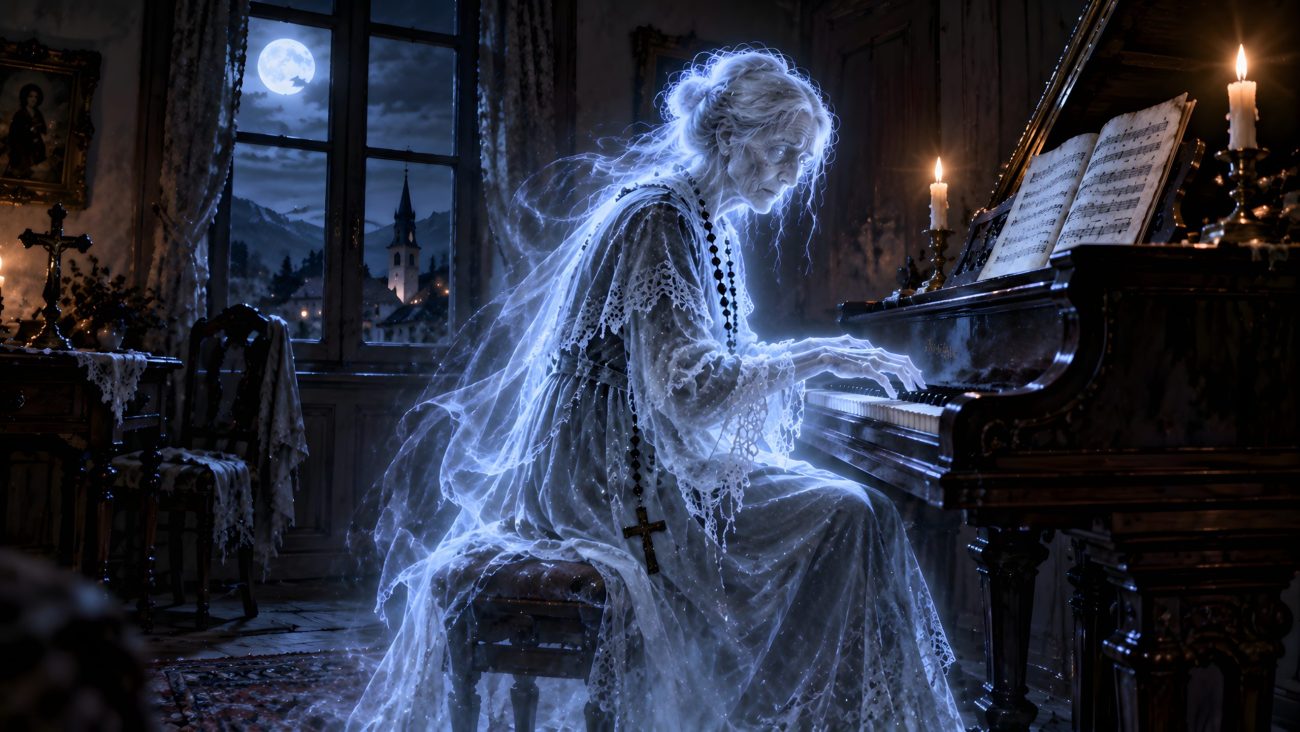
A similar apparition was associated with the old chaplain’s house in Neuheim, where a ghost reportedly wandered through the building at night and played the piano. Its music disturbed the sleep of the household, turning an ordinary home into a place of nocturnal unrest. Together, these accounts describe spirits whose presence was revealed not only through strange visions but also through unexplained sounds and music that disturbed the living.


Sources

“Das Gespenst.” SAGEN.at – Traditionelle Sagen aus der Schweiz (Zug). Reproduced by SAGEN.at. https://www.sagen.at/texte/sagen/schweiz/zug/gespenst.html


Bleichi-Mueterli

Tradition: Swiss Mythology
Alternative Names: Bleichi-Mueterli, The Spirit of the Bleaching Field
Category: Ghost


The Myth

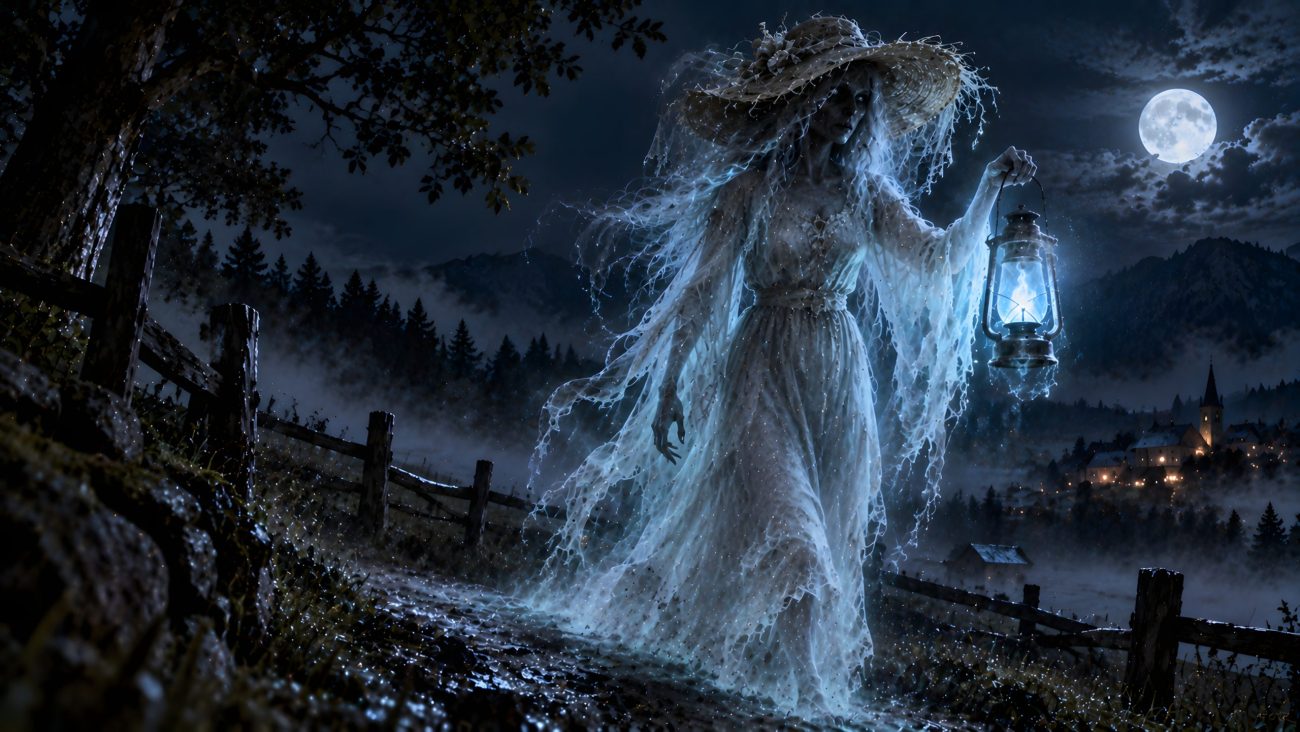
Above Schönbrunn, along the road toward Hinterburg between Bethlehem and a place known as the Loch, lies a stretch of land called the Bleichi. The area was once haunted by a mysterious female apparition known as the Bleichi-Mueterli. She was described as a dark-faced figure wearing a white gown and a straw hat, often emerging from the Wösch, a forest between Bethlehem and Edlibach. She carried a light as she wandered through the area, and her strange appearance frightened those who encountered her.

Even in the nineteenth century, the apparition was remembered as a source of terror. A young boy from Schönbrunn was so frightened by seeing the Bleichi-Mueterli that he remained ill for some time afterward. In another account, a boy from Menzingen was walking past the Bleichi with his father when he saw the ghost carrying a small blue light. Terrified, he stayed close to his father, who could perceive nothing of the apparition.

The name of the Bleichi-Mueterli also became associated with a more earthly figure. A cheeky fruit thief reportedly disguised himself as the bleaching-field spirit and made his rounds among the heavily laden fruit trees, using the ghost’s frightening reputation to carry out his thefts. His long fingers helped him pluck the fruit, but the farmers eventually became watchful and put an end to his schemes. The legend thus preserves both the memory of a feared nocturnal apparition and the tale of a thief who exploited local superstition.


Sources

“Der Bleichi.” SAGEN.at – Traditionelle Sagen aus der Schweiz (Zug). Reproduced by SAGEN.at. https://www.sagen.at/texte/sagen/schweiz/zug/bleichi.html


Schönbrunn Pious Recluse

Tradition: Swiss Mythology
Alternative Names: The Treasure-Guarding Hermit of Schönbrunn
Category: Ghost


The Myth

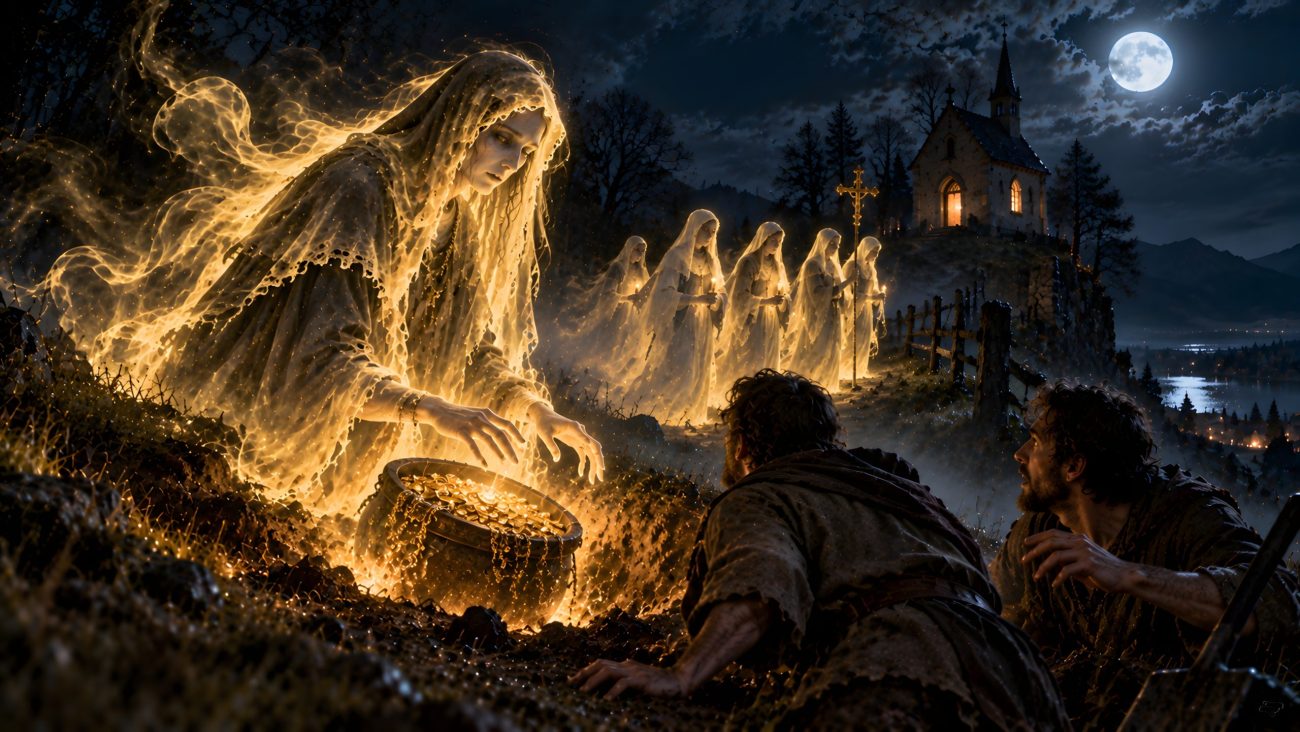
Around the turn of the twelfth and thirteenth centuries, pious women lived as recluses on the hill above Schönbrunn in the Swiss canton of Zug. According to local tradition, one of their houses stood at a place called Chilebode, below the site of the present-day chapel. One legend tells of a great treasure hidden deep beneath the earth in an earthen vessel. The treasure was guarded by a devout woman who watched over it as the centuries passed. Every hundred years, the treasure rose gradually toward the surface until it finally emerged into daylight, allowing it to be unearthed by anyone who knew how to retrieve it.

When the appointed time arrived, two local men set out to recover the treasure. They began their work, knowing that they had to remain completely silent if they wished to claim the riches. As they labored, one of the men suddenly noticed a procession of pious nuns approaching from the direction of the chapel. Surprised by the sight, he nudged his companion and exclaimed, “Look there!” The moment he spoke, the treasure sank back into the earth, disappearing beyond their reach.

The treasure-guarding recluse sighed in distress, for she had nearly been freed from her endless duty. Had the two men remained silent throughout their work, the treasure could have been recovered and her long watch would finally have ended. Instead, she was condemned to guard it for another hundred years, awaiting someone who could retrieve it in complete secrecy. As the treasure vanished, the procession of praying women disappeared along with the hermit, leaving the two disappointed treasure hunters with nothing.


Sources

“Die Klausnerin von Schönbrunn.” SAGEN.at – Traditionelle Sagen aus der Schweiz (Zug). Reproduced by SAGEN.at. https://www.sagen.at/texte/sagen/schweiz/zug/klausnerin_schoenbrunn.html


Menzingen Ghost

Tradition: Swiss Mythology
Alternative Names: The Sunken Monastery of Menzingen
Category: Ghost


The Myth

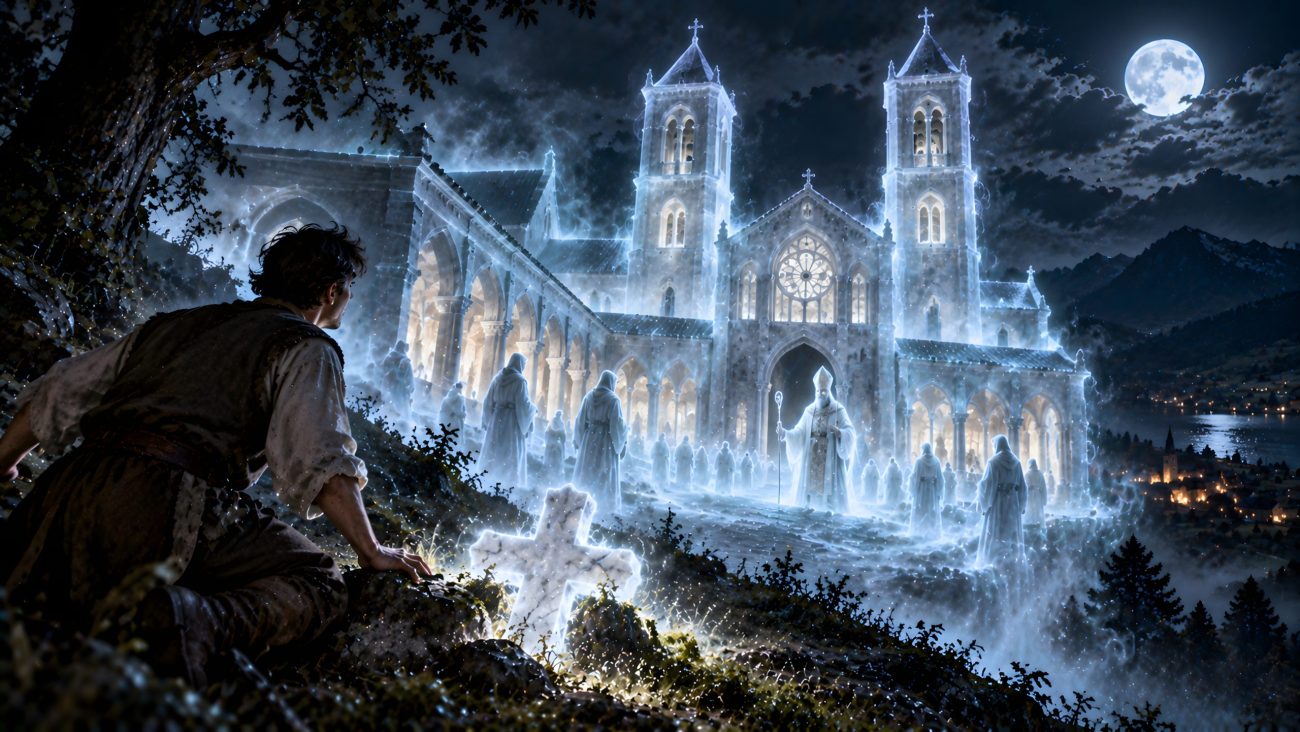
Near Menzingen in the Swiss canton of Zug, a monastery once stood before suddenly disappearing into the earth without leaving a trace. Yet its presence was not entirely forgotten. From time to time, the faint ringing of its hour bell could still be heard, calling the faithful to prayer as though the vanished religious community continued its devotions beneath the ground. The mysterious sound eventually drew the attention of a simple farmhand from Menzingen, who heard the bell and climbed the hill to investigate.

There, the farmhand discovered a brightly shining, square marble cross lying on the ground. When he reverently touched it, a magnificent monastery suddenly appeared before him, complete with two imposing bell towers. A pale monk emerged through a narrow gate and beckoned him inside. The farmhand followed him through a broad colonnade into a tall, dimly lit church, where a black curtain concealed the chancel. When the monk touched its hem, the curtain slowly rose, revealing richly decorated choir stalls occupied by sleeping monks. On a raised seat sat the abbot, wearing a gleaming mitre. The monk led the bewildered farmhand toward him.

The elderly abbot opened his eyes and asked in a dark, melancholy voice, “What time is it outside?” Thinking that he was expected to answer, the farmhand quickly replied that it was half past four. Immediately, a wild storm swept through the church. The monastery vanished, and the farmhand found himself sitting in a daze upon a large stone. According to the legend, had he remained silent instead of answering the abbot’s question, he would have become a rich man. The mysterious encounter thus offered a fleeting glimpse of the vanished monastery and the fortune that might have been his.


Sources

“Das verschwundene Kloster.” SAGEN.at – Traditionelle Sagen aus der Schweiz (Zug). Reproduced by SAGEN.at. https://www.sagen.at/texte/sagen/schweiz/zug/kloster_verschwunden.html


Hüper

Tradition: Swiss Mythology
Alternative Names: The Egelsee Hooter
Category: Ghost


The Myth

The Hüper is a mysterious haunting spirit associated with Lake Egelsee in the Swiss canton of Zug. Its legend dates back to the defeat of the Zurichers at Gubel in 1531, when a young horseman fled wildly from the battlefield. Reaching Lake Egelsee, he attempted to escape into the woods on the opposite shore. In the midst of his desperate flight, he found himself in grave danger and made a solemn vow to God in his heart, promising devotion if he were spared a sudden death.

When the horse finally carried him onto dry ground, the rider abandoned his pious intentions and began laughing and mocking the vow he had made. Suddenly, his horse turned around and leaped back toward the lake. The terrified rider struggled to control the animal, striking it and digging in his spurs while shouting, “Hup, hup!” But nothing could stop the horse. It plunged into the dark waters with its master, and the rider drowned miserably.

For many years afterward, a terrible cry could be heard around midnight near Lake Egelsee: “Hoo, hoo!” The sound was attributed to the restless spirit of the drowned horseman, known as the Egelsee Hooter or Hüper. Its mournful call served as a reminder of the rider’s broken vow and dreadful fate. According to the legend, however, the eerie cries ceased after the French came to the region, and the Hüper was never heard again.


Sources

“Der Hüper.” SAGEN.at – Traditionelle Sagen aus der Schweiz (Zug). Reproduced by SAGEN.at. https://www.sagen.at/texte/sagen/schweiz/zug/hueper.html


Wildenburg Castle Ghosts

Tradition: Swiss Mythology
Alternative Names: The Battle of Egelsee
Category: Ghost


The Myth

The lord of Wildenburg Castle was a quarrelsome knight who once became embroiled in a fierce dispute with the neighboring Baron of Wädenswil. Seeking to confront his rival, the knight led his men into the Winzwilerholz forest, where they established a camp. However, the cunning baron had discovered their position and maneuvered around them, bypassing the Wildenburg forces and threatening their castle. Realizing that they had been outwitted, the knight and his men hurried home to defend their stronghold.

Their retreat led to a vicious battle beside a stream near Egelsee. The Wildenburg warriors were fiercely attacked, and many were thrown into the nearby lake. So much blood flowed into the stream that its waters turned red, earning it the name of the Red Stream. The battle ended in terrible slaughter, leaving many of the Wildenburg knight’s men dead in the surrounding wilderness.

Afterward, the area around Egelsee became haunted by strange and frightening sounds heard during the night. Ghostly warriors mounted on wild horses were seen riding through the air, accompanied by the dreadful noise of cowbells. These spectral riders were believed to be the fallen men of Wildenburg, returning as restless spirits to reenact their violent fate. Their phantom battle preserved the memory of the bloody conflict, haunting the lake and its surroundings long after the warriors had perished.


Sources

“Die Geisterschlacht.” SAGEN.at – Traditionelle Sagen aus der Schweiz (Zug). Reproduced by SAGEN.at. https://www.sagen.at/texte/sagen/schweiz/zug/geisterschlacht.html


Lake Urdensee Ghost

Tradition: Swiss Mythology
Alternative Names: Lake Urden
Category: Ghost


The Myth

In a narrow, rugged valley descending from the Rothorn toward the Plessur River in Graubünden, Switzerland, lies Lake Urdensee. The lake was not always there. Once, the place was occupied by a beautiful alpine meadow surrounding a dairy hut, where a herdsman lived with his large red cow. The herdsman was wicked and refused to offer refreshments to poor travelers who passed through his pasture. One day, an elderly woman arrived after a long journey, exhausted and desperately thirsty. She begged him for a little milk, explaining that her knees were failing and her tongue burned with thirst. The herdsman insulted her and slammed the door in her face.

When he found the old woman still sitting outside, the herdsman mockingly promised to give her milk so that she could quench her thirst. He milked his red cow and handed her a drink, but secretly he had mixed rennet into the milk. The woman drank gratefully and blessed him, unaware of his cruelty. She had barely continued along the path when terrible pains seized her body. As she collapsed, dying, she cursed the herdsman and his alpine pasture. At that moment, thunder roared across the mountains and lightning struck the dairy hut. The hut, the herdsman, and the red cow sank into the earth, while water surged up to form a lake in their place.

The lake still bears signs of the vanished alpine pasture. The old path leading to the hut can supposedly be seen disappearing beneath the water and reappearing on the opposite shore, where it continues over the mountains toward Obervaz. A dark spot in the middle of the lake marks the place where the dairy hut sank. Once every seven years, during terrible thunderstorms, the cursed herdsman rises from the lake with his red cow. Above the storm-tossed waves, he milks the cow before sinking back beneath the water with a dreadful howl, wringing his hands in despair. Thus, the legend explains the origin of Lake Urdensee and preserves the memory of the herdsman’s cruelty toward a helpless traveler.


Sources

“Der Urdensee.” In Theodor Vernaleken, Kinder- und Hausmärchen in den Alpenländern. Vienna, 1863. Reproduced by SAGEN.at. https://www.sagen.at/texte/sagen/vernaleken/urdensee.html


Elegant Milanese Woman

Tradition: Swiss Mythology
Alternative Names: The Beautiful Milanese Woman
Category: Ghost


The Myth

In the mountains of Valais, the dead are said to wander among the peaks, while the distant sound of a death drum echoes across the valleys. The mighty Aletsch Glacier is considered especially eerie, and a pious priest once claimed to have seen countless heads of suffering souls emerging from its crevasses. It was in this desolate mountain wilderness, near the Törbjeralp and the Grimsel Pass, that a solitary shepherd encountered a mysterious woman while searching for a lost cow. Beneath a gloomy sky, amid jagged rocks and deep glacier crevasses, he saw a beautiful young woman walking slowly toward the ice. She moved with noble grace despite being barefoot and bareheaded in the cold, rainy weather. Her long black hair shone with a bluish sheen, and she wore a necklace of gold and precious stones, golden bracelets, a jeweled belt, and diamonds on her small hands. Her face was pale and streaked with tears, and heavy sighs escaped her lips.

The shepherd approached her, astonished that someone so elegantly dressed could be wandering alone through such a dangerous place. He asked whether she had lost her way or been separated from her servants and horses. The woman answered that she was neither lost nor accompanied by anyone. She had come from a great city and a magnificent palace, and her body still lay warm upon its deathbed in Milan, where her grieving parents mourned their only daughter. God had condemned her to atone upon the glacier for the pampered life she had led. In life, she had rarely touched the bare ground, always traveled by carriage, and been sheltered from rain, cold winds, and physical hardship. She had denied herself no pleasure and avoided every exertion. Now, after death, she was forced to walk barefoot through the freezing wilderness, enduring the harsh weather as penance for her former luxury.

As the woman spoke, a thick black fog rolled over the glacier, and her graceful figure disappeared. When the mist lifted moments later, she was nowhere to be seen. The shepherd suddenly realized that he might have been given an opportunity to help redeem her soul, but he had failed to offer his assistance while she was still before him. Desperate to learn how he could free her, he cried out into the mountains, asking the beautiful woman to tell him what he must do. Only the faint echo of his voice answered. The streams murmured, the glacier thundered and crashed, and pale, misty figures rose and fell among its crevasses. Deeply saddened, the shepherd returned home, but he repeatedly climbed back into the wilderness to search for her. Each time, he called out asking whether he could release her from her punishment. Black mists swept across the ice, strange shapes appeared in the crevasses, and the glacier roared, yet the elegant Milanese woman never appeared again.


Sources

“Die Mailänderin.” SAGEN.at – Traditionelle Sagen aus der Schweiz. Reproduced by SAGEN.at. https://www.sagen.at/texte/sagen/schweiz/allgemein/mailaenderin.html