In earlier times, the ferry at Rosport on the Sauer River was said to be haunted.
When the ferryman had to carry passengers late at night, it sometimes happened that the boat, though empty or only lightly loaded, suddenly became terribly heavy in midstream. It could scarcely be moved and seemed ready to sink at any moment.
The ferrymen believed that this was caused by a malevolent spirit that climbed invisibly into the boat and weighed it down as it crossed the river.
Thus the ferry was feared at night, for people said an unseen being still haunted the crossing.
On the Moselle River, at a place called ob em Meilesteen a short distance upstream from Mertert, fishermen who worked at night often heard a strange sound. It resembled the splashing of countless carp striking the water with their tails, and the noise drifted downstream toward Mertert and beyond. Near Wasserbillig it suddenly ceased, and people said it stopped where the old Moselstadt once stood, for it was believed that a great town of that name had existed there long ago.
The fishermen said the splashing was caused by the Moselgeist, the spirit of the Moselle.
Others told that at the same place, in the darkness of night, they had seen an unknown boatman crossing the river. He rowed silently across the water, and just as suddenly as he had appeared, he vanished into the river and was gone.
Tradition / Region:Luxembourg Mythology Alternate Names: The Well Spirit of Gondelingen, The White Woman of the Sulphur Spring Category: Ghost
The Myth
In the forest between Dalheim and Waldbredimus lies an old spring known as the Sulphur Spring. Long ago, near this place stood the castle of Gondelingen, now almost entirely vanished. People have long believed that a restless spirit dwells at the spring and in the surrounding hills.
Once, several women gathering herbs near the spring saw their collected plants suddenly scattered by an unseen force, as if by an invisible hand. It was said that an underground tunnel once led from the spring to the castle, and that within the castle there was a chamber called the Green Chamber, feared by its inhabitants because the spirit sometimes haunted it at night.
Some described the spirit as a gaunt, slender woman who wandered between the spring, the ruins, and the nearby mountain called the Hurenstein. At midnight she was said to fight with a knight beneath a great beech tree and then, defeated, hurry back toward the castle, disappearing into the tunnel that led to the spring. Woe to anyone she met on the path.
One man from Dalheim told how, while out at night gathering pears, he saw a white female figure walking ahead of him. Though she seemed to move slowly, he could not catch her. He later heard the clock strike midnight, and the figure let out a piercing scream. When he returned to search for her with prayers and holy water, he experienced terrifying noises, crashing blows, and flashes of fire. When he regained his senses, he found himself near the Sulphur Spring, where he saw the white woman glide swiftly through the air and vanish into the spring with cries of lament.
Another man encountered the spirit during a storm near the old ponds fed by the spring. He followed a moving light, sank into swampy water, and saw the spirit rise in a burst of brightness, hovering above the banks and circling the air while wailing. A violent wind arose, and as he fled, he saw the apparition disappear toward the Hurenstein.
Since then, people say the spirit of the Sulphur Spring still wanders between the ruins, the hills, and the water, lamenting without rest.
Tradition / Region:Luxembourg Mythology Alternate Names: Birch Maiden, Birkenjungfer, Birch Damselfly, White Horse of the Birk Category: Swamp dweller, Ghost, Forest dweller
The Myth
In the birch forests and moors near Mutfort, Ötringen, and the Birk, there was said to wander a mysterious female spirit known as the Birch Maiden.
She often appeared as a young woman dressed in dazzling white. At times she spread a white carpet before travelers, upon which a small goat would suddenly appear. Others saw her walking silently along lonely paths, wearing a white skirt, sometimes with a red apron, or carrying a white switch. She would not answer greetings and vanished as suddenly as she appeared.
At the Birkengraben, many claimed to see her at dusk: a white figure who would utter a shrill cry, rise into the air, and disappear toward the birch moor while a terrible roaring swept through the forest. Some saw her carrying two burning candles, accompanying travelers through the night with a rushing noise in the air until she vanished near the village.
The tale says she had once been the daughter of a wealthy count whose castle stood near Ötringen. She wished to remain unmarried, but her father forced her toward a marriage she refused. On the morning of her wedding she fled into the nearby forest. Pursued by her father’s servants, she ran across the birch moor and vanished into its depths with a cry. Since then she has wandered the place as a restless spirit.
On certain nights before midnight, she is seen lamenting at the edge of the moor, clothed in white and carrying lights. If anyone dares to approach, she disappears with a scream. Should a person follow her to the edge of the bog, she may seize him and drag him down into the depths.
The Birch Maiden is also said to roam the area in another form. In the meadow called Lohkaul, a riderless white horse appears at night, bearing a shining saddle. It bursts from the forest, gallops to the banks of the Syr, and grazes there quietly. When a weary traveler passes, the horse comes tamely and seems to invite him to mount. But anyone who accepts is carried with great speed to the birch moor or to the Pleitringer pond and thrown into the water.
Thus the spirit of the Birch Maiden wanders the forest, the moor, and the meadows, appearing sometimes as a grieving woman in white and sometimes as the ghostly white horse that lures the unwary to destruction.
In earlier times, when ghosts were still believed to roam the land, there lived near Heßlingen, by the Wolf’s Mill in the forest called Wölfragrond, a strange being known as Böschgretchen.
She was said to have once been a woman of exceptional height and beauty who had been cursed and bound to the swamp there. People disliked passing that place, though no one was known to have been harmed by her.
One day, an old man known as Burgklees came along the path from Remich. Brave as he was, he went straight past the swamp. But as soon as he neared it, he felt uneasy. Pressing on, he heard someone calling behind him, “Klees, Klees, wait!” He turned and saw Böschgretchen standing before him. Terrified, he tried to flee, but the ground beneath him began to give way. He leapt aside and escaped, reaching home pale and exhausted, collapsing at his door.
The spirit remained in the area for many years and was seen by many. Once, a shepherd grazing his flock near Heßlingen noticed his dog behaving wildly, running and howling so loudly that people came to help. Following the dog, they found Böschgretchen lying dead in a wolf’s den, sunk knee-deep in mud. They pulled the body out, carried it to Ellingen, and buried it in the churchyard, where later the wall was built so that her grave now lies within its foundations.
It was said that once every seven years the dead woman returns by night to the place where she died, and that on stormy nights old people have heard her moaning there.
In old accounts told by travelers to Japan, there was said to be a strange idol worshipped in the eastern lands, known as Chuchedi.
People from every rank of life came to its temple day and night, making offerings and prayers. The idol was feared as a powerful and dangerous spirit, one that demanded a terrible rite. Each month, it was said, the most beautiful maiden in the land would be chosen and brought to the temple.
She would be placed alone inside a private chamber and left there in silence. The doors were shut, and the girl waited through the darkness.
At some point in the night, Chuchedi itself was believed to appear. None saw how it came or what form it took in full, but the spirit would visit the girl and lie with her. When morning came, the spirit had vanished again, leaving behind strange fish-like scales as proof of its presence.
Another maiden would be chosen the following month, yet no one spoke openly about what became of the girls afterward. That remained a mystery whispered among the people.
It was also said that before the ritual, priests could ask Chuchedi questions, and the spirit would give answers to them, as though it possessed knowledge beyond human reach.
Thus Chuchedi was remembered as a hidden temple power— a being that came in the night, left scales behind, and was served by fearful devotion from those who believed in it.
High above the village of Flumserberg, in the dark forests and shadowed slopes of the mountain, there dwelt the Night Folk.
They were seen only at certain times.
When someone in the village lay upon their deathbed, watchers would sometimes glimpse a strange procession descending from the mountain heights. A multitude of black figures moved silently in a long line. Among them strode a towering white man, conspicuous and pale, wearing a wide, floppy hat. He walked at their center, taller than all the rest.
The procession did not enter the village openly. Instead, it halted at an old, crumbling house near the former town hall. There the figures would gather, as if conferring among themselves. From that place came a low, far-reaching murmur—an eerie sound that drifted through the air but could not be understood.
They lingered for a time.
Then, just as silently, the Night Folk turned and made their way back up the mountainside. One by one they disappeared into the darkness of the forest, until no trace of them remained.
Soon after, word would spread that the dying villager had passed.
Because of this, when a body from Flumserberg was carried to burial, the funeral procession would always stop at the old town hall. There the priest would come out to meet it, as though acknowledging the unseen procession that had already come down from the mountain and returned to its hidden realm.
Sources
sagen.at contributors. (n.d.). Nachtvolk vom Berg. In sagen.at, from https://www.sagen.at/texte/sagen/schweiz/st_gallen/nachtvolk_berg.html
In the villages of the Amami Islands, where moonlight turns the paths silver and the forests seem to breathe, people once spoke of a quiet apparition known as Ying Miao. It was not counted among the dangerous spirits, nor was it invoked to frighten children. Instead, it was remembered as something strange and fleeting, a presence that appeared and vanished without leaving harm behind.
One night, under a bright moon, a traveler was returning to Hanatomi from Iyomo along a lonely road. As he walked, he heard a peculiar sound ahead of him—soft yet heavy, like large ears clapping together. From the opposite direction came a creature unlike any animal he knew. It looked neither like a goat nor like a dog, yet carried something of both in its form.
Ying Miao stopped directly in front of the man. Its ears continued to clap slowly as it raised its head and stared at his face in silence. The two stood there for a moment that felt longer than it was, the road empty and the night utterly still. Then, without a sound or gesture, the creature turned and walked on past him, disappearing down the path.
The man continued home, uneasy but unharmed. When he looked back after a few steps, Ying Miao was gone, as if it had never been there at all. No illness followed, no misfortune, no lingering curse. Nothing happened—except the memory.
Unlike many spirits of the Amami Islands, which were feared for stealing souls or killing those they touched or licked, Ying Miao was said to do nothing at all. It appeared, looked, and vanished. Because of this, people came to believe it was not a bringer of death, but a wandering ghost—one that crossed paths with the living without malice, leaving behind only a quiet question in the moonlit road.
Sources
TYZ-Yokai Blog contributors. (n.d.). Ying Miao. In TYZ-Yokai Blog, from https://tyz-yokai.blog.jp/archives/1018147293.html
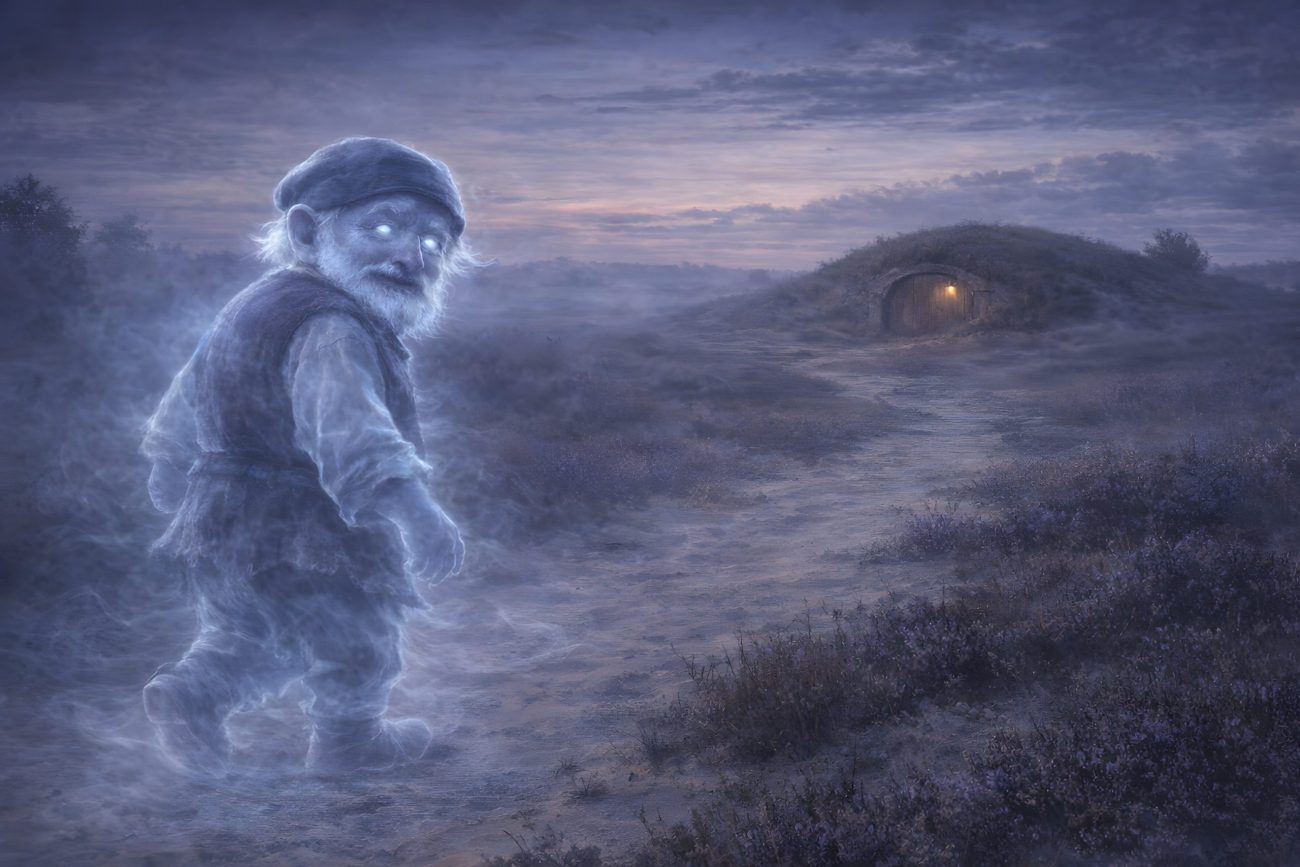
On the heath near Oss, there rises a low hill called the Hansjoppenberg. There, people say, lives a small dwarf-like being known as Hansjop.
Lonely walkers crossing the heath at dusk or in quiet weather may find themselves unexpectedly accompanied. A short figure appears beside them, walking along as if by chance. He does not threaten, nor does he ask questions. He simply keeps pace, sharing the path in silence or light-hearted calm.
After walking a little way together, Hansjop suddenly stops. With a cheerful “houdoe”—a familiar Brabant farewell—he turns aside and vanishes back into his hill, leaving the traveler alone once more, unsure whether what they experienced was real.
Some say Hansjop is no harmless dwarf at all, but the restless spirit of a man named Hans Joppe, or Hans Jacob, who in 1678 murdered his wife and was punished with a brutal execution. According to this telling, his soul never left the place and now wanders the heath, neither fully at peace nor openly hostile.
Whether friendly hill-dweller or condemned ghost, Hansjop remains a figure of quiet encounters—appearing only to the solitary traveler, walking beside them for a time, and disappearing again into the earth as suddenly as he came.
In an age when grudges were believed to stain the world itself, there lived a woman named Monohana whose life ended in cruelty and betrayal. Bound with rope and murdered unjustly, her resentment did not fade with death. Instead, it clung to what lay closest to her final suffering.
In the water where goldfish swam, her hatred took hold.
The fish, once harmless and beautiful, became vessels for her spirit. Their eyes gleamed with an unnatural light, and their movements grew violent and erratic. From within their small bodies, Monohana’s fury watched and waited.
When the man who had wronged her and the woman who shared his crime drew near, the goldfish surged from their container, water spilling as if driven by invisible hands. The possessed fish attacked without mercy, striking at the guilty as though guided by human will. In their thrashing bodies lived the scream Monohana was denied in death.
Thus the goldfish ghost was born—a yōkai formed not from flesh, but from resentment itself. It is said that wherever goldfish are kept, the memory of betrayed women lingers in the water, and that even the most delicate creatures may carry the weight of unresolved hatred.
Sources
TYZ-Yokai Blog contributors. (n.d.). 金魚幽霊 (Kingyo-Yūrei). In TYZ-Yokai Blog, from https://tyz-yokai.blog.jp/archives/1037178954.html