Maiden Lightning

Tradition: Czech Mythology
Alternative Names: Lightning Maiden
Category: Flame


The Myth

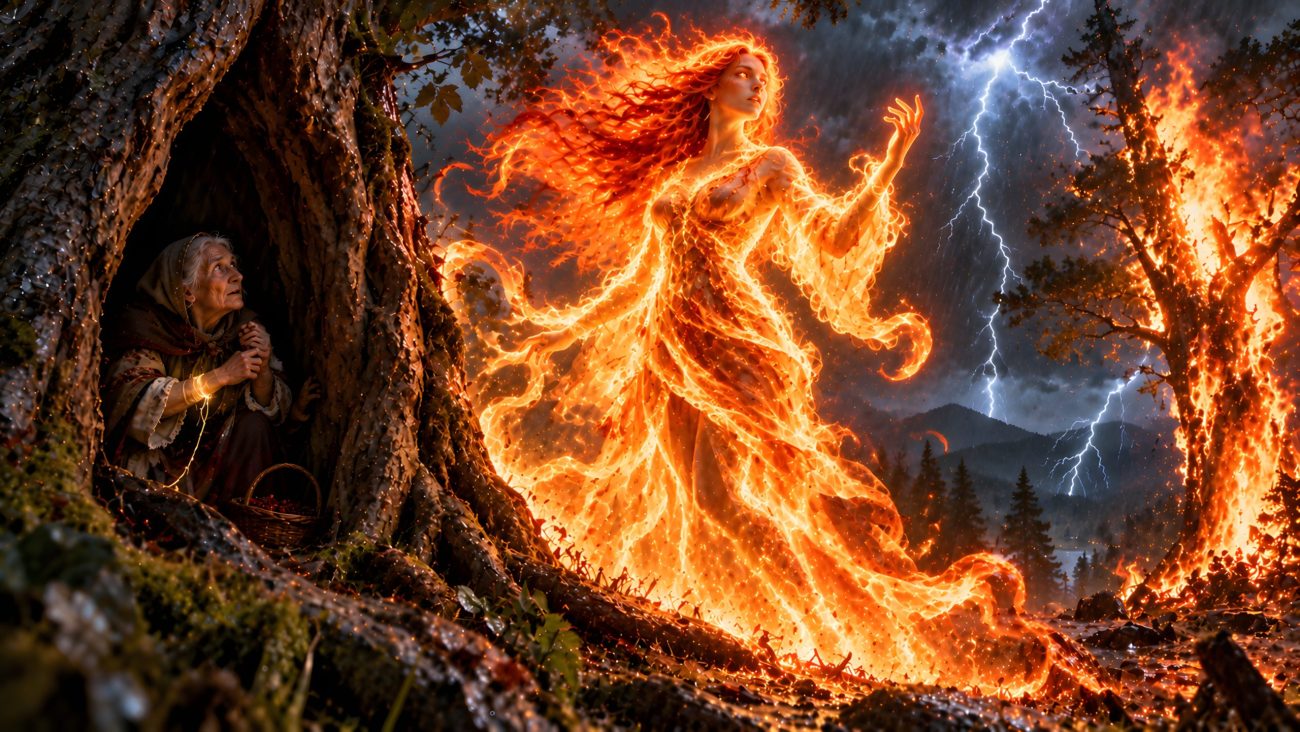
Maiden Lightning is a beautiful supernatural woman who appears during violent thunderstorms. She is completely naked, with fiery red hair and a body that glows so brightly that light radiates from her skin. Her arrival is accompanied by crashing thunder and flashes of lightning, and she can vanish in an instant, leaving behind a blazing flame.

One day, an elderly woman from Mugrau was gathering berries in the forest when a terrible storm approached. Seeking shelter, she climbed inside a hollow maple tree. As she peered outside, she saw the glowing maiden standing before her. Concerned that the stranger would get soaked, the old woman invited her to share the shelter. The maiden refused, explaining that she could not enter because the woman possessed the mysterious Lightning Thread.

At that moment, thunder roared and a spark ignited a nearby tree, sending a bright flame shooting upward. The maiden disappeared, leaving the old woman alone in the hollow tree. Had the bailiff not been carrying the Lightning Thread, the fire would have engulfed her shelter. The encounter revealed the maiden as a powerful spirit of lightning, whose fiery presence could ignite trees during a storm.


Sources

Hans Watzlik. “Jungferblitz.” In Böhmerwald-Sagen. Budweis: Böhmerwalder Dorfbücher, 1921, Heft 5. Reproduced by SAGEN.at. https://www.sagen.at/texte/sagen/tschechien/watzlik/jungferblitz.html
Blauwbroek

Tradition: Dutch Mythology
Alternative Names: Blue Breeches
Category: Flame


The Myth

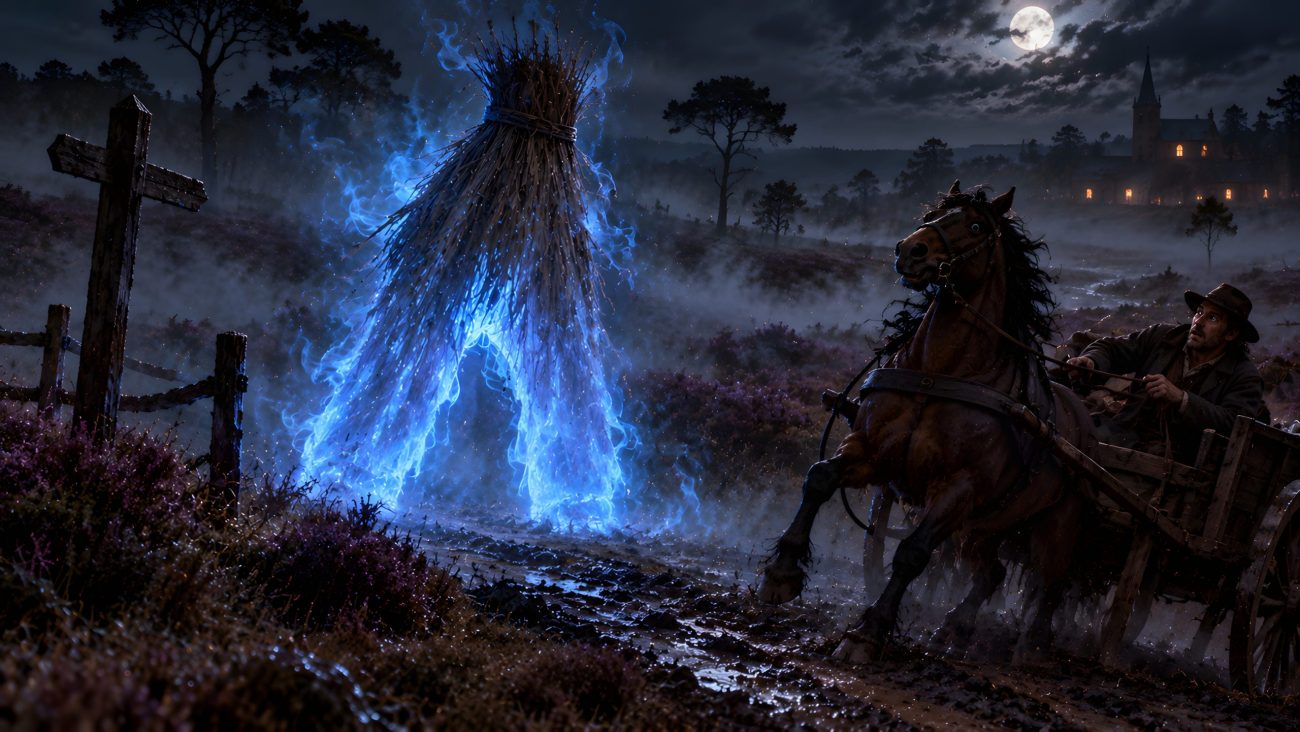
The Blauwbroek is a mysterious ghost from the Dutch province of Gelderland, said to wander across the heath in the form of a glowing sheaf of thatch. By day, it becomes a large, invisible spectre, capable of interfering with travellers despite remaining unseen. It can abruptly push people off the road without warning and even bring horses to a complete standstill, leaving those who encounter it helpless before an invisible force.

According to local tradition, the spirit was once a land surveyor or an arsonist, though the precise origin of the figure remains uncertain. Its name, meaning “Blue Breeches,” is probably derived from the little blue flame associated with its appearance, which resembles a pair of trousers. The Blauwbroek thus combines the eerie imagery of a wandering fire with the frightening idea of an unseen spirit that can obstruct people and animals along the road.


Sources

“Van aardmannetje tot zwarte juffer: Een lijst van Nederlandse en Vlaamse elfen en geesten.” Abe de Verteller. https://abedeverteller.nl/van-aardmannetje-tot-zwarte-juffer-een-lijst-van-nederlandse-en-vlaamse-elfen-en-geesten/


Aarnivalkea

Tradition: Finnish Mythology
Alternative Names: Virvatuli, Aarretuli, Aarreliekki
Category: Flame


The Myth

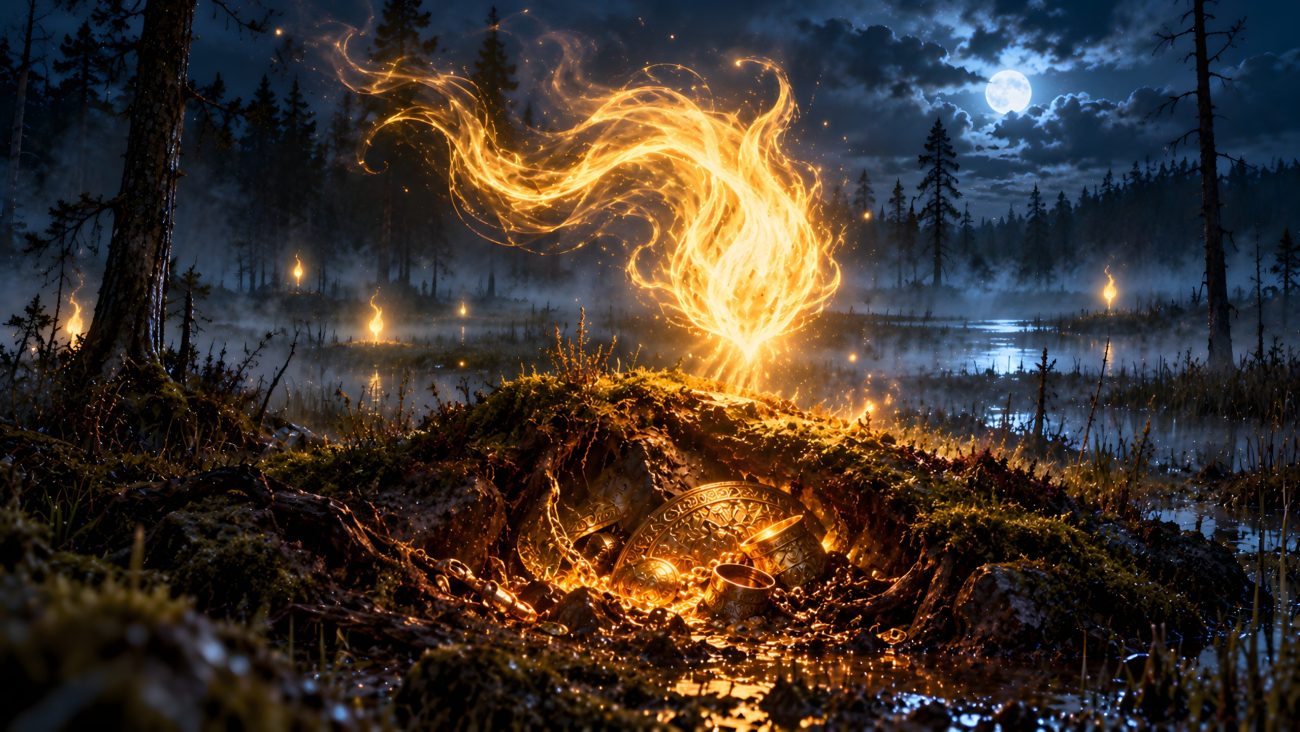
The Aarnivalkea is a mysterious eternal flame in Finnish mythology, associated with will-o’-the-wisps and the hidden treasures of the supernatural world. These strange fires mark the places where fairy gold lies buried beneath the earth. Their flames burn endlessly, revealing the presence of riches that would otherwise remain concealed from human eyes.

The treasures guarded by the Aarnivalkea are protected by a magical glamour that prevents people from discovering them by chance. Even someone who passes directly over a buried fortune may remain completely unaware of its existence. To overcome this enchantment, a fortunate seeker must find the seed of a mythical flowering fern. This rare magical seed is said to lead its possessor toward the hidden gold, allowing them to locate treasures that ordinary people cannot find.

The fern seed is believed to possess another extraordinary power: it grants invisibility to the person who carries it. The legend claims that the fern flowers only on exceptionally rare occasions, despite ordinary ferns producing spores rather than flowers. Finding such a seed is therefore an almost impossible undertaking, but those who succeed may gain both the power to disappear from sight and access to the enchanted treasures marked by the eternal flames.


Sources

“Will-o’-the-wisp.” Wikipedia: The Free Encyclopedia. Wikimedia Foundation. Accessed October 10, 2026. Section: “Americas.” https://en.wikipedia.org/wiki/Will-o%27-the-wisp#Americas


Igebo

Tradition: Japanese Mythology
Alternative Names: Igebo, Oni-bi
Category: Flame


The Myth

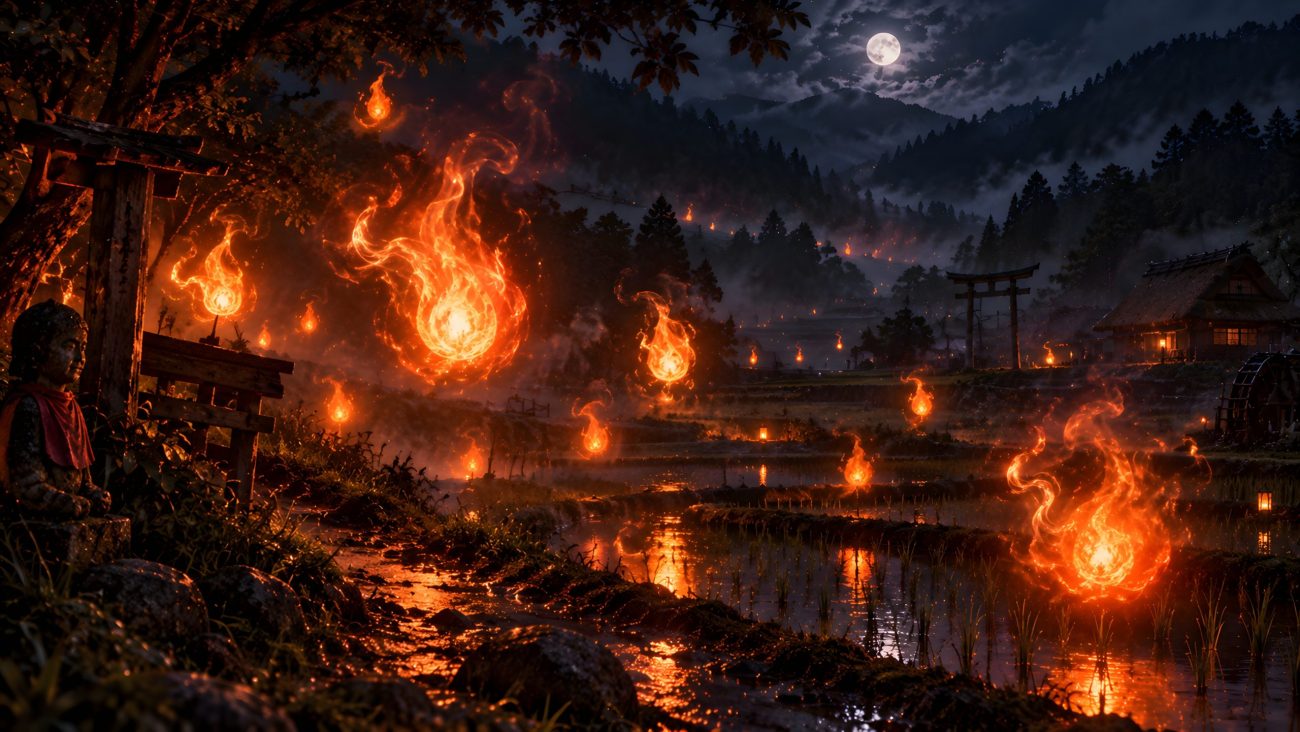
Igebo is a mysterious supernatural fire from Japanese folklore, known as a regional name for the oni-bi, or will-o’-the-wisp. It is associated with Watarai District in Mie Prefecture, where the name refers to the strange, ghostly lights that appear in the darkness. Like other will-o’-the-wisps in Japanese tradition, Igebo belongs to the folklore of unexplained flames that seem to emerge from the night.

The name Igebo was recorded by folklorist Kunio Yanagita in his work Yōkai Dangi (Discussions on Yōkai), among a collection of yōkai names. Yanagita noted that he had not heard the name used anywhere else, making its origin difficult to determine. The precise meaning of the name and the particular stories once associated with Igebo therefore remain uncertain.


Sources

“イゲボ (Igebo).” 新版TYZ 妖怪図鑑 (New TYZ Yokai Encyclopedia). August 11, 2019. https://tyz-yokai.blog.jp/archives/1074589206.html


Yōchin

Tradition: Japanese Mythology
Alternative Names: Eternal Sinking
Category: Flame


The Myth

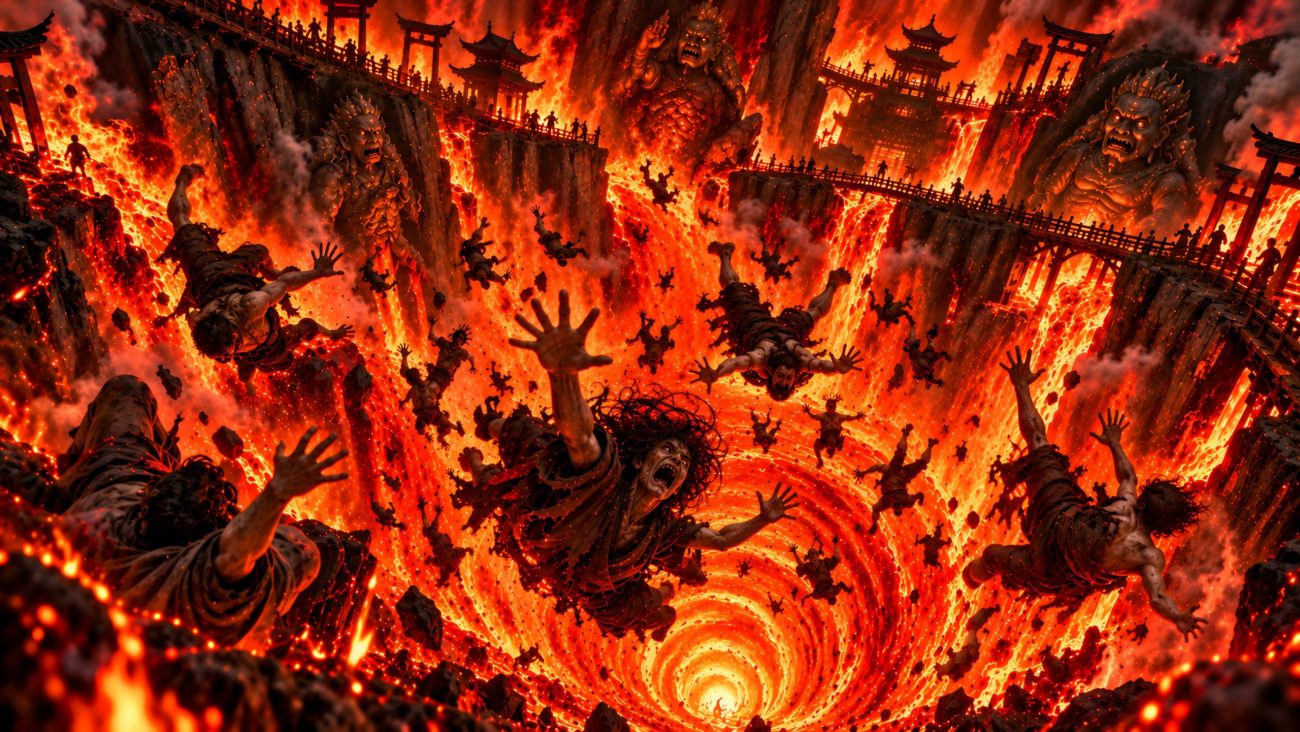
Yōchin, meaning “Eternal Sinking,” represents a terrifying fate from which there is no escape. It is depicted as a place of endless descent into swirling flames, where the souls of sinners fall helplessly toward the deepest reaches of hell. Once a soul enters this dreadful realm, it cannot return to the world above.

In Buddhist-inspired depictions of the journey toward paradise, Yōchin appears as a square on a board game illustrating the fate of the dead. The square shows a soul plunging into a fiery abyss, representing Avīci Hell, the realm of unending torment. Unlike other spaces on the board, which allow the soul to progress toward salvation, Yōchin marks an irreversible fall into damnation. It is the ultimate dead end, where the journey ends in eternal suffering.


Sources

“妖鎮 (Yōchin).” 新版TYZ 妖怪図鑑 (New TYZ Yokai Encyclopedia). https://tyz-yokai.blog.jp/archives/1079630670.html


Cherruve

Tradition: Mapuche Mythology, Argentine Mythology, Chilean Mythology
Alternative Names: Cherruve, Cherufe
Category: Flame


The Myth

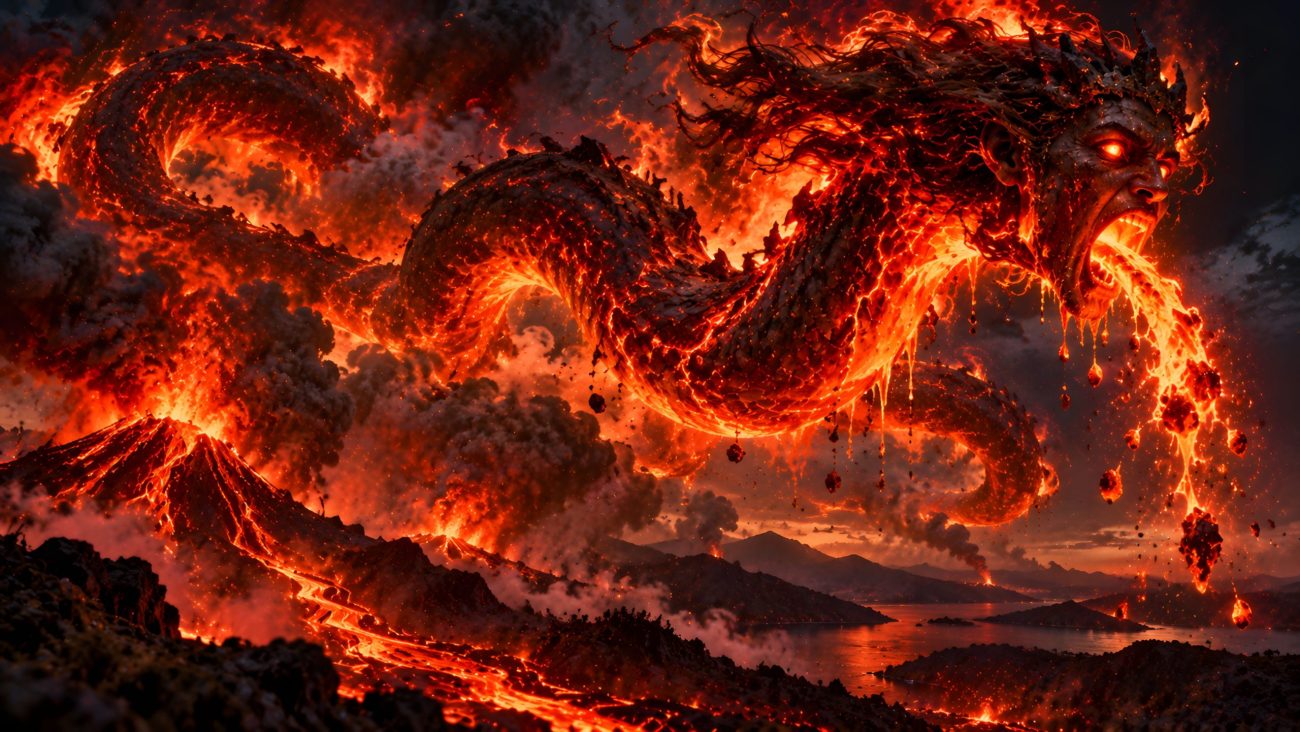
The Cherruve is a fearsome supernatural being associated with comets, meteors, volcanoes, and destructive fire. It is often described as a blazing comet streaking across the night sky, but it can also appear as a gigantic serpent with a human head and molten lava dripping from its mouth. In some regions, it takes the form of a seven-headed dragon, a fiery-eyed giant, or even a two-legged goat with burning eyes. Cherruves dwell underground and within volcanoes, emerging into the sky like flaming celestial bodies.

The appearance of a Cherruve is considered an omen of disaster, foretelling epidemics, the death of great leaders, and other misfortunes. Their movements beneath the earth cause earthquakes, while their fiery vomit becomes lava flowing down volcanic slopes. They are said to create thunder by tossing human heads through the air. Some particularly monstrous Cherruves demand the sacrifice of Mapuche maidens and threaten to withhold the flow of rivers when their demands are refused. Their forms can also include meteorites and strangely shaped volcanic rocks, which sorcerers collect and use as supernatural weapons against their enemies. These enchanted stones can be commanded to spread disease, drain blood, and bring death before returning to their masters.

Despite their destructive nature, Cherruves are also capable of love, jealousy, and grief. One Cherruve married a Cloud, and together they had a beautiful daughter named Snow, whose body was pale and delicate. The Cherruve jealously guarded his wife, but his enemy Wind abducted her, and whenever Wind carried Cloud over the volcano, her tears fell as rain while the Cherruve’s despair erupted in devastating volcanic outbursts. He became equally protective of Snow, forbidding her from leaving the mountain during daylight. Yet Snow longed to see the world beyond her home. One day, she escaped and marvelled at the sunlight, birdsong, and the colours of the world, growing happier even as her strength faded. When Wind carried her mother away once more, Snow collapsed from exhaustion. The Sun, moved by love for the beautiful girl, descended to kiss her. When her father finally found her, Snow had vanished, leaving behind only a puddle of crystalline water.


Sources

“Cherruve.” A Book of Creatures. January 22, 2016. https://abookofcreatures.com/2016/01/22/cherruve/


Soranaki

Tradition: Japanese Mythology
Alternative Names: Kūbō, Kuubou
Category: Flame


The Myth

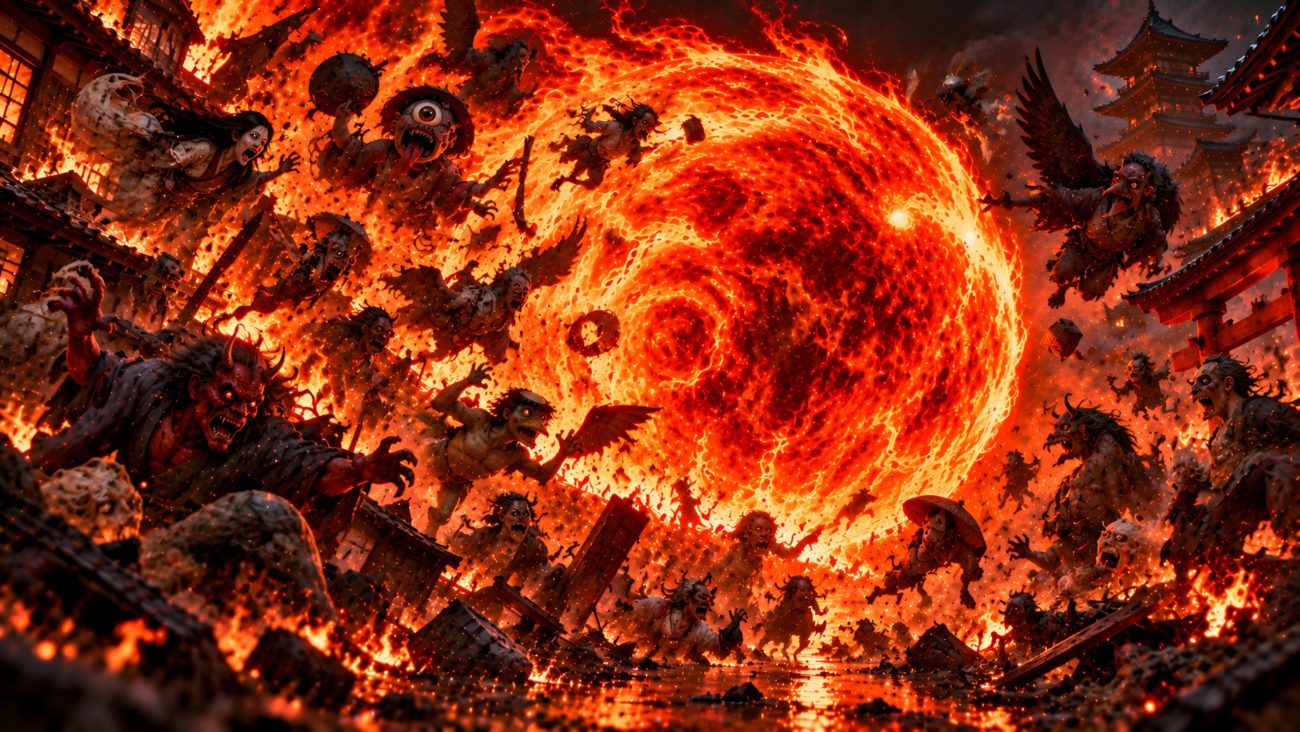
Soranaki is depicted as an enormous, blazing red sphere, resembling a gigantic fireball rolling across the world. In modern interpretations, it is portrayed as an overwhelmingly powerful supernatural being capable of confronting and scattering entire processions of demons. Its fiery, spherical form is associated with the sun, radiating intense heat and possessing the power to drive away other supernatural creatures.

In the story of the Night Parade of One Hundred Demons, the great red sphere appears at the end of the procession and scatters the rampaging demons in its path. One later tale describes a blazing sphere rolling down a main street, sweeping aside the hundred demons encountered by the nobleman Kujō Morosuke. In this version, the sphere is revealed to be a spirit familiar summoned by the onmyōji Abe no Seimei to save Morosuke.

Soranaki is also known as Kūbō, a name associated with a gap in the traditional calendar and a period of misfortune. Its identity as a named yokai, however, belongs to modern interpretations of the mysterious red sphere. Later stories and artistic creations developed it into a powerful supernatural creature, often described as one of the strongest yokai. Its fearsome reputation rests on its immense fiery form and its ability to overwhelm the demons that cross its path.


Sources

“空泣 (Soranaki).” 新版TYZ 妖怪図鑑 (New TYZ Yokai Encyclopedia). https://tyz-yokai.blog.jp/archives/1010654285.html


Hellewagen

Tradition: Dutch Mythology, Belgian Mythology
Alternative Names: Spookwagen, Hell Wagon
Category: Flame


The Myth

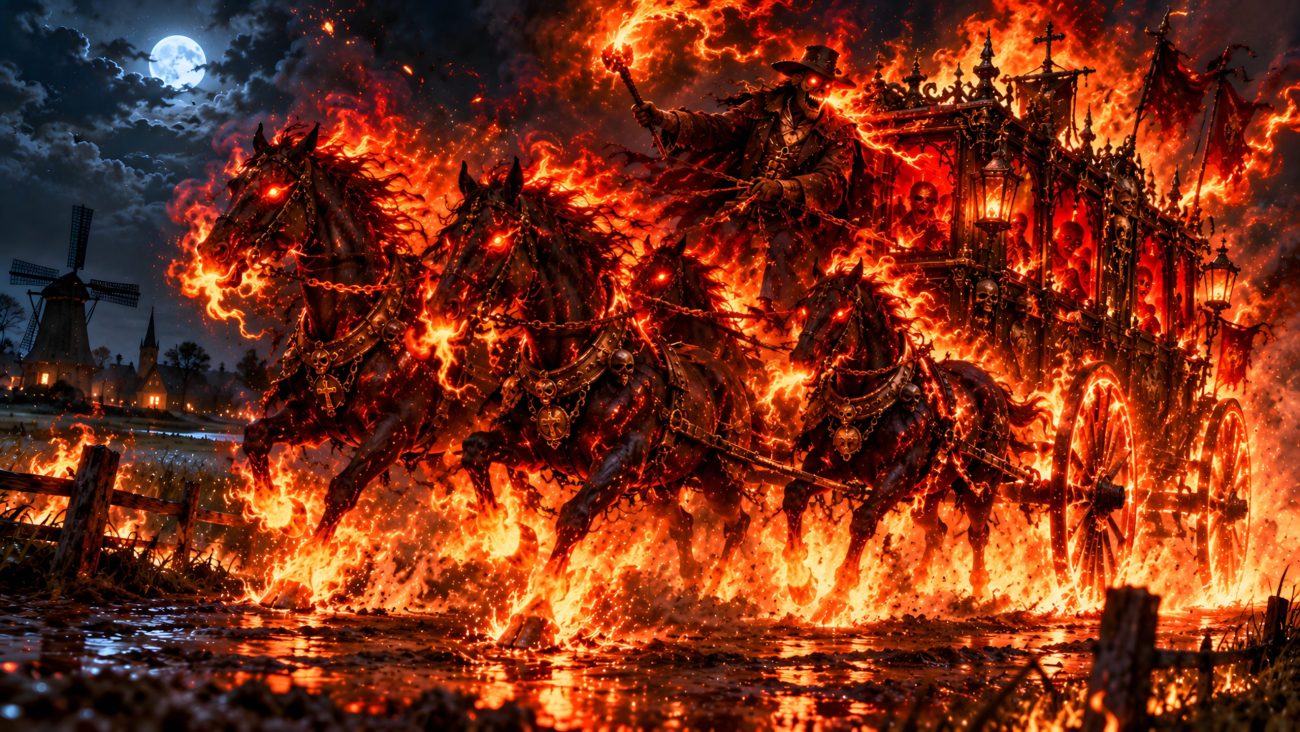
The Hellewagen, or Spookwagen, is a terrifying ghostly carriage that races through the night between midnight and one o’clock. It is drawn by black or invisible horses and sometimes travels through the air, accompanied by a deafening, hellish rumble. Inside the carriage, blood-red lights illuminate its interior, while its spectral coachman glows and spits fire. The entire vehicle shines with an ominous supernatural light as it thunders through the darkness.

The Hellewagen is said to be the punishment of wealthy sinners who exploited and oppressed the common people. In one tale, a late-night wanderer heard the carriage approaching with a tremendous clatter. Yet when it drew near, it suddenly vanished, only to reappear a few metres farther along the road. The apparition is believed to be the restless spirit of a dissolute nobleman, condemned to ride eternally through the night in his blazing carriage.


Sources

“Van aardmannetje tot zwarte juffer: Een lijst van Nederlandse en Vlaamse elfen en geesten.” Abe de Verteller. https://abedeverteller.nl/van-aardmannetje-tot-zwarte-juffer-een-lijst-van-nederlandse-en-vlaamse-elfen-en-geesten/


Znich

Tradition: Lithuanian Mythology
Alternative Names: Znicz, Znichka, Znic
Category: Flame


The Myth

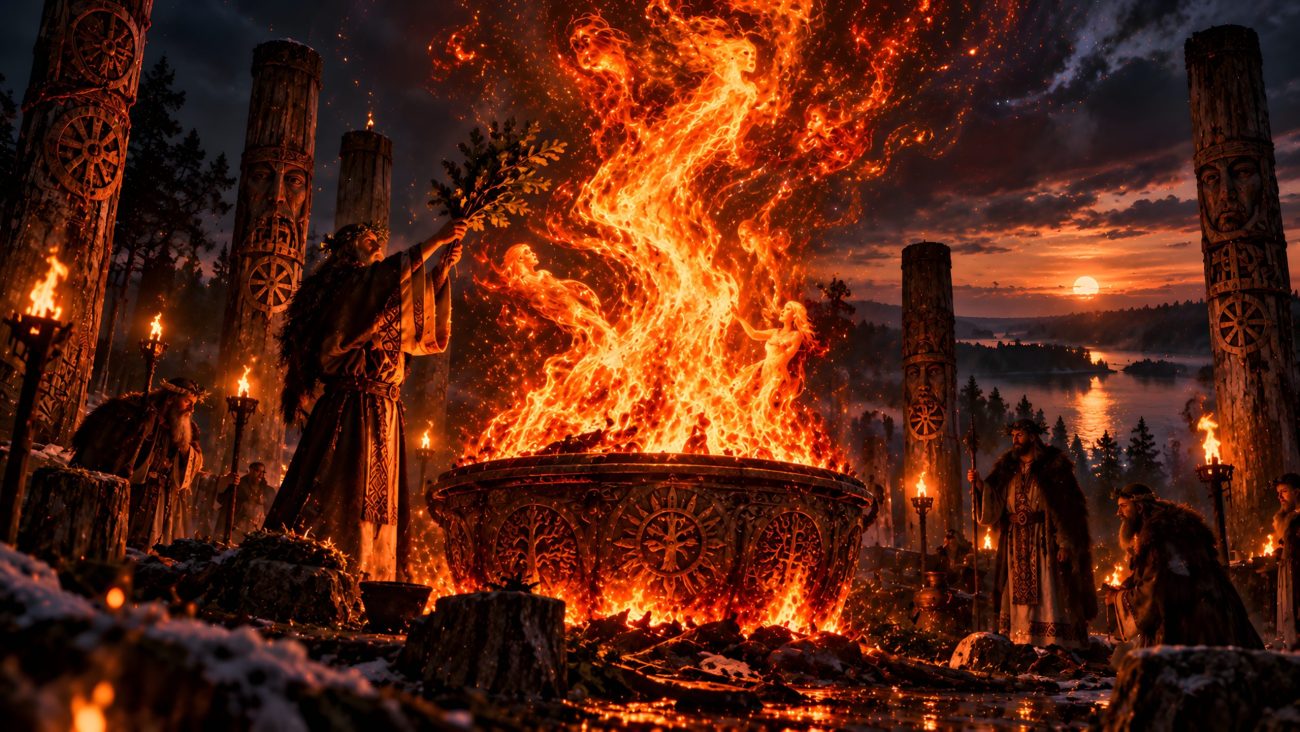
Znich is a sacred eternal fire in ancient Lithuanian tradition, associated with pagan worship and the spirits of the dead. It was maintained by priests in sanctuaries and temples, where the sacred flame was never supposed to go out. The fire was believed to possess great spiritual power, connecting the living with the gods and honouring the souls of the departed. In some traditions, Znich was associated with funeral fires that consumed the bodies and belongings of the dead, turning them to ashes.

The eternal flame was guarded carefully by priests, who tended it with oak branches and wood taken from sacred groves. Its presence marked a holy place, and its extinction was regarded as a serious spiritual loss. Some traditions also associated Znich with a glowing fire at the tombs of the dead, while other accounts described it as a sacred flame burning in a cauldron or sanctuary. The name could refer not only to the fire itself but also to the priest responsible for keeping it alive.

Znich remained a powerful symbol of ancient pagan worship, representing the enduring connection between sacred fire, religious devotion, and the world of spirits. Its flame was more than a source of light: it embodied a holy presence that had to be preserved through continual care and reverence.


Sources

“Знич (Znich).” New Bestiary (Bestiary.us). https://www.bestiary.us/znich-0


Obayifo

Tradition: Ghana Mythology
Alternative Names: Asiman, Obansam
Category: Flame, Vampire


The Myth

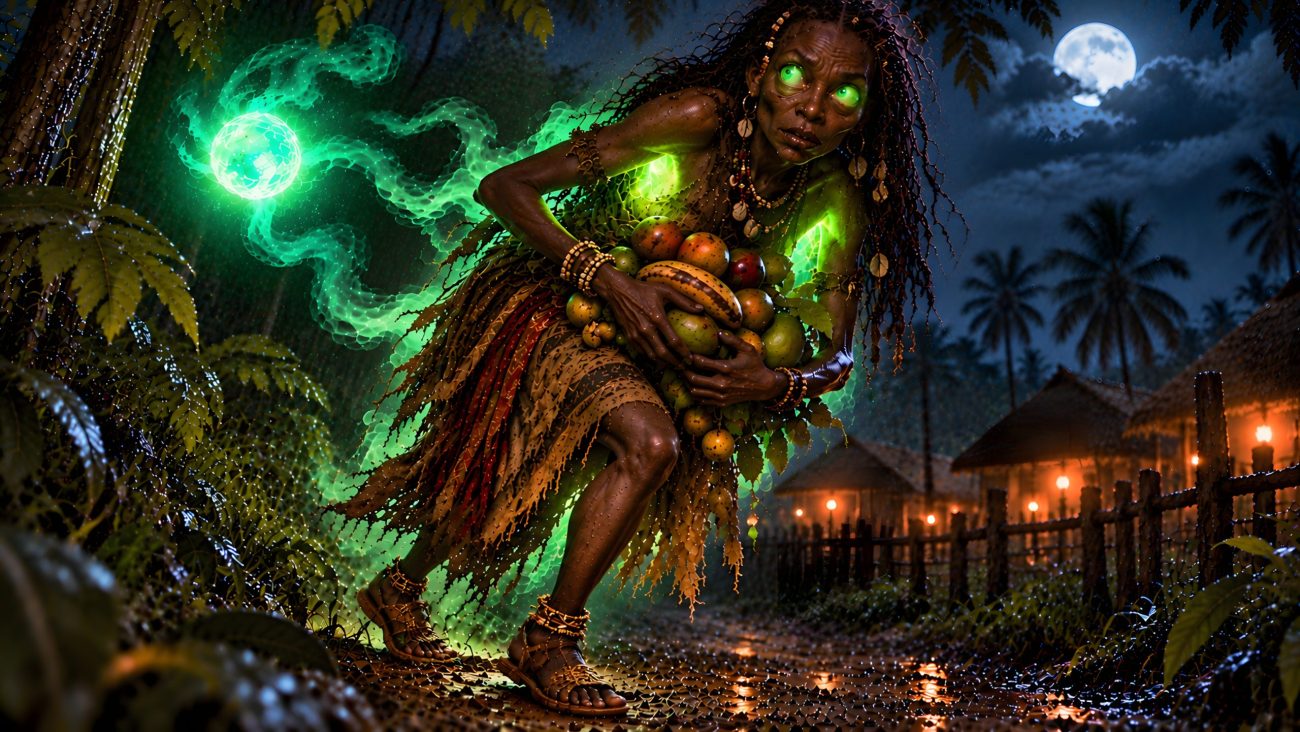
The Obayifo is a terrifying witch-like creature from Ashanti folklore in West Africa, capable of inhabiting the body of an ordinary man or woman. It is often described as having shifting, suspicious eyes and an insatiable obsession with food. Although it can appear human during the day, its supernatural nature becomes apparent at night, when it travels in search of prey.

As it moves through the darkness, the Obayifo emits an eerie, phosphorescent light from its armpits and anus. This strange glow reveals its presence as it hunts beneath the night sky. The creature is associated with vampiric powers and witchcraft, making it a feared figure capable of hiding among ordinary people while concealing its monstrous nature.

Among the Dahomey people, a similar being is known as the Asiman. This creature can shapeshift and fly, transforming itself into a glowing ball of light as it searches for victims at night. Like the Obayifo, it combines the appearance of a supernatural light with the predatory nature of a witch-like spirit, turning the darkness into its hunting ground.


Sources

“Obayifo.” Wikipedia: The Free Encyclopedia. Wikimedia Foundation. Accessed October 11, 2026. https://en.wikipedia.org/wiki/Obayifo