Kotoko and the Magical Hoe

Tradition / Region: Ghana Mythology
Alternative names: Kotoko the Porcupine
Category: Object


The Myth

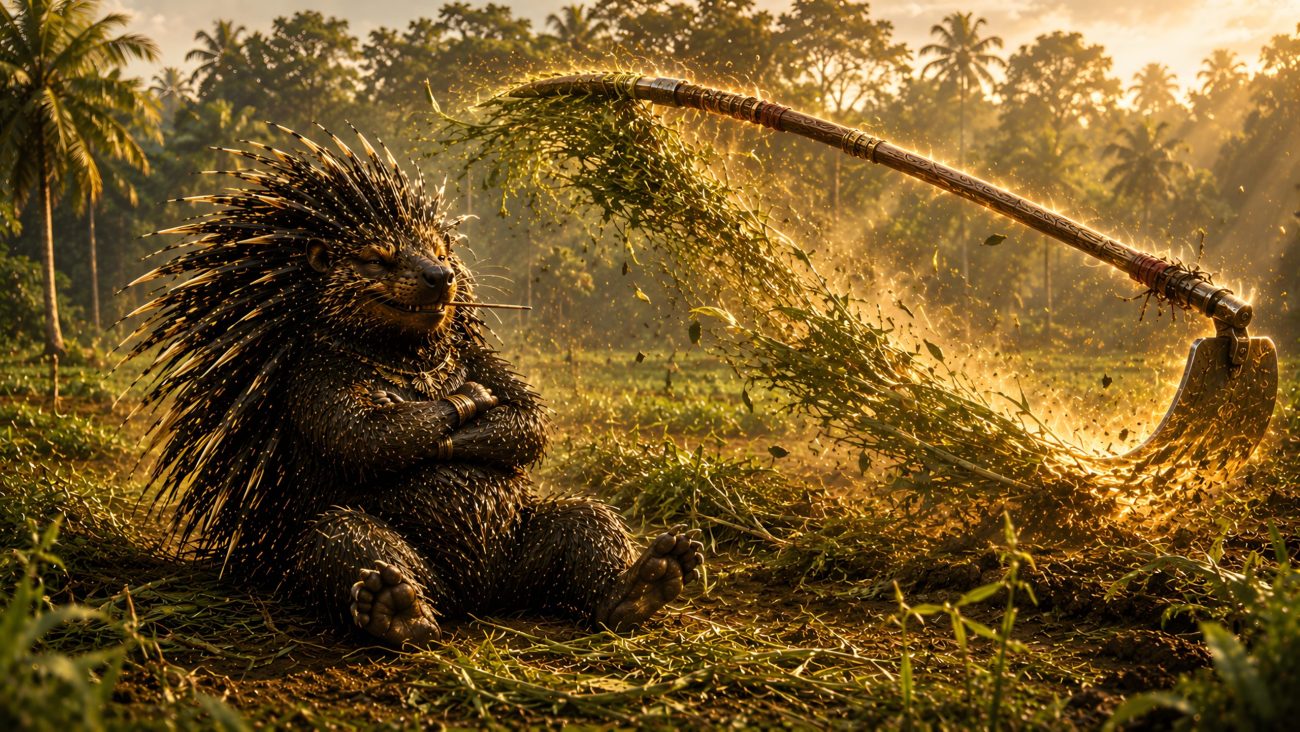
Kotoko, the Porcupine, was believed to possess a magical hoe unlike any ordinary farming tool. The enchanted hoe could clear enormous stretches of land by itself whenever the correct song was spoken.

One story tells that Kwaku Ananse the Spider lived together with his strange children — Tikononkono, Afudotwedotwe, and Nyiwankonfwea — alongside Kotoko the Porcupine. When Kotoko began clearing a new farm, Ananse begged him for a small piece of land to cultivate for himself, and Kotoko agreed.

While Ananse and his children struggled to dig the earth by hand, Kotoko returned home to eat. When he came back, he lifted his magical hoe and sang:

“Gyensaworowa, Kotoko saworowa…”

At once the hoe sprang to life and rapidly turned over huge stretches of land by itself. When the work was finished, Kotoko carefully hid the magical tool. But Ananse secretly watched where it had been hidden and decided to steal it the next morning.

Very early the next day, Ananse took the hoe and carried it to his own farm. He repeated the magical song exactly as Kotoko had done. The hoe immediately began clearing the land at tremendous speed.

But Ananse did not know how to stop it.

The magical hoe continued digging endlessly, racing farther and farther away. It crossed the lands of the Sea God and eventually reached the country of distant white men. There the foreigners discovered the strange tool, examined it, and began making many more hoes modeled after it.

According to the story, this is how hoes first spread among the Ashanti people. Before that time, only Kotoko the Porcupine possessed such a tool.


Sources

Rattray, R. S. (1930). Akan-Ashanti folk-tales. Oxford: Clarendon Press.


Sango the Eagle

Tradition / Region: Ghana Mythology
Alternative names: Sango, Sango the Bird
Category: Bird


The Myth

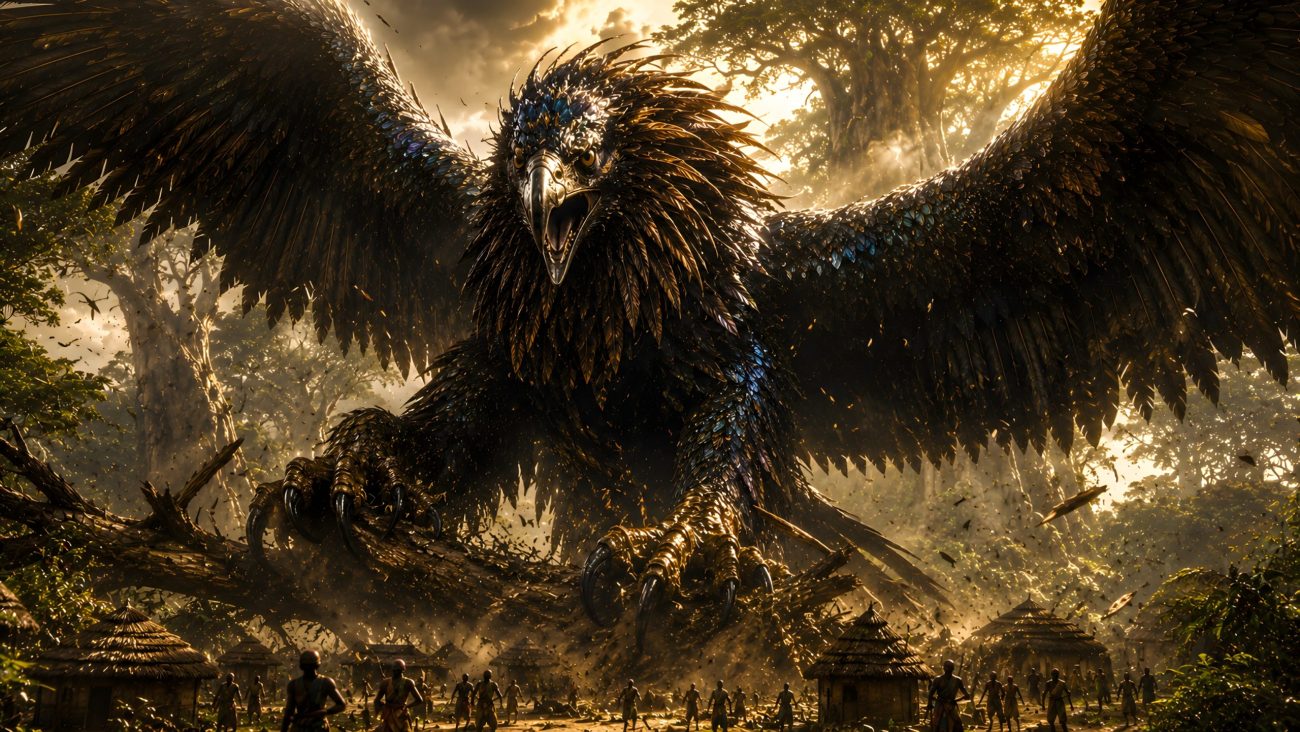
Sango was a powerful magical eagle known for supernatural abilities and terrifying vengeance. She could heal wounds, transform the land itself, restore forests, destroy entire villages, and command reality with spoken words.

One story tells of Sango meeting an old woman suffering from a terrible sore on her leg. The eagle healed the wound instantly with magic. She then transformed the empty land around the woman into farms, houses, and finally an enormous town. In return for all this, Sango asked only for a silk-cotton tree where she could build her nest.

The old woman agreed, and Sango settled there, laying two eggs in the great tree. After hatching her children, she left to search for food. While she was gone, the old woman’s grandchild demanded to eat the eagle’s young. The child cried and screamed until the old woman ordered the villagers to cut down the silk-cotton tree and seize the eaglets.

As the axes struck the tree, one of the young eagles climbed to the edge of the nest and cried out desperately for its mother:

“Sango, the bird!
Sango, come back!”

Sango heard the cries and rushed back through the sky. Using her magic word “Sanguri,” she restored the nearly-fallen tree and swallowed the attackers within it. After feeding her children, she warned them and left once more.

But the villagers returned again. This time Sango was too far away to hear the cries. The silk-cotton tree crashed down, and the villagers captured the eaglets. One escaped, but the other was roasted and eaten by the old woman’s grandchild.

When Sango returned and learned what had happened, she flew to the village in fury. She spoke her magic again:

“Sanguri.”

At once the people vanished. Again she spoke, and every house collapsed. Again the village became wilderness. Finally, the old woman’s terrible sore returned to her leg exactly as before.

Sango then declared that kindness must be repaid with kindness, not betrayal and cruelty.


Sources

Rattray, R. S. (1930). Akan-Ashanti folk-tales. Oxford: Clarendon Press.


Obonto Ya

Tradition / Region: Ghana Mythology
Alternative names: Obonto Ta, Obonto Ya
Category: Fish


The Myth

Obonto Ya was a tiny water creature, usually described as a minnow or very small fish. In Akan folklore she became known for deceit, shame, and restless wandering through rivers and streams.

The story tells of an old grandmother whose property mysteriously disappeared. She believed one of the water creatures had stolen it, so all the creatures of the water gathered together to discover the thief. A crab proposed a test: a brass pan would be brought forward, and every creature would cry into it. Whoever could not produce tears would be revealed as the guilty one.

One after another the creatures came forward. The crab cried and filled the pan with tears. The eel cried. The shrimp cried. Every water creature managed to fill the brass pan with tears from their eyes.

At last Obonto Ya stepped forward. But no tears came from her eyes at all. Immediately the other creatures realized she was the thief who had stolen the grandmother’s belongings.

The water creatures became furious because Obonto Ya had disgraced them all. They beat her severely for bringing shame upon the creatures of the water. Afterward, the old grandmother spared her life, but she cursed her forever, declaring that Obonto Ya would endlessly wander through the water and that nobody would ever truly wish to associate with her again.

Because of this curse, people said the tiny fish could always be seen darting nervously and aimlessly through streams and rivers, wandering from place to place without rest.


Sources

Rattray, R. S. (1930). Akan-Ashanti folk-tales. Oxford: Clarendon Press.


Anansi

Tradition / Region: Ghana Mythology
Alternative names: Ananse, Kwaku Anansi, Anancy, Nanzi, Aunt Nancy
Category: Spider


The Myth

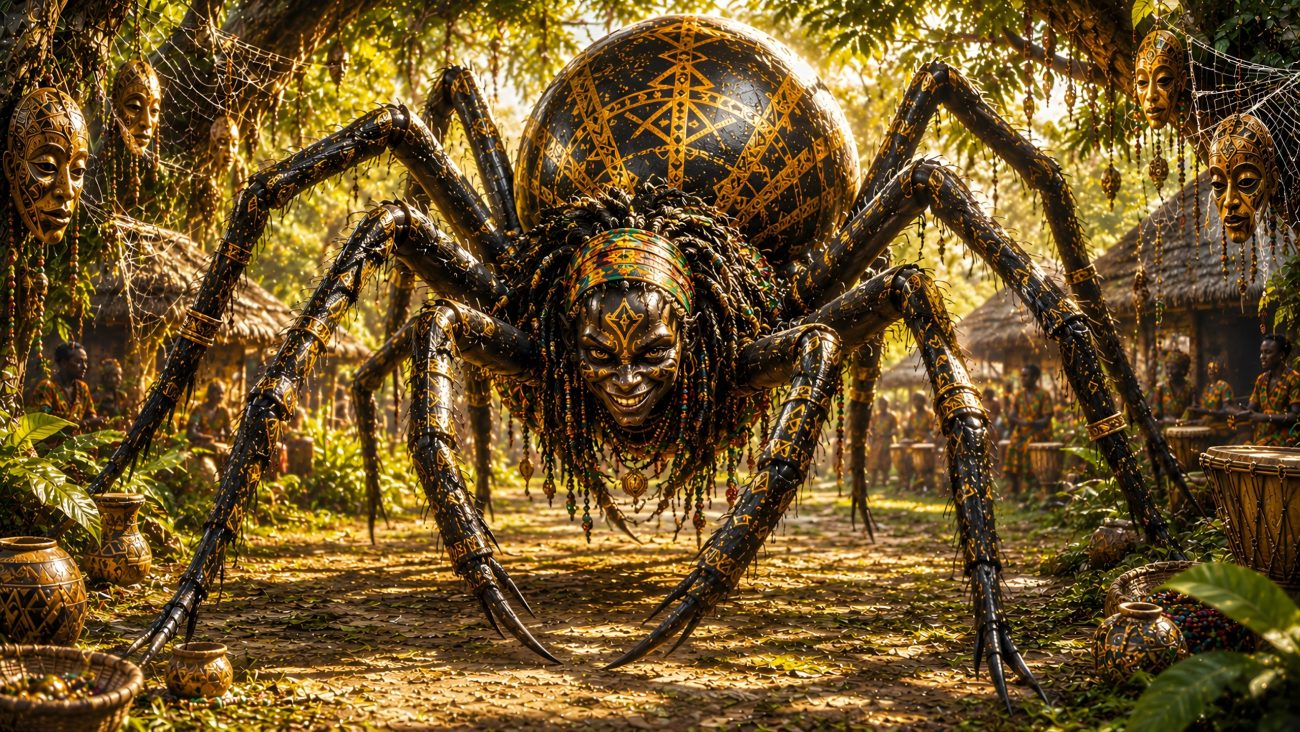
Anansi was a supernatural spider-being famous for his intelligence, cunning, deception, and ability to outwit stronger enemies. He was usually portrayed as a spider, though many stories described him as partly human or as a man with spider-like features.

He was one of the most important figures in Akan folklore and later became widely known throughout the Caribbean and the Americas after enslaved Africans carried his stories across the Atlantic.

Anansi was associated with wisdom, speech, trickery, storytelling, and survival. Many traditions treated him as the owner of all stories, and spider tales themselves became known as Anansesem — “Spider Stories.”

Although often selfish, greedy, and mischievous, Anansi constantly defeated stronger beings through cleverness rather than force. He tricked spirits, animals, humans, and even gods. In some traditions he interacted directly with the Sky God Nyame and other divine beings, sometimes receiving temporary supernatural powers or sacred duties.

Some Akan traditions described Anansi as connected to the divine world and occasionally treated him as a lesser spiritual being associated with wisdom. Certain stories even claimed he created the first human body. In Caribbean religions such as Haitian Vodou, Anansi was sometimes linked to the Guede spirits connected with death and the world of the dead.

One of the most famous stories tells how Anansi became the owner of all stories in the world. The Sky God Nyame possessed every story and demanded impossible tasks in exchange for them. Anansi succeeded by trapping dangerous creatures including the python Onini, hornets, a leopard, and a magical dwarf through tricks and deception. Impressed, Nyame declared that all stories would belong to Anansi forever and would be known as Spider Stories.

Another famous tale tells how Anansi tried to gather all wisdom in the world inside a pot so nobody else could possess it. He attempted to hide the pot high in a tree, but his son Ntikuma pointed out a simpler way to climb. Furious that another person still possessed wisdom, Anansi smashed the pot, scattering wisdom across the earth for everyone to share.

Many stories portrayed Anansi causing trouble through greed and manipulation. He brought diseases into the world after tricking Nyame and releasing sickness from a magical gourd. In another tale he tricked a jealous husband and stole his wife Aso, who later became Anansi’s permanent wife in many stories.

Anansi was also connected with survival and resistance. Enslaved Africans in the Americas saw him as a symbol of intelligence overcoming power because he repeatedly escaped danger and humiliated stronger enemies using wit alone. His stories became both entertainment and lessons about survival, selfishness, cleverness, and human weakness.


Sources

Wikipedia contributors. (n.d.). Anansi. In Wikipedia. Retrieved May 16, 2026, from https://en.wikipedia.org/wiki/Anansi#Anansi_as_a_spiritual_and_mythological_figure