Tradition / Region: Ghana Mythology
Alternative names: Sango, Sango the Bird
Category: Bird
The Myth
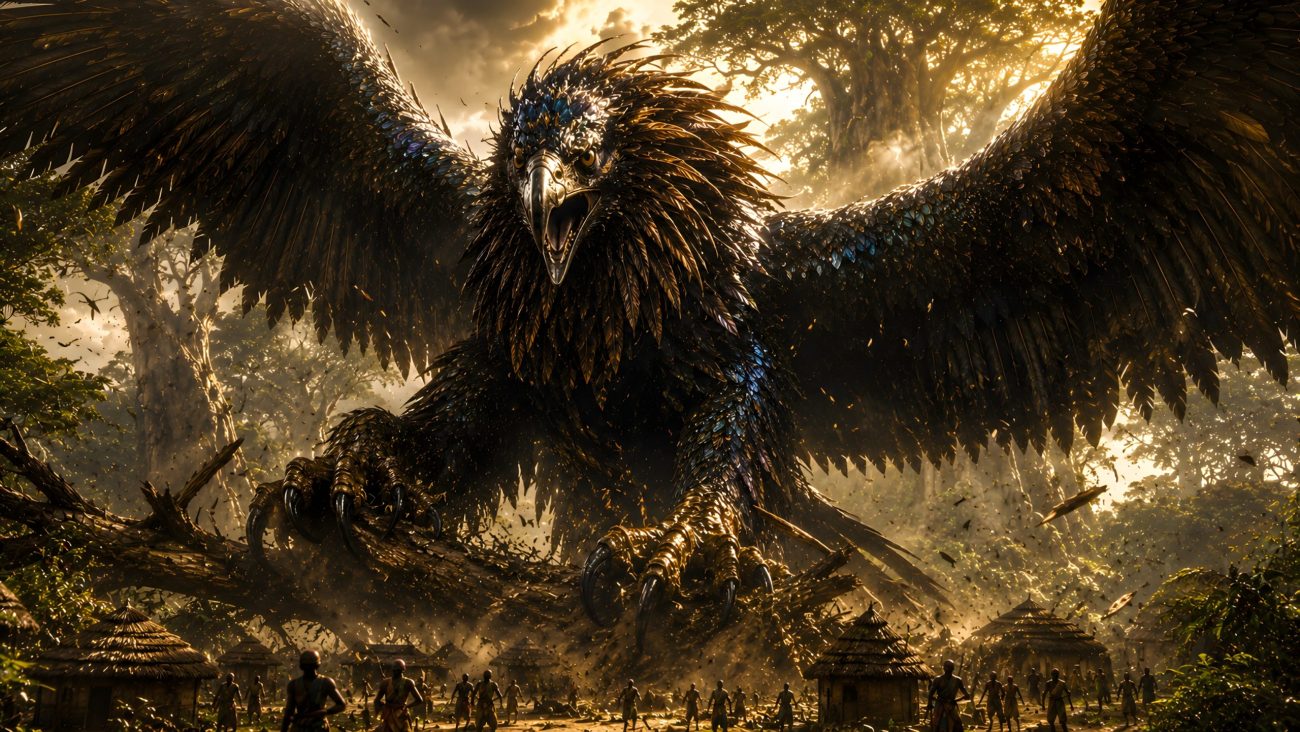
Sango was a powerful magical eagle known for supernatural abilities and terrifying vengeance. She could heal wounds, transform the land itself, restore forests, destroy entire villages, and command reality with spoken words.
One story tells of Sango meeting an old woman suffering from a terrible sore on her leg. The eagle healed the wound instantly with magic. She then transformed the empty land around the woman into farms, houses, and finally an enormous town. In return for all this, Sango asked only for a silk-cotton tree where she could build her nest.
The old woman agreed, and Sango settled there, laying two eggs in the great tree. After hatching her children, she left to search for food. While she was gone, the old woman’s grandchild demanded to eat the eagle’s young. The child cried and screamed until the old woman ordered the villagers to cut down the silk-cotton tree and seize the eaglets.
As the axes struck the tree, one of the young eagles climbed to the edge of the nest and cried out desperately for its mother:
“Sango, the bird!
Sango, come back!”
Sango heard the cries and rushed back through the sky. Using her magic word “Sanguri,” she restored the nearly-fallen tree and swallowed the attackers within it. After feeding her children, she warned them and left once more.
But the villagers returned again. This time Sango was too far away to hear the cries. The silk-cotton tree crashed down, and the villagers captured the eaglets. One escaped, but the other was roasted and eaten by the old woman’s grandchild.
When Sango returned and learned what had happened, she flew to the village in fury. She spoke her magic again:
“Sanguri.”
At once the people vanished. Again she spoke, and every house collapsed. Again the village became wilderness. Finally, the old woman’s terrible sore returned to her leg exactly as before.
Sango then declared that kindness must be repaid with kindness, not betrayal and cruelty.
Sources
Rattray, R. S. (1930). Akan-Ashanti folk-tales. Oxford: Clarendon Press.