Hirin

Tradition: Japanese Mythology
Alternative Names: 火輪, Yake
Category: Flame


The Myth

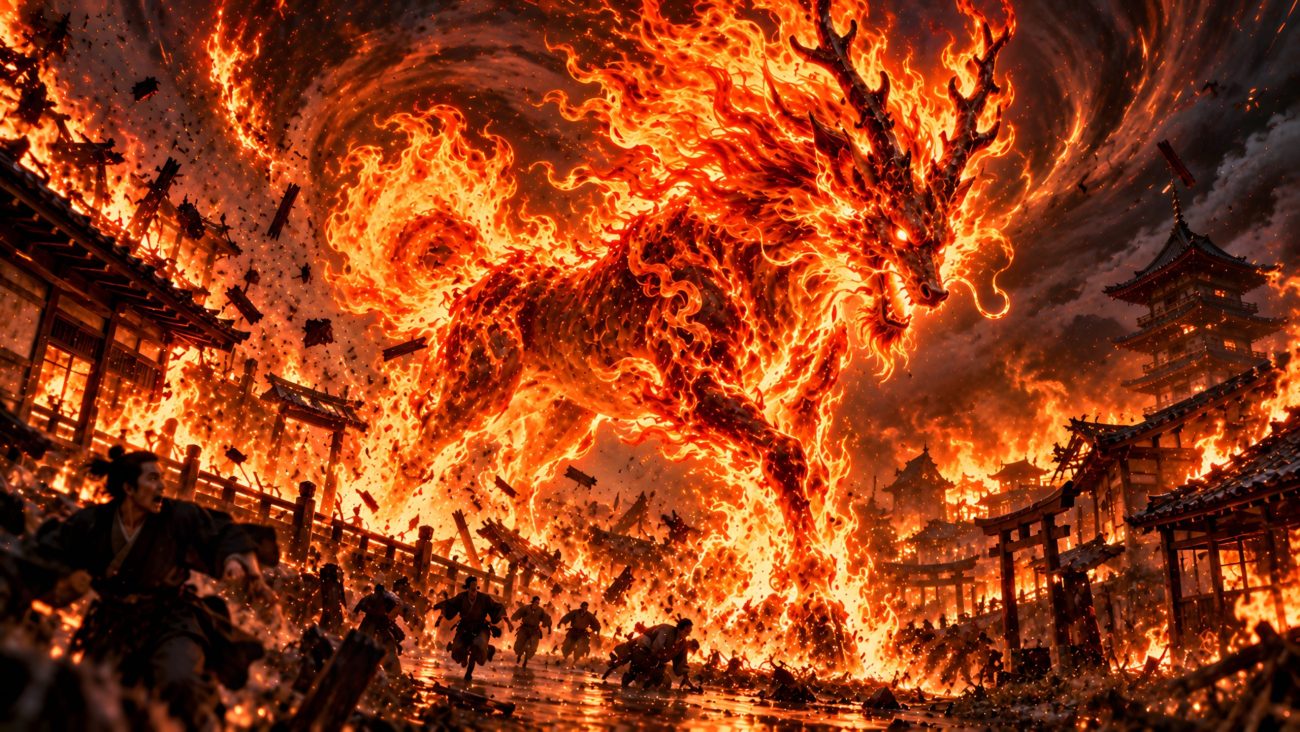
Hirin is a terrifying fire creature resembling a kirin, a mythical beast completely engulfed in flames. It appears amid powerful winds or a raging whirlwind, its blazing form sweeping through towns and setting buildings alight. Its fiery body represents destruction on a massive scale, as the creature advances through settlements and leaves burning ruins in its wake.

According to the legend, the Hirin appeared during a devastating fire, bringing destruction and causing numerous deaths. Its immense flaming form symbolises the spreading blaze itself, transforming an ordinary disaster into a monstrous supernatural event. The related name Yake is associated with burning, reinforcing the creature’s connection to fire and destruction.


Sources

“飛輪 (Hirin).” 新版TYZ 妖怪図鑑 (New TYZ Yokai Encyclopedia). https://tyz-yokai.blog.jp/archives/1078433256.html


Itqiirpak

Tradition: Yupik Mythology, American Mythology
Alternative Names: Fireball
Category: Flame


The Myth

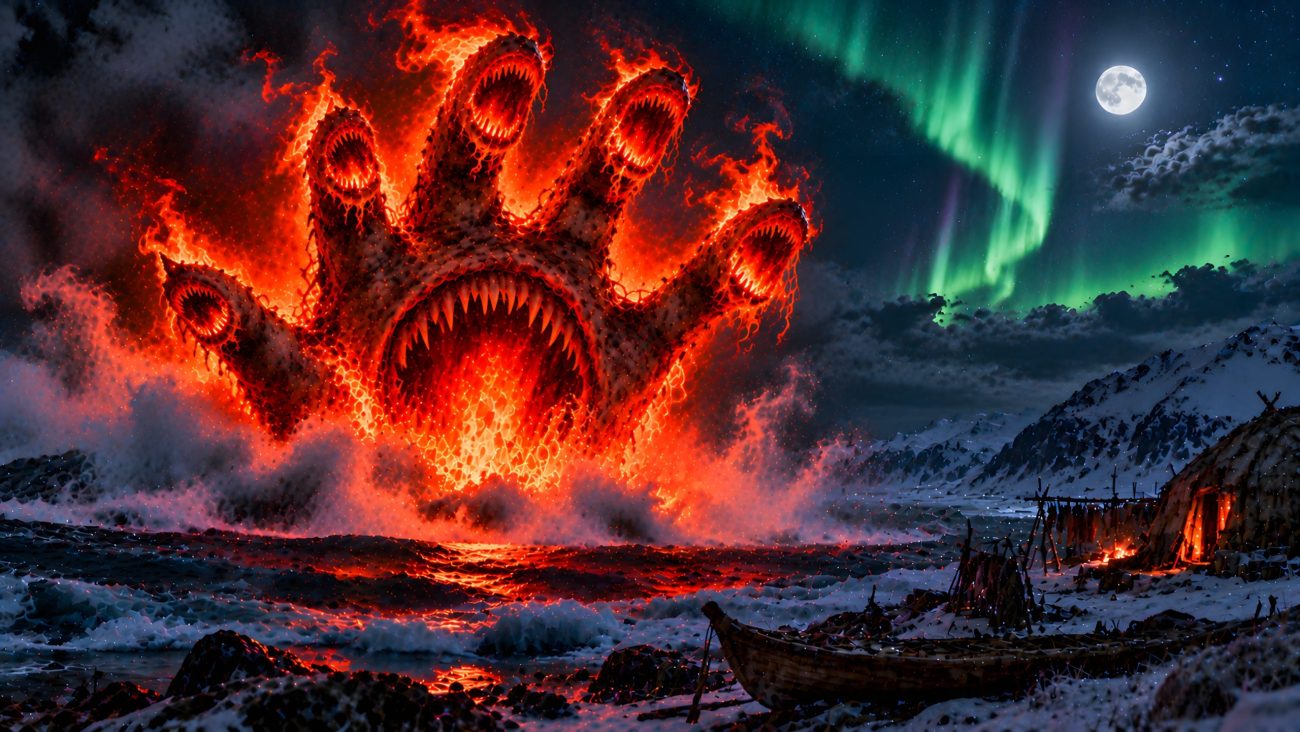
The Itqiirpak is a terrifying supernatural creature from Yupik folklore, appearing either as a crimson fireball flickering over the sea in the western sky or as a gigantic hand rising from the ocean. The monstrous hand has a mouth on each fingertip and one enormous mouth in the centre of its palm. Both forms are associated with death and disaster, making the Itqiirpak a dreaded sight for coastal communities.

The Itqiirpak is a harbinger of terrible misfortune, sometimes appearing before disasters and sometimes bringing harm directly to those it considers troublesome. In one story, a male Itqiirpak burned its way into a qasgiq, the traditional men’s communal house, where it seized ill-mannered children and dragged them outside to devour them. The only sound heard was the crunching of their bones. When the men returned, they saw the creature jumping up and down on the ice like a blazing fire. They eventually killed it by setting a swinging blade-trap for it.

The female Itqiirpak, however, remained at large. Taking the form of the monstrous hand, it continued to appear as an omen of impending death. In more recent stories, the crimson fireball has been seen before tragedies within Yupik communities, including the drowning of two children in the Kun River in 2007. The Itqiirpak thus remains a frightening presence associated with unexplained tragedy, appearing over the sea as a warning of misfortune to come.


Sources

“Itqiirpak.” A Book of Creatures. November 20, 2020. https://abookofcreatures.com/2020/11/20/itqiirpak/


Barcädžy Calh

Tradition: Ossetian Mythology, Russian Mythology
Alternative Names: Wheel of Balsæg, Cutting Wheel, Barsæg, Marsug
Category: Flame


The Myth

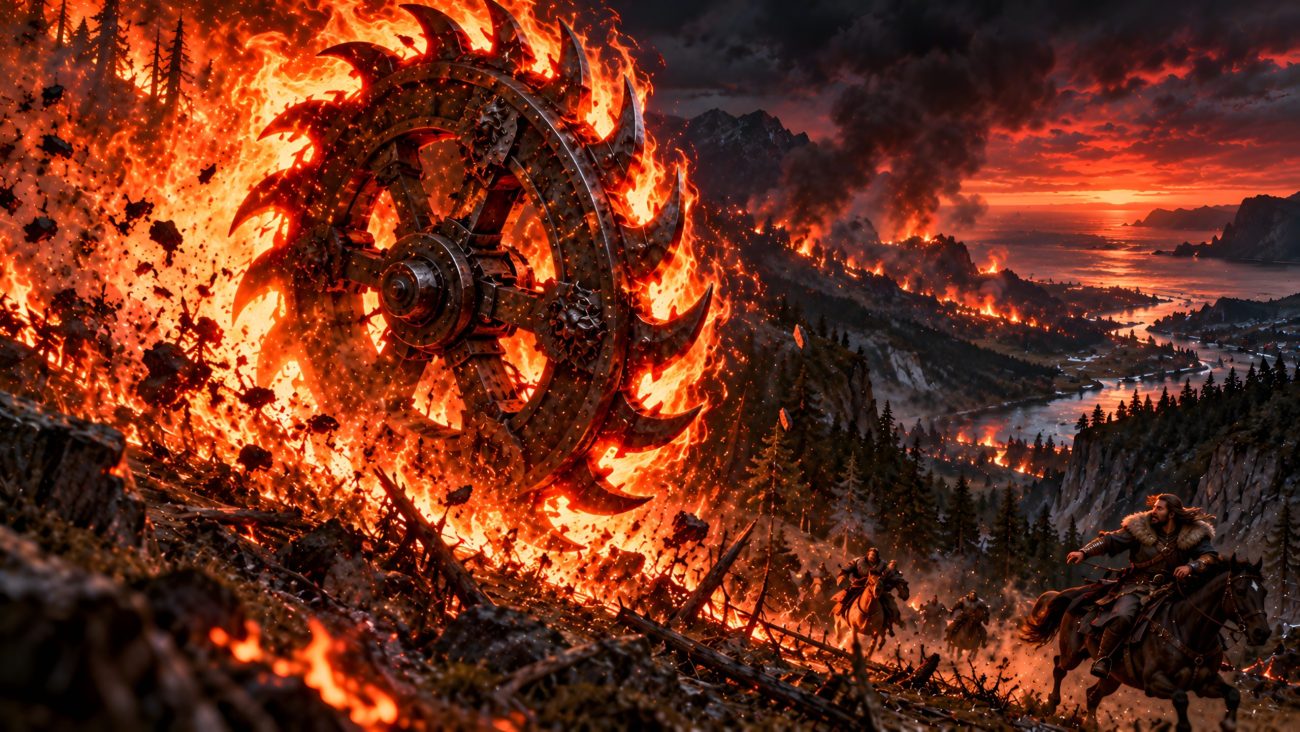
Barcädžy Calh, the Wheel of Balsæg, is a terrifying supernatural weapon in the form of a razor-sharp metal wheel covered in steel teeth, with flames bursting from its surface. It is an intelligent and malevolent automaton capable of moving by itself. When unleashed, the blazing wheel rolls down from the heavens and races across the earth, setting plains and forests ablaze as it charges toward the Black Sea. Only birch trees escape its fiery destruction.

The Wheel plays a central role in the death of Soslan, also known as Sosryko, one of the greatest Nart heroes. After Soslan’s horse is brought down by arrows striking the vulnerable undersides of its hooves, the jealous Syrdon calls upon the Wheel to destroy the hero. Soslan pursues the fiery machine and manages to capture it, but it breaks free and rushes at him, slicing through his knees—the one vulnerable part of his otherwise invulnerable body. Mortally wounded, Soslan is left to die. His sons pursue the Wheel into the Black Sea, but they cannot save their father. Before his death, Soslan takes revenge on Syrdon from beyond the grave, while his nephew later avenges him by breaking the Wheel in half.

The Wheel’s ownership varies between tellings. In some stories, it is sent by the Daughter of the Sun; in others, it belongs to Father Ojnon, identified with John the Baptist. Its master, Balsæg, remains mysterious, and the Wheel itself sometimes appears in simplified versions of the tale as a deadly training discus. Whatever its origin, the blazing Wheel remains a fearsome force of destruction, combining supernatural intelligence, razor-sharp steel, and a trail of fire.


Sources

Barcadzy Calh.” A Book of Creatures. November 9, 2015. https://abookofcreatures.com/2015/11/09/barcadzy-calh/
Fiery Body

Tradition: Austrian Mythology
Alternative Names: The Fiery Corpse
Category: Flame


The Myth

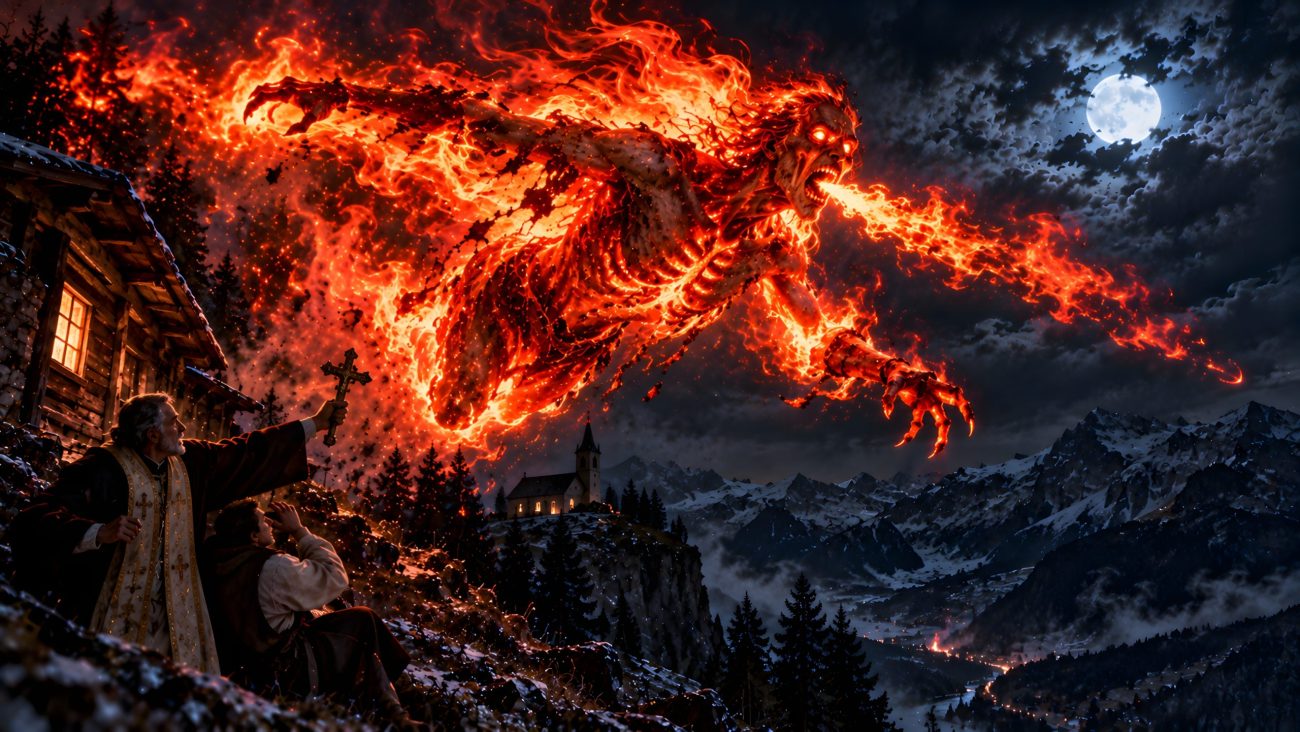
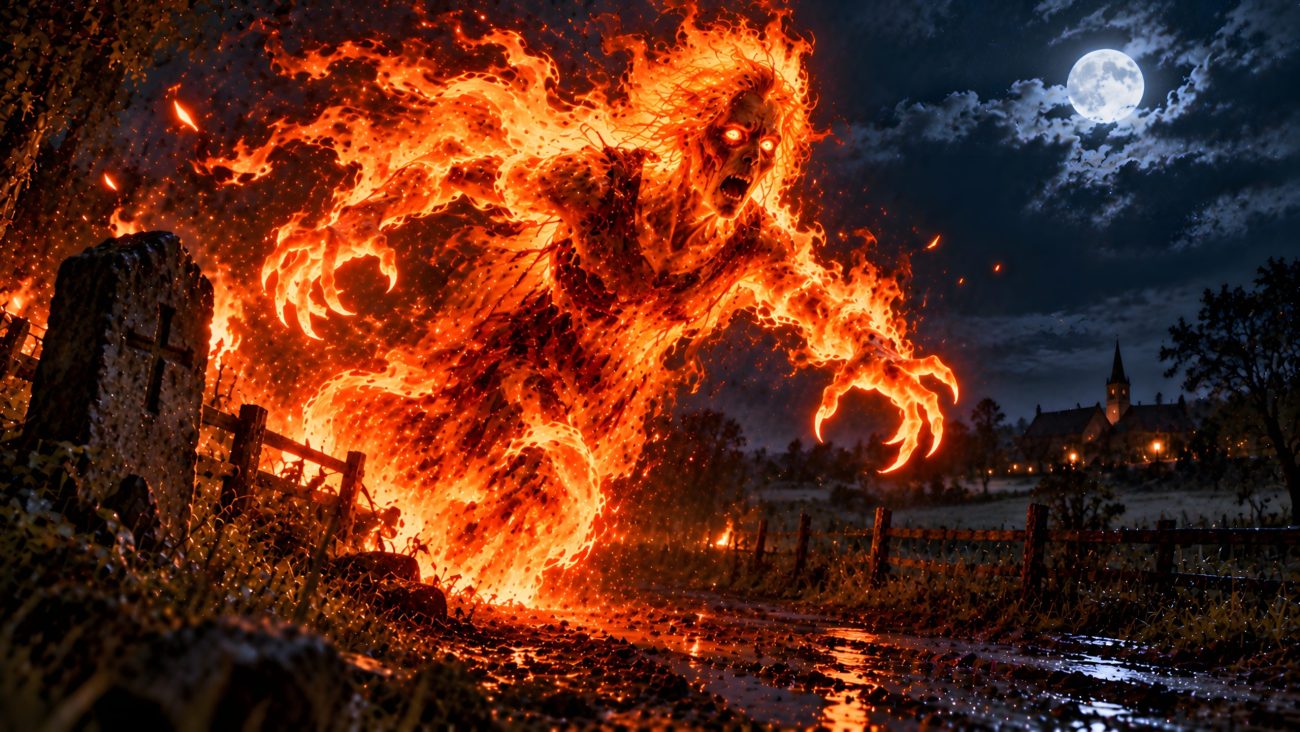
The Fiery Body is a terrifying supernatural apparition from the folklore of the Passeier Valley in the Tyrol. It appears as a fiery red human body rushing through the air, spitting flames as it flies. The apparition is said to be the spirit of a wicked man who died without repentance after repeatedly breaking the Sabbath and mocking religion.

According to the legend, a man living on an isolated mountain farm became gravely ill after injuring his foot while hunting in the forest on a Sunday. His wound worsened until he was consumed by a deadly fever. Although his neighbours urged him to abandon his wicked ways, he refused to listen. Even when a priest tried to persuade him to repent, the man responded with contempt, throwing a plate at the priest and remaining defiant until his final moments.

As the man lay dying, his household begged the priest to return and save his soul. The priest hurried up the mountain with his sacristan, carrying the Holy Sacrament. Near the farm, they suddenly encountered a blazing red body hurtling through the air directly toward them. Recognising the apparition as the body of the unrepentant sinner, the sacristan fell to the ground in terror. The priest remained calm, declaring that Christ was with them. The fiery apparition swept past without harming either man before plunging down the terrible precipice of the Matatz Valley.


Sources

Von Günther, Amalia. Tales and Legends of the Tyrol. London: Chapman and Hall, 1874.


Liekkiö

Tradition: Finnish Mythology
Alternative Names: Ihtiriekko, Flamey
Category: Flame


The Myth

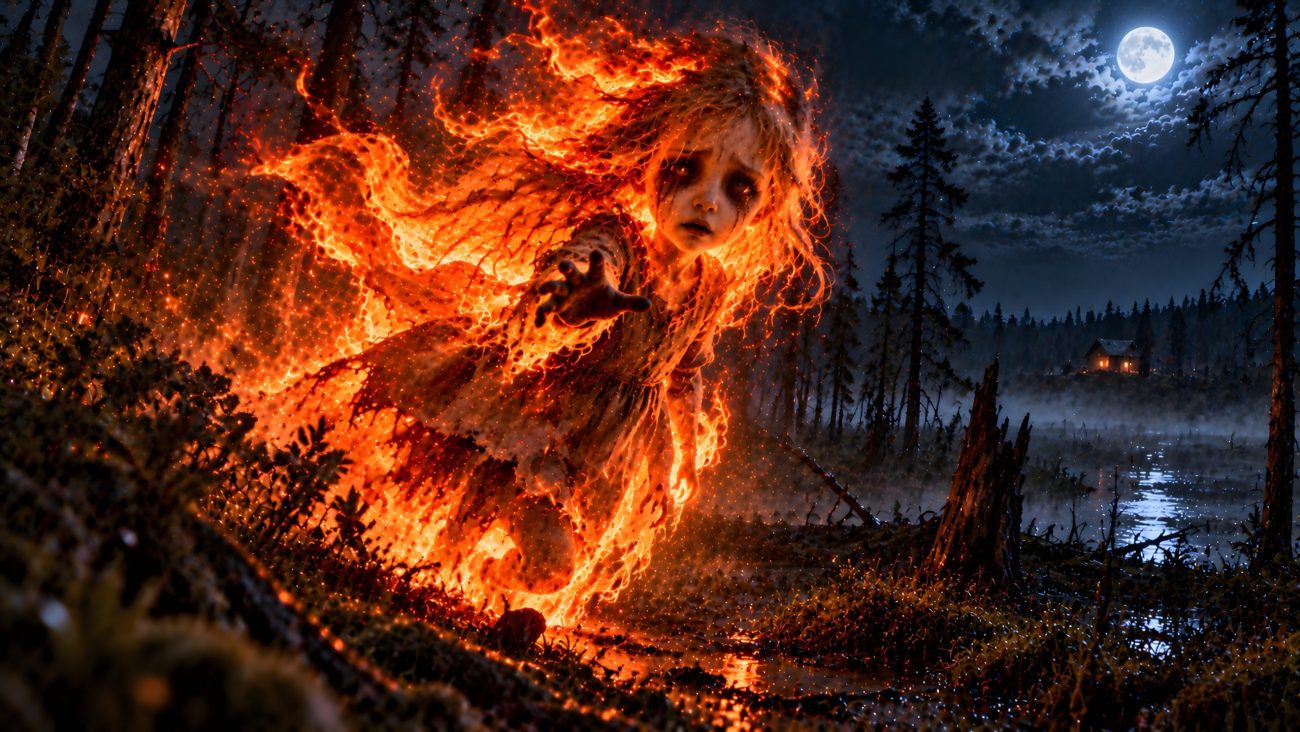
The Liekkiö is a ghostly spirit from Finnish mythology associated with the souls of children who were killed by their mothers and buried outside consecrated ground. In traditional stories, a woman who gave birth to a child outside an accepted marriage might kill the baby to avoid condemnation from the church and the surrounding community. The child was then buried without a priest’s blessing, leaving its soul unable to find peace in the afterlife.

One form of this restless spirit is called the Ihtiriekko. It is said to make terrible noises until someone discovers its buried body and gives it a proper burial in a graveyard. The spirit’s cries reveal its distress and its longing for the burial rites that were denied to it in death.

Other spirits of this kind are known as Liekkiö and may remain silent, appearing instead as mysterious flames in the forest. Like will-o’-the-wisps, these ghostly lights flicker among the trees, marking the presence of restless souls unable to find peace. Their eerie glow serves as a reminder of the neglected dead who remain trapped between the world of the living and the afterlife.


Sources

“Liekkiö.” Simple English Wikipedia. Wikimedia Foundation. Accessed October 11, 2026. https://simple.wikipedia.org/wiki/Liekki%C3%B6


Glène Kerel

Tradition: Dutch Mythology, Belgian Mythology
Alternative Names: De Gloeiige (Engelsman), Gloeiende Gerrit, Gleunigen, Glende Kerels, Sjoufert
Category: Flame


The Myth

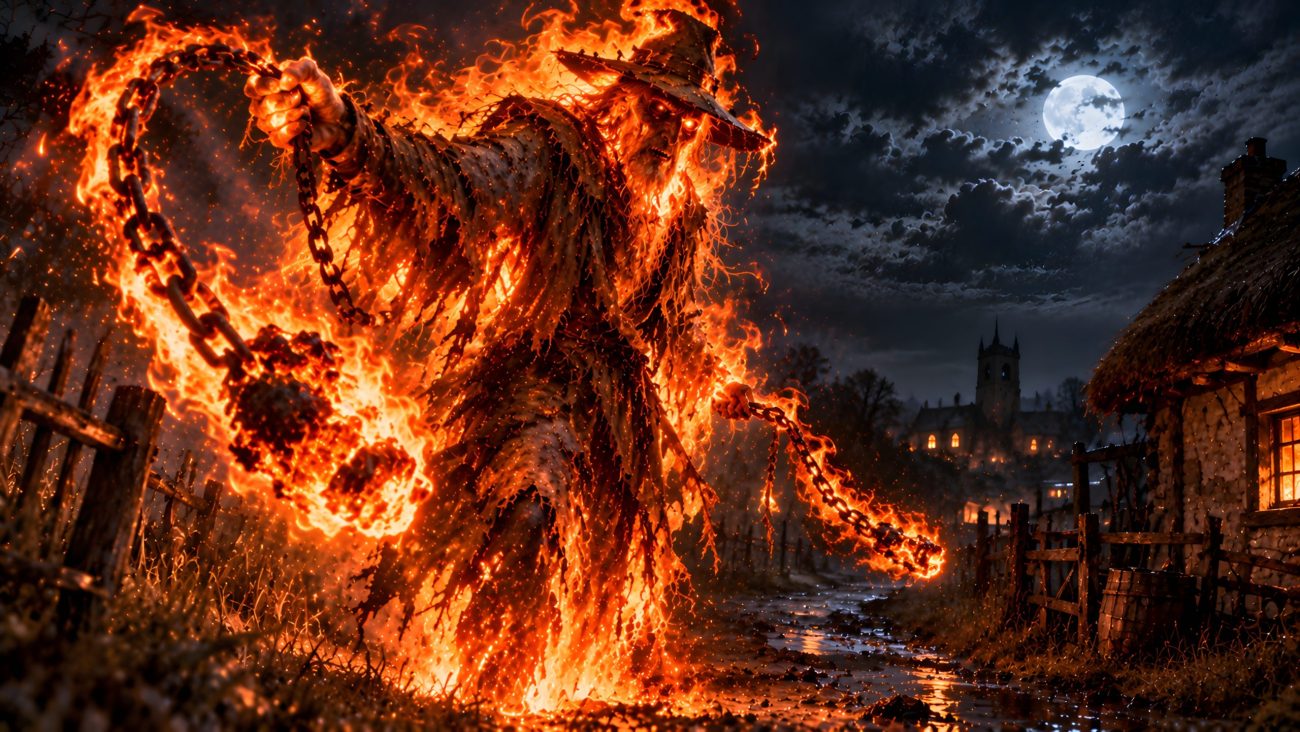
The Glène Kerel, also known as the Gloeiende Gerrit or Sjoufert, is a fiery ghostly figure condemned to burn because of a curse he brought upon himself during his lifetime. He usually appears as a living flame, but may also take the form of a blazing ball of fire, a fiery projectile, or a burning bundle of straw or thatch. The spirit is often said to have once been an unjust land surveyor, an arsonist, a thief, or a murderer. Many had sworn false oaths, declaring that they would burn forever if they were lying. After their deaths, these words became their eternal punishment.

The Glène Kerel wanders through the darkness as a burning apparition, frightening travellers and responding to those who call or whistle for him. Anyone who summons the fiery figure and then flees may discover a blackened handprint burned into their door the following morning. The spirit’s punishment is not limited to wandering the roads, however. During autumn, the fiery men are said to descend from the sky and scourge chimneys with burning chains. Sometimes they enter houses themselves, striking sinners with their chains and leaving painful burn marks as a sign of their supernatural punishment.

In Venlo, tradition held that the community had to provide the fiery man each year with a cartload of sand, several pairs of tin shoes, and seven and a half stuivers. These offerings formed part of the local relationship with the dangerous spirit, whose blazing appearance and burning chains made him a feared presence in the region.


Sources

“Van aardmannetje tot zwarte juffer: Een lijst van Nederlandse en Vlaamse elfen en geesten.” Abe de Verteller. https://abedeverteller.nl/van-aardmannetje-tot-zwarte-juffer-een-lijst-van-nederlandse-en-vlaamse-elfen-en-geesten/


Rōjinbi

Tradition: Japanese Mythology
Alternative Names: Rōjin no Hi, 老人火, Tengu no Miakashi
Category: Flame


The Myth

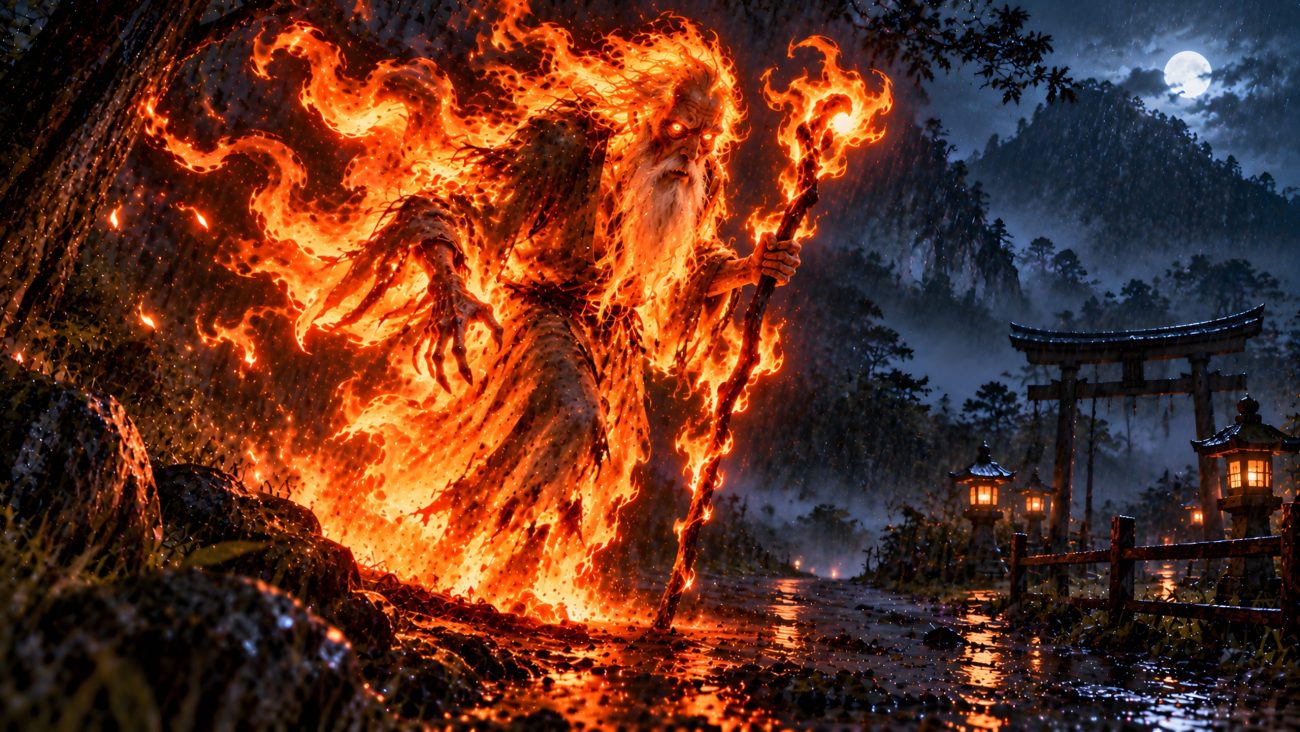
The Rōjinbi, meaning “Old Person Fire,” is a demonic flame from Japanese mythology that appears deep in the mountains on rainy nights. It is said to manifest alongside an elderly figure, creating an eerie sight on lonely mountain roads. The supernatural fire is extremely difficult to extinguish: water has no effect on it, while beating it with animal skins is said to make it disappear.

The Rōjinbi is particularly dangerous to travellers who encounter it on a straight stretch of road. According to tradition, a person can make the flame change direction by holding their footwear above their head. However, anyone who panics and attempts to flee may find the Rōjinbi pursuing them endlessly, following them wherever they run.

The fire is sometimes associated with the Tengu, supernatural beings that inhabit the mountains. Under the name Tengu no Miakashi, meaning “Tengu’s Lantern,” it is connected to a mysterious flame supposedly kindled by one of these mountain spirits. The Rōjinbi’s vulnerability to animal skins is also linked in folklore to the Tengu’s reported dislike of the smell of roasting meat, suggesting a connection between the strange fire and the spirits of the mountains.


Sources

“Rōjinbi.” Wikipedia: The Free Encyclopedia. Wikimedia Foundation. Accessed October 11, 2026. https://en.wikipedia.org/wiki/R%C5%8Djinbi


Katasharin

Tradition: Japanese Mythology
Alternative Names: Katachinsharin, Kataringuruma, One-Wheeled Cart
Category: Flame


The Myth

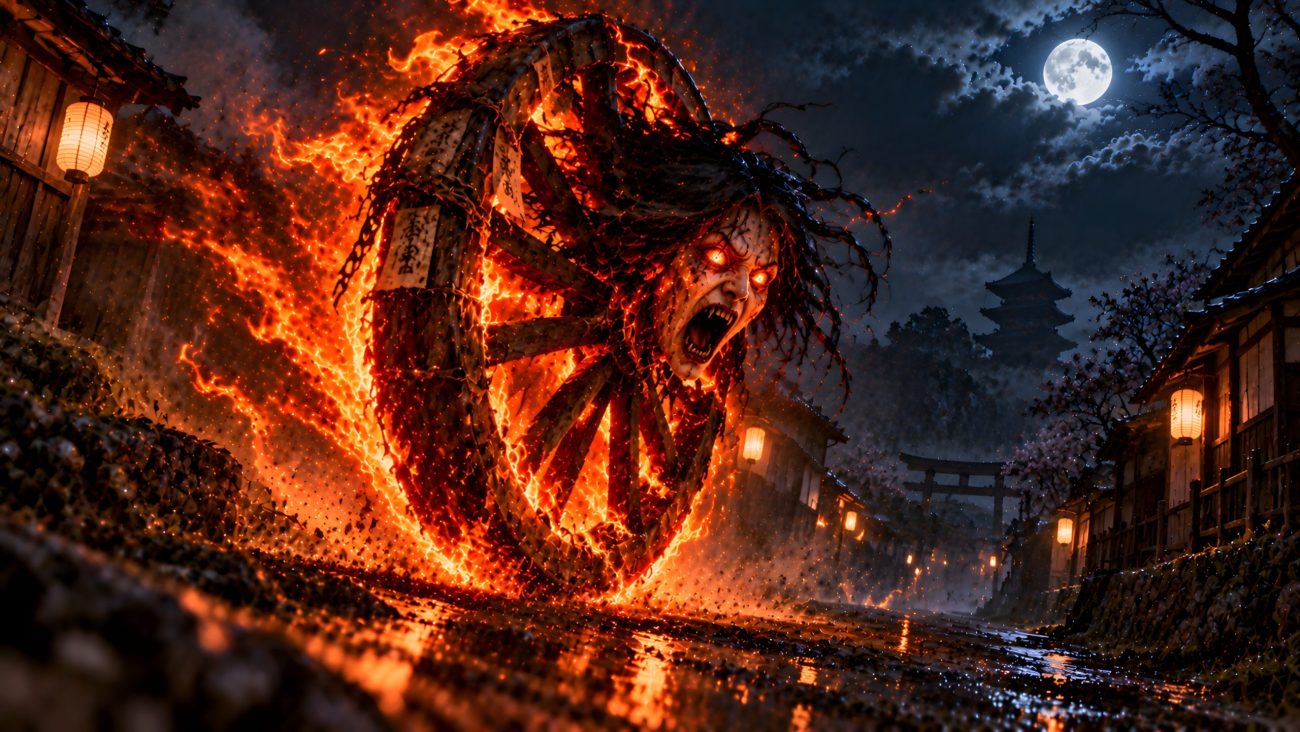
Katasharin is a terrifying yōkai from Japanese folklore that appears as a single, burning wheel that rolls through the streets at night without anyone pulling it. Its wheel creaks as it moves through the darkness, and in some depictions, it bears the face of a woman. Other portrayals show it as a flaming wheel with a demonic face, making it a frightening sight for anyone who encounters it after nightfall.

The creature is said to have appeared in Shiga Prefecture long ago, racing through the streets at night with the sound of its wheel turning. According to the legend, children who see the one-wheeled apparition risk being carried away by it. Its sudden appearance and eerie creaking make it a feared nighttime presence, haunting roads and settlements as it rolls through the darkness.


Sources

“片車輪 [かたしゃりん] (Katasharin).” 新版TYZ 妖怪図鑑 (New TYZ Yokai Encyclopedia). December 20, 2021. https://tyz-yokai.blog.jp/archives/1079937491.html


Onmorake

Tradition: Japanese Mythology
Alternative Names: Onmorake, Onmoraki
Category: Flame


The Myth

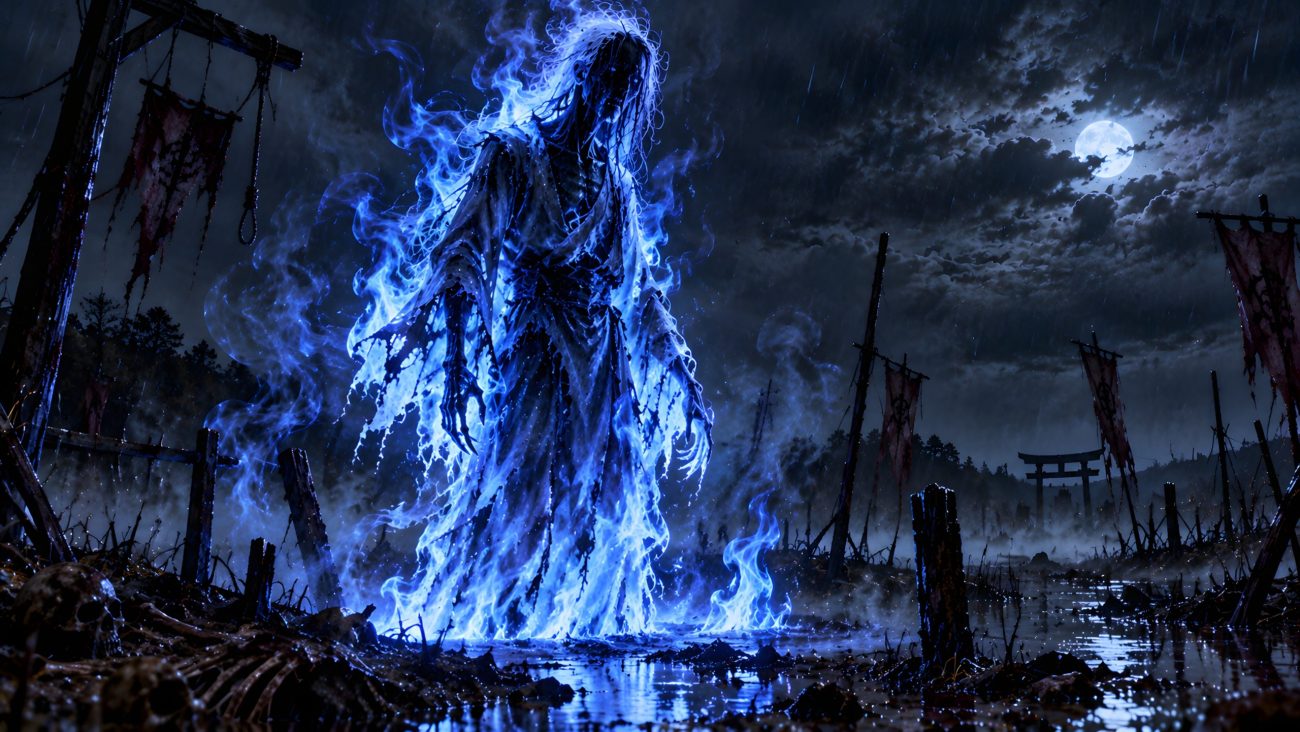
Onmorake is a mysterious supernatural fire described in Japanese folklore, appearing on gloomy, rainy nights near execution grounds, old battlefields, and ancient tombs. One account from Suruga no Kuni Zasshi describes a strange blue flame spotted at the execution grounds of Abegawara in Suruga Province. The light took the shape of a standing human figure, glowing eerily in the darkness as though a person were engulfed in ghostly fire.

According to local belief, these strange lights were ghost fires formed from human blood that had soaked into the earth and remained there for a long time without disappearing. The Onmorake was therefore associated with places marked by death and suffering, where the remnants of the dead were believed to give rise to supernatural flames. Its appearance near execution grounds and battlefields made it an unsettling reminder of the violence that had occurred there.

The Onmorake is also known from other Japanese writings, including Hayashi Razan’s Kaidan Zensho, where it is described as a transformed corpse that takes the form of a black bird. Although this bird-like creature differs in appearance from the blue human-shaped flame described in Suruga no Kuni Zasshi, both traditions connect the Onmorake with transformations arising from the remains of the dead.


Sources

“陰摩羅鬼 [おんもらけ] (Onmoraki).” 新版TYZ 妖怪図鑑 (New TYZ Yokai Encyclopedia). October 13, 2018. https://tyz-yokai.blog.jp/archives/1072599976.html


Sjoufert

Tradition: Belgian Mythology
Alternative Names: Sjoferik, Schoferik, Schofet, Schoverd, Schoefer, Brandende Schoof
Category: Flame


The Myth

The Sjoufert is a terrifying supernatural apparition from Belgian Limburg folklore, appearing as a great ball of fire or a blazing human figure. It is often said to be the restless spirit of a man who moved a boundary stone to steal land from his neighbour. Such a man was sometimes believed to have sworn that he would burn if he had ever moved the stone, and after death his oath became a terrible reality. Condemned to wander as a fiery being, he haunts the landscape where his dishonesty brought him damnation.

Like a will-o’-the-wisp, the Sjoufert attempts to lead travellers astray, drawing them away from familiar paths with its glowing appearance. It is particularly dangerous to those who whistle in the darkness, for the sound attracts the spirit and causes it to approach. Anyone who fails to flee quickly enough risks being burned by the apparition until nothing remains but ashes.

Those who manage to escape and reach home safely may still discover a frightening sign of the encounter the following morning: a blackened handprint burned into the doorpost. The mark serves as a reminder that the Sjoufert’s fiery pursuit can reach beyond the lonely roads and into the lives of those unfortunate enough to cross its path.


Sources

“Van aardmannetje tot zwarte juffer: Een lijst van Nederlandse en Vlaamse elfen en geesten.” Abe de Verteller. https://abedeverteller.nl/van-aardmannetje-tot-zwarte-juffer-een-lijst-van-nederlandse-en-vlaamse-elfen-en-geesten/